
The biggest unspoken skill in inpatient medicine is not note-writing or “sick vs not sick.” It is knowing exactly when that joke you just used in pediatrics will get you reported to Risk Management on the adult ward.
Let me break this down specifically.
Humor in medicine is not optional fluff. It is a clinical tool. But the way you deploy it at a child’s bedside versus with a 78‑year‑old with CHF is completely different. Same clinician, same day, two totally different comedy sets.
You already know this intuitively. You probably do it clumsily. Let’s make it deliberate.
1. The Core Reality: Same Tool, Different Brains
Humor is timing + context + shared reality. Pediatric and adult wards differ in all three.
On a pediatric floor, you have:
- A developing brain that thinks concretely, not abstractly.
- A terrified parent scanning your every move for “are we safe here?”
- A physical environment deliberately designed to pretend this is not a hospital.
On an adult ward, you have:
- A brain with decades of social references, but maybe impaired by delirium or hypoxia.
- Family members juggling guilt, burnout, and Google printouts.
- An environment that barely pretends to be human, let alone fun.
So the same joke lands completely differently.
“Wow, that’s a really big IV!”
– 5‑year‑old: panic, possibly tears.
– 40‑year‑old: smirk, maybe a joke back about “I’ve had bigger.”
If you remember nothing else: kids take you literally, adults take you contextually.
2. Pediatric Wards: Concrete, Playful, Parent‑Mediated Humor
Pediatrics rewards the kind of humor that would absolutely bomb in a medicine clinic. On purpose.
2.1 Who are you actually playing to?
You think you are joking with the kid. You are, partly. But your real audience is at least a three‑way split:
- The child (primary emotional target)
- The parent(s)/caregiver(s) (gatekeeper of trust)
- The nurse and team (co‑regulators of the room vibe)
If your joke reassures the parents and lightens the nurse’s shoulders while making the kid smile, that is a tri‑victory.
But if you get the kid laughing and the parent looks alarmed or offended, you just lost.
In other words: in pediatrics, the parent’s face is your laugh track.
2.2 Developmental stage dictates humor style
The way a 3‑year‑old processes humor is not how an 11‑year‑old does. You need to shift gears consciously.
| Age Group | Humor Style | Avoid |
|---|---|---|
| 1–3 yrs | Peek‑a‑boo, silly faces, simple sound effects | Any talk of pain, fear words |
| 4–7 yrs | Slapstick, pretend confusion, naming body parts playfully | Sarcasm, fake threats, exaggerating procedures |
| 8–12 yrs | Light sarcasm, playful competition, “insider” jokes | Dark humor, sexual jokes, complex irony |
| Teens | Self‑aware sarcasm, memes, autonomy‑respecting jokes | Jokes about appearance, sexuality, mental health |
A few concrete examples:
Toddler (2 years): You drop your stethoscope softly on purpose.
“Oh no, my ears fell off! Can you find them?”
Physical comedy + problem‑solving = trust.Early school‑age (6 years):
“I heard you are the boss of this room. Is that true? Should I ask you or Mom where to put this sticker?”
They love status, they love choice, they love stickers. You just used all three.Preteen (10 years):
“Look, there is a strictly enforced law here that anyone with socks cooler than mine has to help teach medical students. You are in trouble.”
You are lightly teasing, but not mocking. They get status, not shame.Teen (16 years):
Knock, pause, “You still accepting visitors or did we close the club?”
You acknowledge their autonomy and privacy. You are a guest, not a dictator.
2.3 Literal minds, real fear: your jokes can harm
I have watched a resident walk into a 7‑year‑old’s room, see a teddy bear by the IV pole and say, “Uh oh, is he next for surgery?” The kid laughed nervously.
Thirty seconds later, while the resident was examining, the kid whispered to Mom: “They are going to do surgery on Teddy, right? Not me?”
That is not microscopic emotional nuance. That is direct harm from lazy joking.
Rules for pediatric humor:
No fake threats. Ever.
“We will just cut the arm off” is not funny. I promise. I have seen the fallout.No exaggerating procedures “for fun.”
“We are going to take ten vials of blood!” becomes a concrete fear.Avoid joking about:
- Dying
- “Going to sleep” without clarifying anesthesia vs normal sleep
- Parents leaving “forever”
- “Losing” body parts
Children do not have the abstract buffer adults use to file things as “obviously joking.”
2.4 Using humor to gain procedural cooperation
If you do pediatrics without weaponizing silliness during procedures, you are working too hard.
Classic moves that actually work:
Rebranding equipment:
- Pulse ox: “finger spaceship light”
- Blood pressure cuff: “arm hugger,” “muscle tester”
- Thermometer: “dragon fire check”
Gamifying stillness:
- “Do not move while I listen. Be a statue. If you move, I have to start over and you will be here until college.”
- For a 4‑year‑old: “If you can keep your arm SO STILL, we will see if the bed starts to float.”
Shared indignation humor:
- To the IV pole: “You again. Always following my patients around. Get your own hobbies.”
You are not just distracting. You are reframing the hospital as a place where they have some agency and predictability.
3. Adult Wards: Darker, Relational, Status‑Sensitive Humor
Adult wards are where your gallows humor instinct shows up. And where it can either save your therapeutic relationship or torch it in one sentence.
3.1 Adults bring their own script
Adults arrive with:
- Prior hospital experiences (good or traumatic)
- Cultural expectations of “serious doctors”
- Their own coping styles (stoic, dramatic, ironic, religious, scientific, etc.)
So your first job is not to “be funny.” It is to identify their script.
Listen for their first self‑generated line:
- “Well, I am back at the hotel again.” (They are already using humor.)
- “Doc, tell me the worst.” (Probably not the moment to joke.)
- “I guess my liver finally gave up.” (Self‑deprecating window you might gently join.)
You calibrate based on that tone.
3.2 Dark humor is a privilege, not a default
I see interns try to “bond” with older COPD patients using ICU‑style gallows humor on day 1. No history. No trust. No shared suffering yet. Just edgy one‑liners.
It usually dies on the floor.
Dark humor in adult medicine works only when:
- The patient initiates or clearly invites it.
- You already have rapport.
- You still pair it with respect and clarity.
Example:
- Long‑standing oncology patient, after hearing about progression: “So this thing is getting pretty good at trying to kill me, huh?”
Possible response: “It is annoyingly persistent. So are you. I am not betting against you yet.”
You acknowledged the dark reality, but you did not one‑up their darkness.
What you do not do:
- “Well, we are all dying slowly, right?”
That is not profound. That is lazy nihilism.
3.3 Status, pride, and body humor
Bowel function, sexual function, cognitive decline. These are not slapstick topics for adult patients unless they make them so first.
On an adult ward, the safe baseline is:
- Humor about the hospital system (the food, the gowns, the noise)
- Humor about yourself (your coffee, your handwriting, your pager)
- Gentle acknowledgment of absurdity (“We woke you up to ask if you are sleeping OK”)
Be cautious with:
- Weight, appearance, physical disability
- Sexual jokes, even implied
- “Old age” jokes unless the patient leans heavily into them
An 85‑year‑old can absolutely joke, “I survived World War II and five kids; this pneumonia is nothing.”
You replying, “You are basically indestructible!” is fine.
You replying, “Yeah, you old guys are tough to kill” is not.
The line is thin. Err on the side of respect.
4. Family‑Centered Humor: Two Audiences, One Room
Both pediatric and adult wards share one complexity: mixed audiences. You are often performing for two age groups at once.
4.1 On peds: kid‑first, parent‑safe
Here is the trap: you start playing it up for the kid, and suddenly your joke implies the parent did something wrong.
Example: “Wow, who let you wear these super‑dirty socks to the hospital? We may have to call the sock police.”
The child laughs. The parent hears: “You are a negligent caregiver.” Atmosphere drops by 10 degrees.
Fix it in advance: If you target anything about the child (clothes, hair, toys), loop the parent into the joke kindly.
- “These socks are clearly for very serious fun. Mom, did you approve these elite socks?”
- Or self‑deprecating redirect: “Your socks are cooler than my entire wardrobe. I need fashion help.”
Never punch down. Not at the kid, not at the parent.
4.2 On adult wards: patient‑first, family‑modulated
Adults with family present complicate humor in a different way. You are walking into pre‑existing dynamics:
- The daughter who thinks Dad minimizes everything.
- The spouse who wants seriousness to “scare them straight.”
- The patient who uses humor to avoid hard topics.
Quick rule: If you are about to use humor to soften bad news, and the family looks tense and silent, drop the joke. Deliver the news plainly. You can layer gentle levity later, once the core message has landed.
Example of getting it right:
- COPD exacerbation, husband cracking jokes, wife wringing her hands.
You: “I am glad you are both here. I am going to be very direct for a moment, then we can go back to our usual complaining about the food.”
You signal: seriousness first, humor second.
5. The One Type of Humor That Must Shift Dramatically: Staff‑Only Gallows Humor
Here is the part no one writes in pamphlets but everyone lives on the wards.
You will use dark humor. You must. You are not a robot.
But the line between protective coping and corrosive cruelty is razor thin, and it shifts depending on whether you are on a pediatric vs adult service.
5.1 Why pediatric gallows humor feels different
On adult wards, staff dark humor often centers around:
- The system
- Noncompliance
- The absurdity of repeat admissions
On pediatric wards, the object is often an ill child or a distressed parent. That is much harder to justify.
Example:
Adult side: “Bed 12’s kidneys and I are not on speaking terms after last night.”
Dark but distanced from personhood.Pediatric side: “Well, at least this viral bronchiolitis will scare Mom into actually using the inhaler next time.”
You are punching down at a frightened parent of a sick child. That corrodes you.
I am not saying “never joke in the workroom about peds patients.” I am saying the acceptable boundary is much narrower. You joke about:
- The service load
- The cartoon decor
- Your third glitter‑covered progress note
You do not joke about:
- Code events
- Families sobbing
- Chronically ill kids whose names everyone knows
Not because of optics. Because those jokes change you. And not in a good direction.
5.2 Adult gallows humor still has limits
I have heard versions of:
- “Here comes Mr. Smoking‑With‑His‑Oxygen‑Tank again.”
- “Bed 7 is cirrhosis’s greatest hits.”
Everyone laughs. The med student observes and internalizes that contempt is acceptable when people “did it to themselves.”
Long‑term, this rots your capacity for empathy and makes you less clinically effective. Patients feel contempt even if you never say a word.
You can use humor to manage burnout without dehumanizing:
- “I am starting to dream in Epic inbox messages.”
- “If you hear another ‘but the internet said,’ you are allowed one primal scream in the stairwell.”
Aim your dark jokes at the job, not the patient’s character.
6. Culture, Language, and “Safe Jokes” That Aren’t
Humor is dangerously culture‑specific. What reads as playful teasing in one culture reads as disrespect in another.
6.1 The “nickname” trap
On peds, calling a child “buddy,” “champ,” or “princess” seems harmless. In some families, this is fine. In others, it feels:
- Diminishing
- Overly familiar
- Weirdly patronizing
Watch the caregiver’s face. If they stiffen when you say “princess,” retire it for that room. Use the child’s name. You are not doing stand‑up; you can alter your script.
On adult wards, nicknames like “boss,” “chief,” “young man” (to an 80‑year‑old) can hit wrong across cultures. Especially in patients with a history of being talked down to by authority figures.
6.2 Religious and existential humor
Firing off “At least you are in the right place to meet your maker” is not edgy; it is a lawsuit waiting to happen.
Across both pediatrics and adults:
- Do not joke about God, death, or the afterlife unless the patient explicitly opens that door, and even then, tread lightly.
- If a parent or patient uses religious framing (“God is testing us”), you can acknowledge without riffing on it.
You are allowed to say:
“I hear that your faith is a big part of how you are getting through this.”
You are not required to turn it into a bit.
7. Practical Adjustments: Same Clinician, Two Worlds
You are on a combined peds/adult rotation, or you float between services. You need fast switches. Here is a concrete approach.
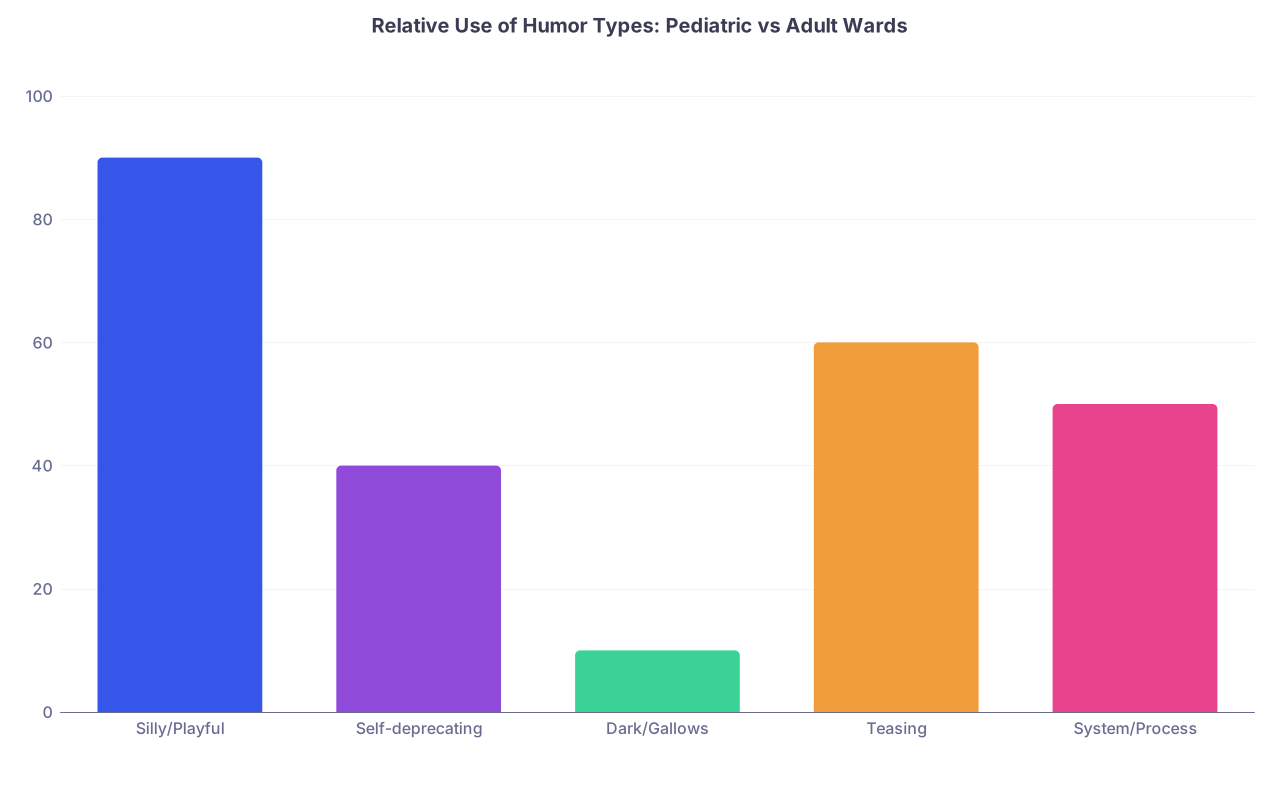
| Category | Value |
|---|---|
| Silly/Playful | 90 |
| Self-deprecating | 40 |
| Dark/Gallows | 10 |
| Teasing | 60 |
| System/Process | 50 |
Think of five humor “dials”:
- Silly/Playful
- Self‑deprecating
- Dark/Gallows
- Teasing
- System/Process jokes
For pediatrics:
- Silly/Playful: turned way up
- Self‑deprecating: moderate (kids like competent clowns, not incompetent ones)
- Dark/Gallows: near zero in front of families
- Teasing: light, always uplifting, never shaming
- System/Process: OK in front of parents if it reassures (“Yes, the computer takes longer than my exam”)
For adults:
- Silly/Playful: moderate and situational
- Self‑deprecating: high yield, disarms power dynamics
- Dark/Gallows: low‑to‑moderate, only with permission
- Teasing: cautious, especially about health behaviors
- System/Process: great shared target
Practical script shift example:
Peds, 6‑year‑old with asthma:
- “OK, we are going to listen to your lungs and see if any dragons are living in there. If they are, we will evict them with the breathing medicine.”
Adult, 46‑year‑old with COPD:
- “Let me listen to your lungs and see if they are a little less cranky than yesterday. That new inhaler seems to be earning its paycheck.”
Same exam. Same goal. Completely different humor skin.
8. Humor, Power, and Apology
You will get it wrong. I have. Everyone has.
The difference between a minor misstep and a relationship‑ending event is how you respond.
8.1 On peds: apologize to both child and parent
You make a joke, kid’s face crumples, parent looks worried. Do not barrel ahead and pretend it did not happen.
You reset:
- To the child: “I am sorry, that joke was not funny. I promise we are only going to do [what is actually planned].”
- To the parent, privately or at the bedside if appropriate: “I worded that poorly. I did not mean to scare them. Let me explain exactly what we are going to do in simple steps.”
You model repair. You restore trust.
8.2 On adults: name the miss, do not over‑explain
If your attempt at levity with an adult lands flat or clearly offends:
- “I was trying to lighten things there and clearly missed the mark. I am sorry about that. Let me stick to the medical side.”
You do not launch into a TED talk about “my intention” or your “coping style.” Just own it and move on.
9. Training the Skill: How to Actually Get Better
You will not become good at this by reading one article and “trying your best.” You need specific feedback loops.
9.1 Watch people who are already good at it
On peds:
- That attending who walks into a room and the child beams before they say a word. Watch their:
- First three sentences
- Body position (often below or at eye level)
- Use of props (pens, stickers, stethoscope as toy)
On adult wards:
- The senior who gets gruff, cynical patients to crack a real smile. Notice:
- Whether they joke first, or wait for the patient
- How they use silence
- How they pivot from humor to seriousness without whiplash
9.2 Ask for specific feedback
After a tricky encounter:
- Ask the nurse: “Hey, did my joking earlier help or hurt in that room?”
- Ask your co‑resident: “That joke I made with Mr. X—did it sound dismissive?”
You will get more honest answers from nursing staff than most attendings. They watch your style more closely than anyone.
10. The Future: Telemedicine, AI, and Where Humor Goes Next
You are not just learning bedside humor for one static setting. Medicine is shifting. Your humor has to follow.

| Step | Description |
|---|---|
| Step 1 | In person peds |
| Step 2 | In person adult |
| Step 3 | Telehealth peds |
| Step 4 | Telehealth adult |
| Step 5 | Asynchronous messaging |
10.1 Telehealth pediatrics
On video with kids:
- You lose physical comedy with equipment, but you gain:
- Room‑based humor (“Show me the weirdest thing in your room.”)
- Pet‑based humor (“Is this the official clinic dog?”)
Parents are even more prominent on screen. Your jokes have to carry through them.
10.2 Telehealth adults
On Zoom or phone, sarcasm and subtle irony do not transmit well. Tone flattens. Latency destroys timing.
Simplify:
- More self‑deprecating, less dark.
- Humor about tech: “If my screen freezes, I promise it is not your heart.”
10.3 AI, documentation, and the vanishing informal moment
As documentation becomes more AI‑assisted and visits get algorithmically structured, the informal 30‑second window when you crack that first joke is under threat.
You will have to fight for it:
- Intentionally use the first 10–15 seconds of the encounter to humanize, not to stare at a screen.
- Guard that micro‑ritual: a one‑liner, a shared eye roll at the gown, a smile at a stuffed animal.
Machines do not do bedside humor well. That is your moat. Your competitive advantage as a human clinician.
Humor is not a garnish on clinical skill. It is a technique for regulating fear, building alliance, and tolerating the absurdity of sickness.
On pediatric wards, you are part clown, part translator, always under the surveillance of an anxious parent and a very literal brain.
On adult wards, you are a collaborator in gallows or gentle humor, walking a line between levity and disrespect with people who know exactly what is at stake.
If you can learn to shift your style with age—pivoting from dragon‑in‑the‑lungs jokes to “cranky airway” banter in the same morning—you are not just being “funny.” You are being precise.
Get that precision right, and your future interactions—whether on a noisy peds floor, a dimmed adult ICU, or a glitchy telehealth call—will feel less like guessing and more like craft.
With that foundation, the next step is tougher: learning how to use humor not just at the bedside, but in leading teams and defusing conflict on the ward. That is another layer of this skill set—and a story for another day.