
It is 07:30 on OSCE day. Your coordinators are printing checklists, standardized patients are drinking bad coffee, and you are staring at one station blueprint thinking, “Is this actually measuring what we say it measures—or just punishing nervous students for forgetting to wash their hands?”
That is the core problem: OSCE stations that feel “clinical” but are psychometrically useless. Or worse, misleading.
Let me break this down properly. If you want valid OSCE stations—not just theatrically convincing ones—you have to design them with the same discipline you expect in a clinical trial. Content, construct, response process, consequences, internal structure. All of it.
We will go step by step, but with the bar set high: assume your students are clever, your faculty are busy, and your dean will ask you to justify every decision with data.
1. Start with Validity, Not With the Scenario Idea
Most people start OSCE design with: “Let’s do a chest pain station” or “We need a pediatric fever case.”
Wrong entry point.
You start with: “What decision am I making with this score, and what inference must be defensible?”
You are not writing theatre. You are building an instrument that supports a decision: pass/fail, progression, graduation, selection.
1.1 Clarify the Level and Decision
Before you design a single task, answer specifically:
- Training phase: end of pre-clinical, early clerkship, late clerkship, residency, fellowship?
- Stakes: low (formative only), moderate, or high (promotion/licensure)?
- Decision: “Safe to see patients under supervision,” “Ready for independent night call,” “Fit to graduate”?
That decision determines the complexity, the critical errors, and the tolerance for minor slips.
A second-year formative OSCE in communication skills can “sample broadly, score generously.” A high-stakes final-year OSCE must be mercilessly aligned with real patient safety concerns.
| Training Stage | Main Target | OSCE Complexity | Tolerance for Error |
|---|---|---|---|
| Pre-clinical | Basic skills | Low–Moderate | High |
| Early clerkship | Core clinical tasks | Moderate | Moderate |
| Late clerkship | Integration & prioritization | Moderate–High | Low |
| Residency | Independent decision making | High | Very low |
1.2 Define the Construct Explicitly
“Clinical competence” is not a construct. It is an umbrella term. You must decide what you are actually measuring in this station.
For example, a “shortness of breath” station could be designed primarily to test:
- Focused data gathering and hypothesis refinement (history + exam), or
- Acute management and prioritization, or
- Communication with a distressed patient, or
- Interprofessional collaboration.
Trying to measure all of them in one 8–10 minute station destroys validity. You get noise, not signal.
Pick one primary construct, maybe one secondary. Then state it in a way you could defend in a meeting:
“This station measures the ability of final year students to conduct a focused history and physical examination in a patient with new-onset dyspnea, identifying immediate red flags that require urgent action.”
Now you have boundaries. Anything that does not serve that construct is optional or noise.
2. Content Validity: Blueprinting Like You Mean It
Most schools claim to blueprint. Many do it badly—too vague, too top-level, no link to decisions.
A robust blueprint is your first major validity argument: that your OSCE samples the right stuff in the right proportions.
2.1 Build a Three-Dimensional Blueprint
Good OSCE blueprints are not just “systems” (cardio, resp, neuro). They cross three dimensions:
- Clinical content (e.g., systems, age groups, acute vs chronic).
- Task type (history, exam, procedure, data interpretation, communication, counseling, handover).
- Competency domain (medical knowledge application, clinical reasoning, communication, professionalism, teamwork).
You do not need a monstrous spreadsheet, but you do need an honest matrix showing:
- The relative weight per domain aligned with your curriculum outcomes.
- Where OSCEs sit relative to other assessment modalities (e.g., knowledge tests cover guidelines; OSCE covers application and performance).
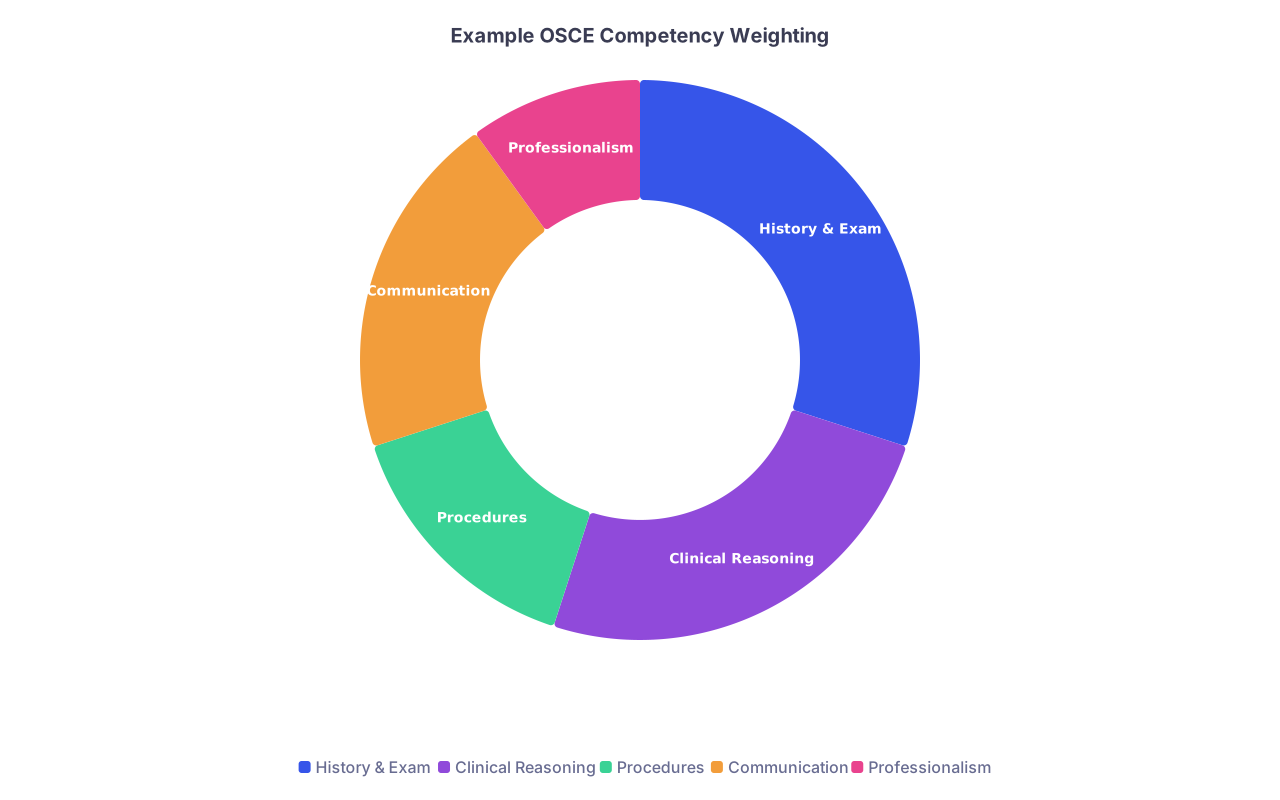
| Category | Value |
|---|---|
| History & Exam | 30 |
| Clinical Reasoning | 25 |
| Procedures | 15 |
| Communication | 20 |
| Professionalism | 10 |
If communication is 20% of your learning outcomes, but 60% of your OSCE stations primarily assess communication, you have a validity problem. Your evidence trail starts falling apart.
2.2 Avoid “Cool Case” Bias
There is a common pathology: faculty who are subspecialists want to test their favorite zebra.
“Let’s do an OSCE station on myasthenic crisis in pregnancy with respiratory failure.”
No. Not for undergrads. Not if they cannot even structure a basic abdominal exam reliably.
You anchor your station choices in:
- National/board exam blueprints.
- Local morbidity and mortality patterns.
- Course learning objectives and entrustable professional activities (EPAs).
If an examiner cannot point to a specific documented outcome that the station addresses, it does not go into a high-stakes OSCE.
3. Constructing the Station: From Stem to Scoring
This is where the artistry meets the psychometrics. We will go layer by layer.
3.1 The Station Stem: Clarity and Constraint
A good OSCE stem does three things:
- Sets context quickly and clearly.
- Constrains scope so students know what is expected.
- Avoids hidden tasks that surprise them mid-station.
Bad stem:
“You are a junior doctor in the emergency department. See this patient.”
What does that even mean? Take a history? Do a full exam? Manage? Break bad news? Interpret an ECG? All of the above? That sort of vagueness wrecks response process validity.
Good stem:
“You are the junior doctor in the emergency department. A nurse has asked you to review this 58-year-old man who presented with chest pain 30 minutes ago.
In this station, you must:
– Take a focused history of the chest pain and relevant risk factors.
– Explain to the patient what immediate tests you will arrange and why.You do not need to perform a physical examination.”
You have defined the domain of observable behavior. Examiners, standardized patients, and students are looking at the same thing.
3.2 Task Design: Observable, Discrete, and Aligned
Every required action in the station should:
- Be observable in 8–10 minutes.
- Map to your defined construct(s).
- Be realistically executable in the simulated context.
If you want to assess “prioritization” in a 10-minute station, you cannot bury the critical cue behind ten minutes of small talk. Students must have realistic opportunity to display target behaviors.
Examples of aligned station designs:
- Construct: breaking bad news → Task: disclose CT findings of inoperable cancer to patient and relative; manage emotional response.
- Construct: acute management priority-setting → Task: receive brief handover, review vital signs + single lab printout, call for urgent interventions and justify them aloud.
What you must stop doing: expecting students to demonstrate ten separate high-level constructs simultaneously, then wondering why reliability is poor.
4. Score Design: Checklists, Global Ratings, and Hybrids
Most OSCEs fail here. They rely on bloated checklists, or they swing to “holistic global rating” without structure. Both extremes are lazy.
You want a hybrid model: structured global ratings supported by focused checklists.
4.1 The Problem with Pure Checklists
Checklists feel objective. Ticks and crosses. But they overvalue trivial behaviors and undervalue integration.
Classic example: A history station checklist with 40 items, including:
- Introduced self by name.
- Checked patient’s name.
- Asked about smoking.
- Asked about alcohol.
- Asked about family history.
- etc.
Students quickly learn “box-ticking medicine.” They shotgun questions with no clinical reasoning. Examiners tick, because they heard the words, even if the student clearly did not process the answer.
The result:
- Content validity: distorted (you test recall of questions, not reasoning or communication quality).
- Construct validity: poor (you are measuring memory + speed + exam familiarity).
4.2 The Problem with Pure Global Ratings
On the other side, some people push for “just give a 1–7 overall grade for performance.” That may work for very experienced raters in stable, very familiar tasks. It usually does not in diverse student cohorts with mixed-fidelity cases.
You get:
- Halo effect (good first impression → inflated overall score).
- Leniency/stringency bias.
- Different mental models of “good enough” across examiners.
4.3 An Advanced Hybrid Approach
Here is the higher-level technique: pair short, high-value checklists with anchored global ratings.
Identify a small set (10–15 max) of critical behaviors that directly index your construct.
For a chest pain history station, that might be:- Character of pain (site, onset, duration, radiation).
- Red flag features (associated dyspnea, syncope, diaphoresis).
- Past cardiac history and risk factors.
- Clear explanation of next steps in plain language.
Build 2–3 global rating scales (GRS), each with clear behavioral anchors. For example:
- Clinical reasoning / focus of history.
- Communication & rapport.
- Organization & time management.
Each GRS should be 1–5 or 1–7, with explicit descriptors at key points. Not just “poor–average–excellent,” but:
- 1: Disorganized, misses key areas, data gathering appears random.
- 3: Reasonably structured, covers most key areas but some gaps or irrelevant digressions.
- 5: Highly focused, logically sequenced, all key areas covered with appropriate depth, minimal irrelevant questions.
You combine these subscores into a station total.
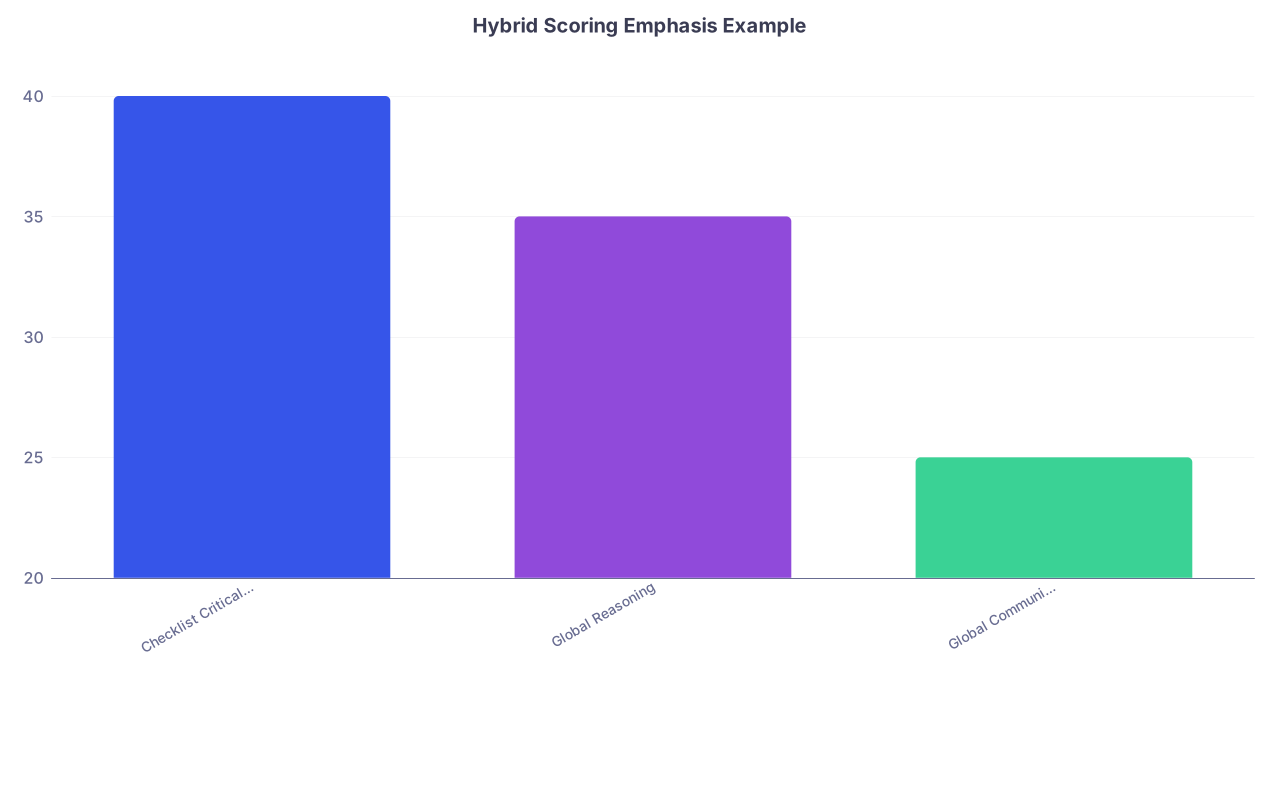
| Category | Value |
|---|---|
| Checklist Critical Items | 40 |
| Global Reasoning | 35 |
| Global Communication | 25 |
The trick: design the station and the scoring system together. Not sequentially. You should not bolt a GRS on top of an old checklist.
5. Advanced Cueing: Standardized Patients, Prompts, and Information Flow
Most OSCE validity gets quietly destroyed by inconsistent cueing and information leaks.
5.1 Standardized Patient (SP) Scripts That Actually Standardize
SPs can be your greatest asset or your biggest source of error.
At advanced level, your SP materials must include:
- A core script: history, symptoms, emotional tone, baseline demeanor.
- A cueing map: what information is offered spontaneously vs only if asked, and what wording to use.
- Response rules: how to react to different candidate approaches (e.g., if candidate is dismissive → become more withdrawn, not argumentative; if candidate is empathic → remain distressed but cooperative).
You should specify which information may never be given unless asked directly, and which should emerge with non-specific prompting.
Bad example: SP volunteering “I have been more short of breath when I walk to the mailbox” unprompted in some runs and not in others. That will destroy comparability between candidates.
5.2 Controlling Information Density
In complex stations, you often need to control how much information is visible at once to avoid cognitive overload or gaming.
For example, an acute management station where candidates are given:
- A triage note.
- Vital charts for last 12 hours.
- Lab results.
- ECG.
- Medication chart.
If you dump all of this on the desk at 0:00, some students will “hunt” the answer by pattern recognition. Others will freeze.
Better design:
- Triage note and abbreviated vitals on entry.
- Option to request further data (e.g., “Can I see the ECG?”).
- Examiner or nurse confederate hands over data only when explicitly requested.
Now you are truly measuring prioritization and focused data gathering.
6. Examiner Training and Response Process Validity
You can design the world’s most elegant station and ruin it with poorly trained examiners.
Response process validity is about ensuring that the human processes used to generate scores matched your intended construct and rules.
6.1 Structured Examiner Training: Not Just a Briefing
Advanced programs run short but focused examiner calibration sessions, using:
- Anchor videos of “borderline fail,” “solid pass,” and “excellent” performances.
- Group scoring followed by explicit discussion of why a performance is a 2 vs 3 vs 4 on each GRS.
You want to minimize idiosyncratic standards like:
“Well, when I was a student, I had to do a full neurological exam in three minutes, so I expect the same.”
No. The station blueprint defines expectations, not faculty nostalgia.
6.2 Real-Time Clarifications and “No New Rules”
Every examiner should have:
- The exact station stem that candidates see.
- The checklist / GRS with clear anchors.
- A short “examiner notes” sheet: clarifications, typical pitfalls, what not to penalize (e.g., “Use of first names is acceptable in this context”).
Critical rule: examiners do not create their own additional rules. If they discover an ambiguity during early sessions, it gets clarified centrally, not on a per-room basis.
7. Using Data to Refine Station Validity
If you stop after station deployment, you have done half the job. Validity is an ongoing accumulation of evidence.
7.1 Item- and Station-Level Statistics
Post-exam, analyze:
- Station mean scores and standard deviations.
- Item-level facility (how many candidates “pass” a given checklist item).
- Discrimination (does performance on the station distinguish high vs low overall performers?).
For high-stakes OSCEs, you should also look at:
- Generalizability coefficients (G-coefficients) for the exam overall.
- Variance components: how much variance is due to candidate, station, examiner, candidate×station interaction.
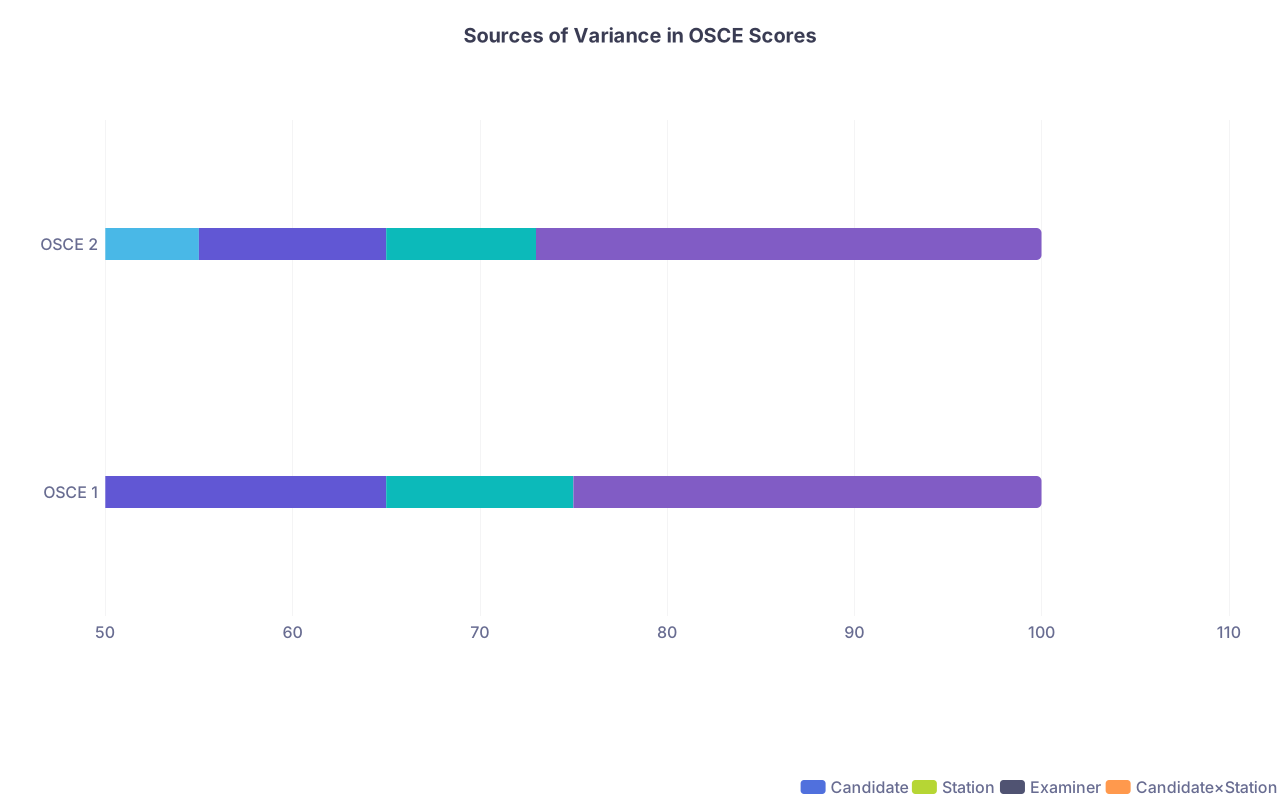
| Category | Candidate | Station | Examiner | Candidate×Station |
|---|---|---|---|---|
| OSCE 1 | 50 | 15 | 10 | 25 |
| OSCE 2 | 55 | 10 | 8 | 27 |
If a station shows:
- Very high mean (everyone scores 95%+) and low variance → likely too easy; minimal contribution to decisions.
- Very low mean and floor effect → might be misaligned with training level or poorly designed.
7.2 Borderline Regression and Standard Setting
For advanced, high-stakes OSCEs, your pass/fail decision should come from a defensible standard setting method, not arbitrary 50% cutoffs.
Borderline regression is commonly used and relatively robust:
- Examiners give each candidate a global rating (e.g., fail, borderline, pass, good, excellent).
- You compute the mean checklist score for each category.
- Fit a regression line through global rating (x-axis) vs checklist score (y-axis).
- The predicted checklist score at “borderline” on this line becomes your cut score.
This approach links analytic scores to holistic examiner judgment. It builds a strong validity argument that your cut score reflects expert consensus at the border of competence.
8. Designing for Higher-Order Skills: Reasoning, Prioritization, and Teamwork
Basic OSCE design is repeatable checklists. Advanced OSCE design deliberately targets complex cognitive skills.
8.1 Reasoning Out Loud: Think-Aloud Elements
To assess reasoning, not just end-product decisions, you can:
- Include a brief “explain your reasoning” component at the end of a task.
- Ask candidates to verbalize differential diagnoses and justify their order.
- Require justification for selected investigations and treatments.
You then score:
- Appropriateness of differentials (breadth and depth).
- Logic of prioritization (what is most likely vs most dangerous).
- Rational use of investigations.
Careful: you cannot do a full think-aloud protocol in 8 minutes. But a focused 2-minute reasoning component is feasible and very informative.
8.2 Multi-Stage Stations
If you have 15–20 minute blocks, use multi-stage designs:
- Stage 1 (10 min): History + exam or data review.
- Stage 2 (5 min): Structured oral presentation to an examiner (e.g., handover) plus management plan.
This allows assessment of:
- Data gathering.
- Synthesis and organization.
- Communication with colleagues.
Scoring then covers both performance with patient and performance in professional communication context.
8.3 Teamwork and Interprofessional OSCEs
Designing valid teamwork stations is harder, but not impossible.
Techniques:
- Use a confederate nurse or junior colleague with scripted behaviors (missed critical sign, incorrect dosage, etc.).
- Require candidates to delegate tasks, correct errors, and escalate appropriately.
- Score specific behaviors: closed-loop communication, assertiveness with respect, acknowledgment of others’ input.
You are not scoring whether they “like nurses.” You are scoring observable teamwork behaviors that tie directly to patient safety.
9. Iterative Refinement and Station Lifecycle Management
Advanced OSCE programs treat stations like living entities with versions, review cycles, and retirement.
9.1 Versioning and Documentation
For each station, maintain:
- Version history (v1.0, v1.1 after minor wording change, etc.).
- Date of each use, cohort characteristics.
- Statistical performance data.
- Documented changes with rationale (e.g., “Removed low-discrimination item about asking about pets; not clinically relevant”).
This matters when you present validity evidence for accreditation or external audit.
9.2 Retirement and Redevelopment
Stations should not live forever. Signs you need to retire or radically redevelop:
- Content becomes outdated (e.g., management guidelines changed).
- Repeated use for the same cohort → risk of recall / leakage.
- Statistics repeatedly show poor discrimination despite fixes.
Create a planned rotation: each high-stakes OSCE includes a mix of:
- Proven “anchor stations” with known performance.
- New or revised stations that are carefully monitored.
10. A Concrete Example: From Idea to Valid Station
Let’s walk a brief example so this does not stay abstract.
Goal: End-of-clerkship internal medicine OSCE station assessing acute chest pain evaluation.
Decision: Are students safe to assess chest pain in an ED under supervision, identifying life-threatening causes and planning initial investigations?
Construct: Focused history and risk assessment + explanation of initial management to patient. Not ECG interpretation, not final diagnosis.
Station stem:
- Context: Junior doctor in ED.
- Task: Take focused history; explain next steps; do not perform physical exam.
SP script:
- 58-year-old male with central chest pain, onset at rest, radiating to left arm, sweating.
- Provides core history spontaneously when asked open questions; risk factors only if specifically asked.
- Anxious but not hostile.
Checklist (max 12–14 items):
- Onset, character, location, radiation, relieving/aggravating factors.
- Associated symptoms (dyspnea, nausea, diaphoresis, syncope).
- Cardiac risk factors (HTN, DM, smoking, family history).
- Clarifies nature of pain vs reproducible chest wall pain.
- Explains need for ECG and troponin in plain language; warns about admission and monitoring.
Global ratings:
- Focus and clinical reasoning (1–5 with anchors).
- Communication and empathy (1–5).
- Organization and time management (1–5).
Standard setting:
- Use borderline regression with global “overall performance” rating from examiner.
Data use:
- After exam, you find mean score ~70%, good spread, moderate discrimination.
- Identify one item “asked about occupation” with no discrimination, low relevance → remove next round.
This is how you migrate from “we have a chest pain station” to “we have a defensible instrument that measures what we claim and supports our pass/fail decisions.”
FAQ (6 Questions)
1. How many stations do I need for a “valid” OSCE?
There is no magic number, but psychometric studies and generalizability theory analyses consistently show that reliability (and thus one component of validity) improves more by increasing the number of stations than by making each station longer. For a high-stakes undergraduate OSCE, you usually need at least 10–12 stations to reach an acceptable generalizability coefficient (around 0.7–0.8). Fewer than 8 stations almost always leads to shaky inferences unless stakes are low and decisions are very narrow.
2. Are video-based or virtual OSCE stations as valid as live stations?
They can be, but only if they are designed with the same rigor. Video or virtual stations are good for standardized data interpretation, clinical reasoning, or telehealth communication tasks. They are weaker for subtle communication cues and physical exam technique. Validity depends on alignment with your outcomes: it is reasonable to assess ECG interpretation via digital OSCE; it is not reasonable to infer physical exam proficiency from a multiple-choice item about “where would you place the stethoscope?”
3. Should I penalize students for minor infection control lapses at every station?
Not automatically. If hand hygiene is a defined outcome and safety priority, include it selectively as a critical behavior in certain stations (e.g., procedural skills, high-risk patients) with explicit scoring rules. If you try to score micro-behaviors like alcohol gel usage multiple times per OSCE without clear priorities, you dilute your content focus and inflate the impact of trivial errors on high-stakes decisions. Decide where it truly matters and weight it accordingly.
4. How do I handle “gaming” behaviors, like students memorizing station patterns from seniors?
You reduce predictability in structure while preserving construct alignment. Rotate specific cases, change demographics, alter the main diagnosis while keeping the construct constant (e.g., undifferentiated dyspnea from PE one year, pneumonia the next). Use multi-stage or reasoning-focused components that cannot be reduced to rote memorization of checklists. At the same time, accept that some familiarity with OSCE format is legitimate—your goal is not to surprise them but to prevent content leakage from invalidating scores.
5. Are global ratings acceptable for pass/fail decisions in small programs with few stations?
They can be, but only with strong safeguards: intense examiner training, clear behavioral anchors, and triangulation with other assessment data. If you have a small program and can run only 6 stations, do not pretend the OSCE alone can support high-stakes progression decisions. Combine it explicitly with workplace-based assessments, written exams, and faculty reviews. Your validity argument must draw from multiple sources; OSCE becomes one important piece, not the sole determinant.
6. How often should I completely redesign my OSCE stations?
You do not need to rebuild everything every year. A pragmatic approach: review station statistics and qualitative feedback after each sitting; make small targeted edits annually; and perform a deeper overhaul every 3–5 years or when guidelines shift significantly. Rotate out stations that show persistent psychometric problems or outdated content, and bring in new designs focused on emerging competencies (e.g., telemedicine, interprofessional collaboration). Treat stations as evolving tools, not one-off products.
Two closing points.
First, valid OSCE stations are not an art project; they are instruments built to answer a specific question about a learner’s readiness. Start from that question and stay tethered to it.
Second, your strongest validity argument is cumulative: careful blueprinting, disciplined station design, structured scoring, examiner calibration, and honest post-hoc data analysis. Do all of that consistently, and your OSCE stops being a “performance day” and becomes a defensible clinical measurement tool.