Microteaching is the single most underused tool for turning residents into actual educators rather than just older interns.
Everyone talks about “resident-as-teacher” curricula. Most are PowerPoints, a workshop, maybe a teaching OSCE if you are lucky. Then you throw residents back into the wild and hope they magically start running tight, effective teaching encounters at 6:45 a.m. on post-call rounds. They usually do not. They mimic whatever their seniors did—good, bad, or chaotic.
Microteaching fixes that. But only if you treat it as a structured skill lab, not a feel-good exercise.
Let me break down a concrete framework you can plug into an existing residency schedule and actually see housestaff teaching improve over a few months—not a few years.
What microteaching actually is (and what it is not)
Microteaching is not “give a short talk.” That is the mistake most programs make.
Proper microteaching has four non-negotiable elements:
- A very short, focused teaching encounter (5–10 minutes, occasionally 15)
- A defined, narrow objective (one concept, one skill, one decision point)
- An observing faculty member (or trained chief) using a structured tool
- Immediate, specific feedback and a chance to adjust
Strip out any of those and it becomes “just another presentation.”
In the residency world, the power of microteaching is that you can:
- Fit it into the cracks of the day (pre-round huddle, noon conference, sign-out).
- Target precise competencies (teaching on the fly, questioning, giving feedback).
- Make “resident-as-teacher” observable. And coachable.
Think of it as the clinical skills lab you never had for teaching. In med school, you practiced physical exams in structured sessions before touching real patients. Microteaching is the teaching equivalent—but for housestaff who are already in the deep end.
The core framework: 6 steps to resident microteaching that actually works
Here is the bare-bones structure I recommend. I have seen this work in internal medicine, pediatrics, EM, and OB-GYN with minor tweaks.
| Step | Focus |
|---|---|
| 1 | Narrow the objective |
| 2 | Design the micro-session |
| 3 | Run the encounter |
| 4 | Observe with a tool |
| 5 | Debrief with feedback |
| 6 | Re-run or plan next |
Step 1: Narrow the objective to something teachable in 5–10 minutes
Most residents overreach. “I will teach sepsis” becomes a 30-minute ramble. You need to force ruthless narrowing.
Good micro-objectives sound like this:
- “By the end of this 8-minute session, interns will correctly identify SIRS vs. sepsis vs. septic shock using one patient from our list.”
- “In 10 minutes, students will be able to write a problem statement and one-line summary for a patient with decompensated cirrhosis.”
- “In 7 minutes, interns will name three indications for emergent dialysis and apply them to today’s AKI patient.”
Bad objectives:
- “Understand heart failure.”
- “Review insulin.”
- “Discuss abdominal pain.”
The litmus test: If you cannot state the teaching behavior in one sentence using a verb you can observe (identify, apply, construct, prioritize), it is too vague.
This is where a faculty coach or chief can be most helpful at the beginning: forcing residents to sharpen the objective before the session ever happens.
Step 2: Design the micro-session: structure in miniature
Every microteaching session, no matter how short, needs a recognizable spine:
- Hook / set-up (1–2 minutes)
- Active learning core (5–7 minutes)
- Consolidation / check for understanding (1–2 minutes)
If a resident “plans” simply by listing slides or facts, the teaching will be flat. You want them planning interactions, not content dumps.
Take a concrete example:
Objective: “By the end of 8 minutes, students will be able to construct a prioritized differential for microcytic anemia in a hospitalized adult.”
A decent micro-session might look like this:
- Hook: Present a 1–2 line case from the team list: 62-year-old with microcytic anemia discovered pre-op. Ask: “What 2–3 diagnoses must we not miss?”
- Active core:
- Have learners quickly brainstorm possible causes on the board.
- Group them into categories (iron deficiency, chronic disease, thalassemia, sideroblastic).
- Use 2–3 quick questions: “Which would fit this mean corpuscular volume? Which is most likely with these labs?”
- Consolidation:
- Ask one learner to state a prioritized differential out loud.
- Summarize the key discriminators and what they will actually order today.
No slides. No monologue. Just structured, interactive teaching tied to real patients.
Step 3: Run the encounter in a realistic context
Microteaching should not live only in a classroom. If you want residents to teach well on rounds, you need to practice in environments that feel like rounds.
Three typical formats that work:
Pre-brief microteaching (pre-rounds or pre-shift, 10–15 minutes)
- Resident picks a patient or theme from the upcoming list.
- Teaches the intern(s) and student(s) using a whiteboard or scrap paper.
- Faculty observes quietly.
Embedded microteaching (on rounds / during shift, 5 minutes)
- After a case presentation, resident signals: “Let us take 5 minutes to break down X.”
- They run a structured, question-based mini-session by the bedside or in the hall.
- Faculty steps back and just watches.
Noon-conference microteaching (clinic half-days, protected edu time)
- Residents teach each other in small groups (e.g., senior teaching juniors, PGY-2 teaching PGY-1s).
- Faculty rotates through rooms with a simple observation tool.
Residents must know: this is not a show audition. It is a lab. Mistakes are expected. The only failure is refusing to try structure.
The observation piece: you cannot coach what you do not see
You need a simple, brutal rule for resident teaching:
If nobody is observing it, it does not count as teaching skill development. It is just talking.
So you build observation into the framework. Consistently.
What to observe: 4 domains that actually matter
Do not overcomplicate the observation checklist. The resident cannot remember 18 items. And faculty will not fill them out.
Focus on four domains:
Clarity of objective
- Did the resident state what they were trying to accomplish?
- Could a learner tell what the point was?
Structure and time management
- Was there a beginning, middle, and end?
- Did they finish within the planned time without rushing or trailing off?
Learner engagement
- Did they ask questions that required thinking (not yes/no trivia only)?
- Did multiple learners participate?
Clinical relevance and accuracy
- Was the content correct?
- Was it explicitly tied to actual patients / decisions?
Create a one-page tool. Something like:
- Objective stated: Yes / No / Partially
- Structure evident: Yes / No
- Time used well: Yes / No
- Questions asked: 0–1 / 2–3 / >3
- Learners engaged: 1 learner / >1 learner
- Clinical linkage: Weak / Moderate / Strong
- Content accuracy: OK / Needs correction
Then add one free-text box: “Most effective moment” and “One high-yield change for next time.”
That is it. Anything more complex becomes paperwork theatre.
The feedback engine: where residents actually learn to teach
Microteaching without feedback is pointless. The resident just rehearses whatever habits they already have.
You want a tight feedback cycle: observe → debrief within minutes → re-attempt soon.
How to debrief in 5–7 minutes without sugarcoating
The best debriefs are short, extremely concrete, and future-oriented.
I use a simple pattern:
- Ask the resident: “What was your teaching objective?”
- Ask: “What went well, from your perspective?”
- Faculty gives one specific strength linked to an observable behavior.
- Faculty gives one specific change, framed as “next time, try X instead of Y.”
- If time allows, rehearse that “next time” move for 1–2 minutes.
Concrete example:
- “You started with a clear clinical question tied to Mr. Gomez. That anchored the session well.”
- “Next time, instead of answering your own questions after one second, wait a full 4–5 seconds. Or tell them upfront: ‘I am going to give you a bit of time to think before I call on someone.’ That will boost engagement.”
Avoid vague fluff: “You did great,” “Nice job with engagement.” That teaches nothing.
Where you can, let the resident see the mismatch between their perception and your observation:
Resident: “I think I involved the students a lot.”
Faculty: “You asked three questions. Each time, you answered it yourself within 1–2 seconds. Nobody else spoke. Let us try a different rhythm next time.”
That is where the learning happens.
Practical models residents can use for 5–10 minute teaching
Residents need concrete scripts, not just concepts. If you hand them a few microteaching “blueprints,” uptake skyrockets.
Here are three I see work repeatedly.
1. The SNAPPS micro-case for learners
SNAPPS is a learner-centered case presentation model, but residents can weaponize it as a microteaching scaffolding.
- Summarize the case (1 minute).
- Narrow the differential (1–2 minutes).
- Analyze each possibility (2–3 minutes).
- Probe preceptor (resident) about uncertainties (1 minute).
- Plan management (2 minutes).
- Select an issue for self-directed learning (1 minute).
Resident role: guide the process, ask pointed questions, keep it moving. You can teach diagnostic reasoning in a ridiculously short window using this.
2. The “one decision, one tool” model
Objective: teach a single clinical decision anchored to a simple tool or rule.
Example: Deciding when to start anticoagulation in new-onset atrial fibrillation.
Structure:
- Present a 1–2 line patient scenario.
- Introduce one tool (e.g., CHA₂DS₂-VASc) and walk through it together.
- Ask learners to calculate the score and make the decision.
- Debrief: where the tool helps, where it misleads.
Residents like this because it matches how they actually think on call: “What is the one rule I must get right now?”
3. The “error autopsy” micro-session
Pick a near-miss or error (de-identified, obviously) and dissect one teaching point.
Example: Delayed recognition of spinal epidural abscess.
Structure:
- Very short story: “We had a patient last month where we missed X for 24 hours.”
- Ask: “What were the red flags we downplayed?”
- Have learners name them; write them quickly.
- Present the “triad” or key warning constellation.
- Ask: “What specific thing will you do differently on your next back pain admission?”
This is incredibly sticky teaching. Residents remember it years later because it is tied to real failure.
Building microteaching into the residency schedule without chaos
The most common excuse: “We do not have time.” You do. You are just not budgeting it.
Here is what it looks like when you intentionally wire microteaching into a program.
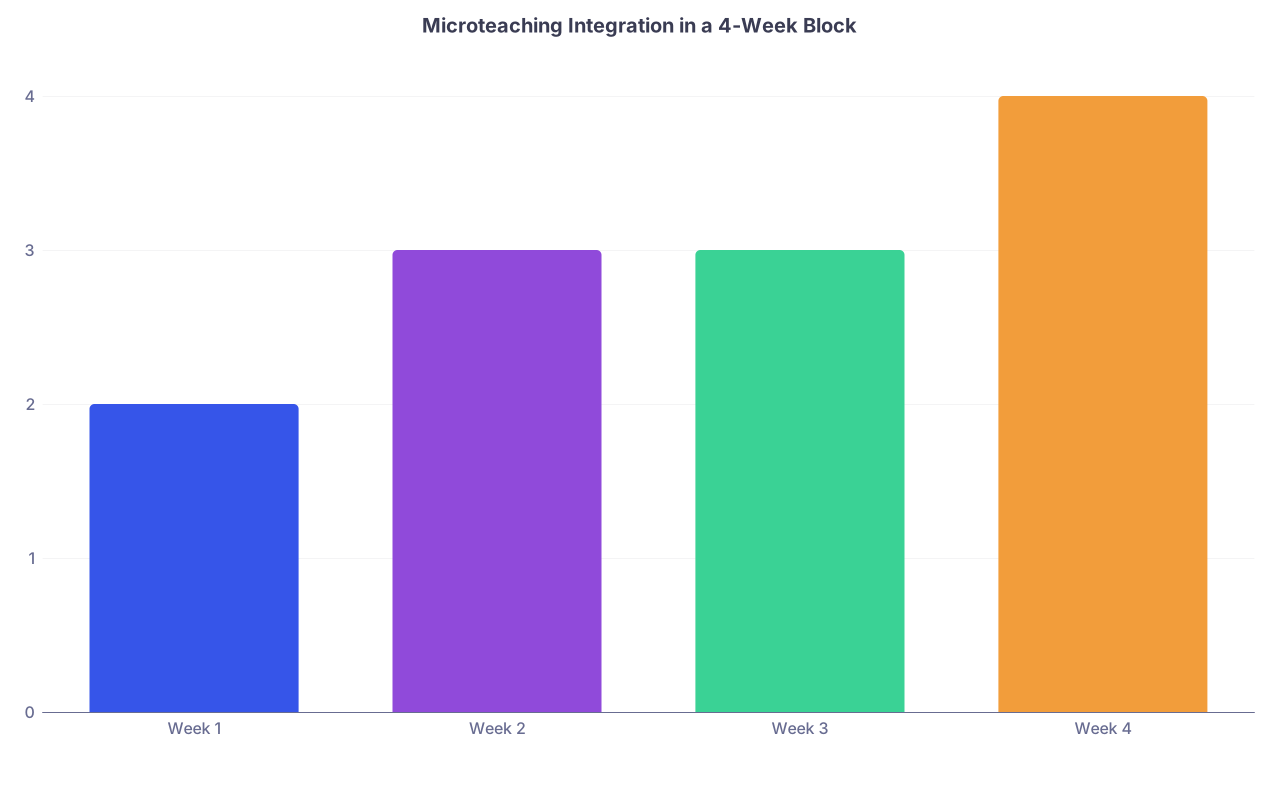
| Category | Value |
|---|---|
| Week 1 | 2 |
| Week 2 | 3 |
| Week 3 | 3 |
| Week 4 | 4 |
Interpretation: 2–4 short microteaching encounters per resident per week. Very feasible.
Sample integration for an internal medicine service
Week 1 (Onboarding to Teaching):
- One 60-minute “Resident as Microteacher 101” session.
- Each senior commits to 2 microteachings that week; faculty commits to observe 1 of them.
Week 2–3:
- Daily 10-minute pre-round microteaching on at least 3 days per week.
- Faculty observation 1–2 times per week, with brief written feedback.
- One noon-session where each PGY-2/3 does a 7-minute microteaching for peers.
Week 4 (Consolidation):
- One protected hour: residents bring their best micro-teaching plan and refine it with faculty.
- Final observed microteaching with a slightly higher-stakes audience (e.g., students + interns from two teams).
You are not adding hours of conference. You are carving out tiny, focused blocks and insisting that teaching time is sacred, not optional.
Training faculty and chiefs to coach microteaching
If your faculty cannot coach teaching, microteaching will stall. Residents will do the sessions, get vague “good job” feedback, and plateau.
You need to do minimal but very specific faculty development.
Faculty micro-training: 3 concrete skills
Give faculty (and chiefs) a 45–60 minute “how to watch and coach” session that hits exactly three things:
How to recognize a clear teaching objective
- Give examples and non-examples.
- Practice rewriting vague objectives on the fly: “Let us narrow that.”
How to use the observation tool in real time
- Pair them up; one “resident” runs a 5-minute fake session, the other practices scoring.
- Emphasize: do not write novels; mark patterns.
How to give one-strength, one-change feedback
- Have them practice phrasing specific behavior-based comments.
- Ban generic praise without behavior attached.
You want faculty to be able to walk away with something like:
- “Your structure was clear: hook, core, recap. Keep that.”
- “Next time, cut content by 30% and spend that time asking learners to apply one concept to our real patient.”
That is enough to make residents noticeably better over a few months.
Assessing and documenting resident teaching growth
Programs always ask, “How do we prove this is working?” You do not need a randomized trial. You need consistent, visible patterns.
Focus on three data sources:
Observation forms
- Track how often objectives are clear, how often learners are engaged, etc.
- Look for progression: early sessions with “objective not stated” shifting to “objective clear” over time.
Learner feedback (short, not a survey graveyard)
- One or two questions occasionally:
- “Did this teaching help you make a clinical decision more clearly?”
- “What was one useful thing you learned from this micro-session?”
- One or two questions occasionally:
Resident self-reflection snapshots
- At mid-year and end-of-year, ask residents:
- “Describe one microteaching session you are proud of. What made it effective?”
- “What is one teaching habit you changed this year?”
- At mid-year and end-of-year, ask residents:
You can easily turn these into ACGME-friendly language for Clinical Teaching milestones.
| Milestone Domain | Microteaching Contribution |
|---|---|
| Interpersonal Skills | Uses questions to engage learners |
| Practice-based Learning | Reflects on teaching and adjusts |
| Professionalism | Takes responsibility for team education |
| Systems-based Practice | Teaches safe, evidence-based decisions |
Tie promotion discussions to this evidence, not vague opinions about who is a “natural teacher.”
Common failure modes—and how to prevent them
I have watched plenty of microteaching initiatives fizzle. The same mistakes repeat.
Failure mode 1: Treating microteaching as an add-on, not a requirement
If microteaching is “optional if time allows,” it dies. Every time.
Fix: build it into:
- Rotation requirements (“3 observed micro-sessions per 4-week block”).
- Evaluation forms (“Teaching: based on observed microteaching and team function”).
- Resident schedules (“10 minutes protected at 7:45 a.m., no pages except code”).
Failure mode 2: Overemphasizing slides and “mini Grand Rounds”
Residents will default to what they know: 20-slide decks shrunk into 10 minutes. Useless.
Fix: explicitly ban slides for most microteaching. Require:
- Whiteboard, paper, or bedside explanation.
- At least 3 learner responses per session (questions, answers, summaries).
- One real patient from the team as anchor whenever possible.
Failure mode 3: No feedback, or feedback that is too nice to matter
Residents are not fragile. They are exhausted and time-poor, but they want to improve. Vague praise is more disrespectful than direct, specific critique.
Fix:
- Train faculty to always give one specific change item.
- Normalize it: “We all have something to tweak every time we teach.”
- Let residents ask for the type of feedback they want before the session: “Watch my time management,” or “Help me see if my questions land.”
Failure mode 4: No follow-through or deliberate practice
One-off workshops do not build skill. You would laugh at a program that taught central lines once in a lecture and called interns “proficient.”
Fix:
- Plan repeated microteaching cycles across PGY years.
- Make expectations explicit: PGY-1 begins practicing; PGY-2 gets observed regularly; PGY-3 coaches others.
A simple 3-year scaffold for resident-as-educator development
If you want this to be more than a fad, you scaffold across training.
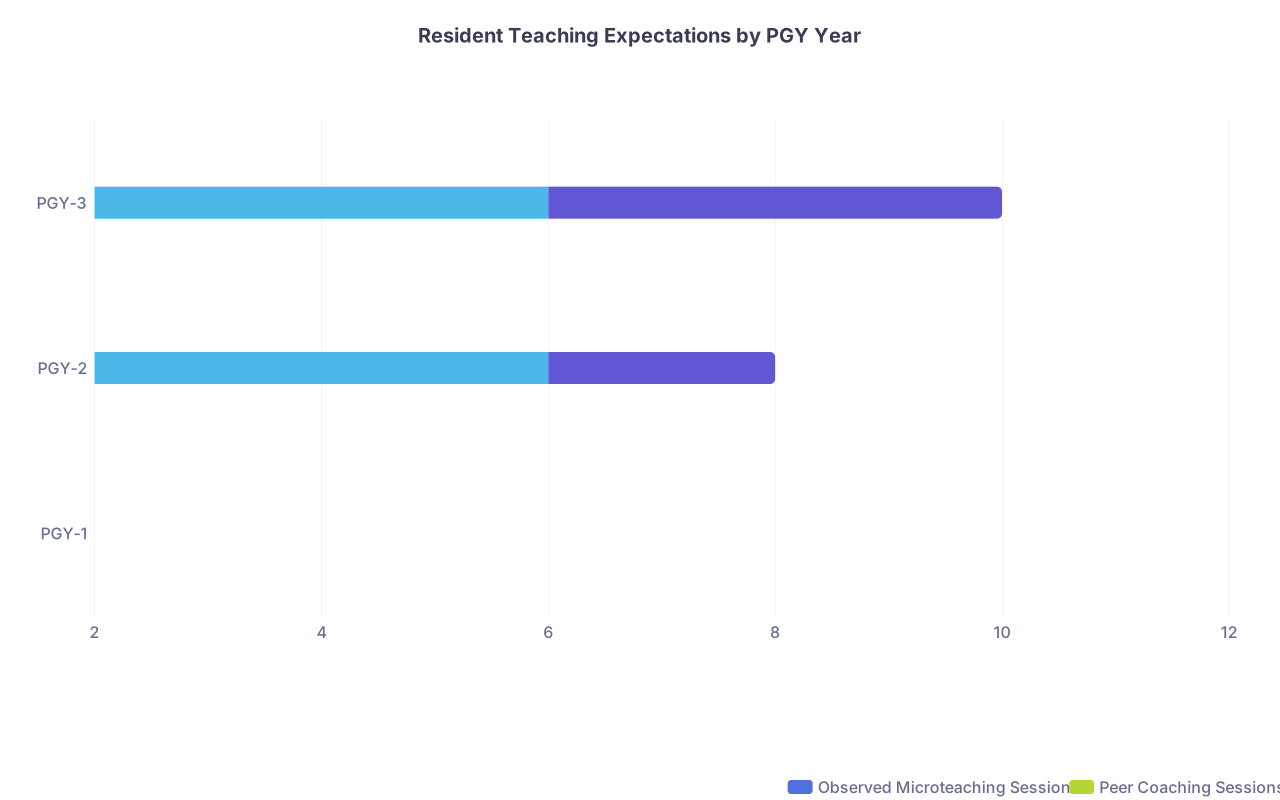
| Category | Observed Microteaching Sessions | Peer Coaching Sessions |
|---|---|---|
| PGY-1 | 2 | 0 |
| PGY-2 | 6 | 2 |
| PGY-3 | 6 | 4 |
A reasonable progression:
PGY-1: Learning the basics of teaching
- 1–2 microteaching exposures in intern year, often safer settings (e.g., intern-only noon time).
- Focus on stating objectives and not drowning in content.
- Mostly receiving feedback.
PGY-2: Regular, structured microteaching
- 1–2 micro-sessions per week on core rotations, observed at least weekly.
- Focus on engagement, questioning, and linking to clinical reasoning.
- Start doing low-stakes peer coaching of interns.
PGY-3: Microteaching + coaching
- Continue own microteaching, but now also observe junior residents or interns.
- Learn to use the observation tool and run 5-minute feedback conversations.
- Potentially participate in resident-as-teacher curriculum design.
This is how you graduate people who can walk into any ward or clinic and build a learning environment on command.
A concrete example: One 4-week block, fully wired for microteaching
To make this even more tangible, here is what it looks like for a single senior resident.
| Week | Microteaching Focus | Observations Planned |
|---|---|---|
| 1 | State objective, basic structure | 2 sessions, 1 observed |
| 2 | Questioning and engagement | 3 sessions, 2 observed |
| 3 | Clinical reasoning emphasis | 3 sessions, 2 observed |
| 4 | Peer feedback and coaching | 2 sessions, 2 observed |
During that block, the resident might:
- Teach “prioritizing chest pain differential” on Monday pre-rounds.
- Do an “error autopsy” about delayed DKA recognition at noon on Wednesday.
- Run a “one decision, one tool” session on anticoagulation thresholds in clinic.
- Get 4–5 brief but high-quality coaching conversations from two different attendings.
Multiply that by multiple rotations per year and you are not just saying “we value teaching.” You are proving it.
Where microteaching fits in medical teaching careers
If you want residents to consider clinician-educator careers, you have to give them something more sophisticated than “you are good with students.”
Microteaching builds:
- A vocabulary for discussing teaching (“objective,” “engagement,” “structure”).
- A portfolio of observed, documented teaching encounters.
- Early coaching skills—critical for anyone who will be faculty, chiefs, or fellowship leaders.
You can even fold microteaching into formal educator tracks:
- Require a certain number of observed micro-sessions for entry into an “education concentration.”
- Have residents design microteaching modules that can be used by future cohorts.
- Use the best resident-designed sessions as part of your clerkship or sub-I teaching arsenal.
Residents who go on to fellowships or faculty roles with this background are miles ahead. They already know how to build a 5–10 minute, high-yield teaching moment around a busy clinic schedule or chaotic ICU day. That is what real clinician-educators do.
Key points
- Microteaching is not “short talks.” It is structured, observed, feedback-rich practice in 5–10 minute blocks, built around clear objectives.
- Residents improve quickly when you give them simple frameworks, a streamlined observation tool, and blunt, behavior-specific feedback.
- To make it stick, integrate microteaching into schedules and evaluations, scaffold expectations across PGY years, and train faculty to coach—not just watch—resident teaching.