Implementing Flipped Classroom Models in Pre-Clinical Medical Courses
You are in week four of teaching first-year medical students. It is 8:05 a.m. You walk into a lecture hall that technically seats 150 and are greeted by…32 tired faces. The rest? Watching the recording at 1.75x speed later, if at all. You have a carefully crafted 60-slide deck on cardiac physiology that you spent your Sunday perfecting. Half the room is toggling between Anki, WhatsApp, and UpToDate.
You know this is broken. You also know your dean is starting to mutter phrases like “active learning,” “LCME standards,” and “flipped classroom.” But nobody is giving you a concrete playbook. Just vague “move content online, do more small groups” hand-waving.
Let me give you the playbook.
This is how you actually implement a flipped classroom model in pre-clinical medical courses without burning yourself out, tanking student satisfaction, or turning your course into a chaotic mess of PDFs and Zoom links.
1. What “Flipped Classroom” Really Means in Medical School (And What It Doesn’t)
First, clear the fog. A lot of what passes for “flipped classroom” in med ed is just “we posted the slides and added a quiz.”
A true flipped model in pre-clinical medicine has three non-negotiable components:
Structured pre-class learning
Students get core content before class, typically via:- Short, focused videos (5–15 minutes)
- Curated readings / textbook sections
- Question sets (e.g., 8–12 SBAs or MCQs)
- Sometimes interactive modules (e.g., H5P, Articulate, or commercial platforms)
Protected in-class application time
Live time is used for:- Case-based discussions
- Problem-solving in small groups
- Concept mapping
- Interpretation tasks (ECGs, images, labs) Not for re-reading slides aloud.
Accountability loop
There is a mechanism that:- Ensures most students actually prepare
- Feeds data from pre-work into what you do in class
- Gives students feedback on their own understanding
What it is not:
- Not just “record your 60-minute lecture and call it pre-work.”
- Not “more content dumped on students.”
- Not “random small-group time” with no structure or outcomes.
If you remember one thing: flipped classroom is not about video; it is about moving information delivery out of class and using class time for cognition higher than ‘remember’ and ‘understand’.
2. Start with One Course and One Block – Not the Whole Curriculum
I have seen schools crash and burn trying to flip everything at once. You want to avoid the “institutional moonshot that collapses under its own weight.”
Pick something targeted:
- One pre-clinical block (e.g., cardiovascular, renal)
- Or one course (e.g., physiology, pathology, pharmacology)
- With a cooperative course director and at least one ally on faculty
Then pick specific sessions within that block to flip first. Good candidates:
- Topics where:
- Students traditionally struggle (e.g., acid–base, renal physiology)
- You repeat the same explanations semester after semester
- There is a clear clinical application (EKGs, arrhythmias, shock states)
- Sessions currently dominated by didactic slide delivery
Avoid trying to flip:
- Disjointed “miscellaneous” lectures
- Sessions owned by visiting speakers who will not change their approach
- Highly political turf topics where faculty fight over minutes
You want early wins. That means high-yield topics, controllable content, and faculty who are actually willing to do this.
3. Designing Pre-Class Materials That Med Students Will Actually Use
Here is where most flipped experiments die: bloated pre-class work that students ignore or resent.
Med students have a viciously efficient filter: “Does this help me pass exams and boards?” If the answer looks like “maybe,” your videos will sit untouched while Boards & Beyond or AnKing gets their attention.
So pre-class materials must be:
- Tightly focused
- Explicitly aligned to course and board-style objectives
- Time-bounded
3.1 Set a hard time budget
For a 2‑hour in-person session, a realistic pre-work target:
- 30–45 minutes for M1
- 45–60 minutes for M2 (they tolerate slightly more if it feels “board-relevant”)
Do not exceed this unless you like angry end-of-course evaluations.
Explicitly state at the top of the module:
“Estimated pre-class time: 40 minutes.”
And actually time yourself doing it like a student. Double your own time for reality.
3.2 Use short, modular videos
If you are building your own videos:
- Aim for 5–12 minutes per video, each tied to 1–2 objectives.
- Use simple slides and voiceover; do not chase Hollywood production value.
- Embed 1–3 low-stakes questions inside longer videos if your platform allows.
Structure them like this for, say, cardiac output:
- “Determinants of Cardiac Output – Overview (8 min)”
- “Frank–Starling and Pressure–Volume Loops (10 min)”
- “Clinical Application – Heart Failure and CO (7 min)”
Do not create a single 40-minute monolith. Students cannot quickly locate what they need to review.
If your institution already purchases board-style video resources (e.g., Lecturio, Osmosis, Aquifer), leverage them instead of duplicating effort. Your job then is to:
- Curate specific videos
- Wrap them with:
- A structured intro explaining why they matter
- Your own question set
- A short “bridge” explanation to your local curriculum or assessments
3.3 Write focused, aligned learning objectives
No fluffy objectives like “understand the heart.”
Write 4–6 specific pre-class objectives at the “remember/understand” level, for example:
- Define preload, afterload, contractility, and cardiac output.
- Sketch a normal pressure–volume loop and describe each phase.
- Describe how increased venous return shifts the Frank–Starling curve.
- Predict how systolic heart failure alters the pressure–volume loop.
In-class objectives will then sit at the “apply/analyze” level, e.g.:
- Interpret changes in a pressure–volume loop given a clinical vignette.
- Distinguish between cardiogenic and hypovolemic shock based on hemodynamic profiles.
Students need to see the progression: “I learn definitions and basic relationships at home. I interpret and solve problems in class.”
3.4 Build pre-class questions that matter
Pre-class quizzes are not busywork; they are your triage.
Design:
- 6–10 MCQs or SBAs per 40–60 minutes of pre-work.
- Questions that:
- Directly test your pre-class objectives
- Mirror the style of your summative assessments (and boards)
Use immediate feedback:
- Show correct answer immediately after submission
- Provide a 1–2 sentence explanation linking back to the objective
Example (renal physiology):
Stem: “A patient with chronic diarrhea presents with metabolic acidosis. Which best describes the expected change in anion gap and bicarbonate level?”
Choices: normal gap vs increased gap, high vs low bicarb.
Feedback: Short explanation of non-gap acidosis and HCO₃⁻ loss.
You collect two things from these quizzes:
- Performance data (which items students missed in aggregate)
- Completion data (who did the work)
You will use that to shape what you do in class.
4. Designing In-Class Sessions: What You Actually Do in the Room
Flipped classrooms fall flat when in-class time is just “OK, any questions?” followed by awkward silence.
You need a concrete format.
4.1 Choose a working structure and stick to it
Here is a very workable pattern for a 2‑hour pre-clinical session:
0–10 minutes:
- One or two rapid polling questions to re-activate key concepts
- Very brief framing: “Today we will apply X, Y, Z from the pre-work to A, B, C clinical problems.”
10–80 minutes:
- Small-group work (4–6 students) on 2–3 structured cases or problem sets
- Faculty/TA roaming and coaching
80–110 minutes:
- Whole-class debrief:
- Walk through key questions
- Ask groups to justify reasoning
- Address common misconceptions flagged by pre-class quiz data
- Whole-class debrief:
110–120 minutes:
- Short wrap-up:
- 3 key take-home points
- One “exit ticket” question or poll on the hardest concept
- Short wrap-up:
You can vary the details, but do not improvise week to week. Consistent structure lets students allocate their cognitive effort to the content, not to deciphering the format.
4.2 Write cases and tasks that actually require thinking
Do not turn in-class sessions into “read the paragraph and underline definitions.”
You want:
- Short, progressive-disclosure cases: information revealed in steps
- Tasks that require application, prioritization, explanation
Cardiology example (M2 level):
- Case step 1: 65-year-old with exertional dyspnea, early findings.
- Task: Identify the most likely hemodynamic abnormality from options.
- Case step 2: Echo findings and pressure–volume loop provided.
- Task: Label the altered loop and explain the shifts.
- Case step 3: Management decision.
- Task: Predict how ACE inhibitor therapy affects the loop and symptoms.
Give groups clear outputs:
- Fill-in tables
- Annotated figures
- Chosen answer plus written justification
- Ranked differential diagnoses
Then design your debrief around those outputs.
4.3 Decide on group size and room logistics
Space often dictates method more than pedagogy. Work with what you have.
Typical workable formats:
- 100–150 students, large active-learning space:
- Groups of 4–6 at tables
- 1–2 faculty + 3–5 near-peer tutors (residents, senior students)
- 60–80 students, standard lecture hall with fixed seating:
- Row-based groups (turn and work with the 3–4 around you)
- Use Google Forms or paper handouts for group answers
- 30–40 students, seminar room:
- Single-room discussion with breakout moments
Plan faculty coverage:
| Class Size | Recommended Facilitators | Typical Configuration |
|---|---|---|
| 30–40 | 1–2 faculty | Single room |
| 60–80 | 2–3 faculty or 1+2 tutors | Row-based groups |
| 100–150 | 3–4 faculty/tutors | Table groups |
You do not need one facilitator per table. You need enough bodies to keep groups from stalling and to monitor misconceptions.
5. Assessment and Accountability Without Turning It into a Punitive System
If there is no stake, most students will not do pre-work consistently. If the stake is too high, they will hate you. There is a middle ground.
5.1 Low-stakes pre-class quizzes with small course weight
Working range that tends to be accepted:
- 5–15% of course grade from pre-class quizzes across the block
Implementation details:
- Multiple attempts allowed, either:
- Unlimited attempts with highest score recorded, or
- 2 attempts with the higher score counted
- Open until shortly before class starts
- Adaptively weighted:
- Best 80–90% of quizzes counted to allow for illness, bad weeks, etc.
This signals: “Do the work, you will get these points; ignore it, you can still pass, but it will sting.”
5.2 In-class participation credit that is not performative
Avoid grading who talks the most. It rewards extroversion, not learning.
Instead:
- Group-based submissions:
- Each group submits answers to key case questions (clickers, LMS quiz, Google Form)
- Participation credit is tied to submission, not correctness
- Occasional individual “readiness checks”:
- 3–5 questions at the start of class, 2–3% of course grade
- Honest signal about who is consistently arriving unprepared
You are not policing them. You are shaping their study habits.
6. Sequencing: How a Flipped Week Really Runs
Let me put this on a timeline, because the “when” is where logistics break.
Imagine a cardiovascular physiology session on Wednesday morning.

| Step | Description |
|---|---|
| Step 1 | Thu - Identify objectives and cases |
| Step 2 | Fri - Build/curate pre-class materials |
| Step 3 | Mon - Release pre-class module |
| Step 4 | Wed 7am - Review quiz analytics |
| Step 5 | Wed 8-10am - In-class session |
| Step 6 | Wed afternoon - Post-class summary and upload keys |
More concretely:
Previous Thursday–Friday
- Finalize pre-class objectives
- Record or assign videos
- Build the pre-class quiz
- Prepare case materials and debrief slides
Monday 8 a.m.
- Release the pre-class module with explicit instructions and estimated time.
Wednesday 7:00–7:30 a.m.
- Pull quiz analytics:
- Items with <60–70% correct
- Common distractors
- Use these to:
- Add 2–3 targeted polling questions at the start of class
- Emphasize or adjust portions of cases addressing weak areas
- Pull quiz analytics:
Wednesday 8:00–10:00 a.m.
- Run in-class session per your chosen structure.
Wednesday afternoon
- Post:
- Case answer keys and explanations
- 3–5 bullet summary of “key clinical reasoning moves” from the session
- Optional: short (3–5 item) follow-up quiz as spaced repetition.
- Post:
When you build a whole block this way, you get a rhythm. Students know: Mondays – pre-work drops; Wednesdays – we apply what we learned; later – consolidation.
7. Managing Faculty Workload (So You Don’t Burn Out by Week 3)
You are not a full-time instructional designer. You still see patients, sit on committees, and review IRB protocols. So you need to be smart about effort.
7.1 Front-load then reuse
The heavy lift is year 1. The payoff is years 2–5.
If you design:
- 15–20 short videos
- 40–60 high-quality questions
- 10–15 well-structured cases
You can reuse and refine them for several cohorts with minor updates.
Record once, then iterate:
- Year 1: Build bare-bones version, accept some rough edges.
- Year 2: Fix unclear questions, trim bloated pre-work, tighten cases.
- Year 3+: Only update for content changes (e.g., guideline shifts) or student feedback.
Do not try to create the definitive, perfect flipped course in one go. Get to “good enough to run,” then improve.
7.2 Steal shamelessly, adapt selectively
There is a ridiculous amount of open-access material now:
- Peer-reviewed MedEdPORTAL flipped classroom modules
- Specialty society resources (e.g., ACC, AHA, ASN educational cases)
- Existing institutional teaching files
Pull:
- Question stems you can adapt
- Case structures
- Images, diagrams, and example loops or tracings
Do not blindly import entire modules. Align everything to:
- Your exam blueprints
- Your local clinical context
- Your students’ level (M1 vs M2 vs PA vs NP add-ons)
7.3 Use near-peer teachers
Senior medical students and residents are often far better at pacing and difficulty calibration than full professors. They also cost less.
Ways to use them:
- Co-facilitate in-class groups
- Pilot-test pre-class quizzes and cases
- Help rewrite explanations for clarity
Train them with:
- A 1–2 page “facilitator guide” per session:
- Session objectives
- Suggested probing questions
- Common pitfalls and misconceptions
Near-peers make your flipped sessions feel more grounded and exam-relevant. They also reduce your cognitive load during the session.
8. Technology: Minimal Viable Stack vs Over-Engineered Circus
You do not need to buy six new platforms. In fact, that is one of the fastest ways to lose both faculty and students.
Minimal viable tech stack for a flipped pre-clinical course:
- An LMS (Canvas, Moodle, Blackboard, etc.) for:
- Modules
- Quizzes
- File distribution
- A polling tool:
- Built-in LMS polls, Poll Everywhere, Mentimeter, TurningPoint, or similar
- A basic video host:
- Panopto, Kaltura, or even unlisted YouTube
Keep the rules simple:
- One place for pre-class modules.
- One quiz engine.
- One in-class response tool.
Students should not need a flowchart to figure out: “Where is this week’s pre-work?”
9. Dealing with Common Failure Modes (I’ve Seen All of These)
This is where things usually go wrong. Let me call them out and give you the fix.
9.1 “Students are not doing the pre-work”
Common causes:
- Pre-work is too long or unfocused.
- No grade impact or accountability.
- Students do not see alignment with exams.
Fix:
- Cut pre-work to realistic time.
- Add low-stakes graded quizzes (5–15% total).
- Put 2–3 questions from each session directly on summative exams.
- Explicitly tell them: “If you skip pre-work, you will be lost in class and lose easy points on quizzes and exams.”
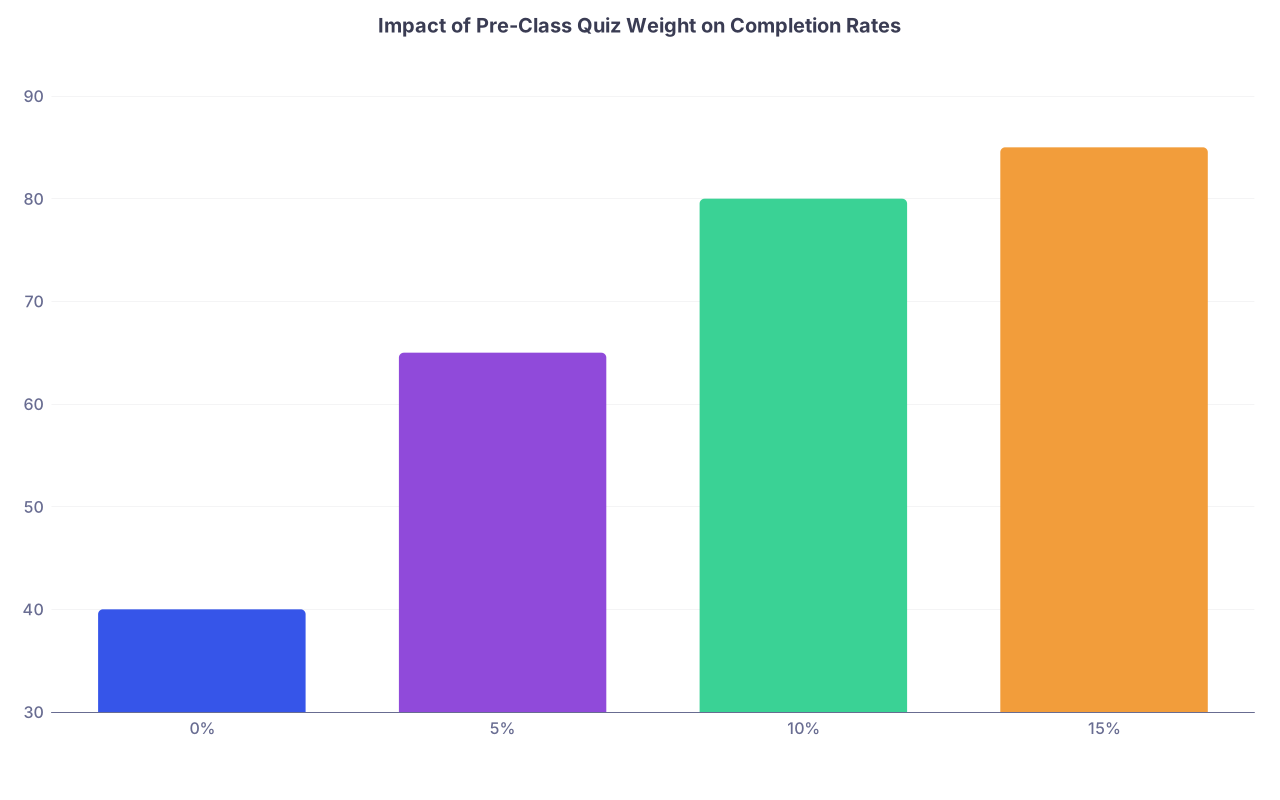
| Category | Value |
|---|---|
| 0% | 40 |
| 5% | 65 |
| 10% | 80 |
| 15% | 85 |
(These are realistic numbers I have seen in real programs: completion jumps sharply once there is even modest grade value.)
9.2 “In-class time feels chaotic and unfocused”
Common causes:
- Vague instructions to groups.
- No clear time boundaries.
- Debrief that meanders into tangents.
Fix:
- Put task instructions on each case page:
- “You have 10 minutes. As a group, do X and Y. Submit Z.”
- Timebox explicitly:
- “You have 8 minutes for these two questions. At 8 minutes, we will poll and move on.”
- Build a structured debrief deck:
- One slide per key question with:
- Poll results
- Correct answer
- Short explanation
- Brief tie-back to a clinical vignette or board-like stem
- One slide per key question with:
9.3 “Faculty resistance: ‘I’ll just keep lecturing’”
You will hear:
- “I do not have time to redesign everything.”
- “My lectures work; my evals are fine.”
- “Students like traditional lectures better.”
Most of this is inertia plus fear.
Approach:
- Start with volunteers and early adopters, not the entrenched skeptics.
- Give them:
- Protected time (even 0.05–0.1 FTE) to build materials
- Very tangible support (IT help, templates, examples)
- Share early outcome data:
- Improved exam performance on previously weak topics
- Higher ratings of “class time helped me apply concepts”
Do not try to convert every faculty member at once. You win people over by showing that:
- It actually works.
- It does not double their long-term workload.
- Students still respect them.
10. Measuring Whether Your Flipped Model Is Actually Working
If all you do is “students seem to like it,” you will eventually face a skeptical dean or curriculum committee. Collect real data.
10.1 Short-term metrics
- Pre- vs post-implementation exam performance
- Compare performance on identical or very similar questions across cohorts.
- Failure and remediation rates on tricky units (e.g., renal, acid–base).
- Item-level analysis:
- Are previously low-performing questions now in a healthy range?
10.2 Process metrics
- Pre-class quiz completion rates.
- Attendance rates in optional vs required in-class sessions.
- LMS analytics: time spent on pre-class modules.
10.3 Student perception – but with precision
Do not ask “Do you like flipped classrooms?” Ask:
- “Pre-class materials prepared me adequately for in-class activities.”
- “In-class activities helped me understand how to apply concepts clinically.”
- “I could see alignment between pre-class work, class activities, and assessments.”
Use this to refine. If students say “videos were too long,” they are usually correct.
11. Case Example: Flipping Cardiac Physiology in a Pre-Clinical Course
Let me walk through a concrete mini-case of implementation.
Course: M1 Medical Physiology
Unit: Cardiovascular (2 weeks)
Old format: 8 hours of lectures, 2 hours of review Q&A
Redesign target: Flip 4 of those 8 hours.
11.1 Pre-class components (for one 2-hour session)
Topic: Cardiac Output and Pressure–Volume Relationships
Pre-class module (45 minutes):
- 3 videos (total 25 minutes)
- Definitions and equations (CO, SV, HR, EF)
- Frank–Starling and PV loops
- Effects of preload, afterload, contractility
- 1 reading handout (optional, 10 minutes)
- Excerpts from existing physiology textbook
- Quiz (8 questions, 10–15 minutes)
- Mix of recall and simple application
11.2 In-class session
Structure:
- 0–10 min: 3 polling questions based on lowest-performing quiz items.
- 10–70 min: 3 progressive cases, each with:
- Vignette
- Hemodynamic data or PV loop
- Tasks for groups (interpretation, prediction of therapy effect)
- 70–110 min:
- Debrief with polling
- Ask 2–3 groups to explain their reasoning
- 110–120 min:
- Wrap-up, “3 things to remember” slide, exit ticket question.
Assessment:
- Pre-class quiz: 1% of course grade.
- In-class group participation: 0.5% (submission-based).
- 4 exam questions pulled directly from session concepts.
Outcomes (realistic, extrapolated from similar real projects):
- Exam performance on PV loop items increases from 62% to ~80% correct.
- Remediation requests for this unit drop by half.
- Student comments shift from:
- “Cardio phys is impossible to follow in lecture”
to - “Pre-work made class make sense; cases matched exam style.”
- “Cardio phys is impossible to follow in lecture”
This is what you are aiming for. Not magic. Just a systematic shift of where the hard thinking happens.
12. Practical Templates You Can Steal
Since most faculty want something they can copy-paste, let me give you skeletons.
12.1 Pre-class module template (LMS)
Title: Cardiac Output and Pressure–Volume Loops – Pre-Class Module
“Start Here”
- Brief intro (2–3 sentences): Why this matters clinically.
- List of pre-class learning objectives.
- Estimated time: 40–45 minutes.
“Watch”
- Video 1 – Determinants of CO (8:32)
- Video 2 – Frank–Starling and PV Loops (10:11)
- Video 3 – Clinical Example – Heart Failure (6:45)
“Optional Read”
- PDF excerpt – Guyton & Hall, Chapter X sections Y–Z.
“Check Your Understanding”
- Quiz: 8 questions, due Wednesday 7:30 a.m.
- Unlimited attempts until due date; highest score counts.
- Worth 1% of course grade.
12.2 In-class case handout template (first page)
Case 1 – Shortness of Breath on Exertion
Step 1: Vignette (2–3 sentences)
Question 1: Select the most likely primary hemodynamic abnormality (MCQ).
Question 2: On the PV loop diagram, draw and label the expected change.
Step 2: Additional data (echo or cath findings)
Question 3: Describe how ACE inhibitor therapy will affect afterload and PV loop shape.
Group task:
As a group, submit answers to Questions 1–3 via the LMS quiz labeled “Cardio Session – Group 1 Case Submission” within 15 minutes.
Final Takeaways
- Flipped classrooms in pre-clinical medicine work only when content, structure, and assessment are aligned: tight pre-work, purposeful in-class cases, and low-stakes but real accountability.
- Start small: one block, a few sessions, and reused materials, then iterate based on item performance, student feedback, and your own sanity.
- Protect in-class time for application and clinical reasoning, not re-lecturing the videos; that is where the real value—and the real learning—actually happens.