
The myth that you can either be a “serious educator” or a “present new parent” is garbage.
You can do both. But you cannot do both the way everyone around you pretends they’re doing it. You need a different playbook.
You’re in medical training (student, resident, or fellow), you’ve got a new baby or one on the way, and you actually like teaching. You enjoy helping juniors, maybe you’re eyeing clinician-educator roles, chief, or academic medicine. And you’re wondering: how do I not drown?
Let’s walk through what to do, step by step, in the real world you’re actually living in: call shifts, sleep deprivation, pumping schedules, sick toddlers, and evaluation forms that don’t care your kid was up from 1–4 a.m.
Step 1: Decide What “Teaching” Means For You This Year
First mistake I see constantly: new parents trying to maintain their pre-baby definition of “being an educator.”
Before baby:
- Volunteering for extra small groups
- Designing new curricula “for fun”
- Saying yes to every tutoring request, review session, and committee
After baby:
- You try to do the same. You burn out. You start resenting both the kid and the teaching. Lose-lose.
You need a 12-month definition of “teaching” that’s realistic. Not for your whole career. Just for this window.
Ask yourself three concrete questions:
- How many hours per week can I consistently give to teaching without wrecking my family or my sanity?
- When am I most functional during the day (honestly, not aspirationally)?
- What kind of teaching lines up with my existing responsibilities?
Then set one of these as your explicit goal for this year:
- “My teaching this year is primarily on-shift teaching and one recurring low-prep activity per month.”
- “My teaching is small-group facilitation only, no new curriculum development.”
- “My teaching focus is 1:1 coaching of one or two learners, not large-group stuff.”
That’s it. One sentence. You can revise next year when the kid sleeps like a human.
Here’s how this might look for different stages:
| Role | Reasonable Teaching Scope (with new baby, 1st year) |
|---|---|
| MS3/MS4 | On-rotation peer teaching + 1 low-commitment role |
| Intern | Bedside/checkout teaching only, no extra projects |
| Resident (mid) | 1–2 talks per year + consistent on-shift teaching |
| Senior/Chief | Protected roles that count as duty hours |
| Fellow | One defined teaching lane (e.g., small group series) |
If what’s in your head doesn’t fit that table, adjust what’s in your head. Not the other way around.
Step 2: Make Teaching Serve Your Training (Not Compete With It)
If teaching is something you add on top of everything else, it’ll always feel impossible as a new parent.
You want teaching that double-counts:
- Counts for your evaluation
- Counts for your CV
- Counts for your daily patient care
If it doesn’t do at least two of those three, be very suspicious about saying yes.
Here’s the rule I teach residents:
No “extra” teaching that isn’t tied to something you’re already doing.
Examples of smart “double-counting”:
You’re on wards:
Turn your daily pre-rounds into a 5-minute chalk talk with the med student on one of your patients (DKA gap, hyponatremia types, chest pain workup).
Same time, better structure = teaching credit.You’re preparing a noon conference:
Choose a topic you need for boards. The prep becomes your own studying. Reuse the slides later for:- Resident noon conference
- Student small group
- Fellowship mini-lecture
You’re in a simulation session:
Volunteer to be the debriefer for one scenario instead of taking on an additional game-night review session later.
You want compounding use: one teaching product used in multiple ways.
Step 3: Protect Your Limited High-Energy Time
New parents don’t have a time problem. They have an energy and predictability problem.
You might “have” two free hours tonight. But if they’re 9–11 p.m. after a 14-hour day and three night feedings, it’s junk time. You won’t produce good teaching or be kind to your learners.
You need to match teaching task → realistic energy window.
Typical pattern I see with new parents in training:
- Early morning: reasonably focused, short window before chaos
- Midday on lighter rotations: some mental bandwidth, but unpredictable
- Evenings: destroyed
So:
- Put planning and creative teaching work (building slides, writing questions) in your best 45–60 minutes of the week. Often early morning off a post-call or on a golden weekend.
- Put on-shift teaching into your regular clinical workflow (since you’re already there).
- Put low-brain tasks (emailing learners, scheduling, uploading materials) into the tired time.
Stop trying to draft a brand-new 1-hour lecture in the 30 minutes between baby bedtime and your own collapse. That’s where resentment grows.
Step 4: Choose the Right Kinds of Teaching Commitments
Not all teaching opportunities are equal. Some are perfect for a new parent; others are traps.
Here’s how I’d rank them for you right now.
Good choices (high value, controllable, re-usable):
- Leading one recurring small group with pre-written cases
- Giving 1–2 talks per year on a topic you already know well and can reuse
- On-shift bedside teaching tied to your actual patients
- Being an assigned resident teacher on rotations where that role replaces other work, not adds to it
- Short, defined mentorship (e.g., coaching one M3 through an OSCE cycle)
Terrible choices (time sink, low control, low ROI this year):
- Designing a brand-new curriculum from scratch
- Joining a “curriculum committee” that meets every other week at 5 p.m.
- Precepting unpaid extra clinics just to “get teaching experience” when you’re already over hours
- Big, vague roles like “help with student education” with no clear expectations
- Anything where the phrase is “just a small thing” but there’s no end date
If the opportunity doesn’t have:
- A clear time commitment
- A clear deliverable
- A clear end point
You say no. For now. You can come back to it when the kid’s in daycare and you’re not counting sleep in 90-minute chunks.
Step 5: Be Honest With Program Leadership Early
Most people don’t do this. They try to “just muscle through” a year as a new parent, say yes to everything, and then quietly flame out or miss deadlines. Then they look “unreliable.”
You’re smarter than that.
You should have one explicit conversation with your PD, APD, or faculty mentor that sounds roughly like this:
“I care a lot about teaching and want it to be a major part of my career. I’m also in my first year as a parent, so I’m being deliberate about what I commit to. For this year, I can realistically take on [X]. I want to do that well. Beyond that, I’ll need to say no to protect my clinical performance and my family. Does that seem reasonable?”
Good leaders will respect this. It signals maturity, not laziness.
Then connect the dots:
- “I’d like one recurring small-group or lecture opportunity I can really own.”
- “I want feedback on my on-shift teaching every few months so I can grow without taking on massive extra projects.”
- “If there are opportunities with built-in mentorship in medical education, I’m interested, but I need predictable time blocks.”
Now when someone says, “Can you join this ad hoc working group?” you can say:
“I spoke with Dr. X about focusing on just one teaching project this year while I’m adjusting to being a new parent. I’m at capacity with that right now, but I’d love to revisit in a year.”
No guilt. Also no chaos.
Step 6: Use On-Shift Teaching as Your Workhorse
If you’re a resident or fellow, this is your secret weapon. Done right, your daily work can generate 80% of your teaching experience.
Stop picturing “teaching” as a 60-minute PowerPoint. Think:
- 3-minute “one pearl per patient”
- 5-minute whiteboard sketch while waiting for labs
- Structured debrief at the end of a shift or round
Concrete ways to do this:
The One-Case, One-Lesson Rule
Every day, pick one patient and turn that into a mini-teaching moment:- “Let’s walk through the exact orders I put in for this new CHF admission and why.”
- “List three causes of this electrolyte issue and which labs rule each out.”
Ask Twice, Lecture Once
Before you start explaining, ask the learner:- “What do you already know about [topic]?”
- “What’s one thing that confuses you about [this disease/procedure]?”
Then target just that. Saves time, and they’ll stay awake.
Use the End-of-Day Debrief
On busy days, skip mid-day teaching. Then:- Last 10 minutes of the shift: “Okay, 2 quick questions from today’s patients” or “What’s one thing you learned and one thing still confusing?”
You’re not carving extra time; you’re structuring what’s already happening.
Step 7: Make Your Family Logistics Explicit, Not Secret
You can’t balance teaching and parenting if you’re hiding your parenting reality.
You do not need to share your entire life story. But you should calmly set boundaries where they matter.
Examples:
- “I can’t stay past 5:15 on Wednesdays because of daycare pickup, but I can do a 7 a.m. teaching session those days if helpful.”
- “I’m pumping at 10 and 2; I can join meetings around those, but not during.”
- “If we schedule this small group, evenings after 7 p.m. are off the table for me while I’m solo with the baby.”
Most colleagues are fine with this when they know ahead of time. What they hate is last-minute surprises.
So you:
- Block protected times in your calendar (pumping, daycare, pediatrician visits).
- Tell the relevant people once. Clear, non-apologetic.
- Offer one or two alternative windows.
This is not being “high maintenance.” It’s being a functioning adult.
Step 8: Use Baby Time Wisely (But Not Delusionally)
Yes, you’ll think: “I’ll work while the baby naps!”
Sometimes that works. Often it doesn’t.
So design tasks that are nap-sized and interruptible:
Good nap tasks:
- Rough outline of a future talk (just bullet points)
- Jot down 3–4 clinical cases that would make good teaching vignettes
- Read 2–3 pages of a teaching book or paper and screenshot key paragraphs
- Reply to non-urgent learner emails
- Make a one-page handout rather than a 30-slide deck
Terrible nap tasks:
- Full-slide design from scratch
- Complex data analysis for an education project
- Long Zoom meetings where you can’t mute a screaming infant
Assume a nap will be 20 minutes and intermittently noisy. If you get more, great. If not, you’re not wrecked.
Step 9: Capture Teaching for Your Future Career Without Extra Work
You’re interested in teaching long term. Good. Don’t wait five years and then try to remember what you did.
But. You don’t have time for a full “teaching portfolio” this year. So you’re going minimalist.
Create one running document (Google Doc, OneNote, Apple Notes, whatever) called “Teaching Log.”
Each time you do something teaching-related that’s more than ordinary on-shift chatter, log:
- Date
- Type (small group, talk, debrief, case-based teaching)
- Audience (M3s, interns, nurses, etc.)
- Topic
- Any feedback you got, even informal (“This was actually useful” from a tired M3 counts)
Example entry:
- 2026-02-10 – 20-min chalk talk on “Approach to syncope” for 2 M3s on wards, created 1-page algorithm, plan to reuse. Verbal feedback from student: “Helped me not panic on my H&P.”
That log becomes:
- Content for your teaching statement
- Bullets for future CV
- A memory bank of ideas you can expand later when you’re less sleep-deprived
Zero polishing. Just don’t let experiences vanish.
Step 10: Don’t Ignore Your Own Learning in the Name of Teaching
Common trap: you care about teaching, so you pour yourself into it and quietly fall behind in your own studying. In training, that’s deadly. Board scores and clinical performance still matter. A lot.
Rule:
If your own learning is suffering, teaching scope shrinks. Immediately.
Signs you’ve crossed the line:
- You’re saying “I’m not totally sure” more than seems right for your level
- Your in-service or shelf scores drop
- You’re cutting your own reading to prep a session for others
- You’re chronically short on sleep because of teaching prep, not the baby
In that case, downshift:
- Convert a long talk into a brief case discussion with more learner participation and less you talking.
- Cancel or postpone optional teaching that isn’t required.
- Tell your mentor: “My learning is taking a hit; I need to scale back.”
Nobody is going to save you from overcommitting. You have to call it.

| Category | Value |
|---|---|
| On-shift teaching | 40 |
| Prep for 1–2 talks/year | 15 |
| Own studying/reading | 35 |
| Admin/emails | 10 |
A Sample “Balanced” Month for a New Parent Interested in Teaching
Let me show you what this looks like in real time. Assume you’re a PGY-2 with a 4-month-old.
- Weekly:
- Daily: 5–10 minutes of conscious on-shift teaching on at least one patient.
- One early-morning 45-min block on your golden day for teaching prep or reading about education.
- Monthly:
- One 30–45 minute small-group session or case-based discussion you run.
- One brief check-in with a mentor or chief about your teaching (even 10 minutes on the fly).
- Quarterly:
- One more formal teaching event (e.g., noon conference) that you prepare by reusing materials.
That’s it. You’re not lazy. You’re targeted.
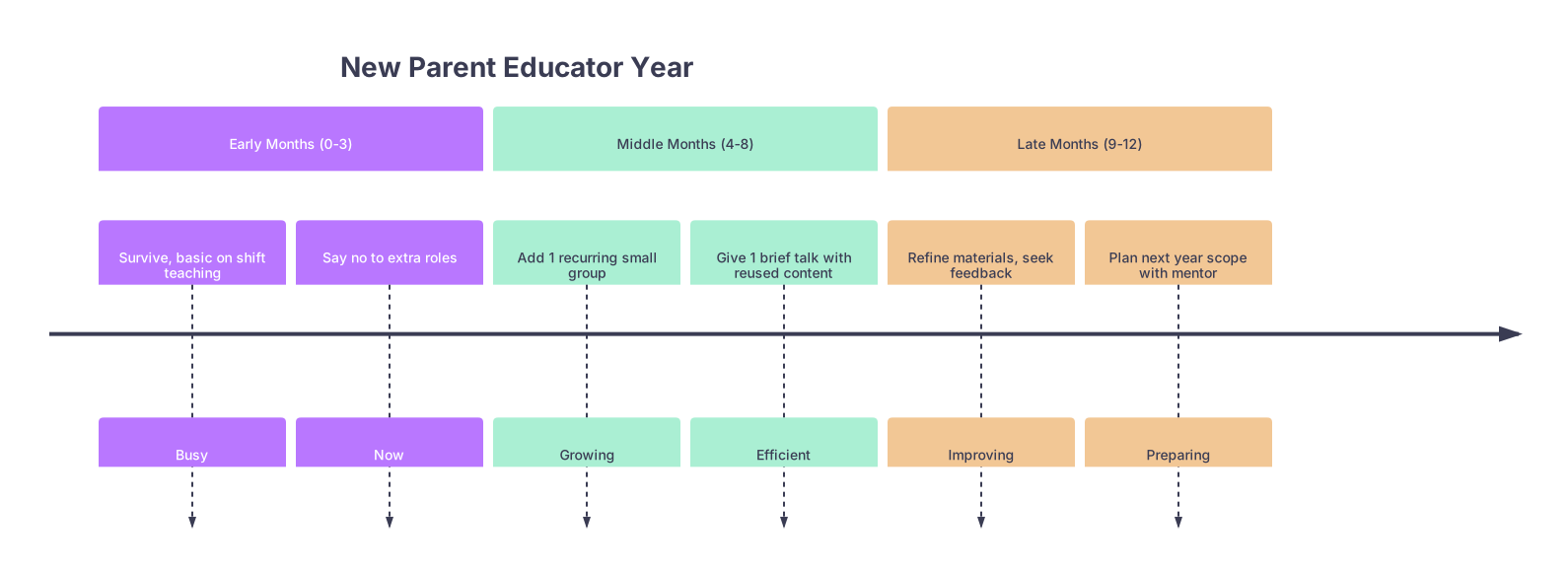
| Period | Event |
|---|---|
| Early Months (0-3) - Survive, basic on shift teaching | Busy |
| Early Months (0-3) - Say no to extra roles | Now |
| Middle Months (4-8) - Add 1 recurring small group | Growing |
| Middle Months (4-8) - Give 1 brief talk with reused content | Efficient |
| Late Months (9-12) - Refine materials, seek feedback | Improving |
| Late Months (9-12) - Plan next year scope with mentor | Preparing |
FAQ (Exactly 5 Questions)
1. Will limiting my teaching this year hurt my chances at an academic/educator career later?
No, not if you’re intentional. What matters long term is a trajectory of involvement and evidence of impact, not that you did maximum teaching in the year you had a newborn. If anything, thoughtful boundaries show better professional judgment. Keep a teaching log, do a few things well, and focus on quality over quantity. You can ramp up in later years and still be a strong education candidate.
2. Should I tell learners I’m a new parent, or keep that private?
You don’t owe them your personal life, but a light, matter-of-fact mention can humanize you and explain small constraints. For example: “I’m juggling a new baby, so our session will be short but focused today.” Don’t turn it into a long story, and don’t apologize constantly. Simple context, then back to business.
3. How do I say no to a teaching opportunity without burning bridges?
Use a formula: appreciation + brief reason + clear boundary + possible future interest.
“Thanks for thinking of me. Teaching is a priority for me, but I’ve committed to just one project this year while I’m in my first year as a parent. I’m at capacity with that now, so I need to decline. I’d be glad to revisit next year if the opportunity is still around.” Then stop talking. No over-explaining.
4. What if my co-residents without kids seem to be doing way more teaching?
They probably are. That doesn’t mean you should. They’re in a different season of life. Your comparison group is: “Me, given my current constraints, last month vs this month.” Your goal is not to be the busiest teacher; it’s to be the most sustainable one. If you try to keep pace with someone who doesn’t have your responsibilities, something will break—and it’ll probably be you or your family.
5. Is now a bad time to start a formal medical education certificate or fellowship track?
Not automatically, but you need to look hard at the structure. If the program has clear protected time, reasonable demands, and leadership that understands your parenting situation, it can be fine. If it adds nights/weekends, frequent meetings, and big projects on top of full clinical duty hours, it’s probably better deferred a year or two. Ask current participants who have kids what the real workload looks like before you sign anything.
Key points to walk away with:
- Redefine “teaching” for this year only, in one clear sentence, and make it small enough to actually do well.
- Force your teaching to double-count with your clinical work and your own studying; anything that doesn’t is a luxury, not a requirement.
- Set explicit boundaries early—with leadership and with yourself—so teaching becomes a sustainable part of your life as a new parent, not the thing that breaks you.