
What do you do when the “natural teacher” on your team gets worse evaluations than the quiet attending who actually studied how to teach?
Let’s kill a very persistent myth: that good medical teachers are “born,” not made.
In medicine, this myth lingers like a hospital-acquired infection.
You hear it in corridors:
“She’s just a natural teacher.”
“He’s not a teacher type.”
“She’ll never be good at teaching; it’s just not her personality.”
The problem is simple: that story feels true, but the data say otherwise.
The Myth vs Reality: Are Great Teachers Born?
The “born teacher” myth rests on three bad assumptions:
- Teaching skill is basically personality.
- If you’re not good early, you’ll never be good.
- Formal training in teaching is optional window dressing.
Reality, from medical education research, looks very different.
Across multiple studies of faculty development in medicine, we see the same pattern: when clinicians receive structured teaching training—even relatively short programs—they improve in:
- Learner ratings
- Feedback quality
- Questioning skills
- Session organization
- Use of evidence-based teaching methods
And the effect is not tiny.
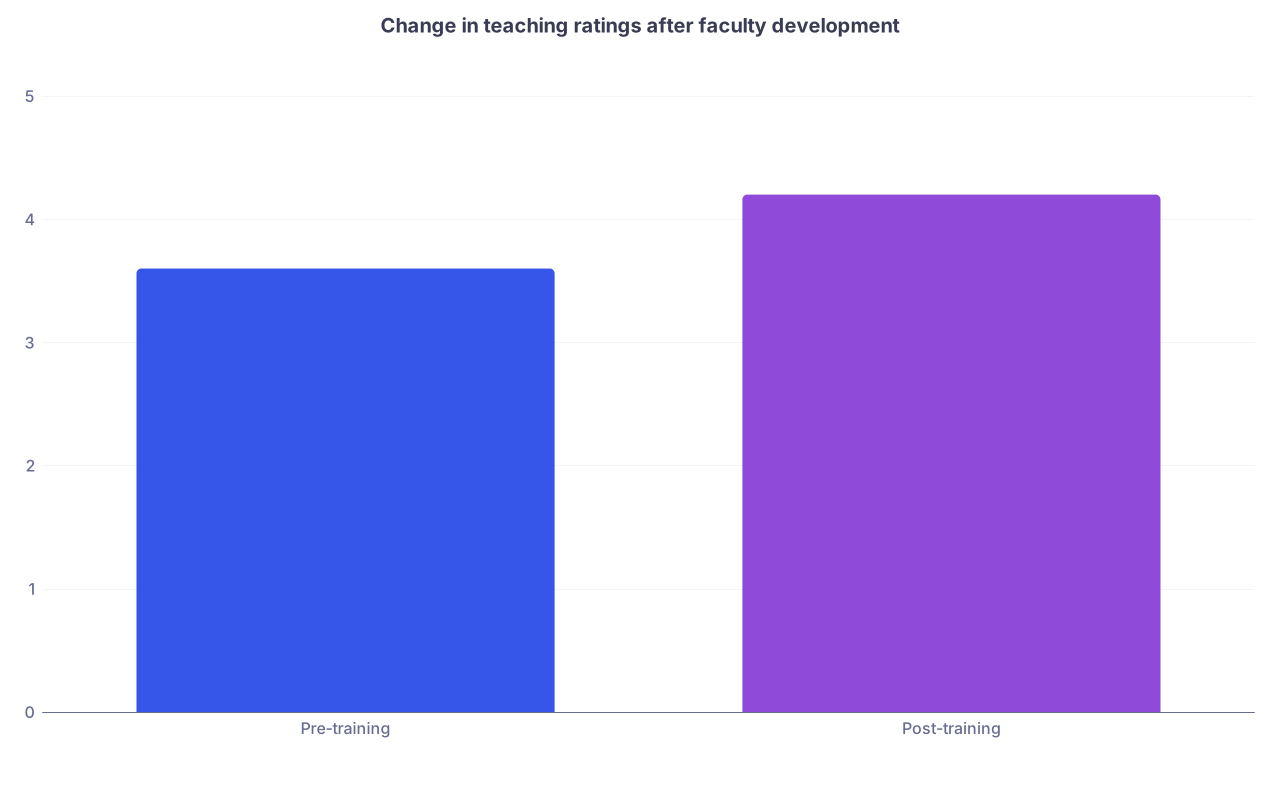
| Category | Value |
|---|---|
| Pre-training | 3.6 |
| Post-training | 4.2 |
Those numbers are typical of multi-program reviews: average teaching evaluations move from the mid-3s to low-4s on a 5-point scale after training. Not perfection. But very real, and very reproducible.
If teaching were purely innate, short faculty development interventions wouldn’t move the needle that much. Yet they do. Consistently.
So yes, people start at different baselines. Just like with procedural dexterity or clinical reasoning. But pretending teaching is fixed at birth is intellectually lazy and demonstrably wrong.
What Predicts a Good Medical Teacher? (Hint: Not Just “Charisma”)
Let’s look at what actually shows up in the data when residents and students rate effective clinical teachers.
Over and over, the same themes:
- Clear expectations and structure
- Targeted feedback
- Role modeling of clinical reasoning
- Psychological safety
- Active engagement (not just lecturing)
- Responsiveness to learner level
Notice what’s missing: “Funniest,” “Most charismatic,” “Biggest personality.”
When researchers actually analyze teaching encounters, they don’t find some magical charisma gene. They find behaviors. Learnable ones.
Here’s how those map out.
| Domain | Example Behaviors |
|---|---|
| Structure | States objectives, outlines plan |
| Diagnosis | Thinks aloud, explains reasoning |
| Feedback | Specific, timely, behavior-focused |
| Engagement | Uses questions, cases, brief tasks |
| Climate | Invites questions, normalizes uncertainty |
Every one of those can be trained. I’ve watched painfully awkward residents turn into solid, even excellent, teachers by systematically practicing these behaviors.
Were they “born” that way? No. They built it.
What the Faculty Development Evidence Actually Shows
Medical education has been obsessively studying this for decades. The data are not perfect, but they’re surprisingly consistent.
Most systematic reviews of faculty development in medical education report:
- Moderate to large improvements in teacher knowledge and skills
- Small to moderate improvements in learner evaluations
- Some improvement in learner outcomes when teaching improves (not always measured, but visible when it is)
Typical successful interventions:
- Longitudinal “Clinician-Educator” programs (6–12 months, part-time)
- Shorter workshops focused on:
- Giving feedback
- Teaching in the OR/ward
- Bedside teaching
- Small-group facilitation
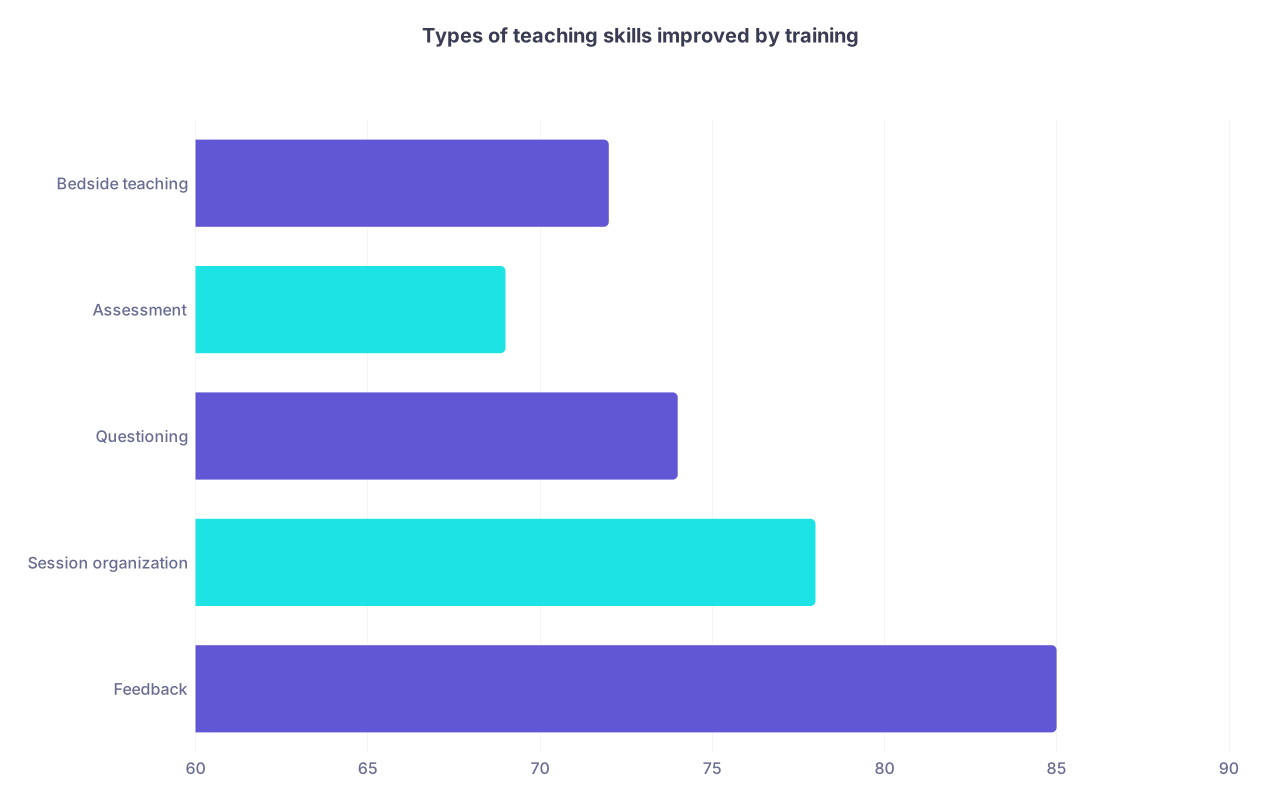
| Category | Value |
|---|---|
| Feedback | 85 |
| Session organization | 78 |
| Questioning | 74 |
| Assessment | 69 |
| Bedside teaching | 72 |
Those percentages reflect programs reporting measurable improvement in those domains.
The pattern is so consistent it’s almost boring: when people are taught evidence-based teaching methods and actually practice them, they get better. A lot better.
What does not show a strong effect?
- Generic “how to be a doctor” professionalism lectures
- Inspirational talks on “the art of teaching” with no skill practice
- One-off online modules with no application or feedback
So the real divider isn’t “born teacher” vs “not a teacher.”
It’s trained vs untrained. Practiced vs unpracticed.
Personality vs Technique: Who Actually Wins?
I’ve seen both types in academic hospitals:
- The “natural”: loud, quick, charismatic, great at telling stories.
- The “built teacher”: deliberate, structured, thoughtful, a bit slower, but methodical about learning needs.
Students love the natural—for about 20 minutes. Then the cracks show:
- No clear expectations
- Stories instead of structured reasoning
- Minimal feedback beyond “good job” or “read more”
- Evaluations that say “great person, not sure what I learned”
The built teachers, especially early in their development, may feel less flashy. But:
- They state exactly what the session will cover.
- They calibrate to the learner’s level.
- They use questions to expose reasoning, not to humiliate.
- They give pointed, actionable feedback.
Who do learners rate higher over time? The second group. It’s not even close.
And again, that second group is not made of “born teachers.” It’s mostly people who decided: if I’m going to spend my life in academic medicine, I should probably actually learn how to teach.
The Biggest Lie Trainees Hear: “You’re Just Not a Teacher”
This one annoys me.
I’ve heard attendings tell residents:
- “Teaching just isn’t your thing.”
- “Some people are teachers, some are doers.”
- “You’re great clinically; just don’t worry about the teaching part.”
That’s like telling an intern, “You’re bad at notes, so just never learn documentation.”
What’s actually going on when someone “isn’t a teacher”?
Three common patterns:
- They’ve only seen bad models: pimping, monologues, humiliation.
- They never learned basic educational techniques.
- They never got specific feedback on teaching behavior—just vague “you’re okay” or “not very engaging.”
When you break it down into concrete, trainable skills, most people can substantially improve:
- How to set a learning agenda in 90 seconds at the start of a shift
- How to do a 3-minute teaching script on a common topic
- How to give one piece of targeted feedback every shift
- How to ask questions that probe thinking without shaming
Not everyone becomes a master teacher. But the floor rises dramatically with even modest training.
Real Barriers (Spoiler: They’re Systemic, Not Genetic)
If “born teacher” is a myth, why do so many clinicians plateau as mediocre educators?
Because the system rewards almost everything except becoming a better teacher.
Look at the promotion criteria at many academic medical centers:
- RVUs? Counted.
- Grants? Counted.
- Publications? Counted.
- Faculty development in education? Maybe a line on your CV.
Now add:
- No protected time for teaching skill development
- Little structured observation of teaching with feedback
- Leadership that talks about “education mission” but pays for clinical FTE
That’s how you get departments full of “accidental teachers” who were never trained, rarely observed, and judged largely on vague learner satisfaction scores.
The issue isn’t that you weren’t born a teacher.
It’s that your institution treats teaching like a hobby.
What Actually Works to Build Teaching Skill (For Real People, With Real Schedules)
Let me be practical. You do not need a PhD in education to be a strong clinical teacher. The research and real-world experience point to a handful of high-yield moves.
If you want to get significantly better in 6–12 months, focus on:
Micro-skills of feedback
- Learn and use one simple model (Ask–Tell–Ask or Pendleton or R2C2).
- Force yourself to give at least one specific behavior-based feedback comment per shift.
- Avoid “good job.” Say what was good and why.
Structured teaching scripts
- Build 5–10 short, rehearsed talks on bread-and-butter topics (chest pain workup, sepsis, COPD, anticoag reversal).
- Each 3–5 minutes. One key algorithm or mental model.
- Re-use and refine them endlessly.
Thinking aloud
- Stop acting like you magically know answers. Verbalize your reasoning.
- “Here’s why I’m not worried about PE in this patient…”
- Learners repeatedly rate clinical reasoning transparency as one of the most valuable teaching behaviors.
Explicit expectations
- First 5 minutes of working with a learner: “Here’s what I expect from you today, and here’s what you can expect from me.”
- That’s it. It’s ridiculously simple and ridiculously underused.
Create psychological safety on purpose
- Say out loud: “I will ask questions to understand how you’re thinking, not to embarrass you.”
- Mean it. And model it by admitting your own uncertainty occasionally.
You do those things, consistently, and your teaching will improve. Even if you’re introverted. Even if you don’t tell jokes. Even if you weren’t the med student everyone adored.
How Programs Should Stop Perpetuating the Myth
If you’re in a position of authority—program director, clerkship director, DIO—you have more influence over this than you think.
Drop the “natural teacher” language from evaluation forms and promotion discussions. Replace it with specific behaviors.
For example:
- Instead of “Is a strong clinical teacher”
Use “Consistently states objectives, gives specific feedback, and explains clinical reasoning to learners.”
Then build a minimal, realistic educational development pathway:
- Required basic teaching workshop for all residents who supervise
- Longitudinal teaching program for interested faculty with:
- Observed teaching sessions
- Feedback from trained observers
- A portfolio of teaching activities and reflections
And crucially: tie some form of recognition (time, titles, promotion) to teaching excellence as defined by behaviors, not vibes.
Because the “born teacher” myth is not just wrong. It’s a convenient excuse for institutions to avoid investing in training and evaluating educators properly.
Quick Reality Check: What the Evidence Really Says
Let me condense this:
- Baseline teaching talent varies. Of course it does.
- But structured training and deliberate practice reliably improve teaching behavior and learner ratings.
- Personality helps with engagement but doesn’t substitute for actual educational technique.
- Most “bad teachers” are simply untrained, unsupported, and unevaluated—not genetically doomed.
Drop the fate narrative. Teaching is a skill set, not a personality type.