The idea that only big-name tertiary centers “produce real educators” is wrong. Not just a little wrong—backwards.
If you actually look at who does most of the teaching, where students and residents spend their time, and who holds many of the key education leadership roles, the data point in the opposite direction: community and regional hospitals are carrying far more educational weight than the prestige myth suggests.
Let me walk through what the evidence actually shows—and what it means for your career if you want to teach.
Myth: “If You Don’t Train at a Major Academic Center, You’re Not an Educator”
You’ve heard some version of this:
- “If you want to be a serious educator, you have to be at a tertiary academic center.”
- “Community hospitals are great for service, not for education careers.”
- “Real clinician-educator jobs only exist at big-name universities.”
This story survives for three reasons, none of them evidence-based:
- Brand worship. People confuse institutional name recognition with educational quality and output.
- CV signaling. Applicants believe they need a tertiary center to “prove” they’re academic material, so they cluster there.
- Survivor bias. The educators you see speaking at national conferences disproportionately come from large centers, so you assume they’re the only ones doing the work.
Now compare that to the structural reality of how medical education is actually delivered.
| Level | Dominant Site Type | Typical Proportion of Time |
|---|---|---|
| Pre-clinical shadowing | Community/outpatient | High |
| Core clinical clerkships | Mix, heavy community use | Moderate–High |
| Sub-internships / acting intern | Tertiary + community | Mixed |
| Residency inpatient rotations | Community + VA + tertiary | High |
| Outpatient continuity clinics | Community-based practices | Very High |
The bulk of patient care—and therefore the bulk of hands-on learning—does not happen inside a gleaming quaternary referral palace. It happens in:
- Community hospitals
- Regional referral centers
- VA hospitals
- Federally Qualified Health Centers
- Large multi-specialty group practices
If “only tertiary centers train educators,” then where are the thousands of educators working at all those other sites coming from? Spoiler: from everywhere, including community programs.
What the Data Actually Show About Educator Training
Let’s disentangle a few things people lazily bundle together:
- Where someone completed training
- Where someone currently works
- What role they play in education
Those are not the same.
1. Where clinician-educators actually work
Look at any large medical school’s clerkships: internal medicine, pediatrics, family medicine, OB/GYN. Then check where students are physically rotating. Many are at “affiliate” or “teaching” hospitals that are not the flagship tertiary center.
Across multiple countries, surveys of medical schools show:
- A substantial portion of core clerkship teaching is done at community or affiliated hospitals, not the main academic center.
- A majority of ambulatory teaching sites are non-tertiary: community clinics, private groups, regional hospitals.
So who’s doing the hands-on teaching? Attending physicians who trained in:
- University-based residencies
- Community-based residencies
- Hybrid programs (university-affiliated but community-located)
No requirement that they all came from giant academic powerhouses.
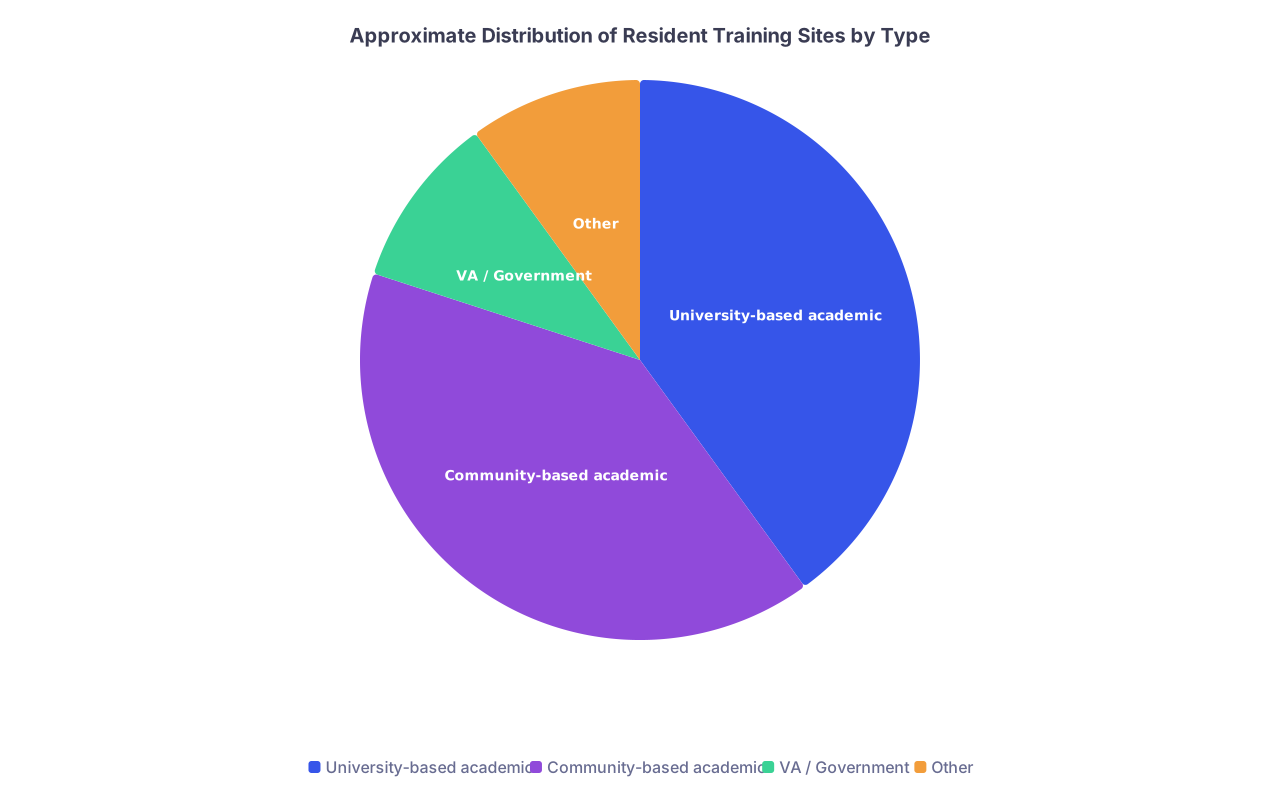
| Category | Value |
|---|---|
| University-based academic | 40 |
| Community-based academic | 40 |
| VA / Government | 10 |
| Other | 10 |
Do exact numbers vary by specialty and country? Of course. But the general pattern is stable: a huge proportion of physicians train in community-based or hybrid programs—and then go on to teach.
2. Who holds education leadership roles?
Look at the structure of graduate medical education (GME):
- Every residency has a program director and associate program directors.
- Every medical school uses dozens (sometimes hundreds) of site directors and clerkship directors for different locations.
- Many community hospitals have Directors of Medical Education or Designated Institutional Officials (DIOs) overseeing all training programs.
Spend ten minutes scrolling through GME leadership rosters and you’ll see a consistent pattern:
- Many PDs and APDs trained at community programs.
- Many people who run core clerkships (especially in family medicine, internal medicine, pediatrics, OB/GYN) work at non-tertiary sites.
- A significant fraction of national education committee members come from regional or community institutions.
Do tertiary centers produce a lot of educators? Yes. Are they the only source? Not even close.
The Four Real Inputs to an Education Career (None Require a Tertiary Center)
What actually creates an educator isn’t the building’s ZIP code. It’s exposure, mentorship, and formal training. Let’s break that down into four pieces.
1. Teaching experience: can you actually teach?
Students don’t care if you trained at “Big Name U” if:
- Your explanations are confusing.
- You’re disorganized.
- You give no feedback.
On the other hand, a community-trained physician who:
- Runs efficient case-based discussions
- Gives specific, actionable feedback
- Knows how to set learning objectives
is a better educator. Full stop.
Where do you get that skill? By:
- Taking on near-peer teaching as a resident (interns teaching students, seniors teaching interns)
- Leading morning reports, journal clubs, simulation sessions
- Getting observed and coached on your teaching
All of those opportunities exist at community programs. In fact, some community residents get more reps as teachers because:
- There are fewer fellows to soak up teaching roles.
- Residents run more of the board sign-outs, case conferences, and bedside teaching.
- Attendings rely heavily on resident-led teaching during busy services.
I’ve watched community residents graduate with a thick stack of teaching evaluations while a big-name academic resident has done relatively little structured teaching outside rounds.
2. Formal educator training: academies, fellowships, certificates
Here’s where the myth really collapses.
Over the past 10–15 years, educator development has exploded outside classic tertiary centers:
- Teaching skills curricula built into community residencies (modules on feedback, bedside teaching, small-group facilitation)
- Medical education tracks or concentrations in many non-tertiary programs
- Online or hybrid medical education certificates that any motivated clinician can complete
- Master’s programs in Health Professions Education that do not require you to work at a mega center
| Pathway Type | Where It’s Available | Typical Participant |
|---|---|---|
| Med ed certificate | Online universities, schools | Clinician-educators |
| MEd/ MHPE degree | Regional/online programs | Faculty from any hospital |
| CME teaching workshops | Specialty societies, boards | Practicing clinicians |
Tertiary centers might have more locally available programs, but access is no longer exclusive. If you want formal training, you can get it—without a 1,200-bed academic fortress on your badge.
3. Mentorship and sponsorship
This is where people get confused: they see strong mentors at major centers and assume the location caused the mentorship.
In reality:
- High-quality educator mentorship exists in lots of places.
- Some tertiary centers have abysmal mentorship cultures.
- Some community programs have tight, supportive educational environments because they’re smaller and less bureaucratic.
What matters to your education career:
- Does someone actually observe your teaching and give feedback?
- Will someone co-author curriculum projects with you?
- Will someone help you present a workshop at a regional or national meeting?
- Does anyone care enough about your trajectory to say your name in rooms you are not in?
I’ve seen that done brilliantly by faculty at 250-bed community hospitals who are quietly running national-level workshops while their institution flies under the radar.
4. Scholarship: the only “academic currency” that somewhat favors tertiary centers
Here’s the only partial concession to the myth.
If your version of “educator” includes:
- Continuous grant-funded education research
- Running multi-site RCTs of educational interventions
- Chasing promotion based on high-volume publications
then yes, a large tertiary center with robust infrastructure makes that easier:
- Biostatistics support
- IRB staff familiar with education projects
- Education research groups and labs
- Ready access to big learner populations
But two key points:
- That’s a subset of educator careers. Many successful clinician-educators focus on curriculum design, assessment, program leadership, and faculty development—not NIH-level education research.
- Multi-site educational work now routinely includes community programs as equal partners and sometimes as the lead sites.
The delta here is about ease and density of research infrastructure, not some magical “we train educators; you don’t” line.
The Hidden Strengths of Non-Tertiary Training for Educators
Here’s where people really misjudge the landscape. Community and regional training environments actually give you some advantages if you want to be an educator.
1. Closer contact with learners
At big tertiary centers, hierarchies are heavy:
- Med students
- Sub-I’s
- Interns
- Juniors
- Seniors
- Fellows (sometimes multiple layers)
- Attending
As a resident, you may be three steps removed from the students. Fellows handle most of the detailed teaching; you’re buried in notes and orders.
At many community sites:
- There are fewer or no fellows.
- Teams are smaller.
- Students interact directly with residents and attendings constantly.
Translation: more chances to practice teaching, feedback, and assessment. And less competition for those roles.
2. Broader scope, less hyper-subspecialization
Tertiary centers are great at zebras and exotic pathology. Wonderful for research. Less representative of where most clinicians—and learners—will actually practice.
Community environments excel at bread-and-butter:
- Common chronic disease management
- Real-world resource limitations
- Multimorbidity in non-ideal patients
- Social determinants of health in their raw form
If you want to be an educator who prepares learners for real practice, depth in these everyday scenarios is not a disadvantage. It’s a core strength.
And no, you don’t need ten ECMO patients a week to teach solid clinical reasoning.
3. More leadership opportunities earlier
Look at how responsibility is distributed:
- In large academic giants, new attendings wait years to chair committees or run major courses.
- In smaller or community-based institutions, a motivated junior faculty member can become:
- Site clerkship director
- Program associate director
- Simulation curriculum lead
- Faculty development workshop organizer
Within a few years of finishing training.
If your goal is to actually do education, not just watch it from the cheap seats, that acceleration matters.
How the “Only Tertiary Centers Count” Myth Hurts Trainees
This myth doesn’t just distort perception; it actively damages smart career decisions.
1. It pushes people to overvalue prestige over fit
I’ve watched students rank big-name programs above lower-profile ones that:
- Actually have a structured medical education track
- Guarantee protected teaching time
- Offer funded attendance at education conferences
- Provide real mentorship in curriculum design
They choose the fancy logo without even asking basic questions like:
- Who runs your resident-as-teacher curriculum?
- How many residents last year presented at national education meetings?
- Do you have a clinician-educator promotion track?
Result: they get the hierarchy and the name, but not the education development they actually wanted.
2. It makes community educators invisible—until you really look
Students internalize the myth, then rotate through community sites where:
- Patient volume is high
- Teaching is practical and intense
- Faculty give genuine feedback
but they file those experiences under “service” instead of “education” because they’re not happening in the marble lobby of a flagship hospital.
Then those same faculty quietly end up:
- Winning institutional teaching awards
- Presenting at regional and national meetings
- Leading clerkships and residencies
The disconnect is perception, not reality.
3. It discourages residents from building educator skills where they are
If you believe “real” education careers start later, at some imagined future tertiary job, you don’t:
- Volunteer to give noon conference
- Ask for feedback on your teaching
- Join a curriculum project
- Submit an education abstract to a conference
You delay the work of becoming an educator. And that delay has nothing to do with where you train—and everything to do with what you think counts.
If You Want an Education Career, Here’s What Actually Matters
Let me strip this down to something actionable.
Where you trained is one line on your CV. The following lines matter more:
- Evidence of effective teaching (evaluations, peer observation, awards)
- Formal training in education (courses, certificates, degrees)
- Education leadership roles (course director, site director, curriculum committee)
- Scholarly work in education (workshops, posters, publications—single-site or multi-site)
You can build all of those from:
- A pure tertiary academic center
- A community-based teaching hospital
- A hybrid or regional program
- A VA or integrated health system
You just have to stop acting like the logo determines your trajectory.
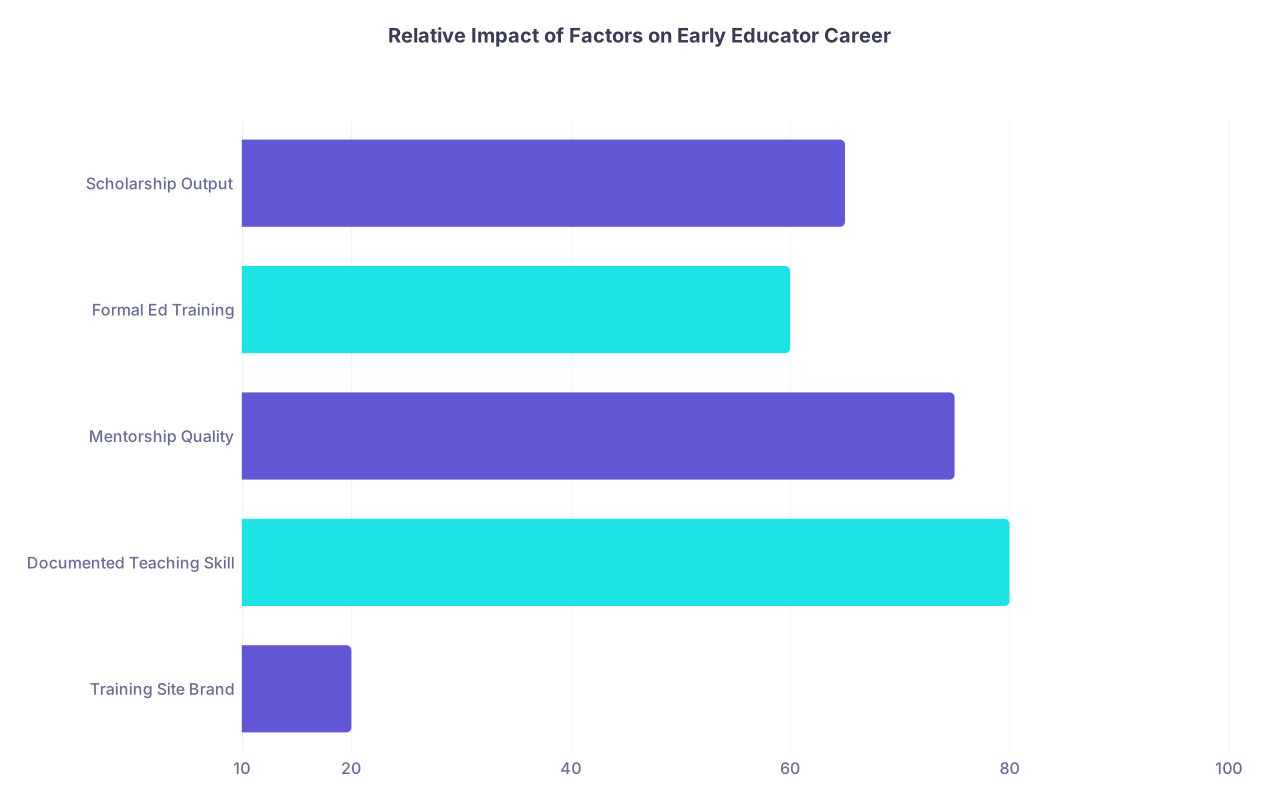
| Category | Value |
|---|---|
| Training Site Brand | 20 |
| Documented Teaching Skill | 80 |
| Mentorship Quality | 75 |
| Formal Ed Training | 60 |
| Scholarship Output | 65 |
Is “training site brand” worthless? No. It can open some doors, especially in hyper-competitive academic environments. But it’s nowhere near as decisive as your actual education portfolio.
The Bottom Line
I’ll end bluntly.
- Most real-world teaching does not happen in tertiary centers. Community and regional hospitals are responsible for massive portions of medical education—undergraduate and graduate.
- Educators are trained by experiences, mentors, and deliberate development, not building size or brand. Teaching reps, feedback, education training, and scholarship can be built almost anywhere.
- If you want an education career, stop worshipping logos and start optimizing for environments that will actually let you teach, learn how to teach, and lead. That might be a tertiary center. It might just as easily be a community program that takes education seriously.
The myth says: “Only tertiary centers train educators.”
The data say: educators are made every day in places you’re irrationally overlooking.