
You’re PGY-2. When you matched, your residency had 6 categorical spots per year. Solid mid-sized program, decent autonomy, enough volume to learn, not so much that you’d drown.
Now the rumor mill’s confirmed: next year they’re jumping to 10 residents per class. Or 12. Maybe they’re adding a whole new track. The email said something hand-wavy about “meeting institutional needs” and “exciting growth.” You’re not excited. You’re wondering:
- Is my training about to get diluted?
- Are my cases and procedures going to evaporate?
- Who is going to teach all these people?
- And does this screw up my fellowship chances?
This is exactly the kind of thing no one explained to you on interview day. So here’s how to handle it.
1. First: Figure Out What Kind of Expansion You’re Dealing With
Not all expansion is bad. Some is just chaos disguised as opportunity. You need to know which one you’ve got.
There are a few main patterns I’ve seen:
- “Cheap labor” expansion: hospital wants more bodies on the wards, no parallel increase in faculty or ancillary support.
- “True growth” expansion: new services, new ICUs, new clinics, more faculty, maybe a new hospital in the system.
- “Paper shuffle” expansion: same number of residents, but they relabeled prelims, added a rural track, converted fellows, or rearranged funding.
Your first job is to classify the situation as honestly as you can.
| Aspect | Red Flags | Green Flags |
|---|---|---|
| Faculty hiring | No new faculty | Explicit multiple new hires |
| Clinical sites | Same sites, more residents | New units/hospitals/clinics added |
| Call schedule | Same or worse for you | Call redistributed or reduced |
| Education time | Conferences unchanged or cut | Protected time emphasized/expanded |
| Communication | Vague email, no Q&A | Town hall, clear rationale and numbers |
You are looking for two things:
- Will there be more work total?
- Will you have to share your existing work more?
If the hospital just opened a new tower with 40 extra beds and an additional ICU, and they’re hiring 5 new hospitalists and 2 intensivists, more residents may actually protect you from brutal hours while still preserving volume.
But if they’re tacking on 4 more residents per year “to improve coverage” on the same three wards, that’s dilution plus creep. Bad combination.
2. Protect Your Training: Procedural and Clinical Volume
The main threat when your program expands fast during your years: you quietly get less hands-on experience.
Nobody will email you “congrats, you will now do 30% fewer procedures.” It’ll just happen unless you’re deliberate.
Do a quick volume audit
Sit down and write out, honestly:
- How many of each key procedure you’ve done so far (or key types of cases in non-procedural specialties).
- What your program’s “expected” numbers are by graduation (if they exist).
- Where your procedures/cases usually come from (exact rotations, services, sites).
This doesn’t need to be pretty. Just an honest baseline.
If you’re in IM, list: central lines, paracenteses, thoracenteses, LPs, intubations (if you do them), codes run, etc.
If you’re in a surgical field: appendectomies, cholecystectomies, hernias, scopes, whatever is core in your case log.
Once you’ve got the baseline, overlay the expansion.
Ask yourself:
- With X more residents per year, who’s now in the room when that procedure happens?
- Will there be more total procedures, or just more bodies?
- On which rotations does dilution hurt the most? (Often ICU, ED, consult-heavy services, and procedural rotations.)
Bring this to leadership with numbers, not vibes
Go to your PD or APD and say something like:
“I’m excited about more residents, but I want to make sure our graduating class still hits strong procedural numbers. Right now I’m at about 18 central lines and 20 paracenteses as a PGY-2 midway. Historically, seniors have been around 40–50 of each by graduation. With 4 extra residents per year, have we modeled what that looks like for procedure exposure, especially in the ICU and night float?”
This does a few things:
- Signals you’re focused on training quality, not just complaining.
- Forces them to articulate whether they’ve considered this at all.
- Opens the door to concrete solutions.
Sometimes the fix is simple:
- Reworking the procedure service or ICU staffing to prioritize seniors.
- Creating a dedicated “procedure resident” on certain rotations.
- Formalizing that lines/paras/etc. go to residents before APPs when safe and reasonable.
Push for structured solutions, not hand-wavy “oh, there’ll be plenty of procedures.”
3. Guard Your Autonomy and Senior Role
Another quiet casualty of program expansion: senior autonomy.
You finally reach PGY-3 and picture yourself running the team. Interns call you first, you run codes, you’re the one staffing tricky cases before the attending.
Then they drop in more residents. Maybe they add a “junior senior” level (PGY-2s paired with PGY-3s), or they fill services with extra upper levels so “nobody is overwhelmed.”
What actually happens? You go from being the primary decision-maker to one of several people hovering around the same patients, tripping over each other.
Here’s how to keep your senior year from getting hollowed out.
Get clarity on roles. In writing.
Ask your chief or PD, very directly:
- “Next year, how many seniors will be on each ward team/ICU?”
- “Who is responsible for admitting decisions? For sign-out? For running the list?”
- “On codes and rapid responses, which level is expected to lead?”
Then push for this to be written into the rotation descriptions. Vague talk like “you’ll all share leadership” is code for “we have not figured this out, and you’ll compete for experience.”
You want:
- Clear primary senior per team.
- Clear hierarchy at codes (PGY-3 then PGY-2 then intern, or equivalent ranks in your specialty).
- Specific “ownership” responsibilities that can go in your letters: e.g., “ran a 20-patient ICU with night admissions,” “led cross-cover on X beds,” etc.
Watch for “extra resident = less responsibility”
I’ve seen this play out multiple times: program adds residents → suddenly:
- Night float has two upper levels instead of one.
- ICU has three seniors where there used to be one senior + intern.
- Ward teams get bloated: attending + fellow + two seniors + two interns.
On paper, this looks “supportive.” In reality, you stop making independent decisions.
If you see this coming, propose a better structure:
Instead of 1 team with 3 seniors standing around:
- 2 teams with 1 clearly defined senior each.
- Or a “triage senior” and a “team senior” with separate scopes.
Goal: every senior should be able to say, specifically, “this part of the service is mine.”
4. Workload and Burnout: When “More Residents” Doesn’t Help You
You’d think: more residents = less work. Often, it’s the opposite. Workload expands to fill the available bodies.
Nurses and consultants page more because “there are tons of residents now.” Admin decides, “Great, let’s open that extra wing” or “we can stop using locums.”
Meanwhile:
- Notes increase because more people are involved.
- Handoffs multiply.
- Teaching expectations rise because “there are more learners.”
You have to monitor whether the expansion is making your life better or worse in actual hours and intensity.
Track a couple of signals over 2–3 months
Very rough is fine:
- Average time you leave the hospital on a standard ward day.
- Average number of patients per resident.
- Number of days off that get encroached upon with “just a few messages/notes.”
If you notice a clear slide in the wrong direction after expansion, bring that data to your chiefs/PD.
Language to use:
“Before the expansion, most of us were out by 6:30 p.m. on wards. Since adding extra residents, we’re now regularly leaving at 7:30–8:00 p.m., even though caps haven’t changed. I’m worried the system is just filling extra tasks into the same day. Can we review what’s actually being put on residents’ plates?”
You’re not whining about hours. You’re pointing out mission creep.
5. Education vs. Service: Make Them Show You the Plan
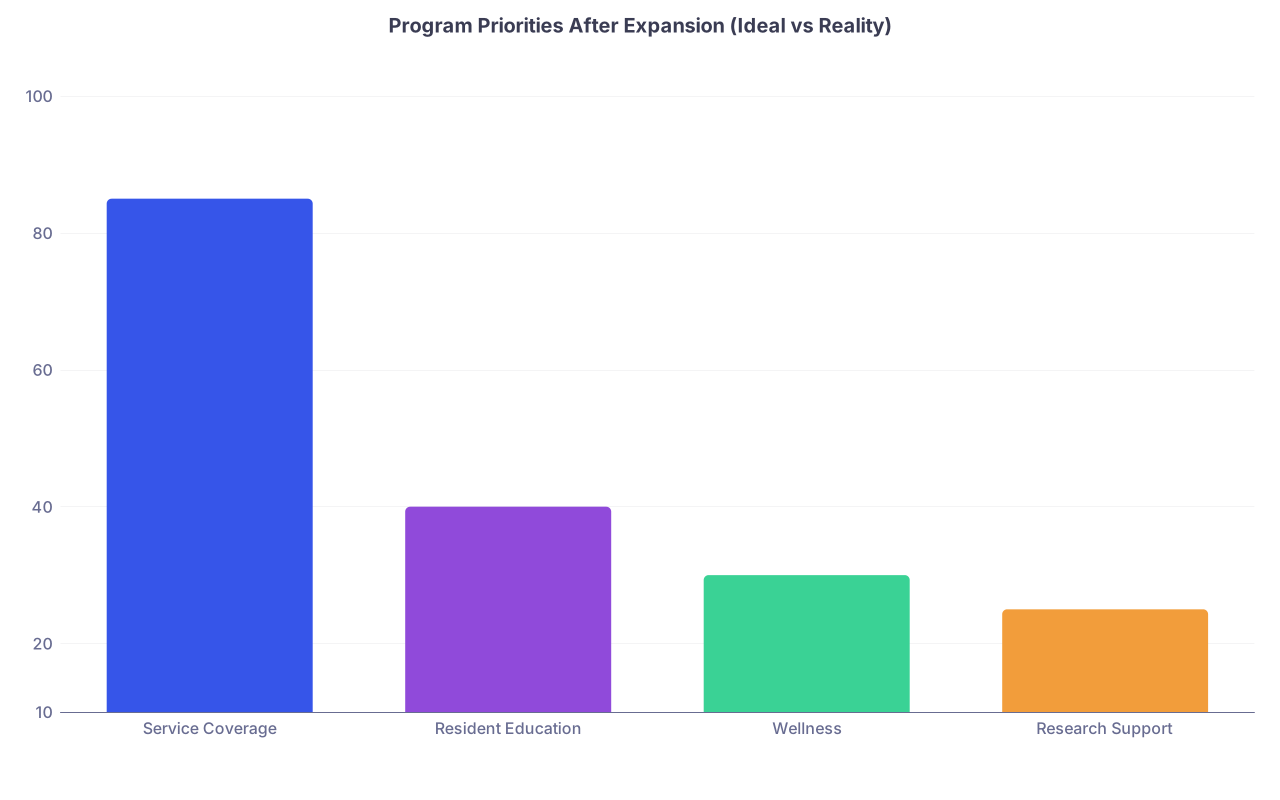
Rapid growth often exposes a program’s real priorities: training vs. coverage.
If they’re serious about education, they’ll have:
- A clear plan for didactics with larger groups.
- Thought through simulation, small group teaching, skills labs.
- Adjusted clinic templates so residents still see meaningful volumes, not 5-minute fly-bys.
| Category | Value |
|---|---|
| Service Coverage | 85 |
| Resident Education | 40 |
| Wellness | 30 |
| Research Support | 25 |
Ask explicitly in a meeting or town hall:
- “How will resident education be protected with the larger class sizes?”
- “Are there changes to conference structure, simulation, or small group teaching?”
- “How are you ensuring everyone still gets meaningful feedback and mentorship, not just check-box evaluations?”
Then watch what they actually do over 6–12 months.
If conferences get more crowded, more chaotic, and less interactive, you need to push back:
- Suggest splitting conferences by PGY level.
- Advocate for hands-on workshops instead of endless lectures.
- Ask for designated faculty mentors with protected time, not just “open-door policies.”
If they say yes but nothing changes, that tells you where you stand.
6. Your Fellowship and Job Prospects: Will This Hurt You?
Here’s the fear: “My program is ballooning while I’m here. Are fellowship directors going to think less of it? Am I now from ‘that factory program’?”
Reality:
Fellowship directors care about:
- Your letters (detail, strength, and who wrote them).
- Your performance relative to peers.
- Your case volume / log if procedural field.
- Your research or scholarly work.
- How your program’s grads have done historically.
They don’t sit there tracking your PGY-2 class size.
Where this can affect you is indirect:
- If competition for marquee cases goes up and your logs look weaker.
- If faculty are stretched thinner and your letters end up generic.
- If you get fewer leadership roles because everything’s split among more residents.
So, counter that—intentionally.
Turn expansion into leverage, not a liability
- Grab leadership roles early.
More residents means more chiefs, more committees, more QI projects. Volunteer smart:
- Morbidity and mortality committee.
- EHR optimization/QI.
- Education chief for interns or med students.
You want to be the person who stepped up when the program changed, not the one who sulked on the sidelines.
- Lock in strong letter writers now.
Do not wait until PGY-3 to “see who knows you.” Pick 2–3 faculty:
- Work with them on service and ideally on a project.
- Ask for feedback early (“What could I do this year to be someone you’d feel great writing for?”).
- Make sure they see you in high-responsibility situations (running a list, ICU nights, big cases).
- Document your experience aggressively.
Keep your logs up to date. Screenshot them occasionally. If your program uses an inadequate system, make your own spreadsheet.
On your CV and in interviews, you can say:
“Our program expanded rapidly while I was there. Despite that, I maintained strong procedural volume and progressive autonomy—over 60 central lines, 45 paras, and senior responsibility on a 20-bed ICU.”
That’s not a weakness. That’s a story of adaptation.
7. How to Actually Talk to Your PD and Chiefs About This
Most people handle this badly. They mumble about being “nervous about expansion” without any specific ask. That goes nowhere.
Here’s how to approach it like an adult:
Step 1: Go as a small, aligned group
Not a mob. Two to four residents who represent different classes or perspectives.
Show up united on 2–3 concrete concerns:
- Procedural volume.
- Senior autonomy and roles.
- Workload creep vs. educational time.
Step 2: Use specific examples, not vague anxiety
Instead of:
“We’re worried the program’s getting too big.”
Say:
“Historically, seniors have done about 40–50 bronchoscopies by graduation. With the current expansion and no added bronch attendings or OR time, case opportunities will likely be split among 30–40% more residents. What is the plan to preserve that experience—more bronch blocks, dedicated bronch rotations, or restricting which levels do them?”
That forces an answer you can evaluate.
Step 3: Ask for concrete, trackable adjustments
Examples:
- A written procedure allocation policy.
- Adjusted team structures (clear single senior, defined responsibilities).
- Additional elective or away-rotation slots in high-volume centers.
- Regular review of ACGME case logs at CCC meetings with resident input.
Then, get agreement on a follow-up time frame:
“Can we revisit this at the end of next block after we’ve seen how the new structure actually runs?”
Now you’ve turned a one-off complaint into an ongoing negotiation.
8. What To Do If the Program Clearly Expanded Wrong
Sometimes, you do all of the above and it’s obvious: this expansion is a mess, and leadership doesn’t care.
Signs:
- Repeated dismissals of specific concerns.
- No real increase in faculty or sites, just more residents.
- Rising duty hour “self-reporting pressure” to under-document.
- Sharp decline in morale and off-service rotation quality.
Then you have to think about self-preservation.
Option 1: Tactical survival
If you’re too far in to leave (PGY-3+ most places, or you just don’t want to transfer):
- Maximize every high-yield rotation. Be aggressive (professionally) in getting into cases and procedures.
- Build your letter portfolio outside your program if needed—away rotations, research mentors at another institution, etc.
- Offload low-yield nonsense. Protect your study time and your sanity.
Option 2: Explore transfer, early
If you’re early enough (PGY-1 or early PGY-2) and things are clearly going south, you can quietly explore transfer options.
You’re not going to blast this on group chat. You:
- Talk to one trusted mentor (inside or outside program).
- Quietly email a few PDs at programs you have some connection with.
- Frame it around training quality, not drama.
“Our program has undergone rapid expansion without parallel faculty or site growth. I’m concerned about meeting case volume and autonomy requirements. I’m looking for a setting with stable training where I can be a high-contributing resident.”
Transferring is messy and not guaranteed. But pretending a clearly failing expansion will magically get better is worse.
9. Mental Framing: How To Not Be Furious All the Time
Yes, some of this is infuriating. You signed up for one program; now you’re in another.
But there’s a difference between righteous concern and simmering bitterness that poisons your whole training.
A few framing tricks that help:
- Treat it like a moving target problem. Your job is not to insist the target stop moving. It’s to hit it anyway.
- Focus on levers you actually control: which rotations you rank high, how visible you are to faculty, what projects you pick up, which piles of scut you quietly refuse to normalize.
- Remember: future employers and fellowship directors mostly judge you, not the administrative decisions of your hospital C-suite.
I’ve seen residents in badly expanded programs still match excellent fellowships and get strong jobs because they adapted intelligently and didn’t waste all their energy on resentment.
10. If You’re Early in Training and Expansion Has Just Been Announced
You’re a new intern, and the email just dropped about next year’s big class increase. You’ve got the most time to adjust, so use it.
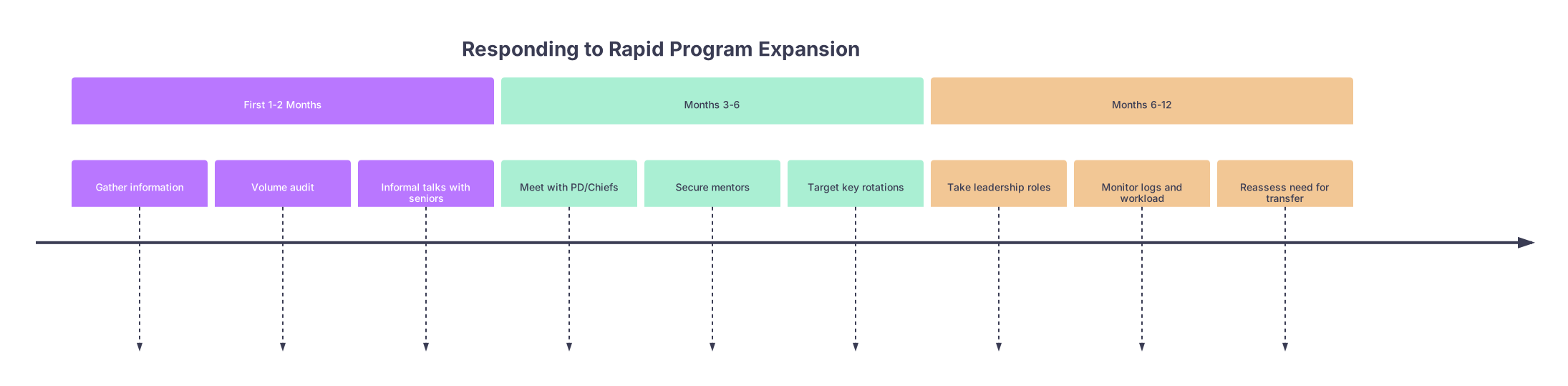
Early concrete moves:
- Pick rotations strategically. Grab ICU, ED, high-volume services early and often. Don’t hide in cushy electives your first year.
- Get on the chiefs’ radar as someone who can help fix things, not just complain. Volunteer to help pilot new schedules or workflows. You’ll then have influence.
- Start your logs from day one. Watch them like a hawk when more bodies show up.
11. Quick Reality Check: What’s Actually Normal?
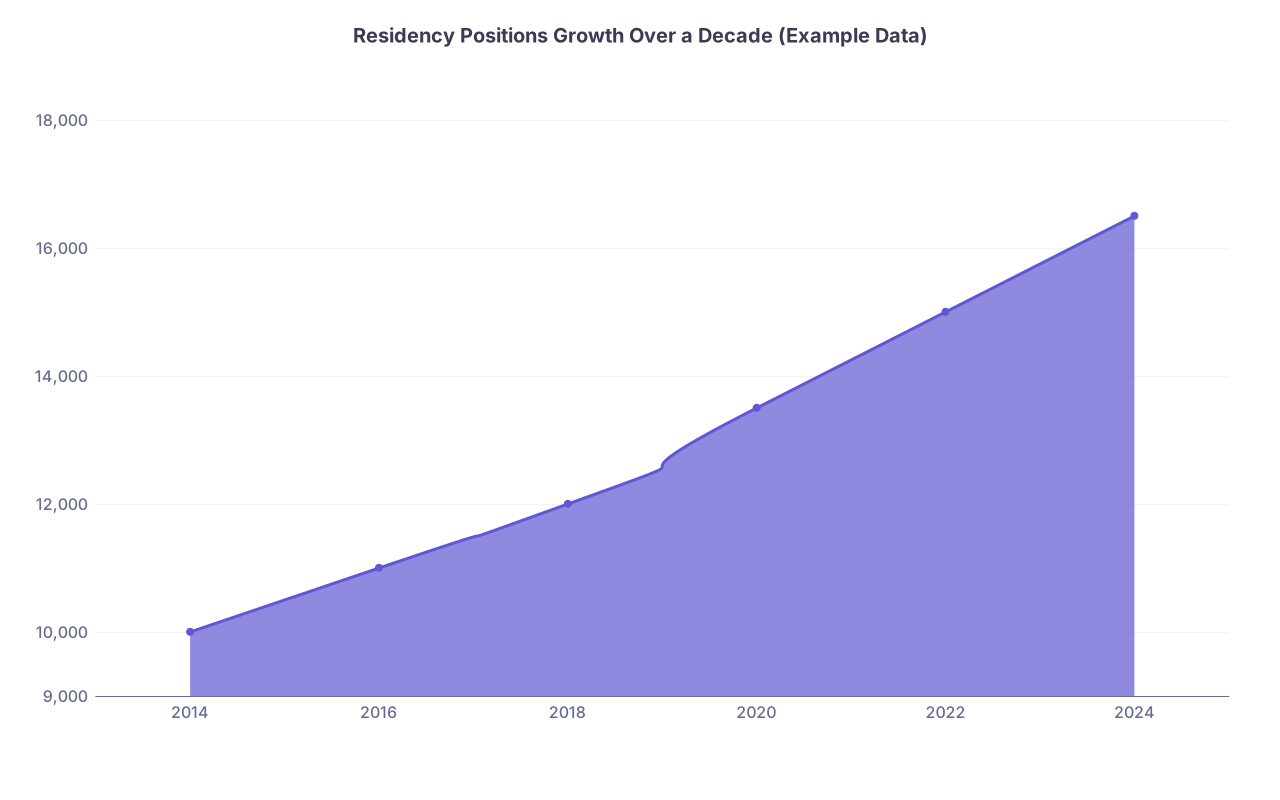
Some context. Across many specialties, expansion is happening everywhere:
| Category | Value |
|---|---|
| 2014 | 10000 |
| 2016 | 11000 |
| 2018 | 12000 |
| 2020 | 13500 |
| 2022 | 15000 |
| 2024 | 16500 |
A moderate, planned increase with proper resources can be fine. Even good. You get:
- More friends/colleagues.
- Better call distribution.
- Larger alumni network.
The problem is rapid, poorly planned expansion in the 2–3 years you’re there, without faculty, sites, or thought behind it. That’s what you’re reading this for.
Your goal is not to stop growth. You can’t. Your goal is to make sure your individual training doesn’t get quietly watered down in the process.

12. Bottom Line: What To Actually Do This Month
If your program is rapidly expanding during your training years, your immediate move list looks like this:
- Get clarity. What’s changing, exactly—numbers, sites, faculty, call, rotations. Not rumors. Facts.
- Audit your training. Where do your procedures, autonomy, and key experiences come from now—and how will extra residents affect those?
- Engage leadership with specifics. Bring data and concrete suggestions about autonomy, volume, and workload. Push for written roles and structures.
- Protect your trajectory. Secure strong mentors and letters, hoard high-yield experiences, and step into leadership instead of shrinking back.
- Watch for real harm. If the expansion is clearly undermining training and leadership doesn’t care, consider more drastic steps early—externally built mentorship, away rotations, or even a transfer.
You cannot control hospital expansion. You can absolutely control whether you graduate as the resident who quietly watched their training get diluted, or the one who adapted, pushed back where it mattered, and still came out sharp and competitive.