

Withdrawals from the Match are not always a violation. But people behave as if they are, and that confusion gets applicants and programs in real trouble.
Ask around and you’ll hear the same myths repeated in resident lounges and on Reddit:
“If you withdraw after ranking, you’ll get banned.”
“If a program pulls out late, they must be cheating the system.”
“If something changes in your life, you’re stuck – too bad.”
Wrong. All of that is too simplistic, and sometimes flat-out false.
The NRMP (National Resident Matching Program) actually gives both applicants and programs several legal off-ramps. There are ways to withdraw without violating the Match Participation Agreement. There are also ways to get yourself labeled as a violator even if you think you’ve “just” backed out quietly or “never actually signed a contract.”
The problem is not that the rules are unclear. It’s that most people never actually read them.
Let’s fix that.
The Core Myth: “Any Withdrawal = NRMP Violation”
The big myth is binary thinking: either you stay in all the way, or any form of quitting equals a violation. That’s not how the NRMP is structured.
The NRMP has three very different things that people blur together:
- Withdrawing from the Match process
- Breaking a Match commitment (after you’ve matched)
- Program or applicant being “released” from the Match by official NRMP action
Those are not the same thing.
You can withdraw from the Match before certain deadlines, for certain reasons, and be completely within the rules. You can be released from a Match commitment under specific circumstances — still within the rules.
You commit a violation when you blow past those rules and try to do an end-run around the binding nature of the Match or the participation agreement.
Let me lay out the actual structure NRMP uses, then we’ll tackle specific scenarios everyone loves to argue about.
When Withdrawal is Completely Allowed
There are several situations where withdrawing is not only allowed — it’s expected. The NRMP even has official mechanisms and deadlines for this.
1. Withdrawing before the rank order list deadline
If you decide you’re not going to participate in the Match cycle at all — maybe you are reapplying next year, maybe you got a guaranteed position outside the Match that is legitimately exempt — you can withdraw your application or your NRMP registration before the rank list certification deadline.
That is 100% allowed. No violation. No ethics hearing. No scarlet letter.
For applicants, this usually looks like:
- Logging into NRMP and withdrawing from the Match before the ROL certification deadline.
- Informing programs as a courtesy (not a rule, but it avoids drama).
For programs, this means:
- Officially withdrawing the program from the Match via NRMP before the rank list deadline if they no longer have positions or can’t participate.
Again: before that deadline, the Match is still optional. After that deadline, the game changes.
2. Sponsored withdrawals (ex: SOAP-eligible status issues, visa problems)
Sometimes a school or NRMP itself will sponsor a withdrawal. That’s also not a violation. Common examples:
- You fail Step 2 CK just before rank list certification and your school or NRMP determines you’re no longer eligible.
- Your visa falls through and you cannot legally start residency on July 1.
- There is a serious, documented health crisis that makes participation unrealistic.
In these cases, the withdrawal is processed through official channels. Nobody is pretending. Nobody is hiding. And NRMP is explicitly okay with it.
Where Withdrawals Become Violations: The Line You Cannot Cross
Violations typically happen in one of three places:
- After the rank list deadline but before Match Day
- After the Match, refusing to honor a binding commitment
- Trying to secure or accept positions outside the Match when you’re bound by NRMP rules
The NRMP’s basic stance is simple:
- Before the ROL deadline, you can back out (properly).
- After the ROL deadline, your submission is binding.
- After you Match, it’s a contract — not a suggestion.
| Scenario | Usually a Violation? |
|---|---|
| Withdraw before ROL deadline (properly) | No |
| School/NRMP-sponsored withdrawal | No |
| Ghosting programs after interviews | No (rude, but legal) |
| Unilateral withdrawal after matching | Yes |
| Accepting another NRMP position simultaneously | Yes |
| Leaving after Match with NRMP release | No |
Now let’s look at what actually triggers the NRMP’s disciplinary side.
Applicants: When Withdrawing Is a Violation
Here’s where most of the online horror stories come from: people misunderstanding what “binding” really means.
1. Backing out after you Match
Once you’re matched to a program, you have entered into a binding commitment under NRMP rules. You cannot simply say, “I changed my mind, I’m not coming” and think that because you didn’t sign an employment contract yet, you’re safe.
You are not.
The NRMP explicitly states that the Match result is binding. Walking away without being formally released is a Match violation. The consequences can include:
- Being barred from future Matches for a period (commonly 1–3 years)
- Being tagged as a Match violator in the IRIS system (programs see this)
- Your medical school being notified
- Public posting of your violation summary in NRMP’s violation reports
The key point: the lack of a signed hospital employment contract does not save you. The Match agreement is its own contract.
2. Accepting another residency or fellowship while bound
If you’ve matched to Program A in Internal Medicine and then secretly accept a PGY-1 prelim spot at Program B outside the Match, you’re violating the rules unless one of two things happens:
- NRMP officially releases you from your original Match commitment
- You were never actually under the NRMP agreement for that role (very rare in residency-level positions in the U.S.)
This goes for fellowships too. The NRMP has separate fellowship matches with similar rules. You cannot be bound to two concurrent NRMP commitments. You also can’t break one silently so you can start another.
Programs do report this. And NRMP investigates.
Programs: When Withdrawal or “Rescinding” Becomes a Violation
Programs are not innocent bystanders in all this. They violate just as often, sometimes more brazenly, and often assume the applicant is powerless.
They’re wrong.
1. Withdrawing positions after the rank list deadline
If a program submits a rank list saying they have, say, 8 categorical positions, they’re promising those positions exist and will be filled through the Match. If they then try to pull positions after the ROL deadline because of budget shifts, new leadership, or a “better candidate” outside the Match, they’re skating on thin ice.
NRMP has disciplined programs for:
- Withdrawing positions late without valid cause
- Failing to start matched residents they had committed to
- Secretly promising out-of-Match positions while still participating in the Match
This can lead to:
- Program citations and being labeled as an NRMP violator
- Loss of ability to participate in the Match for one or more cycles
- Their sponsoring institution being placed on “probation” or facing additional scrutiny
Yes, this does happen to “big-name” places too. They’re not immune.
2. Pressuring applicants to back out informally
Another game I’ve seen: a program doesn’t want to go through the official release process, so they “encourage” the applicant to resign or withdraw quietly — often with vague threats about references, visas, or “how small this specialty is.”
If the program has no legitimate, NRMP-approved reason not to honor the Match, and they’re essentially coercing the applicant to walk away from a binding spot, that can also be a violation.
The NRMP’s Standardized Violation Report is full of programs that thought intimidation would keep this stuff off the radar. It didn’t.
The Official Escape Hatch: NRMP “Releases”
This is the part that almost no one bothers to understand, and it is exactly where the myth “all withdrawals are violations” collapses.
There is a legal way out of a Match commitment: it’s called being released by the NRMP (often after the other party agrees or after a formal review).
How a release works in practice
At a high level:
- You submit a request to NRMP explaining why you can’t or shouldn’t continue with the commitment (health crisis, spouse placement, serious unresolvable issue, etc.).
- NRMP contacts the other party (program or applicant) and asks if they agree to the release.
- If both sides agree, NRMP can issue a mutual release with no violation recorded.
- If one side objects, NRMP may investigate and decide whether a unilateral release is appropriate — but that’s rarer and more complex.
Now compare that with what people actually do: send a vague email, delay replying, simply vanish, or sign something elsewhere and hope no one notices. That’s what turns a possibly manageable situation into a documented violation.
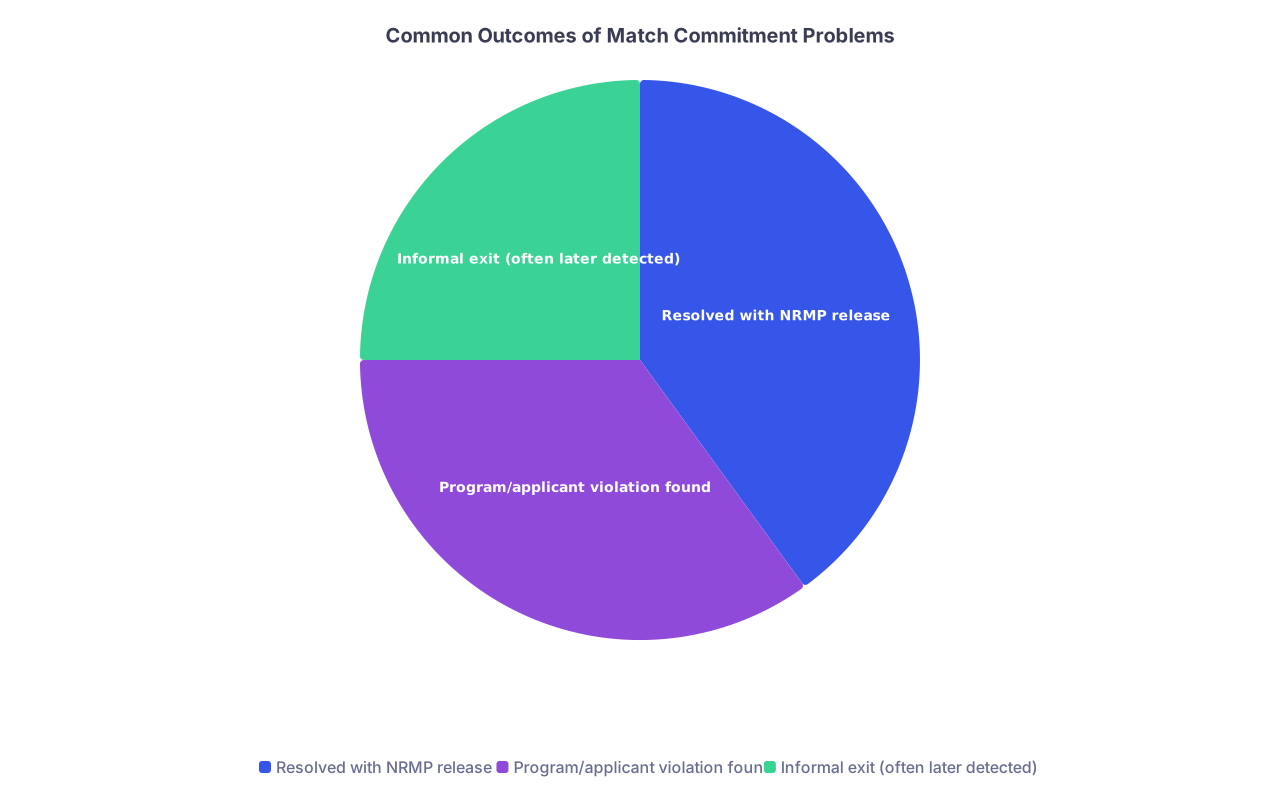
| Category | Value |
|---|---|
| Resolved with NRMP release | 40 |
| Program/applicant violation found | 35 |
| Informal exit (often later detected) | 25 |
The data NRMP publishes in its violation reports suggests exactly this pattern: a sizable chunk get handled via formal mechanisms without a violation. The rest? People trying to be clever.
Edge Cases People Constantly Misunderstand
Let’s tackle a few scenarios that generate the most misinformation.
Scenario 1: “I want to withdraw after ranking but before Match Day”
If the ROL deadline has passed, your participation is locked. You cannot simply withdraw at this point to chase another opportunity. Trying to “cancel” or telling programs you’re out now doesn’t undo your legal status under NRMP.
If you end up matched, that result is binding. If you don’t want to honor it, you need a formal release from NRMP. Doing it informally is what turns this into a violation.
Scenario 2: “I matched but got an incredible research fellowship abroad”
Cool opportunity. But the NRMP doesn’t care how prestigious it is.
You still have a binding obligation to your residency program. If the program is excited for you and willing to let you go do research and maybe return later, you can both approach NRMP for a mutual release or variance. If the program says no and expects you to start as matched, and you bail anyway, that’s a violation.
This is where people’s entitlement collides with regulations.
Scenario 3: “The program became toxic before I even started – can I withdraw?”
If new, credible information comes to light — say, the program is under sudden probation, major leadership collapse, unsafe patient care — you can request a review or release from NRMP. It’s not automatic, and you’ll have to document the situation.
But again, doing it through NRMP is the difference between a lawful exit and a violation. Quietly backing out because things “seem bad” with no formal process is what gets you labeled.

| Step | Description |
|---|---|
| Step 1 | Unexpected change after Match |
| Step 2 | Proceed as matched |
| Step 3 | Contact NRMP for guidance |
| Step 4 | Mutual NRMP release - no violation |
| Step 5 | NRMP reviews and decides |
| Step 6 | Release or violation determined |
| Step 7 | Can you still start? |
| Step 8 | Program willing to release? |
What the Data Actually Shows: Violations Are About Process, Not Preference
If you read NRMP’s annual violation reports instead of forum gossip, a pattern jumps out:
Most violations are not about someone wanting to leave. They’re about how they leave.
Common applicant violations:
- Failing to honor a Match commitment and starting elsewhere
- Entering a new NRMP agreement while still bound by the previous one
- Attempting to back out late without any formal NRMP process
Common program violations:
- Not honoring the Match results (refusing to start someone they matched)
- Adding or promising out-of-Match spots while participating in the Match
- Coercing or misrepresenting conditions to push applicants to walk away
The NRMP is not in the business of forcing miserable marriages at all costs. They are, however, in the business of protecting the integrity of the process. That means:
- You cannot pretend you’re not bound when you are.
- You cannot make side deals that undercut the Match.
- You cannot handle your “withdrawal” via ghosting or back-room agreements and expect no consequences.
If you handle your withdrawal through the channels the NRMP actually provides, you’re usually fine.
How to Avoid Becoming a “Withdrawal Violator”
You do not need to live in fear of the system. You do need to stop treating rumors as policy.
Three practical rules:
Know your deadlines.
Before rank list certification = lots of flexibility.
After certification = treat everything as binding unless NRMP says otherwise.If circumstances change, talk to NRMP early.
Not your friend, not Reddit, not “that intern who said it’s fine.” The NRMP has staff whose whole job is to handle this.Never rely on informal assurances.
“Our PD said it’s okay if I just don’t show up.”
Unless that ends in an official NRMP release, you’re exposed. Same for programs: “The applicant said they’re fine declining.” Great, get that processed officially.
You don’t get in trouble for asking NRMP what the options are. You get in trouble for quietly doing what you wish the rules were.
Years from now, you won’t remember this year’s drama over ROL deadlines and SOAP rumors. You will remember whether you treated formal commitments casually or seriously — because your reputation in this profession is cumulative, and the Match is one of the first places it gets recorded.


