

The biggest threat to your Match from an international rotation is not your performance. It is an overseas program director casually breaking NRMP rules they do not even know exist—and dragging you down with them.
You’re not paranoid to worry about this. I’ve watched it happen in real time: a fantastic US applicant does an away in Europe / the Middle East / Asia, the local PD is thrilled, sends some “helpful” email to US programs or offers a loose “pre-agreement”… and suddenly there’s an NRMP violation investigation with the applicant right in the middle.
You’re the only one in that hospital who is actually subject to NRMP rules. So you have to be the adult in the room.
This is how to handle it.
1. First: Know What NRMP Actually Cares About
You do not need the whole NRMP handbook memorized. You do need to know the landmines.
Here’s the short list that matters when you’re dealing with overseas faculty and PDs who’ve never heard of NRMP.
| Risk Area | What It Looks Like in Real Life |
|---|---|
| Pre-arranged commitments | “If we rank you first, will you rank us first?” |
| Soliciting ranking info | “Are we your top choice? Where will you rank us?” |
| Promises of positions | “We’ll make sure you match here” or “You have a spot” |
| Unauthorized contacts | PD emailing US programs to ‘guarantee’ you |
| Coercion/pressure | “If you do not promise to come, we will not rank you” |
You, as an applicant, agree to NRMP rules when you register. The overseas site did not. But NRMP does not care that the foreign PD “didn’t know.” They care that your behavior complied with the rules and that you didn’t participate in or encourage violations.
The most common problems in international settings:
Pre-match promises or deals
- “If you promise to come back, we can secure a position for you.”
- “We do not use the Match; we can offer you a job if you commit now.”
Rank list fishing
- “Are we your first choice? You can tell me, just between us.”
- “If you rank us high, we’ll rank you high.”
Overeager recommendations
- PD emails US programs: “We will be hiring this candidate” or “Please rank them highly; they will rank you highly.”
Side agreements for research or fellowships contingent on Match outcomes
- “If you match here, we guarantee you a fellowship—just tell us your rank intentions.”
The core rule: NRMP is built on no promises, no deals, no pressure before Match results. Anything that smells like “we’ll do X if you do Y on your rank list” is dangerous.
Your job: stop these before they become written, forwarded, or reported.
2. Before You Go Overseas: Set Yourself Up Correctly
If you’re already on the rotation, skip to the next section. If not, this is how you preempt a lot of chaos.
A. Clarify your actual relationship
Are you:
- A visiting student doing a clerkship?
- A visiting resident on an elective?
- A research visitor attached to a department?
Make sure your home school/program documents what this experience is, officially. That matters when NRMP looks at your status if things get messy.
B. Tell your dean’s office or program you’re going abroad
Do not just disappear for 4 weeks in another country.
Send an email to your Dean of Student Affairs (for med students) or your PD/APD (for residents) saying something like:
“I’ll be completing a 4-week elective in [Department, Hospital, Country] from [dates]. I’ll be participating as a visiting [student/resident]. Given NRMP rules, are there any specific guidelines or documentation I need to be aware of?”
Now they can warn you of common pitfalls, and if something goes sideways, you have a record that you were proactive.
C. Draft your “NRMP explanation” in simple English
Foreign PDs are not going to read the NRMP code of conduct. They will, at best, read one paragraph of plain language.
Have this ready to paste into an email or say out loud:
“For my US residency, I’m bound by a matching system (NRMP) that prohibits pre-arranged commitments or discussions of how I’ll rank programs. It also prohibits programs from asking me for my ranking or promising me a position. I’m happy to discuss my interests and goals, but I cannot make or accept any promises about rankings or positions before Match Day.”
You’ll use this more than you think.
3. On the Rotation: The Conversations That Get You in Trouble
This is where things actually blow up. Someone says something informal in a hallway. You nod. They put it in an email. Now it’s a record.
Let’s walk through specific situations and what to say.

Situation 1: “If we rank you highly, will you rank us highly?”
Sometimes they won’t even realize this is loaded. They think the Match is like some informal mutual promise.
Bad answer:
“Of course, you’re my top choice.” or “Yes, I’ll put you first.”
Good answer (NRMP-safe, still respectful):
“Because of the Match rules I’ve agreed to, I actually cannot discuss how I’ll rank any programs or make commitments in advance. I can tell you I’ve really enjoyed working here and this is exactly the kind of training environment I’m looking for.”
Same move, every time:
- Reference the rules.
- Decline to talk ranking.
- Express genuine enthusiasm.
Situation 2: “We’d love to have you. You have a spot if you want it.”
Outside the US, this is normal. Direct hiring. No centralized match. They’re trying to help you.
Your instinct may be to say “Yes!” You can’t. Not for a residency position participating in NRMP.
You answer differently depending on what they’re offering.
If it’s a US NRMP-participating residency:
“I’m very honored to hear that. Because I’m applying through NRMP, I can’t accept or make any pre-Match commitments. I’ll definitely take my experience here into account when I prepare my rank list, but I have to follow the Match process.”
If it’s a non-NRMP job (e.g., a UK training post, Canadian job, or a non-US fellowship) and you are also in NRMP:
You’re allowed to accept non-NRMP jobs. But if that job would conflict with a NRMP position if you match, that’s a problem.
In practice: be very careful saying yes to a full-time overseas post that overlaps with your US residency start date.
Safe reply:
“This is extremely generous. Right now I’m committed to completing the NRMP Match process for US positions. I’d love to stay in touch and explore this further once I know my Match outcome and timing.”
Do not lock yourself into something that would force you to break a Match contract later.
Situation 3: “Where will you rank us?”
Again, direct question. Feels rude to dodge. Too bad.
Response:
“The rules of the Match prohibit me from sharing or discussing my specific rank list with any program. I can say that this experience has been very positive, and I think this environment would fit well with my long-term goals.”
If they push:
“I really have to stick to the rules I signed. It protects both applicants and programs. I hope you can understand that I’m not allowed to disclose any rankings.”
Hold the line. Repeating yourself is fine.
Situation 4: Overseas PD wants to “call their friends” in the US
This one looks like:
- “I know the PD at [US program]. I’ll email him and tell him to rank you first if you say you’ll rank them first.”
- “Let me write that you’ve committed to us as your top choice. That will help.”
You cannot control every email they send. But you can make it very clear what is and isn’t acceptable.
What you say before they send anything:
“I really appreciate your willingness to support me. The only concern is that NRMP has strict rules about programs and applicants not making or appearing to make ranking commitments. A strong letter about my clinical performance and your overall support is perfect. But I can’t have anything suggesting that I’ve promised to rank a program in any particular place.”
Add another layer if needed:
“If there’s any question, I can send you a short explanation of what’s allowed in terms of letters and communication.”
If they’ve already sent something problematic (e.g., copy you on an email that says “She will rank you #1 if you rank her #1”)? You need to act.
Steps:
- Reply-all quickly, clarify your position:
“Thank you again for your support. Just to clarify from my side, as a NRMP applicant I’m not permitted to make or discuss specific ranking commitments with any program. I’m grateful for your advocacy and will complete my rank list independently per Match guidelines.”
- Tell your dean or PD what happened and forward the email thread.
- Document that you tried to correct it.
That’s how you show NRMP you did not collude.
4. Letters of Recommendation from Overseas PDs: Do Them Right
International letters can be gold. They can also be landmines if they hint at guarantees or side deals.
You want letters that say:
- You’re excellent.
- You functioned at or above your level.
- You’d be a great resident in [specialty].
You do not want:
- “We intend to hire her if she applies.”
- “We have an understanding that he will return to us.”
- “She has promised to rank our program highly.”
When asking for the letter, you can guide them without being weirdly controlling.
You say:
“For US residency, letters are most helpful when they focus on my clinical performance, work ethic, and potential as a resident. The system is match-based, so letters shouldn’t mention anything about how I might rank programs or any future job promises, just to keep everything compliant.”
If they’re comfortable, give a one-page “what US PDs like in letters” summary.
And if you’re getting a departmental letter from an overseas PD who also runs a US-affiliated program site, be extra careful. Those folks are considered “program leadership” in NRMP’s eyes. Their words carry more weight in any investigation.
5. When You’re Actually Applying to That Overseas-Connected Program
Different scenario now: You did an international rotation at Hospital X. That hospital is affiliated with a US program and you’re applying there. Or the overseas PD knows the US PD well.
Your risk goes up because:
- Communication volume increases.
- People start talking about “fit” and future plans more directly.
- There may be cultural expectations of direct commitment that clash with NRMP norms.
Here’s how to handle typical touchpoints.
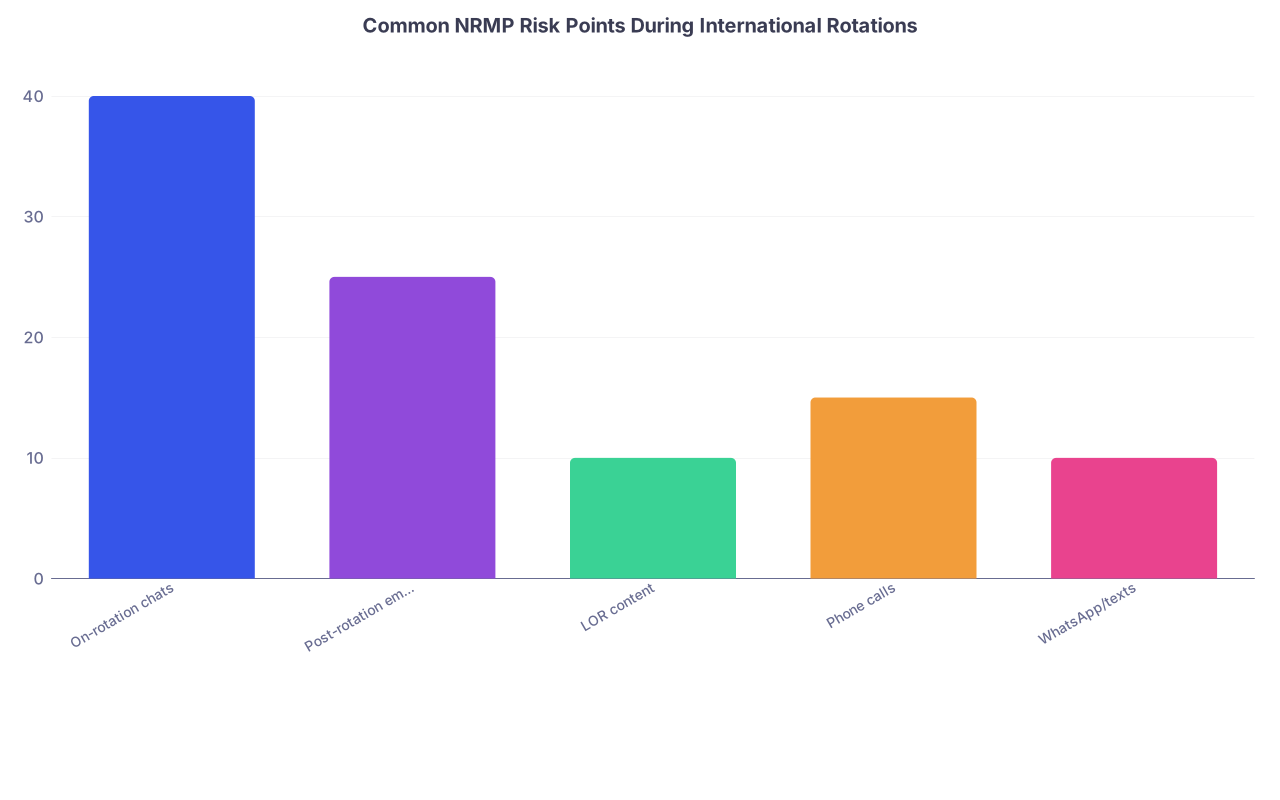
| Category | Value |
|---|---|
| On-rotation chats | 40 |
| Post-rotation emails | 25 |
| LOR content | 10 |
| Phone calls | 15 |
| WhatsApp/texts | 10 |
A. Post-rotation “stay in touch” email
Send a clean, NRMP-safe version:
“Dear Dr. [Name],
Thank you again for the opportunity to rotate with your team at [Hospital]. The experience confirmed my interest in [specialty], particularly in [specific aspects].
I’ll be applying through the NRMP Match this cycle and will certainly be considering programs where I saw the same strengths I experienced with your team. I’m very grateful for your mentorship and any support you’re comfortable providing in the form of a letter or general recommendation.
Best regards,
[Your Name]”
Notice what’s missing:
- No “you’re my top choice.”
- No language about ranking positions.
- No hints of side deals.
B. If they write: “We will rank you to match”
Foreign PDs sometimes think they’re being supportive by being that blunt.
You cannot control what they write to you. You can control your response.
Reply something short:
“Thank you very much, that means a lot to me. As an applicant, I’m required to keep my own rank list confidential and independent, but I truly appreciate your support and the confidence you’ve shown in me.”
You have now:
- Acknowledged the compliment.
- Reaffirmed you’re sticking to the rules.
- Not made any reciprocal promise.
Keep that email. If NRMP ever asks, it’s your evidence.
6. If Things Already Went Sideways: Damage Control
Maybe you’re reading this after someone made a promise. Or you casually wrote “You’re my #1” in a moment of poor judgment. Let’s not pretend this never happens—I’ve seen it plenty.
You cannot time-travel, but you can mitigate.
Step 1: Stop digging
No more:
- “clarifying” promises in more emails
- text messages hinting at mutual ranking agreements
- “just between us” explanations
Freeze the damage where it is.
Step 2: Write a correction email
If you said something like “You’re my top choice” or “I’ll rank you first,” send a follow-up that reframes it.
Example:
“I wanted to clarify my last message to stay aligned with NRMP rules. While I’m very enthusiastic about your program and it’s absolutely one of the environments where I’d be excited to train, I’m not allowed to make or discuss specific ranking commitments with any program. I’ll be finalizing my rank list independently per Match guidelines.
I really appreciate your understanding and your support during this process.”
Now if anyone pulls that email thread, it doesn’t look like a secret contract. It looks like an over-enthusiastic line that you then cleaned up.
Step 3: Tell your dean’s office or PD
Yes, even if it’s embarrassing.
You forward the relevant emails and say:
“I realized, after reviewing NRMP guidelines more carefully, that a recent exchange might be interpreted as discussing rank positions. I’ve since clarified my position in writing to comply with NRMP rules. I wanted you to be aware in case any questions arise.”
They would rather know now than when NRMP calls them.
Step 4: If NRMP contacts you
Answer honestly. Straight. Do not dodge.
Your answers should show:
- You understand the rules now.
- You tried in good faith to comply.
- You corrected mistakes once you recognized them.
Applicants who lie or minimize look much worse than those who say: “I messed up, then I fixed it.”
7. Quick Scripts You Can Use Word-for-Word
When you’re tired, jet-lagged, and English is everyone’s second language, having a script helps. Use these as-is if you want.
To shut down rank questions politely:
“I’m actually not allowed to discuss my rank list with any program under the Match rules. I can say that I’ve had a very positive experience here and this type of program is one I’ll seriously consider.”
To decline pre-Match promises:
“I really appreciate your confidence in me. Because I’m in the NRMP Match, I can’t make any pre-Match commitments. I’ll be submitting my rank list independently, based on overall fit.”
To shape a safe recommendation:
“Letters that focus on my clinical skills, professionalism, and potential as a resident are most helpful. The system is match-based, so nothing about how I might rank programs or any guaranteed positions.”
To redirect an overeager PD offering to call friends:
“That’s extremely kind of you. If you’re willing to share your impression of my work and potential as a resident with colleagues, that would be wonderful. The only thing we have to avoid is anything that looks like a pre-arranged ranking agreement or promise, since NRMP prohibits that.”
8. The Real Rule Behind All the Rules
Strip away all the legalese and this is the mental model:
- You are allowed to express genuine interest.
- You are allowed to say a program is “one of my top choices” or “a place I’d be excited to train.”
- You are not allowed to:
- Promise a specific rank order.
- Ask for or agree to reciprocal rank deals.
- Accept or encourage guaranteed positions contingent on the Match.
Overseas PDs, by default, will not know this. That’s not their fault. It is your problem.
So you become the person in the room who calmly says, “I’d love that, but here’s what my rules allow me to do.”
That’s how you get the benefit of an international rotation—the experience, the letter, the connections—without stepping on an invisible mine that blows up in March.
Open your email now and draft a 3–4 sentence “Match rules explanation” you can send or say to any overseas PD or consultant who starts talking about promises or rankings. Save it in your notes app. You’ll need it the moment someone says, “If we rank you first, will you rank us first?”


