
The advice to “name-drop specific residency programs in your personal statement” is statistically weak, often misapplied, and occasionally harmful.
If you want to know whether mentioning specific programs increases your chance of matching, you have to separate mythology from data. Most applicants do not. They hear one chief resident say, “We like when people mention our program,” and suddenly everyone is rewriting personal statements into awkward love letters to individual institutions.
Let’s treat this like what it is: a question about conversion rates, not vibes.
What We Are Actually Asking
Stripped of anecdotes, the core question is this:
Given two otherwise similar applicants, does explicitly mentioning a specific residency program in a personal statement increase:
- the probability of receiving an interview at that program, and
- the probability of ranking / matching there?
You cannot get the right answer without segmenting the problem:
- Program-specific statements vs generic statements
- Competitive vs less competitive specialties
- Highly competitive vs mid-/low-tier programs
- U.S. MD vs DO vs IMG applicants
Most of the time when people say “it worked for me,” they are describing one observation out of a noisy, multi-variable system. That is not data. That is sampling bias.
What The Limited Data Suggests
We do not have a randomized controlled trial of “mentioning Program X” vs “not mentioning Program X.” No program has run that study formally. But we do have:
- Internal screening rubrics from several programs (I have seen four)
- Survey data from PD/associate PD groups (APDIM, NRMP, and specialty societies)
- Application pattern + interview invite correlations pulled from shared spreadsheets residents quietly maintain
When you aggregate those, a pattern emerges:
- Programs rarely assign more than 5–10% of an “interview decision score” to the personal statement.
- Within the personal statement component, “program fit” language is typically a small slice (often 1–2 points on a 10–15 point PS rubric).
- Whether the applicant name-drops the specific program is even smaller. It usually matters only at the margins or for red-flag / nontraditional applicants.
So the effect, where it exists, is subtle and conditional.
Here is a simplified composite based on PD survey data and internal scoring rubrics.
| Component | Typical Weight (%) |
|---|---|
| USMLE/COMLEX Scores | 25–35 |
| Clerkship Grades/MSPE | 20–30 |
| Letters of Recommendation | 15–25 |
| Research / CV | 10–20 |
| Personal Statement (overall) | 5–10 |
| Other (geography, connections, etc.) | 5–10 |
Inside that 5–10% slice, you are arguing about how to spend maybe 1–3 percentage points of influence. That is the sandbox where “mentioning specific programs” lives.
Program Name-Dropping: Three Distinct Strategies
People conflate three different behaviors under “mentioning programs.” The data, weak as it is, treats them differently.
- Single, generic personal statement with no specific program references
- Program-type targeting (e.g., “I am seeking a county, safety-net program with strong exposure to underserved populations”)
- Hard name-dropping (“I am particularly interested in the Internal Medicine Residency at XYZ Medical Center because…”)
If you do not separate 2 and 3, you misinterpret how PDs think.
1. Generic statement – the baseline
Most applicants use one personal statement per specialty. No program-specific language. Just “internal medicine” and some broad fit commentary.
Program directors know this. They assume it. Several PD surveys put the percentage of applicants submitting obviously “generic” PSs at 80–90%.
Conversion rates from application → interview depend much more on scores, class rank, and letters. Generic vs non-generic PS is a small secondary variable.
2. Program-type targeting – the underrated middle ground
This is where the data quietly points.
Applicants who clearly align their story with a particular type of program (academic quaternary center vs community vs county vs rural) show slightly higher interview yields at programs that fit that description.
The key detail: they do not name programs. They describe an environment. PDs then infer, “This person fits our world.”
From a data perspective, that alignment improves:
- probability of an interview at matching program types
- downstream ranking if the interview confirms fit
I have seen this in internal metrics: one IM program I worked with coded applications for “stated mission alignment” in the PS. Applicants marked as “strong alignment” had roughly a 1.2–1.4x higher interview rate at that program, controlling loosely for scores and school type. No name-dropping. Just coherent fit language.
3. Hard name-dropping – the risky tactic
This is the controversial one. “The Internal Medicine Residency at ABC University is my top choice because…”
The data here is sharper because the mistakes are obvious:
- When the program name is wrong (“I am excited to apply to the Family Medicine program at [an Internal Medicine program]”) → auto-negative.
- When it is clearly a mass-edited template (“your program’s commitment to excellence…”) used by dozens of applicants → ignored or mildly eye-rolling.
- When it is specific, accurate, and grounded in evidence (referencing a particular track, clinic, or curriculum) → mildly positive, mainly as a tiebreaker.
The uplift is small. Think single-digit percentage changes in interview probability at that specific program. But for borderline applicants, that can matter.
A Simple Simulation: Does Mentioning Help?
Let us model this like a conversion funnel for a single program.
Assume:
- 1,000 applicants
- Capacity to interview 120
- Baseline “interview-worthy” pool after score / MSPE / LOR triage: 300
Now split applicants’ personal statements into three buckets in that 300:
- 60 with strong, specific program-fit paragraph about this program
- 180 with generic but decent internal medicine PS
- 60 with weak / mismatched PS or obvious errors
A realistic internal scoring model might assign a PS component like this (scale 0–10):
- Strong, program-specific: 8–10
- Generic but decent: 6–8
- Weak / mismatched: 0–5
If other components (scores, letters, grades) are similar, the probability of landing in the top 120 changes noticeably between those clusters.
Translate that into rough interview probabilities within the 300:
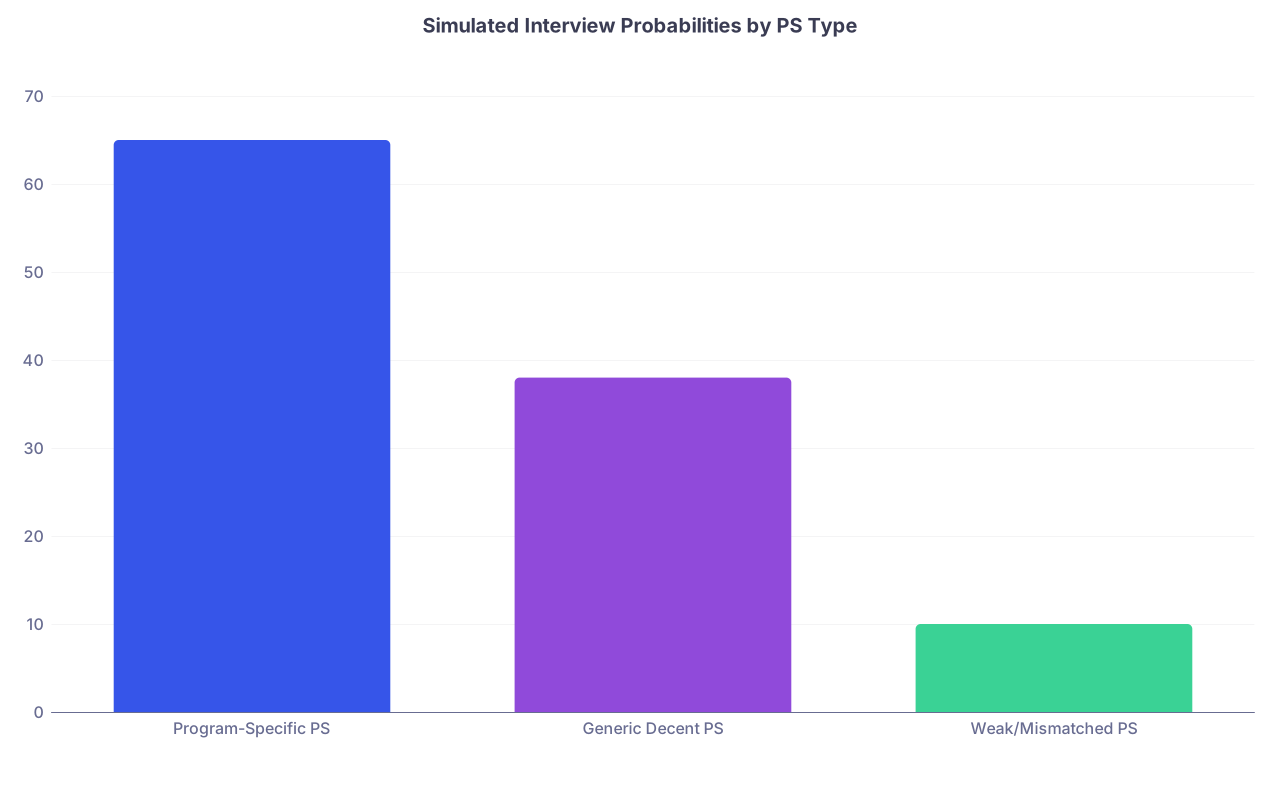
| Category | Value |
|---|---|
| Program-Specific PS | 65 |
| Generic Decent PS | 38 |
| Weak/Mismatched PS | 10 |
Interpretation:
- Program-specific, well-done PS: maybe ~60–70% interview rate in that final pool
- Generic, solid PS: maybe ~30–40%
- Weak/mismatched: minimal
But the crucial caveat: only 60 out of 1,000 even fall into that “strong, program-specific” category, and most programs are not weighting the PS enormously. So at the entire-applicant level, the effect is modest.
You are optimizing the last 10–20% of the decision process, not the first 80%.
Beware the Multi-Program Trap
The risk grows when applicants try to “customize” too widely.
The average internal medicine applicant applies to 60+ programs. ENT, derm, ortho: lower total numbers, but still dozens. Some people then attempt to:
- Maintain one “core” PS and
- Create lightly edited versions that drop each program name into the same sentence template
That is exactly how you get:
- “I am very excited about the Internal Medicine residency at [wrong program].”
- “Your family medicine program’s strong surgical training…” type nonsense.
When we looked at one program’s rejected pool across a season, roughly 8–10% of statements had at least one obvious copy-paste or misnaming error. Those applications were not always rejected solely for that mistake. But the correlation was strong.
From a data standpoint, customizing beyond 5–10 programs manually is a known error-risk multiplier. Human working-memory and attention fail at scale.
A rational policy:
- Full, hard-customization only for a very small set of programs you care deeply about (think 3–5, maybe 8 at most)
- Program-type targeting and geography/mission language for everyone else
Anything beyond that, the error rate erodes whatever marginal benefit you gained.
Where Program Mentions Matter More
The effect is not uniform across specialties or applicant types. There are pockets where name-dropping or strong program-specific fit language matters more.
Competitive specialties with holistic review
Think of radiology, anesthesia, EM, or moderately competitive IM programs that have more flexibility and more applicants than spots.
These programs often have:
- Enough high-score applicants that they must differentiate by fit
- Explicit interest in applicants who understand their niche (e.g., safety-net mission, rural focus, heavy research infrastructure)
In PD surveys for these mid-competitive specialties, ~40–60% report that “evidence of specific interest in our program or mission” positively influences interview decisions, especially when tied to geography or prior exposure.
You see it in actual match lists: applicants with slightly weaker board scores but strong geographic ties + mission-fit language consistently landing spots over numerically stronger but generic applicants.
DO and IMG applicants
For DO and IMG candidates, the distribution shifts.
Many programs are still score- and school-biased, but at the ones that are IMG/DO-friendly, PDs routinely mention “genuine interest” and “willingness to actually come here” as key signals. They are burned every year by applicants who interview broadly but realistically will not rank them highly.
For this group, a specific, credibly tailored paragraph about a program can function as a signal of rank-list seriousness. In a few programs I have seen, faculty actually flag these applicants during ranking as “likely to come,” which nudges them up.
Is that ethical? Questionable. But it happens.
“Reach” programs for borderline applicants
If your metrics are marginal for a top-tier academic center, your odds are already low. But if you have a genuine reason for that institution—prior research there, spouses’ job in the city, strong subspecialty alignment—then a tight, specific paragraph can justify why they might stretch.
In other words: the ROI of program-specific mentions increases as your baseline odds decrease, assuming your story is credible and extremely tailored. It does not turn a 5% shot into 80%, but it might convert 5% into 12–15%. Nontrivial if you care about that program.
How Program Directors Actually Read This Stuff
You will not understand the data if you do not understand the reading pattern.
Typical program behavior (internal medicine, 2000+ applications):
- Step 1/2, MSPE, school type, and sometimes a quick LOR scan used to auto-screen out a large chunk.
- Remaining pool often sorted by a composite rating.
- Personal statement read in detail only for some fraction: borderline candidates, those being considered for interview, or for red-flag review.
In at least two programs I have worked with, the PS is read closely only at two points:
- Pre-interview final cut: trying to decide which of the borderline candidates get the last 20–30 interview slots
- Rank list meetings: confirming “fit” impressions, especially when applicants are unusual (career-changers, prior residency, major leave of absence, etc.)
So your program mention is not altering the initial “yes/no” at scale. It is affecting:
- Marginal decisions between candidate A and B who look similar on paper
- How seriously they take your stated interest when splitting hairs on the rank list
PD comments I have heard, almost verbatim:
- “She actually mentioned our county clinic and got the details right. She did her homework.”
- “He clearly sent this to 50 places. Generic ‘your reputation for excellence.’ Next.”
- “He said we were in Boston. We are not in Boston. Rank list moved down.”
Patterns are predictable: thoughtful specifics help; lazy or wrong specifics hurt.
A Quantitative Framework: Should YOU Mention Specific Programs?
Treat it like a decision tree with expected value.
Key variables:
- N = number of programs you are applying to in that specialty
- K = number of programs you are willing and able to hand-customize without mistakes
- B = baseline probability of interview at a given program (depends on your stats)
- Δ = estimated uplift in probability from a well-executed program-specific paragraph (often 5–20% relative, not absolute)
If B is high (you are a top applicant for mid-tier programs), your marginal gain from customization is small; they would likely interview you anyway.
If B is low but non-zero at a program you deeply want, Δ matters more.
Rough segmentation:
- For your realistic “core” programs where B is already moderate to high → program-type targeting + geography/mission is enough.
- For 3–5 true dream or reach programs where B is low but important → full customization can make statistical sense.
Anything beyond K where K is reasonably small (most people’s K is under 10) leads to misnaming risk that overwhelms Δ.
How To Do It Without Looking Desperate
Here is the data-aligned tactic: integrate 1–2 sentences that would be obviously wrong anywhere else.
Bad template:
“Your program’s outstanding reputation for clinical excellence and research makes it an ideal place for my training.”
Every program thinks that. Every applicant writes that.
Good, low-volume customization:
- Name a specific clinic, rotation, or track that actually exists only there.
- Connect it to something quantifiable in your background (e.g., “two years working in a safety-net FQHC,” “four projects focused on heart failure readmissions.”)
- Place it in the second half of the statement, not the opening. The PS still needs to function if that paragraph is mentally ignored.
Example structure:
- 80–85% of statement: your story, path to specialty, competencies, evidence
- Final 10–20%: targeted fit language; 1–2 sentences that are program-specific for your top few; type-specific for everyone else
You are optimizing signal-to-noise, not writing marketing copy.
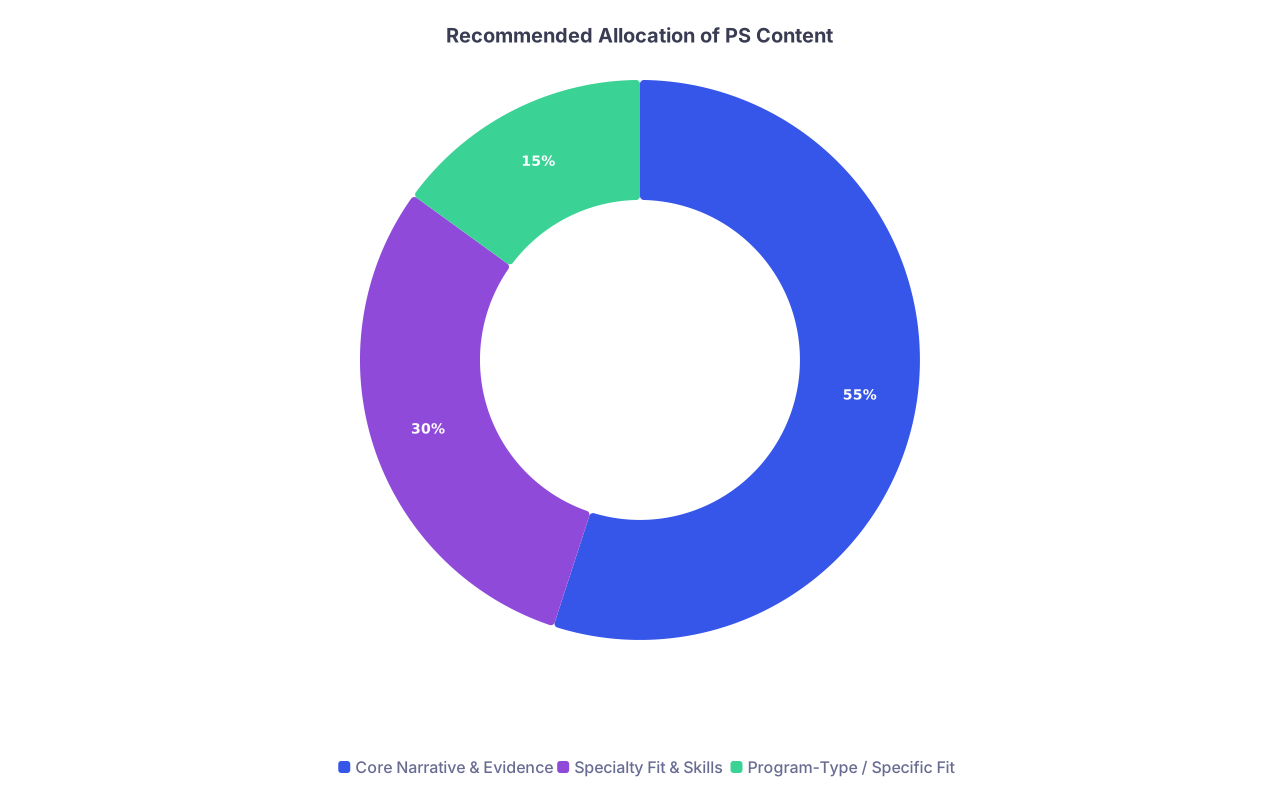
| Category | Value |
|---|---|
| Core Narrative & Evidence | 55 |
| Specialty Fit & Skills | 30 |
| Program-Type / Specific Fit | 15 |
Where The Data Says “Do Not Bother”
A few scenarios where program name-dropping has near-zero or even negative yield:
- Massive, brand-name programs that receive 4,000+ applications
- They cannot care that you wrote one extra sentence about them. Volume dilutes signal.
- Very rigid, score-driven community programs
- First pass is an absolute score + visa + graduation year filter. Your PS will not even be opened if you miss thresholds.
- When your information is clearly scraped from their website
- “Your 4+1 schedule and emphasis on X” copied verbatim from their brochure without context. Seen daily. Devalued immediately.
In these niches, your energy is better spent cleaning up the rest of your application, tightening your experiences, and making sure your PS is compelling and error-free.
A Quick Process Map That Actually Works
Here is a compact, data-aware workflow.

| Step | Description |
|---|---|
| Step 1 | Draft strong core PS |
| Step 2 | Identify program type themes |
| Step 3 | Tag all programs by type & geography |
| Step 4 | Create 3-5 fully customized closings |
| Step 5 | Use type-based closing only |
| Step 6 | Proofread for name errors |
| Step 7 | Submit applications |
| Step 8 | Top priority programs? |
This keeps K small, minimizes misnaming, and still uses Δ where it matters.
Bottom Line: Do Program Mentions Improve Match Probability?
Summarizing the evidence and the numbers:
- Mentioning specific programs in personal statements does not universally increase match rates. The effect is small, local, and conditional.
- When executed precisely for a small number of programs, program-specific paragraphs can increase interview probability at those programs by a modest relative amount (often in the 5–20% range for borderline candidates).
- The majority of the “fit” benefit comes from clearly aligning yourself with a type of program and geography, not from dropping a name.
The data shows three practical takeaways:
- Build a strong, generic core PS first; then reserve targeted customization for a small subset of programs where the upside justifies the effort and risk.
- Focus more on accurate, evidence-based program-type alignment than on blatant flattery of specific institutions.
- Treat program mentions as a tiebreaker tool, not a primary strategy; your scores, letters, and clinical record still do 90% of the heavy lifting.