
Program directors are not forensic detectives trying to catch you in a lie.
But I know that’s not how your brain feels right now.
You’re staring at your personal statement thinking: “I left out this huge thing… are PDs going to think I’m hiding something? Am I basically self-sabotaging my entire application?”
Let me answer that directly:
No, they’re almost never reading your statement thinking, “What is this person NOT telling me?” They’re thinking, “Do I get a clear, coherent sense of who this person is, and do they fit my program?”
Let’s untangle what’s actually risky, what’s completely fine, and what’s just your anxiety doing laps around your frontal lobe.
What Personal Statements Are Actually For (Not What We Tell Ourselves)
We act like the personal statement is:
- The autobiography of our entire existence
- A full legal disclosure form
- A chronological list of every important thing we’ve ever done
It’s not. It’s a narrative slice. One angle. A curated sample.
Program directors use it for a few things:
- To see how you think and communicate
- To understand your motivation for the specialty
- To get a vibe of who you are beyond bullet points
- To have something to talk about during interviews
They are not expecting it to:
- Explain every gap
- List every project
- Mention every crisis, illness, or trauma
- Justify every weird grade or leave of absence
That’s what ERAS, MSPE, transcripts, and interviews are for.
The personal statement is a spotlight, not a security camera.
The Big Fear: “If I Don’t Mention X, They’ll Assume the Worst”
Let’s spell out the nightmare script running in your head, because I’ve had the same one.
You’re thinking something like:
- “I had a major leave of absence but I didn’t put it in my statement. They’re going to assume I’m hiding it.”
- “I didn’t talk about my PhD / prior career / military service. They’ll think it wasn’t important or that I’m lying about it.”
- “I had a major mental health episode, and I didn’t explain it. They’ll think I’m unstable.”
- “I switched specialties and didn’t fully explain why. They’ll assume I’m flaky.”
Here’s the boring reality:
Program directors mostly think: “If it’s important, it’ll show up somewhere in their file. If it’s not here, fine.”
They are used to:
- Fragmented stories
- Incomplete explanations
- People not wanting to air everything in a 1-page essay
They read hundreds of these. The bar is not “perfectly comprehensive.” The bar is “coherent and not weirdly contradictory.”
When leaving something out is totally normal
Leaving something out is usually fine if:
- It’s already clearly visible elsewhere in ERAS/MSPE
- It doesn’t directly contradict what you are saying
- It’s not an obvious unexplained disaster (like disappearing from med school for a year with no note anywhere)
Example: You did a full extra degree (MPH, PhD) and ERAS clearly shows those years. But you chose not to center your personal statement on it because you wanted to talk about patient stories instead. That’s fine. Lots of people do that.
Example: You had a challenging clerkship but the grade is already in your transcript and your MSPE has comments. You don’t have to process that in your PS unless it’s central to your story.
When leaving something out might raise a question
The only time your silence starts to look weird is when:
- There is a big, obvious thing in your record
- It clearly affects your trajectory
- And nowhere do you acknowledge or contextualize it
Even then, “weird” doesn’t equal “rejected.” It usually equals “maybe I’ll ask about this at the interview” or “I wonder what happened there.”
“Do They Think I’m Hiding Something?” Let’s Be Honest About PDs
Program directors are overworked humans. They are not reading your personal statement with a magnifying glass thinking, “Aha, they didn’t mention their leave of absence here.”
More like:
- Skim PS for motivation
- Check if it’s reasonably well written
- Look for red flags (unprofessional, hostile, bizarre content)
- Move on
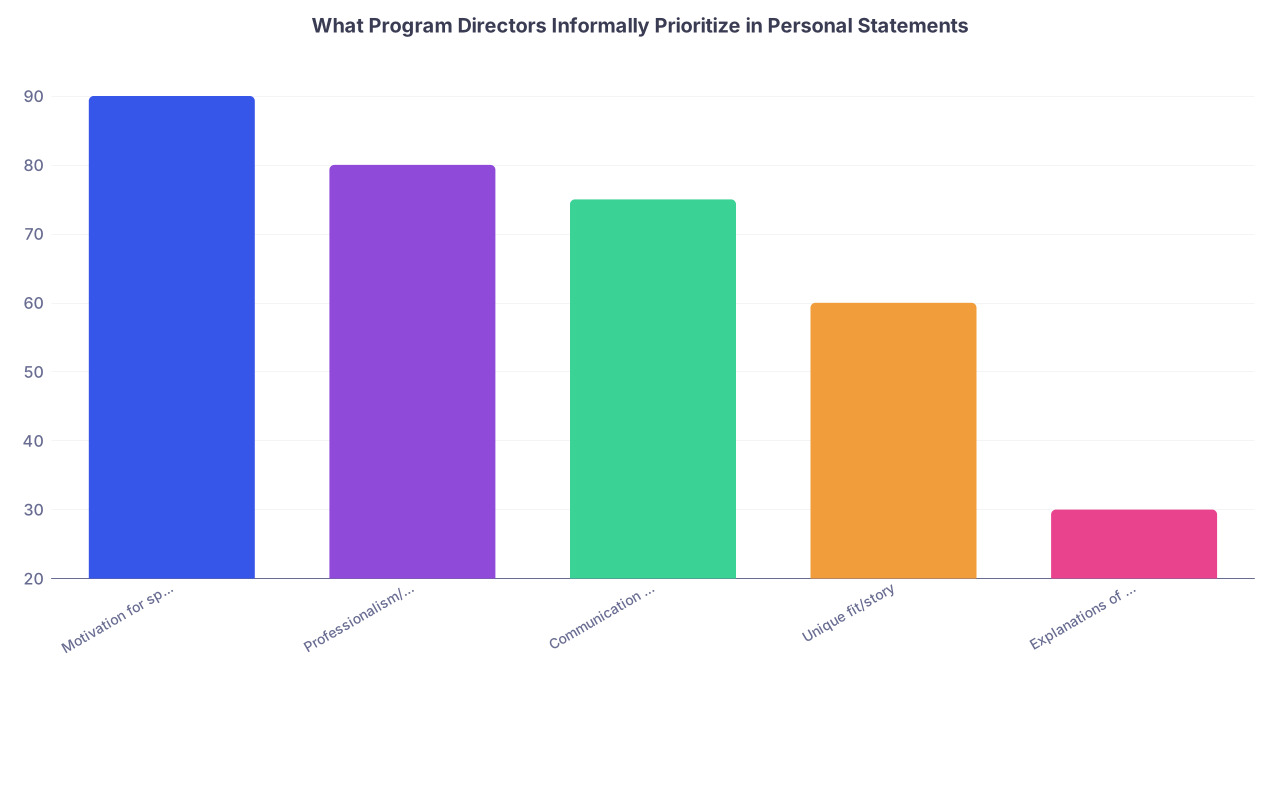
| Category | Value |
|---|---|
| Motivation for specialty | 90 |
| Professionalism/tone | 80 |
| Communication skills | 75 |
| Unique fit/story | 60 |
| Explanations of gaps | 30 |
Do they ever notice omissions? Sometimes. Usually in these scenarios:
- There’s a leave of absence but no explanation anywhere
- There’s a major specialty switch late in the game with no context
- There are professionalism issues documented elsewhere with zero acknowledgment
Even then, the thought is usually:
“Hmm, I wish I had more context” → not “This person is clearly hiding something sinister.”
Your anxious brain fills in “sinister.” A tired PD fills in “unclear, maybe I’ll ask later.”
How to Decide: Should I Have Mentioned This or Not?
Let’s walk through a simple mental flowchart.

| Step | Description |
|---|---|
| Step 1 | Is the experience visible in ERAS/MSPE? |
| Step 2 | Does it affect timeline/grades/trajectory? |
| Step 3 | Is it central to my story for this specialty? |
| Step 4 | Brief explanation somewhere in app is smart |
| Step 5 | Optional to include, low risk to omit |
| Step 6 | Strong candidate to include in PS |
| Step 7 | Can leave for CV/interview instead |
Ask yourself:
Is this experience already clearly documented somewhere else?
If yes, then you’re not “hiding” it. You’re just not spotlighting it in one essay.Is this central to why you chose this specialty or who you are as a physician?
If yes, it’s often worth including. If no, it can live in the CV.Does this experience explain something that otherwise looks confusing or negative?
- A sudden drop in grades
- A long unexplained gap
- A big shift in direction
If yes, it may deserve some context—if not in the PS, then somewhere (MSPE comment, advisor letter, or an ERAS “additional info” type section where allowed).
Am I only considering adding this because I feel guilty leaving it out?
That guilt feeling is not always rational. You are not obligated to turn your PS into an expose on your entire life.
Common Scenarios You’re Probably Overthinking
Let’s get specific, because the generic “don’t worry” isn’t cutting it.
1. You didn’t mention a leave of absence or health issue
If the leave is documented in your transcript/MSPE, PDs already know it happened. The question is: are they entitled to your entire health history in your PS?
No.
You can choose to:
- Explain briefly somewhere (“I took a leave of absence during M2 for personal and health reasons, which have since been fully addressed. Returning to school clarified my commitment to…”), OR
- Let your dean’s letter / MSPE handle it if they already mention context
You’re not required to unpack your entire illness or trauma in the PS to prove you’re honest. Over-disclosing can backfire and make your statement about your diagnosis instead of your future as a resident.
2. You switched specialties and didn’t give a long explanation
This one freaks people out.
You did a year of research in surgery, now you’re applying to anesthesia. Or you were telling everyone you were going into derm, now you’re in IM.
PDs don’t usually need a multi-page confession. What they do like to see is:
- A clear, believable statement of why this specialty fits you now
- No trashing of other fields
- A forward-looking focus
You don’t need:
“I was originally going into X but then I realized Y and then Z happened and—”
You can do:
“My clinical experiences showed me that I’m most fulfilled in [current specialty] because…”
If they want the longer story, they’ll ask at interviews. And they do. I’ve heard PDs say: “I’ll just ask them on interview day what made them switch from peds to EM.” That’s it. Not a secret tribunal. A question.
3. You have a huge non-medical career you barely mentioned
You were an engineer, a teacher, in the military, did a PhD, worked in finance. Now there’s a one-line mention in your PS and you’re like: “Are they going to think I’m minimizing it or hiding something that happened there?”
No. They’re going to think you prioritized your medicine story in the medicine essay.
If that prior life didn’t directly drive your specialty choice or clinical style, you’re allowed to keep it mostly in the CV and supplementals. It’ll catch their eye anyway. They’ll ask you in interviews: “Tell me about your time in the Army / your PhD / why you left engineering.”
You’re not under oath to write “My Entire Origin Story, Unabridged.”
4. You didn’t mention a major personal hardship
Family death. Immigration. Financial strain. Serious mental health struggles.
These are deeply personal. You are not required to drag them into your PS for “transparency points.”
If the hardship:
- Affected your performance or timeline, and
- Would look inexplicable without context
then a brief, dignified mention somewhere in the application can help.
But no program is entitled to the raw version if you don’t want that in writing.
You are not hiding something. You are exercising boundaries.
Fixing It Now: “Do I Need to Rewrite Everything?”
Here’s the panicked question underneath all this:
“Do I need to scrap my PS and start over because I didn’t mention X?”
Usually? No.
Here’s a calmer way to approach it:
- Print your current statement (yes, on paper).
- Read it as a PD who has 3 minutes per file:
- Does it clearly show why you want this specialty?
- Does it sound like a real human, not a robot or a thesaurus?
- Are there obvious contradictions with your ERAS application?
- List the “big things” you left out.
For each, ask:- Is this crucial to understand my fit for this specialty?
- Is this needed to avoid confusion about my record?
If the answer is no to both, you’re probably fine.
If the answer is yes to one, you can:
- Add 1–2 tight sentences that nod to it without turning your PS into a memoir, OR
- Leave it out of the PS but make sure it’s addressed somewhere else (advisor letter, MSPE, or interview talking points)
Your personal statement doesn’t fail because you didn’t mention every “major experience.” It fails when it’s generic, unclear, or disorganized. That’s it.
What PDs Actually Call Red Flags (It’s Not What You Think)
I’ve heard versions of this straight from faculty and PDs.
They worry about:
- Unprofessional tone (hostile, arrogant, blaming others)
- Incoherent structure or very poor writing
- Nothing about the specialty itself (just random life story)
- Obvious copying / cliché template statements
- Wild contradictions (e.g., PS says “lifelong commitment to primary care,” but everything else screams IR fellowship-or-bust)
Notice what’s missing from that list:
“I’m mad this applicant failed to mention every notable thing they’ve ever done.”
They don’t have time—or honestly, interest—for that level of forensic reading.
How to Talk About Omitted Experiences in Interviews (Without Panicking)
You know what actually matters? How you handle it when someone asks.
If a PD says, “I noticed you took a year off—tell me about that,” you don’t need to spiral.
You can:
- Keep it factual and concise.
- Own your decisions or circumstances without oversharing.
- Connect it back to how you grew and what you bring now.
Example framework:
- “During my second year I took a leave of absence due to [personal/health/family reasons].”
- “During that time, I [what you did—treatment, care for family, regroup, etc.].”
- “Coming back, I [what changed—approach to studying, priorities, resilience].”
- “That experience has made me [concrete positive trait relevant to residency].”
You do not need a confession. You need a coherent, calm answer.
Quick Reality Check: What You’re Calling “Hiding” May Just Be “Editing”
Your brain: “I didn’t mention this. I’m being deceptive.”
Reality: “You had 1 page. You made choices.”
Everyone leaves out things that mattered to them:
- Favorite patients
- Sad outcomes
- Entire research projects
- Personal struggles they’re not ready to put into writing
That’s not deception. That’s editing. That’s adulthood.
You’re allowed to have parts of your life that are not turned into application content.
| Situation | Usually Okay to Omit from PS | Probably Needs Some Context Somewhere |
|---|---|---|
| Extra career/degree before med school | Yes | Only if timeline looks confusing |
| Personal hardship not affecting record | Yes | No |
| Leave of absence with visible gap | Maybe | Yes |
| Specialty switch with no obvious chaos | Maybe | Often helpful |
| Failed Step/COMLEX attempt | Maybe | Usually helpful |
FAQ: The Six Questions You’re Probably Still Stressing About
1. I had a major leave of absence and didn’t explain it in my PS. Is that a fatal flaw?
No. Fatal flaws are things like unprofessional content, plagiarism, or blatantly inappropriate material. A missing explanation is, at worst, an unanswered question. If the leave is documented elsewhere, PDs already know it happened. If it’s bothering you, add a brief explanation in another part of your application or prep a clear, concise interview answer.
2. I barely mentioned my previous career (or PhD/military service). Will PDs think I made it up or that it wasn’t a big deal?
They’ll see it in your CV. That alone proves it’s real. Many applicants deliberately choose to focus the PS on clinical growth instead of their previous life. PDs are used to that. If they care, they’ll ask you directly: “Tell me more about your time in X.” You’re not required to center it in your essay.
3. I switched specialties and didn’t explicitly say, “I used to want something else.” Is that suspicious?
Not inherently. What PDs care about is whether your current choice sounds thought-out and genuine. If your story now is coherent—“Here’s why this specialty fits me”—you don’t need to narrate every past version of your plan. If they’re curious, they’ll ask in the interview, and you can explain calmly there.
4. Do I have to disclose mental health issues in my personal statement to explain dips in performance?
No. You never have to disclose more than you’re comfortable with. If a health or personal issue explains a dramatic change in performance or a leave, a brief, general explanation (“personal health reasons now resolved”) is usually enough if you choose to mention it. You are not hiding something by not sharing intimate details.
5. I focused my PS on one experience and left out several other major ones. Does that make my application seem thin?
Not if the rest of your application is solid. PDs see your whole ERAS, not just your essay. The PS is allowed to zoom in on one thread of your story. It’s often better that way—trying to cram every “major experience” into one page makes it feel scattered and shallow.
6. Should I rewrite my personal statement now just to squeeze in the thing I left out?
Only if your current statement is clearly incoherent without it. If your PS already does the big jobs—shows why this specialty, who you are as a clinician, and that you can write like a functioning adult—then you probably don’t need a full rewrite. You can leave the omitted experience for interviews, your CV, or a brief note elsewhere in your application.
Key points to keep in your head when your brain starts spiraling:
- Personal statements are selective narratives, not full confessions.
- PDs are scanning for coherence and professionalism, not hidden secrets.
- Leaving out a major experience is usually editing, not deception—especially if it’s visible elsewhere and you can explain it calmly if asked.