
The biggest risk in turning your vacant home into a rental is not bad tenants. It is you skipping the boring legal and financial steps because you are busy and “it will probably be fine.”
You are a physician. You have assets, income, and a big target on your back. If you are going to turn your primary home into a rental, you need to do it like a professional operator, not like a distracted homeowner.
Here is how to do it safely and profitably, step by step.
Step 1: Get Clear on the Why, the Timeline, and the Exit
Before you touch paperwork, you need a simple written plan. Not a novel. One page.
Answer three questions:
Why are you renting this home?
- Moving for fellowship or attending job and might come back?
- Upsizing to a larger house but want to keep this as a long‑term rental?
- Testing the waters of real estate investing?
What is your time horizon?
- Short term (1–3 years)
- Medium term (3–7 years)
- Long term (7+ years / indefinite)
What is your exit plan?
- Sell when you return
- Refinance and pull equity
- 1031 exchange into a true investment property
- Keep as part of a growing portfolio
Write it down. Why does this matter legally and financially?
- It affects how aggressive you are with upgrades.
- It determines whether you should treat this as a “temporary absence” residence or fully convert it to a rental for tax purposes.
- It drives how you structure leases (length, options, rent escalation).
This is also where you sanity-check if this even should be a rental.
| Metric | Rule of Thumb |
|---|---|
| Gross Rent | ≥ 0.8–1.0% of home value |
| Monthly Cash Flow | ≥ $200 positive per month |
| Emergency Reserves | 3–6 months of rent + expenses |
| Vacancy Assumption | 1 month per year |
If your former primary in a high-cost coastal market rents for $3,000 but costs you $4,200 all-in monthly, that is not a “rental.” That is a hobby subsidy. Decide if you are willing to carry that intentionally.
Step 2: Fix the Financing Risk Before You List It
This is where most high-income professionals mess up. You cannot treat your mortgage like a suggestion.
2.1 Check Your Current Mortgage and Occupancy Rules
Pull up your closing package or call your lender. You are looking for:
- The occupancy clause:
- Most owner-occupied loans require you to occupy the property within 60 days and live there for 12 months.
- Due-on-sale or due-on-transfer clause:
- This is standard. It allows the bank to call the loan due if you transfer ownership.
If you have already lived in the home as your primary residence for more than 12 months, you are usually fine to change occupancy to rental. But do not just assume. Call your lender:
Script:
“I purchased this property as my primary residence in [month/year]. I am moving for work and plan to rent it out. What, if anything, do I need to do to remain in compliance with the loan?”
Get the agent’s name and date, and keep notes in a PDF in your property folder.
2.2 Decide Whether to Refinance Now or Later
You may be sitting on a 2.75–3.5% fixed primary mortgage. If so, that loan is gold. You probably do not want to refinance it into a higher-rate investment mortgage without an extremely good reason.
Reasons you might refinance into an investment property loan:
- You need to pull cash out to fund another purchase and the numbers still work.
- You want the property fully documented as non-owner-occupied for your own risk tolerance.
- You have other reasons to reset the amortization or change the term.
If you plan to move out, convert to rental, then later do a cash-out refinance or HELOC, that is typically fine. Just remember: investment property loans have:
- Higher interest rates
- Stricter LTV limits (often 70–75% for cash-out)
- Higher reserve requirements
Treat that like a planned move, not a surprise.
Step 3: Build a Legal Liability Shield That Actually Works
This is where “accidental landlords” get crushed. You cannot practice medicine without malpractice coverage. You should not be a landlord without a basic asset protection setup.
3.1 Insurance: Your First Line of Defense
You need to convert your homeowner’s policy to a landlord (dwelling) policy.
Call your insurance agent and say:
“I am moving out and converting my primary residence into a long-term rental. I need a proper landlord policy, not a homeowner’s policy.”
Key coverages to confirm:
- Dwelling coverage: Replacement cost, not actual cash value.
- Loss of rents: If a covered loss (fire, water) makes the property uninhabitable, the policy pays lost rent.
- Liability limits: At least $500,000, preferably $1,000,000 if available.
Then you add an umbrella policy:
- Minimum: $2 million for attendings with assets.
- Often cheap: $200–400 per year for a multi-million physician-level umbrella.
Coordinate umbrella with your auto and landlord policies—they usually need to be under the same insurer or linked carriers.
3.2 LLC: When and How to Use It for a Former Primary
Physicians love LLCs. Attorneys love billing for them. But they are not magic, and they are not always necessary for a single rental.
Ask three questions:
- Do you have significant personal assets and income worth protecting? (Yes, you are a physician.)
- Is the state you are in LLC-friendly (reasonable costs, strong protections)?
- Are you willing to handle some admin (separate accounts, annual filings)?
If yes to all three, I lean toward putting the rental into an LLC.
But do it correctly, or you shoot yourself in the foot.
The Mortgage + LLC Problem
Your existing lender gave you a loan in your personal name. If you deed the property directly into an LLC:
- Technically, that can trigger the due-on-sale clause.
- In practice, many banks look the other way as long as:
- Payments are on time
- Same ultimate owner
- No transfer to a third party
Risk is there but typically low for a performing loan. Still, you should:
- Talk to a real estate attorney local to your state.
- Decide knowingly if you are comfortable with that risk.
If you go forward:
- Form the LLC in the state where the property is located (or use a holding structure; talk to an attorney if you are building a portfolio).
- Get an EIN from the IRS (online, 10 minutes).
- Open a separate bank account under the LLC.
- Execute a deed transferring the property from you to the LLC (usually a quitclaim or warranty deed, done by a local title company or attorney).
- Update:
- Insurance policy (LLC as named insured, you as additional insured or vice versa)
- Lease (LLC is landlord)
- Municipality / tax records if needed
If you do not use an LLC:
- Make sure the property is titled correctly (e.g., tenants by entirety or community property where relevant).
- Maximize insurance and umbrella.
- Keep renting activity financially separate anyway (see next step).
Step 4: Set Up a Clean Financial System From Day One
You want to run this like a micro-business, not as another checking account that your spouse forgets about.
4.1 Separate Banking
Open a dedicated bank account for the property:
- If using an LLC: in the LLC’s name.
- If not: a dedicated personal “rental” checking account.
All rent goes into this account. All expenses come out of it. No Starbucks. No groceries. No random Venmo transfers.
This creates:
- Clean records for taxes
- Better defensibility in an audit
- Less chance you miss a bill or mix funds
4.2 Basic Bookkeeping System
You do not need enterprise software for one property, but you need something:
Options:
- Spreadsheet (Google Sheets or Excel) with:
- Rent received by month
- Operating expenses (by category)
- Capital expenditures
- Or simple property management software with accounting baked in.
Track at minimum:
- Income:
- Rent
- Late fees
- Misc (pet rent, parking)
- Operating expenses:
- Property taxes
- Insurance
- Property management
- Repairs and maintenance
- Utilities (if you pay any)
- HOA dues
- Marketing/leasing costs
- Legal and accounting fees
- Capital expenditures (CapEx):
- Roof
- HVAC
- Major appliances
- Flooring replacement
Your CPA will thank you. And you will actually know if you are making money.
Step 5: Nail the Tax Side So You Do Not Overpay or Get Burned
This is where the “profitable rental” is won or lost for high-income physicians.
5.1 Understand the Conversion Date
There are two important “date lines”:
- Date you move out as your primary.
- Date you place it in service as a rental (advertise it for rent or sign a lease).
From the “placed in service” date forward, this is a rental property for tax purposes.
What changes:
- You start depreciating the structure (not the land) over 27.5 years.
- You deduct ordinary and necessary rental expenses against rental income.
- You may create a passive loss that can offset passive income, and sometimes ordinary income depending on your participation and income level.
Your CPA should:
- Set up a depreciation schedule using:
- The lower of:
- The property’s adjusted basis, or
- The fair market value at conversion
- The lower of:
- Allocate value between building and land (often 70/30 or 80/20 in many markets, but must be justified).
5.2 The Primary Residence Capital Gains Exclusion
If this has been your primary residence for 2 of the last 5 years, you probably qualify for:
- Up to $250,000 capital gains exclusion (single)
- Up to $500,000 (married filing jointly)
Here is the trap I see physicians fall into:
- They move out for fellowship.
- They rent the home for 6+ years.
- Then they sell.
- They have a large gain.
- The 2-in-5 rule is gone. No exclusion. Huge tax bill.
You need a timeline:
- Mark the date you moved out.
- Count 3 years forward. That is your rough deadline to sell if you want the full primary residence exclusion.
There are details and exceptions (military orders, etc.), so have your CPA run exact scenarios, but do not ignore the clock.
5.3 Passive Activity Rules and Physician Income
High-income physicians are almost always above the $150,000 AGI threshold where passive losses from rentals are disallowed unless:
- You qualify as a real estate professional (unlikely if you are full-time clinical), or
- You have passive income from other rentals to offset.
Practically:
- The property might show a tax loss (due to depreciation) even if it is cash-flow positive.
- That loss may be suspended and carried forward, not used immediately.
- You eventually use those suspended losses when:
- You have other passive income, or
- You dispose of the property in a taxable sale.
Action items:
- Tell your CPA you are converting a primary to a rental. Explicitly.
- Have them:
- Set up depreciation correctly.
- Track suspended passive losses.
- Plan for a future sale.
Step 6: Get Your Lease and Tenant Risk Under Control
A good lease and good screening save you more money than almost any “optimization.”
6.1 Use a Professionally Drafted Lease, Not a Random PDF
Do not use the free template your cousin used once. Use one of the following:
- State landlord-tenant association lease
- Attorney-drafted residential lease for your state
- High-quality property management platform template customized for your state
The lease must cover at minimum:
- Rent amount, due date, and late fees
- Security deposit amount, holding, and return rules (must match state law)
- Term (fixed vs month-to-month)
- Maintenance responsibilities (who handles what)
- Access rights (landlord entry, notice)
- Use restrictions (no illegal activity, no short-term subletting without consent)
- Pet policy and pet deposits / pet rent
- Smoking policy
- Utilities responsibilities
In physician-heavy areas, I often see departing physicians rent to colleagues or hospital staff “informally.” Handshake deals, no proper lease, “we know each other.”
That is fine. Until it is not. Then it is miserable.
6.2 Screening Tenants Like a Business
You want three things:
- Ability to pay
- History of paying
- Not a nightmare
Run a standard screening package:
- Credit report and score
- Background check (as allowed by your state)
- Eviction history
- Income verification (pay stubs, offer letter, or bank statements)
- Prior landlord references (with actual calls)
Set clear criteria before you list:
- Minimum credit score
- Income-to-rent ratio (commonly 3x monthly rent)
- What is an automatic no (recent evictions, certain criminal history, etc.)
Apply criteria consistently to avoid discrimination issues.
Step 7: Decide: Self-Manage or Hire a Property Manager
You are a physician. You have call. You travel for conferences. You cannot be plunging toilets on night shift.
That said, one well-run rental is manageable if set up correctly.
7.1 When to Self-Manage
Consider self-managing if:
- Property is local
- You are detail-oriented and moderately organized
- You want to learn the ropes of landlording personally
- You are willing to:
- Respond to issues
- Coordinate contractors
- Enforce the lease
Use tools:
- Online rent collection (Buildium, Avail, Apartments.com, local platforms)
- Clear communication channel (email + text)
- Written procedures for:
- Late rent
- Repairs
- Renewals and rent increases
7.2 When to Hire a Property Manager
You should strongly consider a manager if:
- You are moving out of state
- You are regularly on call or in ORs for long stretches
- You have zero interest in executing day-to-day management
Typical costs:
- 8–10% of monthly rent as management fee
- One-half to one month rent for placing a new tenant
- Small markups on maintenance sometimes
Non-negotiable items in your PM agreement:
- Clarity on:
- Who approves repairs over X dollars (e.g., $300 or $500)
- When they can file evictions
- When they can discount or waive late fees
- Monthly detailed statements
- Year-end financial summary and 1099
A good property manager is an expense. A bad one is a liability. Interview at least 2–3 and ask for addresses of current properties they manage that you can drive by and see the condition.
Step 8: Safety, Compliance, and Local Landlord Law
You cannot plead ignorance when a tenant lawyer is involved. You have to know the basics of your state and city laws.
8.1 Habitability and Safety
At minimum, you need to be compliant with:
- Smoke alarms (number and placement per local code)
- Carbon monoxide detectors where required
- Secure locks on exterior doors and windows
- Handrails, steps, and decks in safe condition
- No obvious safety hazards (loose wiring, trip hazards, mold issues)
If your city requires rental inspections or landlord registration, do it. Many cities quietly added these in the last decade.
8.2 Security Deposits and Fair Housing
Two common legal landmines:
Security deposits:
- Most states have:
- Maximum deposit rules (e.g., 1–2x monthly rent)
- Rules on separate bank accounts
- Deadlines and documentation requirements for returning deposits
- You need to know your state’s rules exactly. This is where sloppy landlords get burned in small claims court.
- Most states have:
Fair housing:
- You cannot discriminate on protected classes. That is basic.
- But also be careful with:
- “No kids” preferences
- “No emotional support animals” rules (different from pets)
- Screening criteria applied inconsistently
Solution:
Take one hour, pay a local landlord-tenant attorney or seasoned property manager for a consult. Get a one-page “do not do these dumb things” checklist for your state.
Step 9: Protect Yourself From Vacancy, Major Repairs, and Catastrophic Tenants
Most physicians underestimate the operational risk of rentals and overestimate the “I pick good people” factor.
9.1 Build a Realistic Pro Forma, Not a Fantasy Spreadsheet
Stop using “mortgage vs rent” as your metric. That is amateur hour.
For a single-family home rental, use these conservative annual assumptions:
- Vacancy: 5–8% of annual rent
- Maintenance: 8–10% of annual rent (young property) or more for older homes
- Capital expenditures: another 8–10% set aside (roof, HVAC, etc.)
- Management: 8–10% if using a manager
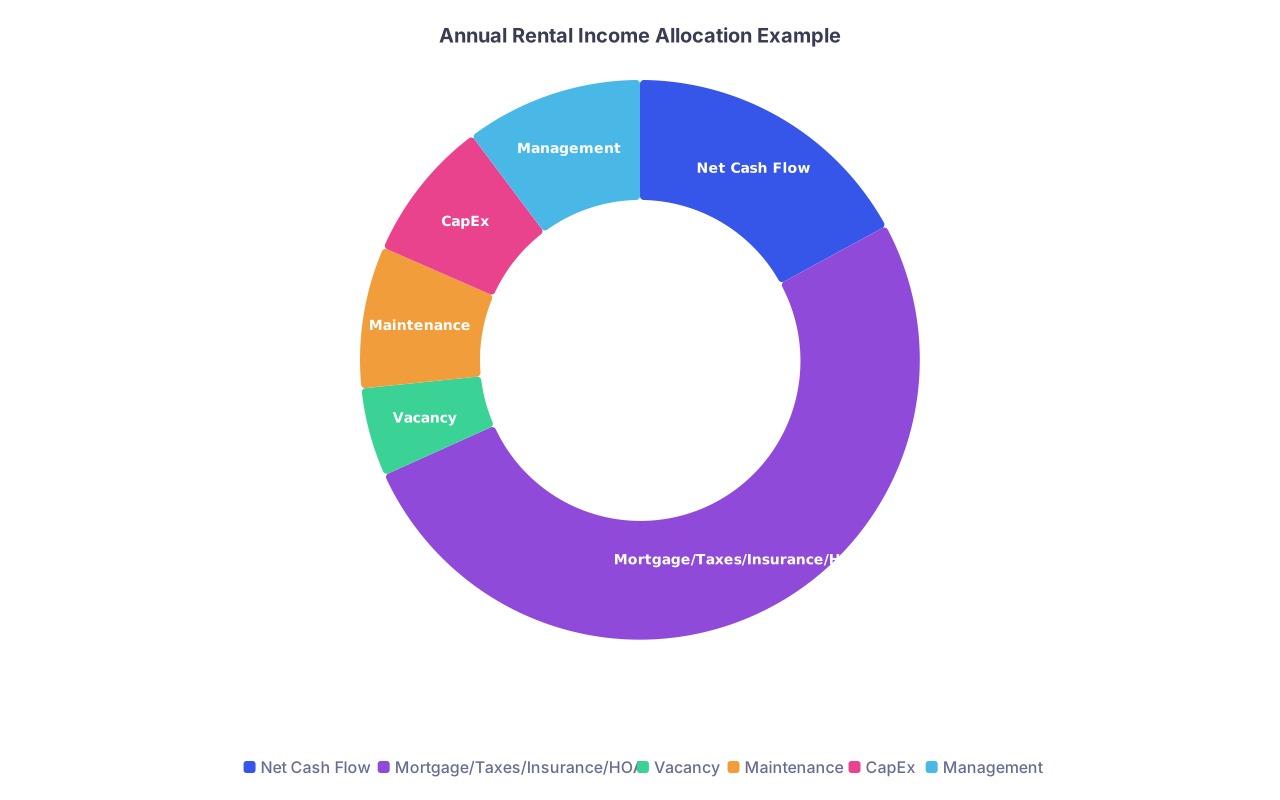
So if monthly rent is $3,000 ($36,000/year):
- Vacancy (5%): $1,800
- Maintenance (8%): $2,880
- CapEx (8%): $2,880
- Management (10%): $3,600
- Total “soft costs”: $11,160 / year, or ~$930 / month
That is before mortgage, taxes, insurance, and HOA.
If you still cash flow positive after this, you have a real rental.
| Category | Value |
|---|---|
| Net Cash Flow | 6000 |
| Mortgage/Taxes/Insurance/HOA | 18000 |
| Vacancy | 1800 |
| Maintenance | 2880 |
| CapEx | 2880 |
| Management | 3600 |
9.2 Reserve Strategy for a Single Property
Minimum reserve target:
- 3–6 months of total rental expenses:
- Mortgage
- Taxes
- Insurance
- HOA
- Average maintenance
Keep this in:
- High-yield savings or
- Money market fund linked to your rental account
Never rely solely on your general emergency fund for property shocks. Compartmentalize.
Step 10: Execute a Clean Conversion Checklist
Here is your “do not forget this” list. Print it. Check boxes.

| Step | Description |
|---|---|
| Step 1 | Decide to Rent |
| Step 2 | Review Mortgage Terms |
| Step 3 | Call Lender |
| Step 4 | Update Insurance |
| Step 5 | Decide on LLC |
| Step 6 | Open Rental Bank Account |
| Step 7 | Prepare Lease and Screening Criteria |
| Step 8 | Set Up Bookkeeping |
| Step 9 | List Property for Rent |
| Step 10 | Place Tenant |
| Step 11 | Inform CPA and Start Depreciation |
Walk-through:
- Decision and plan:
- Clarify timeline and exit
- Confirm rough financial viability
- Financing:
- Review mortgage occupancy clause
- Call lender; document conversation
- Legal structure:
- Consult local real estate attorney if using LLC
- If LLC: form, get EIN, open bank account, deed transfer
- Insurance:
- Convert to landlord/dwelling policy
- Add/check umbrella coverage
- Financial operations:
- Open rental-only bank account
- Set up simple bookkeeping
- Tax setup:
- Inform CPA about conversion and dates
- Confirm depreciation and passive loss plan
- Compliance:
- Research local rental registration/inspection rules
- Fix obvious safety issues and code items
- Tenant readiness:
- Get state-specific lease
- Define screening criteria
- Decide self-manage vs hire PM
- Go live:
- Market property
- Screen tenants
- Sign lease with correct entity/owner
- After occupancy:
- Track income/expenses monthly
- Set up reserves
- Calendar reminder for primary residence exclusion window if planning to sell
The Bottom Line for Physicians Turning Homes Into Rentals
Three points matter most:
Treat this like a real business, not a side experiment. Separate bank accounts, clean bookkeeping, proper insurance, and written processes turn a risky “accidental landlord” situation into a controlled asset.
Protect your downside first: legal, tax, and liability. You already have plenty of professional risk. Use a proper lease, strong insurance and umbrella, and, if appropriate, an LLC and local legal guidance to keep a tenant problem from becoming a personal financial disaster.
Run the numbers ruthlessly and plan your timeline. If the property cannot support itself with realistic assumptions, call it what it is—a lifestyle decision, not an investment. If you plan to sell, watch the 2-in-5-year primary residence clock and coordinate with your CPA so you do not hand the IRS a huge, avoidable check.
Do those three well, and your vacant primary stops being a liability and starts behaving like what you want it to be: a safe, boring, cash-generating rental that quietly builds wealth while you practice medicine.