
Only 17–22% of physician–limited partners in private real estate deals can correctly state all the fees they are paying when you ask them cold. Yet they are wiring $50,000–$250,000 per deal.
That disconnect is where syndication fees and splits either quietly compound wealth for you—or quietly bleed it out.
Let me walk through what the market data actually shows as “fair” right now, grounded in numbers, not marketing decks. And how to run the math fast enough that no GP sales pitch can outrun your calculator.
The Standard Fee Stack: What Sponsors Actually Charge
Across 2021–2024 U.S. real estate syndications (multifamily, self‑storage, industrial, medical office), sponsor fee data clusters in a pretty tight band. The labels vary, but the stack is remarkably similar.
Most deals include some combination of:
- Acquisition fee
- Asset management fee
- Property management fee (often via third party)
- Disposition/sale fee
- Refinance fee (less common but increasing)
- Promote/carried interest (the “split” over a preferred return)
- Occasionally: construction/development fees, loan guaranty fees, organization fees
Typical ranges from sponsor offering documents, investor surveys, and aggregator data (2022–2024 vintages):
| Fee Type | Typical Range |
|---|---|
| Acquisition Fee | 1–3% of purchase price |
| Asset Management Fee | 1–2% of effective revenue or equity |
| Property Management | 3–8% of collected rents |
| Disposition/Sale Fee | 0.5–2% of sale price |
| Refinance Fee | 0.5–1% of new loan |
Those are nominal ranges. But the right question is not “Is 2% bad?” The right question is: “What does this do to my actual net IRR and equity multiple?”
Splits and Preferred Returns: What Is “Market” Now?
Most physician‑facing offerings are structured with a preferred return plus a split. The pref is presented as some kind of protective floor. It is not. It is a priority, not a guarantee.
From current offerings and platforms that cater heavily to high‑income professionals:
Preferred returns:
- 6–7%: increasingly common in core‑plus and stabilized assets
- 7–8%: common in value‑add multifamily, self‑storage
- 8–10%: seen in heavier value‑add or smaller/private groups trying to look competitive
Splits:
- 70/30 (investor/sponsor): most common baseline
- 80/20: more investor‑friendly, often when fees are higher elsewhere
- 60/40: more sponsor‑friendly, sometimes justified by very small deal size or heavy operational intensity
Waterfalls:
- Single tier: 7–8% pref, then 70/30 to infinity. Simple.
- Two tier: 7–8% pref, then 70/30 to maybe 13–15% IRR, then 50/50 above.
- Three tier: increasingly common on institutional‑style offerings but less common in small physician‐focused deals.
Aggregated across popular platforms and confidential OMs I have seen the last few years, something like this captures the center of gravity:
| Asset Type | Typical Pref | Typical Split | Notes |
|---|---|---|---|
| Value-add multifamily | 7–8% | 70/30 | Sometimes 50/50 above 15% IRR |
| Core-plus multifamily | 6–7% | 70/30 or 80/20 | Lower pref, cleaner structure |
| Self-storage | 7–8% | 70/30 | Refi fee more common |
| Medical office | 6–7% | 70/30 | Lower projected IRR, more stable |
Anything meaningfully worse than this for you—as the capital—needs very strong justification in the deal economics or a track record that is bulletproof.
How Fees Move Your IRR: Real Numbers, Not Brochures
Sponsors love to say “We only win if you win.” The data says: not quite. They “win” at acquisition, at refinance, at sale, and every year in between via asset management fees—long before your IRR is known.
Let’s run a clean example.
Assume:
- Purchase price: $20,000,000
- Equity: $8,000,000 (you and other LPs)
- Hold: 5 years
- Projected sale: enough to generate a gross 15% IRR to equity before fees
- Structure A: 7% pref, 70/30 split, 2% acquisition fee, 1.5% asset management fee on equity, 1% sale fee
- Structure B: 7% pref, 80/20 split, 1% acquisition fee, 1% asset management on equity, 0.5% sale fee
Reasonable assumptions, consistent with current offerings.
Step 1: Acquisition fee impact
- Structure A: 2% of $20M = $400,000
- Structure B: 1% of $20M = $200,000
On an $8M equity raise, that is:
- A: 5.0% of investor equity disappears day 1
- B: 2.5% of investor equity disappears day 1
That alone shaves roughly 0.4–0.7 percentage points off annualized IRR, depending on project performance. Most LPs never quantify it; they just accept “2% is standard.”
Step 2: Asset management fee impact
Assume equity stays roughly constant for simplicity.
- A: 1.5% × $8M × 5 years = $600,000
- B: 1.0% × $8M × 5 years = $400,000
Difference: $200,000 over 5 years. That is 2.5% of original equity again, or about another 0.2–0.4% IRR drag.
Step 3: Sale/disposition fee
Assume sale at $26M (just to have a number): 30% total equity gain gross is plausible for a 15% IRR holding 5 years.
- A: 1% of $26M = $260,000
- B: 0.5% of $26M = $130,000
Difference: $130,000, or ~1.6% of original equity.
Now stack the deltas:
- Higher acquisition fee: $200,000
- Higher asset management: $200,000
- Higher sale fee: $130,000
Total delta: $530,000 charged to the same $8,000,000 equity stack.
You just paid an extra 6.6% of your original investment to get the same property and same business plan, purely as a function of fee structure. That is before we even touch the promote split.
In IRR terms, across a 5‑year hold, that kind of fee load difference generally cuts 0.8–1.3 percentage points off your annualized return. On a supposed 15% IRR deal, you might actually be at 13.7% and have no clue why the realized numbers feel smaller than the glossy pro‑forma.
Sponsors know this. Very few walk you through it line by line.
What “Fair” Looks Like by Fee Type
Forget the sponsor pitch and the soft language. Let’s talk thresholds.
Acquisition Fee: 1–2% is the real “market,” 3% is sponsor‑friendly
Data from actual offerings:
- <1%: Rare, usually GP co‑invest heavy or institutional co‑sponsor. LP‑friendly.
- ~1%: Common on larger (> $50M) deals. Reasonable.
- 1.5–2%: Standard on $5–$30M acquisitions. Market‑normal.
- 2.5–3%: Market‑high. Often justified by smaller deal, heavy value‑add, or marketing to less sophisticated capital (including physicians).
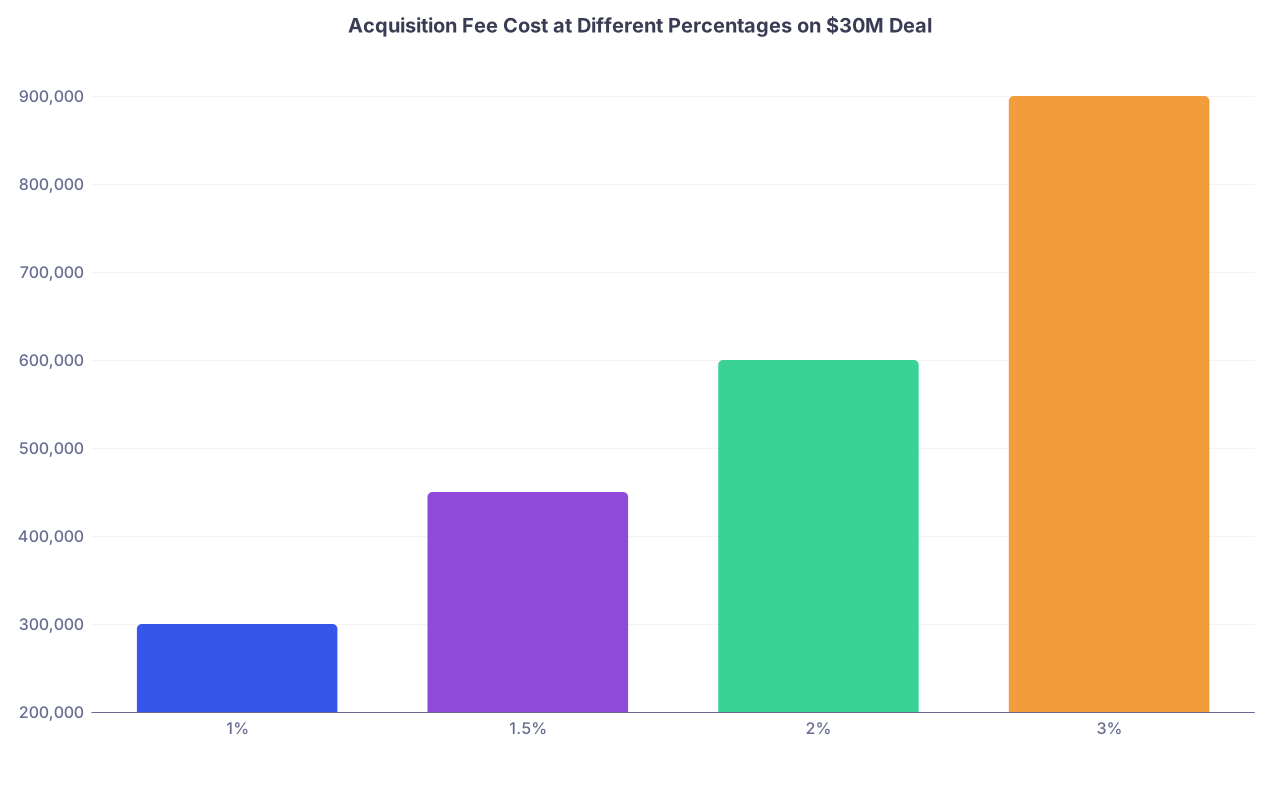
On a $30M building, the progression looks like this:
| Category | Value |
|---|---|
| 1% | 300000 |
| 1.5% | 450000 |
| 2% | 600000 |
| 3% | 900000 |
That $600,000 difference between 1% and 3% is pure drag on your capital from day one. For the same asset. Same rent roll. Same city.
A fair band for most mid‑sized deals: 1–2%. Anything at 3% needs a compelling reason or a much more investor‑friendly promote.
Asset Management Fee: % of equity beats % of revenue
Common structures:
- 1–2% of “effective gross income” (EGI)
- 1–2% of equity
- Flat per‑unit fee (multifamily)
What the data shows:
- 2% of EGI on a 60% expense ratio property can be equivalent to 5–8% of net operating income (NOI). Surprisingly high.
- 1.5% of equity across the board is more predictable and easier to model.
On a $20M property with $8M equity, EGI of $2.4M and NOI of $1M:
- 2% of EGI = $48,000
- 1.5% of equity = $120,000
So you cannot just assume “lower % is better.” It depends which base you are applying it to.
Fair bands:
- 1–1.5% of equity for typical value‑add deals, or
- 1–2% of revenue for very small properties where equity is thin
What you should reject outright: stacked asset management fees (e.g., 2% of EGI + 1% of equity). That is double dipping.
Property Management: 3–8% of rent, but check alignment
Property management is usually a straight cost passed through to the deal. Market:
- 3–4%: Larger multifamily, strong competition
- 5–8%: Smaller buildings, scattered site, or niche assets
Where this turns bad for you: when the sponsor owns the property management company and also charges an asset management fee. They are effectively getting paid twice to oversee the same operations. That is not “wrong” per se, but the total combined fee load must be clearly disclosed and competitive.
Disposition / Refinance Fees: small % but big dollars
Typical:
- 0.5–1% of sale price
- 0.5–1% of new loan on refi
A 1% sale fee on a $30M exit is $300,000. On an $8M original equity raise, that is 3.75% of your original invested capital leaving your pocket at the end.
Fair bands:
- 0.5–1% disposition fee if there is no refi fee
- 0.5% sale + 0.5% refi at most, not stacked to 1% + 1% on every capital event
Anything above that and your sponsor is monetizing transaction volume, not just value creation.
Promote / Splits: The Real Economic Engine
The carried interest—how profits are split after the pref—is where sponsors can make multiples of what they earn in fixed fees. And where your real return gets shaped.
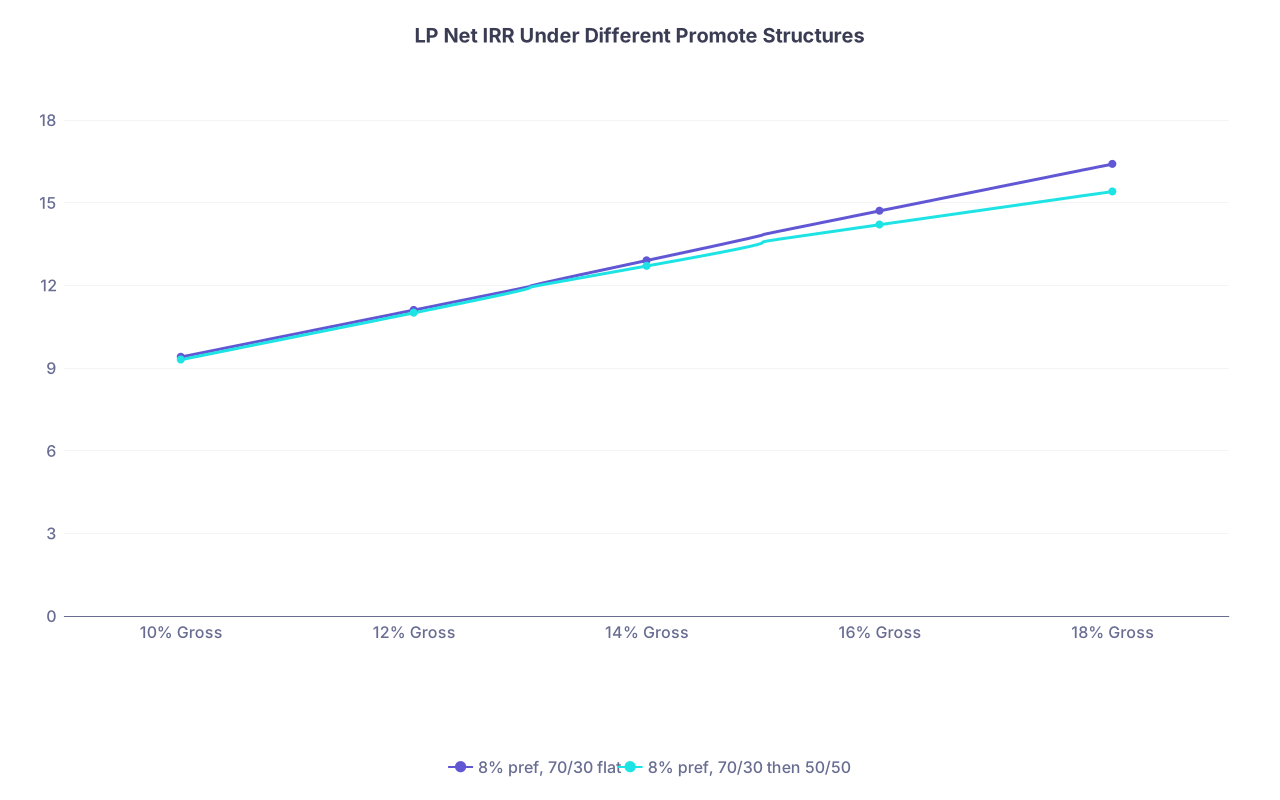
Let’s compare two structures on a deal that genuinely produces a 16% gross IRR to equity before promotes and ongoing fees.
- Structure 1: 8% pref, 70/30 thereafter, no second hurdle
- Structure 2: 8% pref, 70/30 to 15% net IRR, then 50/50 above 15%
Run the math, and you see a pattern that looks roughly like this (numbers illustrative but directionally accurate):
| Category | 8% pref, 70/30 flat | 8% pref, 70/30 then 50/50 |
|---|---|---|
| 10% Gross | 9.4 | 9.3 |
| 12% Gross | 11.1 | 11 |
| 14% Gross | 12.9 | 12.7 |
| 16% Gross | 14.7 | 14.2 |
| 18% Gross | 16.4 | 15.4 |
Headline:
- At modest performance (10–12% gross IRR), the structures are almost identical for you.
- At strong performance (16–18% gross), the second hurdle starts to bite. You leave ~0.5–1.0 percentage point of IRR on the table in exchange for the sponsor’s upside.
Is that “fair”? It can be. If the sponsor is truly adding alpha—finding off‑market deals, executing complex business plans, handling lender relationships—you should absolutely be fine with them being well‑paid when performance is strong.
What is not fair: back‑ending a 50/50 promote above 12–13% IRR on a very plain, low‑complexity asset. That is just sponsor greed dressed up as sophistication.
General thresholds I see as acceptable for most physician LPs:
- 7–8% pref, 70/30 flat to infinity: very fair
- 7–8% pref, 70/30 then 50/50 above 14–16% IRR: fair if other fees are reasonable and the business plan is complex
- 6% pref, 60/40 with extra hurdles: sponsor‑tilted unless you are getting institutional‑grade access or unusually strong co‑invest
What “All‑In” Looks Like: Fee Load vs. Performance
Single fees do not kill you; cumulative fee load does. You need to think in terms of total economic drag.
Using pooled data and pro‑forma walkthroughs, the pattern is roughly:
“Lean” structures (lower fees, simpler promotes):
- Typical LP net IRR discount vs. property‑level IRR: 2–3 percentage points
- So a property earning 15–16% unlevered IRR might deliver 12–14% to you.
“Heavy” structures (higher acquisition, double AM fees, aggressive promote):
- IRR discount: 4–6 percentage points
- That same property might only deliver 10–11% to you while the sponsor points to [property performance] and calls the deal a success.
In plain language: the difference between a fair structure and a fee‑bloated structure is often the difference between you being happy and you quietly wondering why your net worth is not compounding as fast as the slide decks implied.
Quick Diagnostic: Is This Deal Fair?
Let us be blunt. You do not have time for 40‑page spreadsheet models in between cases and call. You need a fast triage process.
Here is a simple heuristic I use when physicians send me deals:
Acquisition fee
- ≤2% of purchase price: pass
2%: yellow flag, needs offset somewhere else
Asset + property management combined
- If same party controls both, I want combined fees to feel competitive versus market third‑party rates
- Anything that looks like “2% of EGI + 1.5% of equity” is a problem
Pref and split
- Pref ≤6% on a value‑add execution: red flag in current rate environment
- Split worse than 70/30 at the first tier: yellow flag unless asset is exceptional
Extra fees
- Refi fee, guaranty fee, construction management fee—these are not automatically bad, but if I see all of them stacked with high promotes, I stop reading
Sponsor co‑invest
- If the sponsor has <5% of total equity at risk, I want fees to be more investor‑friendly, not less
If a deal fails 2 or more of those five checks, the probability that you are overpaying the sponsor is high. I do not care what the projected IRR says on page 2.
Legal Reality: What “Fair” Means When Things Go Wrong
From a legal and regulatory standpoint, there is surprisingly little hard law around what fee levels are “fair.” The standard is disclosure and alignment, not price control.
What actually matters:
- Are all fees and promotes clearly disclosed in the PPM and operating agreement?
- Is there any double dipping or conflict of interest that is not clearly spelled out?
- Is the sponsor a registered investment adviser or operating under an exemption, and are they following their own representations?
For you as a physician investor, this means:
- You cannot rely on regulators to save you from overpaying.
- “But that fee was too high” is not a good argument later if it was written in black and white in your documents.
Your protection is mainly upfront: negotiating or walking away.
How Physician‑Focused Deals Compare
Physician‑only or physician‑centric groups often market themselves as “by doctors, for doctors.” Some are excellent. Some just know you have income, low time, and modest deal experience.
Patterns I have seen repeatedly:
- Acquisition fees consistently at the top of the “market” band (2.5–3%)
- Asset management fees stacked with related‑party property management
- Prefs of only 6–7% on deals that look like standard value‑add
- Splits of 70/30 with additional 50/50 hurdle at low IRR thresholds
When you quantify the economics, many of these “doctor‑only” structures produce all‑in economics worse than the better institutional co‑GP platforms or diversified syndication platforms—while projecting the same headline IRR.
In other words, physician branding does not equal physician‑friendly terms. The data would argue almost the opposite: niche branding often coincides with more sponsor‑favorable fees.
A Simple Framework to Compare Two Deals
Let me put this into a comparison you can reuse.
Imagine two multifamily offerings you are looking at for a $100,000 investment.
Deal X:
- 8% pref, 70/30 flat
- 1.5% acquisition, 1.5% AM on equity, 1% sale
- Target net IRR to LPs: 14%
Deal Y:
- 7% pref, 70/30 to 14%, then 50/50
- 2.5% acquisition, 2% AM on equity, 1% sale + 0.5% refi
- Target net IRR to LPs: 14%
On marketing materials, they look equivalent. Same asset type, same city, same projected LP IRR.
But if you normalize for the fee stack using simple adjustments (shaving IRR for fee differences based on historical patterns), you are likely to find:
- Deal X’s 14% “target” is closer to its real LP number if gross assumptions hold
- Deal Y’s 14% target depends heavily on best‑case assumptions and sponsor‑friendly modeling; your realized outcome is likely lower if anything underperforms
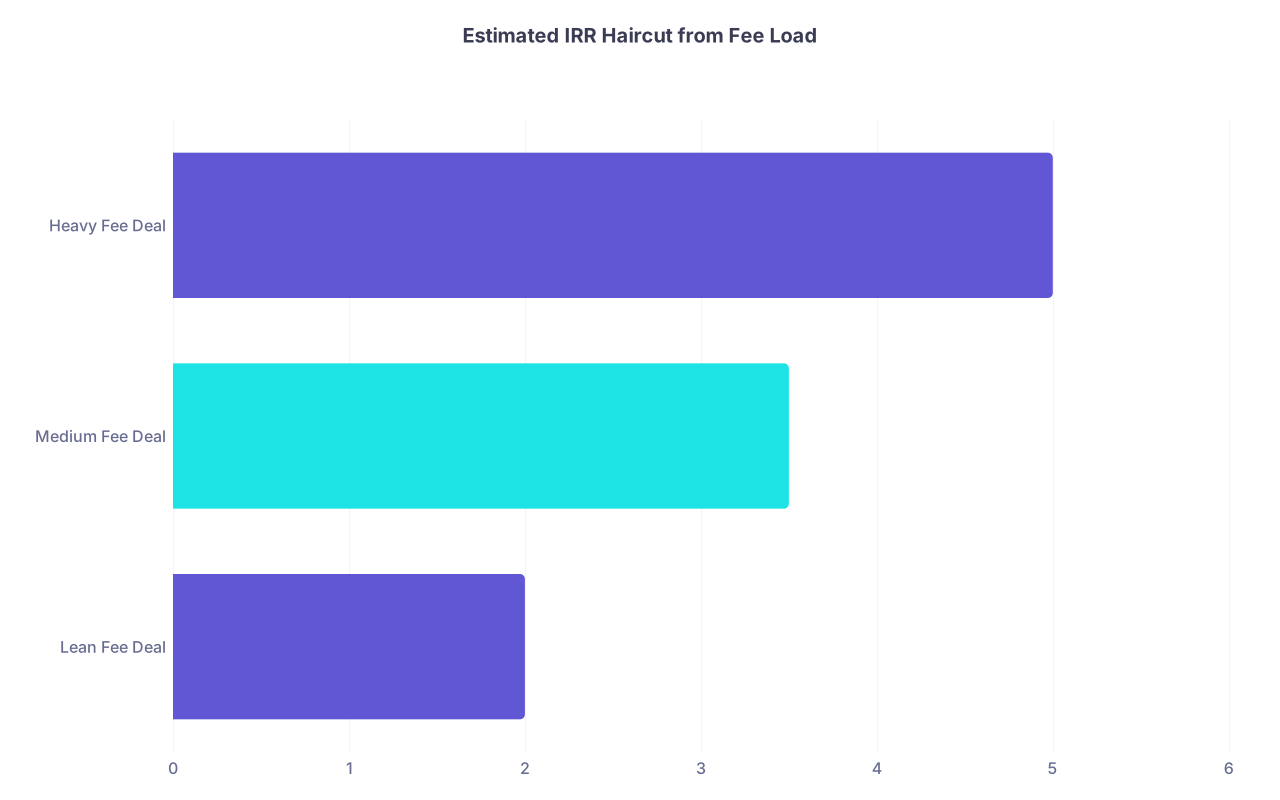
You can think in terms of “fee haircut”:
| Category | Value |
|---|---|
| Lean Fee Deal | 2 |
| Medium Fee Deal | 3.5 |
| Heavy Fee Deal | 5 |
If average property‑level IRR is 17%:
- Lean fee deal might reasonably deliver ~15% net to you
- Medium fee might deliver ~13.5%
- Heavy fee might drop you down near 12%
That 3‑point spread is the difference between doubling your money in 5 years versus needing closer to 7.
Final Thoughts: What Market Data Calls “Fair”
Cutting through the marketing, here is where the data clusters for physician LPs in real estate syndications today:
A fair structure for most mid‑sized value‑add deals looks like:
- 7–8% preferred return
- 70/30 split (maybe 50/50 only above a truly high IRR)
- 1–2% acquisition fee, ≤1.5% asset management on equity, ≤1% sale fee, no stacked hidden fees.
“Doctor‑only” branding does not imply better economics.
- The actual numbers show many physician‑targeted groups charge at the top end of market fees and promotes, not the middle. Read and compare, do not assume.
Your real protection is understanding total fee load and promote structure.
- If you can quantify how many percentage points of IRR are likely being shaved off by fees, you will say “no” to a lot more deals—and say “yes” to the ones where sponsor and investor both win on the same numbers.