
You’re in the conference room. Coffee’s already cold. The managing partner is sitting next to a polished “VP of Physician Integration” from the local health system. The slide on the screen says “Strategic Alignment and Growth Opportunities.”
You’re not thinking about “alignment.” You’re thinking:
Am I about to make more money or less?
This is the right question. Because once your group sells to a hospital or health system, the economics of your job change. Your leverage changes. Your risk changes. The story you’re going to be told is: “We can’t give you a clear long‑term guarantee, but trust us, it will be fine.”
Do not trust that story without running the math yourself.
Here’s what usually happens to physician pay when a hospital buys a group, and what to do at each stage if you’re in the middle of it (or about to be).
1. The 3–Phase Pay Story in Most Hospital Buyouts
Let me simplify what I’ve watched play out over and over again:
Phase 1: The Honeymoon (Years 0–2)
Phase 2: The “Alignment” (Years 2–5)
Phase 3: The Squeeze (Year 3 onward, or sooner if the hospital’s margins tank)
If you understand these three phases, you stop being surprised.
Phase 1: The Honeymoon – “Buyout + Strong Guarantee”
Here’s what usually shows up in the initial offer:
- A buyout/check to partners (for assets and goodwill)
- Employment contracts (or PSA deals) with:
- 1–3 year guaranteed base salaries, often at or above your trailing compensation
- RVU rates that look decent compared with MGMA medians
- Call pay, signing bonuses, maybe relocation or retention bonuses
- “Productivity bonus” structure that seems complicated but harmless
The purpose is not charity. The purpose is to get you to sign and stop shopping other options. And to make sure your key revenue generators do not walk.
During this phase, your income may:
- Go up slightly (common for previously underpaid PCPs, hospitalists, some outpatient subspecialties)
- Stay similar (often for surgical subspecialists who were already doing very well)
- Appear higher when you include the partner buyout check, but your annual pay is flat or slightly down
You’ll hear: “We’re using MGMA benchmarks,” “We want to be market competitive,” “You’ll be protected from payer turmoil.”
What you need to do here:
Separate one‑time money from ongoing pay. Your partner distribution / buyout is not your “salary.” It’s selling equity. Do not mentally blend that with your annual income.
Ask directly for a written Year 1–3 compensation schedule, not just “target wRVUs” and “expected productivity.”
Get exact details on:
- Base salary for each year
- RVU rate for each year
- How call, non‑RVU work, and admin time will be paid
- Who controls your schedule and template
If they “don’t have those details finalized,” that’s not a minor admin issue. That’s your life.
2. How Your Compensation Model Usually Changes
There are only a few standard hospital models. Almost everything is a variation on these.
| Model Type | Years Used | Risk to Physician | Typical Impact on Pay |
|---|---|---|---|
| Straight Guarantee | 1–2 | Low | Stable / slight bump |
| Base + RVU | 2–5 | Medium | Depends on volume |
| Pure RVU | 3+ | High | Often downward drift |
| Salary + Quality | 2–5 | Medium | Flat if quality met |
| Salary + Shared Savings | 3+ | High (variable) | Rare upside |
Model 1: Straight Guarantee
You might see this especially in primary care, hospitalist, anesthesia, EM, or if your group’s numbers are messy.
- “You’ll get $260k/year for 2 years, no productivity requirements.”
- Or: “We’ll pay your trailing 3‑year average net income for 2 years as a base.”
What happens:
- Year 1: Feels good. Less anxiety.
- Year 2: Admin starts talking about “productivity alignment” and “fair market value.”
This model ends. It’s a bridge. Not a destination.
Model 2: Base + RVU Bonus
Extremely common. Your contract might look like:
- Base salary: $250k
- RVU threshold: 4,500 wRVUs
- RVU rate: $50/wRVU above threshold
So if you generate 6,000 wRVUs, you get 1,500 extra wRVUs paid at $50 = $75,000 bonus. Total comp $325k.
On paper? Fine. In reality? It depends on:
- Who controls your schedule and template
- How much non‑billable junk they pile on you
- How aggressive they are with RVU thresholds in renegotiations
When hospitals want to “normalize” pay, they push:
- Higher thresholds
- Lower wRVU conversion factors
- More “quality” and “citizenship” metrics tied to your bonus
Model 3: Pure RVU (with a small floor)
This is where many groups end up 3–5 years after acquisition.
- Minimal base (say $180–220k)
- Everything else is RVU‑based
- RVU rate might start attractive, then slide
The pattern I’ve seen:
Year 1–2: $52–55/wRVU
Year 3: “Market review” → $48/wRVU
Year 5: $44–46/wRVU with higher thresholds and more non‑RVU time expectations
You’re now fully volume‑dependent in a system that controls referrals, scheduling, and staffing. They hold the faucet. You hold the bucket.
3. The Subtle Ways Your Pay Gets Pulled Down
Let me walk through the moves hospitals use that don’t show up directly as “salary cuts” but absolutely hit your income.
1. RVU Creep and “Market Adjustments”
Every few years, compliance/legal does a “fair market value” review. Translation: “We want your comp closer to MGMA median but still keep your volume.”
Typical script:
- “Our analysis shows your wRVU rate is above market.”
- “To ensure compliance, we’re adjusting your RVU rate from $52 to $46.”
- “But your base salary will remain unchanged.”
You do the math later and realize that cut just cost you $30–60k/year.
2. Productivity Targets Go Up
You’ll see targets like:
- Original: 5,000 wRVUs
- New: 5,500 or 6,000 wRVUs for the same or slightly lower pay
Then the system adds:
- EMR tasks
- More mandatory meetings
- Longer quality reporting
- Extra inbox work that doesn’t generate RVUs
Same hours, more non‑billable tasks, higher productivity expectations. That’s a pay cut hidden in “alignment.”
3. Call and Extra Work Devalued
Before the buyout, your group might have:
- Paid call at a decent stipend
- Residual profits from the call burden shared among partners
Post‑acquisition, common switch:
- Call rolled into base salary
- Call stipends cut “for budget reasons”
- Extra coverage framed as “part of being a team player”
You will be told, “Everyone in the system does this.” That doesn’t pay your mortgage.
4. Benefits and Taxes Quietly Change the Bottom Line
You may superficially be “making the same money” while actually taking home less.
Examples:
- Loss of pre‑tax partner distributions → now all W‑2 ordinary income
- 401(k) limits apply vs. previously having defined benefit or cash‑balance plans
- Health insurance cost shares may go up
- CME, licensing, and dues budgets shrink
On paper: $350k before versus $350k after.
In your pocket after taxes and expenses: very different numbers.
4. What Actually Happens to Pay by Specialty
Let’s be blunt. Some specialties tend to do ok in hospital deals. Some get hammered.
This isn’t absolute, but here’s the pattern I’ve seen repeatedly.
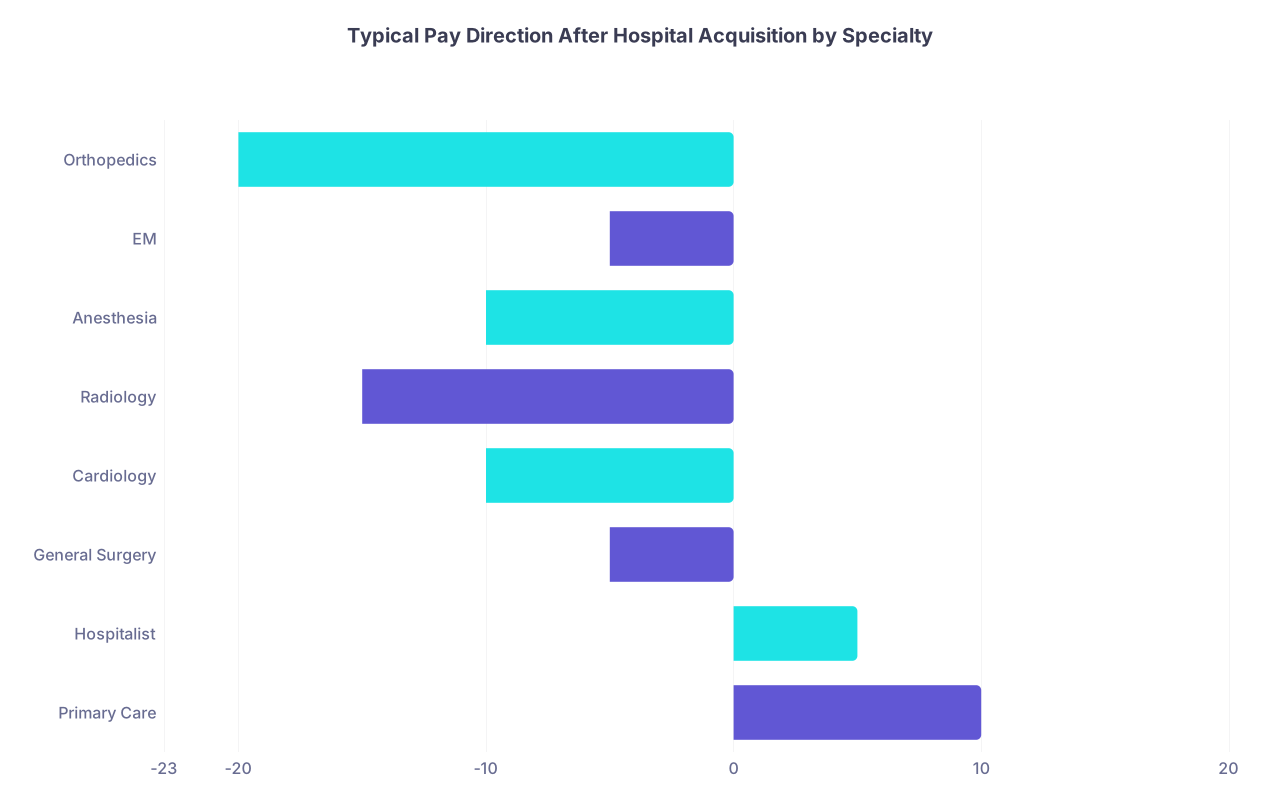
| Category | Value |
|---|---|
| Primary Care | 10 |
| Hospitalist | 5 |
| General Surgery | -5 |
| Cardiology | -10 |
| Radiology | -15 |
| Anesthesia | -10 |
| EM | -5 |
| Orthopedics | -20 |
(Values are rough % change over 3–5 years: positive = up, negative = down.)
Primary Care (IM/FM/Peds Outpatient)
Short term, many PCPs see:
- Small raise (especially if they were underpaid in a small private group)
- More stable paycheck
- Less direct business risk
Medium term:
- Compensation often flattens
- Quality metrics and RVU expectations increase
- Panel size targets grow
Net: Often modestly better or equal, but at the cost of autonomy and time.
Hospitalists
If your hospitalist group is bought:
- You may shift from partnership/share model to employed model
- Shift pay/hour usually holds ok initially
- Schedules get more rigid, census caps more “flexible”
Hospitals desperately need hospitalists. They know it. It gives you bargaining power if your group has backbone and can credibly threaten to walk. Most don’t.
Surgical Subspecialties / Ortho / ENT / Urology
This is where the real long‑term squeeze often shows up.
Pre‑acquisition:
- Strong collections
- Ownership in ancillaries (ASC, imaging, PT)
- Control over scheduling and block time
Post‑acquisition:
- Collections to hospital
- You get an RVU rate and maybe some quality bonus
- Ancillary revenue is gone or massively diluted
Early years: you might be held level or close.
3–5 years out: most high producers lose ground compared with what they could have earned staying independent or joining a strong private group/ASC model.
Radiology / Anesthesia / EM
These are often contracted services. When a hospital buys the group or forces an alignment:
- They may squeeze stipends over time
- Coverage requirements grow
- Locum and overtime pay gets tightened
- Night/weekend coverage normalized into salary
Some systems simply replace entire groups if they don’t like the negotiation. You are replaceable in their eyes. And they act like it.
5. The Core Legal/Economic Constraints: Stark and FMV
You’ll hear “Stark” and “fair market value” used as if they’re natural laws. They’re not. They’re tools. And they’re often used selectively.
Stark Law / Anti‑Kickback Basics (Short Version)
Hospitals cannot blatantly overpay you for referrals. So they lean on:
- MGMA/AMGA benchmarks
- Outside FMV consultants
- Compliance/legal saying: “We cannot approve comp above the 75th percentile for your specialty.”
What that means for you:
- If you’re a true outlier producer (90th+ percentile), they will not pay you in proportion to that production over the long term. They’ll cap you with FMV talk.
- Initial deals might “stretch” to get the acquisition done. Later, compliance uses the same laws to drag you back down.
You don’t win arguing the law. You win by controlling your alternatives and walking if the model is bad.
6. If You’re Being Courted Right Now: What to Do
Here’s the concrete playbook if the hospital is circling your group.
Step 1: Get Your Own Historical Data
Do not walk into negotiations blind. As a group (or individually), pull:
- The last 3 years of:
- Collections by physician
- wRVUs by physician
- Partner distributions vs. base draws
- Call coverage patterns and stipends
- Ancillary income (ASC, imaging, labs, PT, etc.)
You cannot compare offers without knowing your true current compensation, including all sources.
Step 2: Separate “Price for the Practice” from “Ongoing Pay”
Two different negotiations:
- Entity sale price / partner buyout
- Individual physician employment contracts
Hospitals love to blur them. They’ll throw a big number at the senior partners and quietly underpay everyone going forward.
If you’re not a partner, you especially need to focus on #2. The buyout check may never touch you.
Step 3: Demand a Written Compensation Model, Not Just Buzzwords
You want it in black and white:
- Exact base salary by year
- Exact RVU rate by year
- RVU thresholds and whether they can be unilaterally changed
- How often the “FMV review” happens and whether there’s a guaranteed floor
- What counts as work time that’s not RVU producing and how it’s paid (meetings, QI, teaching, committee work)
Verbal assurances mean nothing once admin leadership turns over. And it will.
Step 4: Coordinate as a Group (Even If Informally)
Hospitals do best when they pick you off one by one, offering slightly different deals and playing the “early signers get better terms” game.
Your move:
- Share information transparently among the physicians
- Agree on minimum acceptable terms as a group
- Use one retained physician‑side attorney or consultant to review the deal for everyone (not the hospital’s lawyer dressed up as “neutral”)
You’re not forming a union. You’re just refusing to be blind.
7. If You’re Already Employed and the Squeeze Has Started
Different situation. The deal is done. You’re in years 2–5. Honeymoon is over. The emails about “system alignment” are landing.
Your options are narrower, but you’re not powerless.
1. Get the Redline: Know Exactly What’s Changing
When they bring you a “new standardized contract”:
- Sit down and line‑by‑line compare old vs. new
- Write down:
- Change in base salary
- Change in RVU rate
- Change in thresholds
- New quality/citizenship requirements
- Change in call compensation
Quantify the hit. Do not rely on their “total target compensation” slide.
2. Calculate Your Real Take‑Home with Taxes and Benefits
Sometimes a slightly lower nominal salary could be offset by:
- Better retirement match
- Cheaper/freer health insurance
- More paid time off (if you can actually take it)
But most of the time, cuts are cuts. Run actual numbers.
3. Decide: Stay and Optimize… or Plan an Exit
Staying and optimizing means:
- Minimizing non‑RVU busywork where possible
- Pushing for protected time or stipend if they want heavy committee/admin work
- Negotiating at contract renewal for at least partial restoration of prior terms
Planning an exit means:
- Quietly exploring other private groups, neighboring systems, or different markets
- Looking at mixed models (locums part‑time + part‑time employed)
- For high producers: seriously considering ASC or private equity options that still leave you upside
You don’t announce this. You just keep your options real, not theoretical.
8. Watch the Timeline: When Cuts Usually Show Up
There’s a rhythm to this.
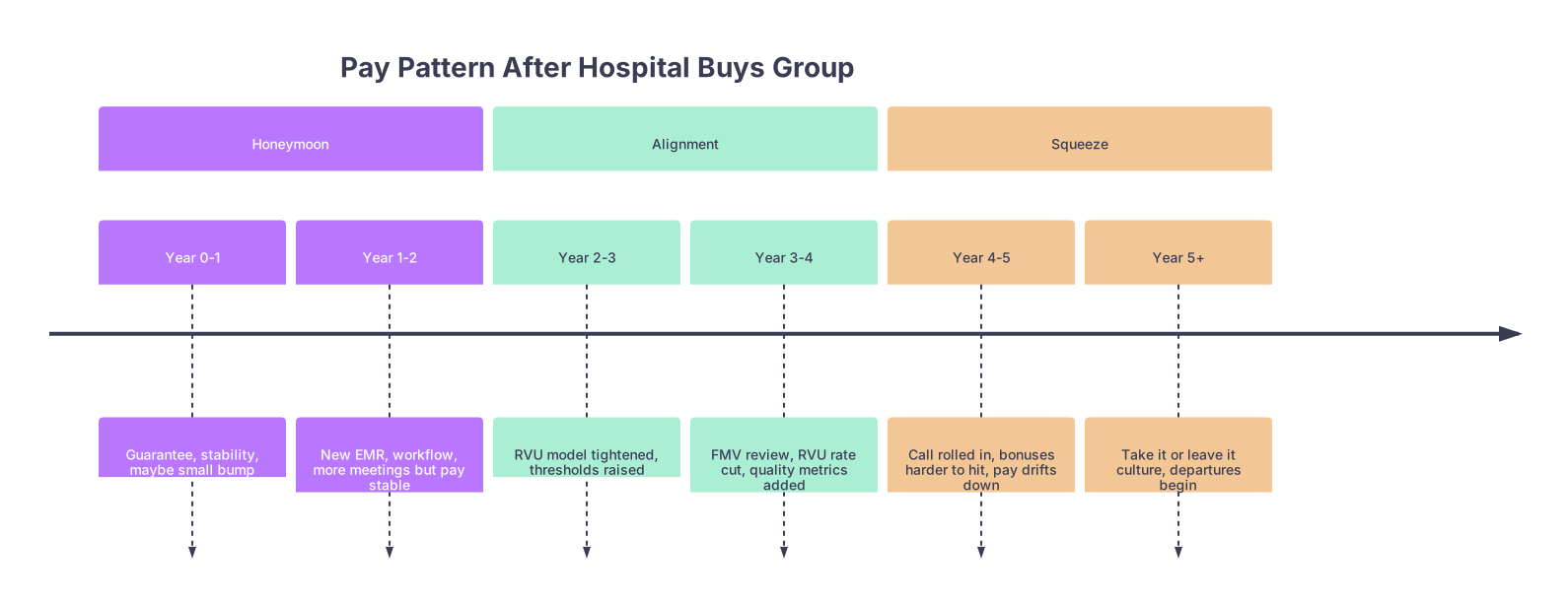
| Period | Event |
|---|---|
| Honeymoon - Year 0-1 | Guarantee, stability, maybe small bump |
| Honeymoon - Year 1-2 | New EMR, workflow, more meetings but pay stable |
| Alignment - Year 2-3 | RVU model tightened, thresholds raised |
| Alignment - Year 3-4 | FMV review, RVU rate cut, quality metrics added |
| Squeeze - Year 4-5 | Call rolled in, bonuses harder to hit, pay drifts down |
| Squeeze - Year 5+ | Take it or leave it culture, departures begin |
If you’re in Year 0–1, use that time to:
- Build savings
- Kill high‑interest debt
- Strengthen your CV and connections
If you’re in Year 3–5, assume the next contract will be worse unless you negotiate collectively or have exit leverage.
9. A Quick Reality Check: Why Hospitals Rarely Overpay Long Term
Hospitals are not stupid. They’re just misaligned with you.
Their goals:
- Lock in referral streams
- Capture facility fees and ancillary revenue
- Keep physicians “aligned” and predictable
- Control labor costs within system‑wide margins
Paying you top‑of‑market forever doesn’t fit that model. So even if they make an aggressive offer upfront, gravity pulls it back down.
Your goals:
- Fair pay for your actual work and value
- Reasonable control over schedule and clinical decisions
- Ability to grow your income if you work harder or bring more value
Those two sets of goals overlap only partially. The rest is friction. If you understand that clearly, you stop being shocked when the squeeze comes.
10. What You Should Actually Do Right Now
If your group is being bought, or might be, this is your checklist:
- Get 3 years of your true current comp (including ancillaries and call) down on paper.
- Demand a specific, written, multi‑year compensation model from the hospital. Percentiles and “targets” are not enough.
- Coordinate with your colleagues; do not negotiate as isolated individuals if you can avoid it.
- Assume the initial guarantee is temporary. Judge the deal by Years 3–5, not Year 1.
- Quietly build your Plan B: other employers, other markets, locums, or private models.
If you remember nothing else:
- First, the hospital buys the group.
- Then, over a few years, the hospital buys back your upside.
Your job is to decide whether the trade is worth it for you, on your terms, with your eyes open.