
The biggest mistake physicians make going part‑time is letting the hospital treat it like a “favor” instead of a business deal.
You are not asking for a gift. You are selling fewer hours of the same high‑value labor. If you do not anchor the conversation correctly and know the math, you will get quietly underpaid. Sometimes by six figures.
Let’s fix that.
Step 1: Get Clear On Why You’re Reducing FTE (Because It Changes the Strategy)
Before we talk numbers, you need to be brutally honest with yourself about the reason you’re cutting back. Different reasons call for different negotiation tactics.
Common real‑world scenarios:
- Burned out in a brutal 1.0 FTE job; want 0.7–0.8 FTE to survive.
- Childcare or eldercare responsibilities; need predictable hours and fewer call shifts.
- Portfolio career: mixing clinical work with teaching, admin, consulting, or side gigs.
- Pre‑retirement glide path: want to ratchet down without walking away.
- Geographically trapped (spouse job, kids in school) so leverage is limited.
If you’re in category 1, 3, or 4, you usually have more negotiating power. You want fewer hours but you could walk. Use that.
If you’re in category 2 or 5 and feel “stuck,” you’re at higher risk of accepting bad deals disguised as “flexibility.” You have to compensate for less external leverage by being more disciplined with your internal rules. Hard lines you will not cross.
Write down—literally, on paper—three numbers:
- The minimum FTE you can tolerate (e.g., 0.6, 0.7).
- The maximum FTE you’re willing to work (anything above this is overtime rate, not “pitching in”).
- The minimum total annual comp that makes it worth staying.
Those three numbers will keep you from agreeing to nonsense when you’re tired in a conference room with an administrator saying, “We’re all trying to be flexible here.”
Step 2: Understand the Math Behind Part‑Time Physician Pay
Most systems say they’ll “prorate” compensation. Then they quietly do two things:
- Reduce salary roughly in proportion to FTE.
- Fail to proportionally reduce the workload, call, meetings, and expectations.
That’s where you get screwed.
Here’s the baseline math you need in your head.
Core concepts
Think in three buckets:
- Base salary – Paid for being there (clinic/rounding/admin sessions).
- Variable compensation – wRVU bonuses, productivity incentives, quality metrics.
- Benefits value – Health, retirement match, CME, disability, malpractice tail.
You want each of these to be either:
- Fairly pro‑rated by FTE, or
- Explicitly uncoupled from FTE with clear rules (e.g., benefits at or above 0.5 FTE).
| Component | 1.0 FTE | 0.7 FTE Fair | 0.7 FTE Bad Deal |
|---|---|---|---|
| Base salary | $300,000 | $210,000 | $180,000 |
| wRVU target | 6,000 | 4,200 | 5,000 |
| Benefits value | $40,000 | $28,000 | $10,000 |
| Call coverage | 1 in 5 | 1 in 7–8 | Still 1 in 5 |
The “bad deal” is what shows up more often than you think: they cut your base and benefits more than proportional, leave productivity expectations roughly the same, and forget to touch call.
Step 3: Know the Pressure Points in Part‑Time Negotiations
You’re not just negotiating dollars. You’re negotiating what those dollars are buying.
There are five levers that matter most:
FTE definition
What exactly is 1.0 FTE in your group? 8 half‑days of clinic? A certain number of shifts? A minimum wRVU? Until this is defined, “0.7 FTE” is meaningless.Clinic/shift load
For ambulatory specialties: number of half‑days and template slots.
For shift‑based (EM, hospitalist, anesthesia): number of shifts per month.wRVU or productivity expectations
The target must fall exactly in line with your fractional FTE. Full stop.Call and nights/weekends
This is where people get exploited. You cannot be 0.6 FTE and 1.0 call.Benefits thresholds
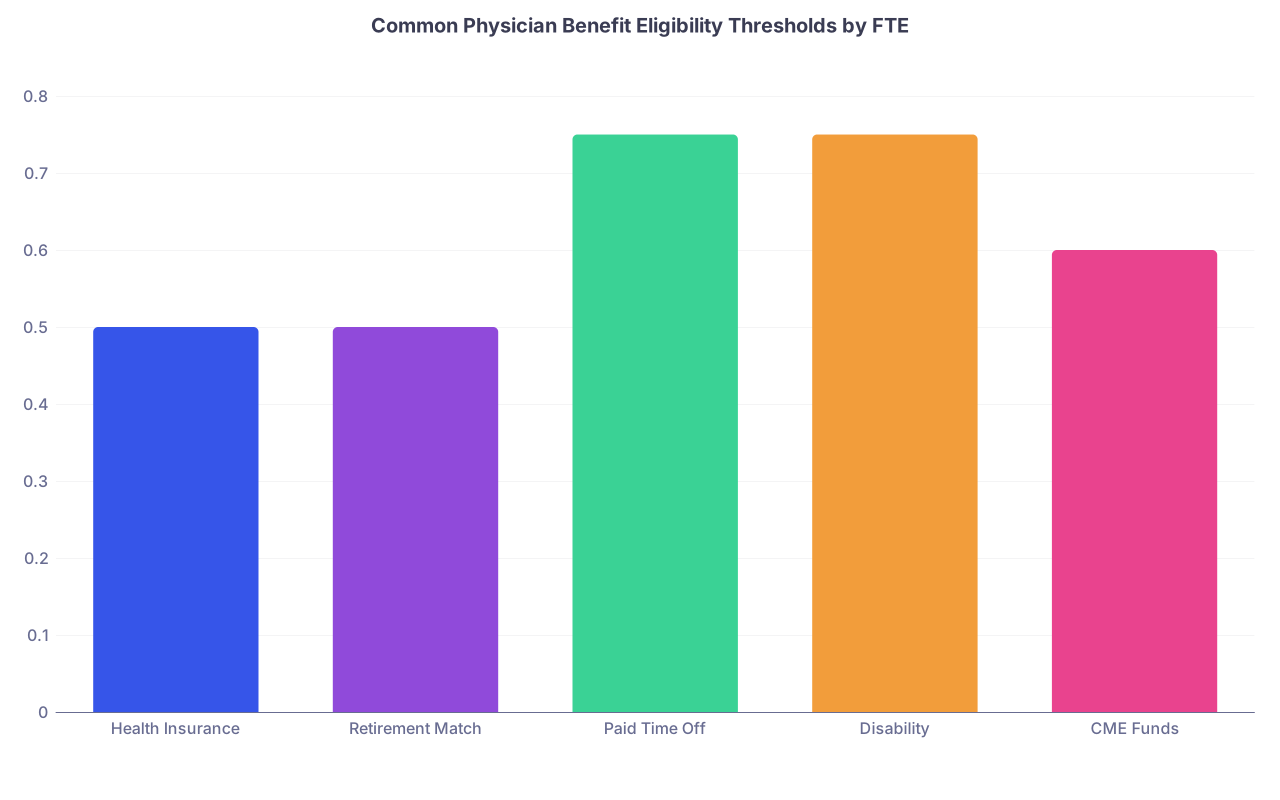
Most systems have cutoffs: 0.5 FTE, 0.75 FTE. Below certain levels, benefits fall off a cliff.
You need to know the current rules before you suggest your ideal FTE so you don’t accidentally land on the wrong side of a benefits cliff.
| Category | Value |
|---|---|
| Health Insurance | 0.5 |
| Retirement Match | 0.5 |
| Paid Time Off | 0.75 |
| Disability | 0.75 |
| CME Funds | 0.6 |
(Those numbers are typical thresholds—your institution will have its own exact cut points.)
Step 4: Run the Numbers Before You Talk to Anyone
You’re a physician. You can handle basic spreadsheets. Use that brain.
Take your current setup and model 2–3 realistic part‑time options.
Example: Full‑time outpatient IM doc
- Base: $240,000
- wRVU bonus: $20 per wRVU over 5,000
- Typical wRVU: 6,000
- Benefits: $35,000 value
- Total effective compensation around $335,000
You’re considering 0.7 FTE.
You’d propose:
- Base: $240,000 × 0.7 = $168,000
- wRVU target: 3,500 (0.7 × 5,000)
- Same $20 per wRVU over 3,500
- Expected wRVU: 4,200 (0.7 × 6,000)
- Benefits: at least 0.7 × $35,000 = $24,500, ideally unchanged if you’re above benefits threshold
- Total expected: ~$168,000 + (700 × $20 = $14,000) + benefits = ~$206,500
Then compare that to what they offer. If they come back with:
- Base: $150,000
- wRVU target: 4,500
- Benefits cut to $10,000
…you can calmly say:
“This isn’t a pro‑rated 0.7 FTE. It’s closer to a 0.9 FTE workload with 0.6 FTE pay. That’s not workable for me.”
It sounds far more powerful when you say it with specific numbers you already ran.
Step 5: How to Frame the Ask Without Sounding Apologetic
You’re not begging for crumbs. You’re proposing a business arrangement.
Here’s a basic script you can adapt:
“I’d like to move to a 0.7 FTE structure starting July. Here’s how I’m thinking about it. Right now 1.0 FTE is 8 half‑days of clinic and a wRVU target of 5,000. At 0.7 FTE, that would be 5–6 half‑days and a wRVU target of 3,500, with base salary and benefits pro‑rated accordingly. Call and administrative expectations should also scale to 0.7 FTE. I’ve put together a simple breakdown if that’s helpful.”
Notice what you’re doing:
- You define 1.0 FTE for them.
- You present a coherent 0.7 FTE model, not a vague “less work.”
- You assume proportional fairness as the default. They have to argue against fairness.
If they immediately say, “We don’t usually do it that way,” your response is:
“Help me understand how you define FTE here then. What does 1.0 FTE mean in terms of clinic, call, and wRVUs?”
Do not negotiate against a fog. Force clarity.
Step 6: Protect Yourself From the Most Common Traps
I’ve seen the same five traps over and over in part‑time deals.
Trap 1: Full call, fractional pay
Scenario: You go to 0.7 FTE. They cut your salary. Then someone says, “But call is shared equally among partners.”
Translation: You’re subsidizing everyone else.
Fix:
- Set a principle: Call is proportional to clinical FTE or separately compensated.
- Example language:
“If I’m 0.7 clinical FTE, then my call should be 70% of full‑time, or we can keep it equal with a call stipend that closes the gap in effective compensation.”
If they refuse to budge on this, that’s a flashing red light about the culture.
Trap 2: Same wRVU target, less guaranteed time
They “allow” you to drop to 0.8 FTE salary but your wRVU target stays the same.
Call it what it is:
“That’s just a pay cut, not a reduction in workload.”
You either proportionally reduce the wRVU target, or you get a higher wRVU payout rate to account for increased marginal productivity.
Trap 3: Admin work and meetings stay at 100%
You’re “part‑time,” but still at every meeting, committee, and mandatory in‑service. No reduction in expectations. No compensation.
You need two lists: clinical duties and nonclinical duties. Both must be explicitly tied to FTE.
For nonclinical stuff, I like language such as:
“At 0.6 FTE, I’d expect my required committee and meeting time to also be 0.6 of full‑time expectations, with any additional work either voluntary or separately compensated.”
Trap 4: Benefits cliff
I’ve seen physicians drop from 0.8 to 0.74 FTE and unknowingly nuke their retirement match.
Before you suggest a number like “0.7 FTE sounds nice,” ask HR very direct questions:
- At what FTE do I:
- Keep full health insurance?
- Keep full retirement match?
- Keep disability and life coverage?
- Keep CME time and funds?
Then design your FTE proposal to land on the correct side of those cliffs. Sometimes 0.75 FTE with full benefits is better than 0.6 FTE with gutted benefits once you do the math.
Trap 5: “We’ll just see how it goes”
Verbal promises like: “We’ll make sure your schedule is lighter” or “We’ll try to keep your panel smaller.”
No. That’s how you end up doing full‑time work with part‑time pay.
Everything must be in writing:
- Number of half‑days or shifts per month.
- Template slots per clinic session.
- Expected wRVUs or encounters per FTE.
- FTE‑tied call schedule or specific call stipend.
If they say, “We don’t usually put that level of detail in contracts,” the answer is:
“Given how significant this change is for my income and family, I need it to be explicitly defined. That way we both know what we’re agreeing to.”
Step 7: Use the Right Legal and Financial Backup
You’re dealing with two separate risk zones: contract language and long‑term financial impact.
Contract review
You absolutely should have a physician‑savvy attorney look at a new or modified contract, especially when FTE is changing.
Specific clauses to check:
- Term length and exit conditions if the part‑time setup is intolerable.
- Non‑compete and geographic restrictions if you need a second gig.
- wRVU and bonus calculation definitions.
- Any language about “duties as assigned” that can be abused.
Short version: if the contract lets them define your “duties” later, you don’t really have a part‑time agreement. You have a part‑time salary with elastic work.
Financial planning
Going from $350k to $230k isn’t just “less take home.” It affects:
- How soon you reach financial independence.
- Debt payoff timelines.
- College savings.
- Your ability to walk if things go sideways.
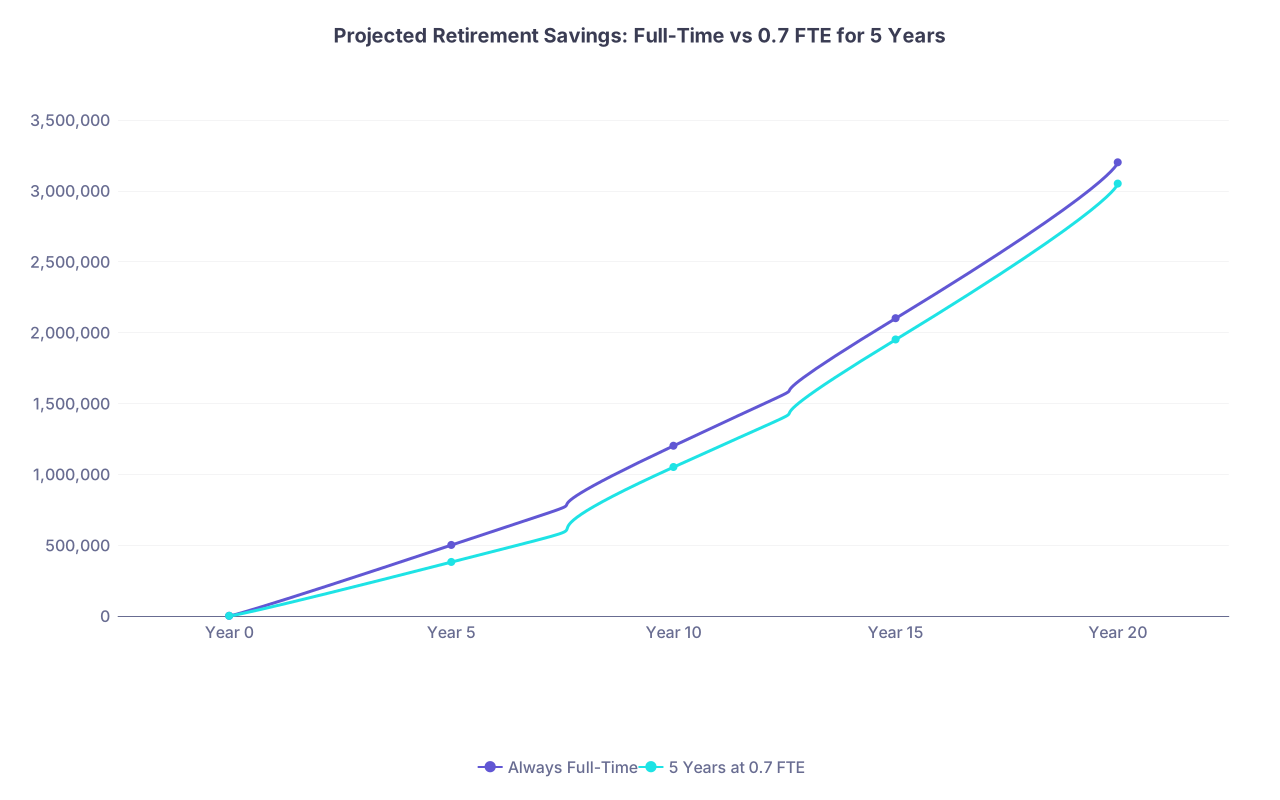
Sit down with a planner or, at minimum, run your own projections: How does 0.7 FTE for 5 years affect your 15‑year plan? Sometimes a temporary part‑time stretch is absolutely worth it. Sometimes it quietly delays retirement by a decade.
| Category | Always Full-Time | 5 Years at 0.7 FTE |
|---|---|---|
| Year 0 | 0 | 0 |
| Year 5 | 500000 | 380000 |
| Year 10 | 1200000 | 1050000 |
| Year 15 | 2100000 | 1950000 |
| Year 20 | 3200000 | 3050000 |
That gap may be acceptable. Or not. But you should choose it consciously.
Step 8: If You’re Already in a Bad Part‑Time Deal
A lot of you are reading this after you agreed to something that now feels unfair. You’re 0.6 “part‑time” doing 0.9 work, carrying normal call, and you’re exhausted and resentful.
You’re not stuck.
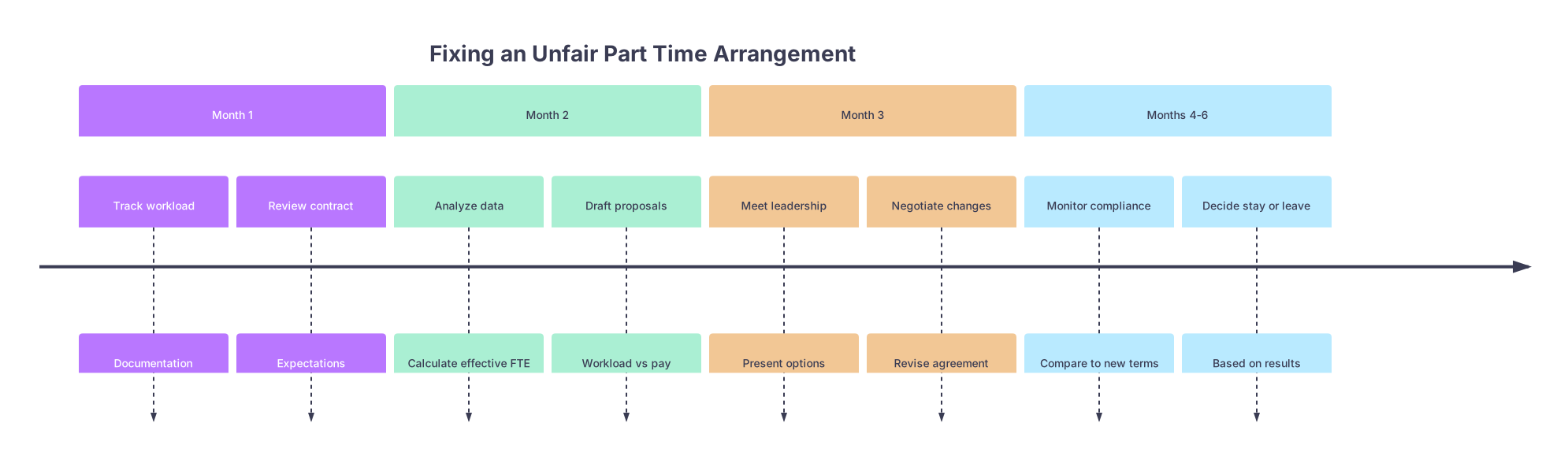
Here’s the rehab plan:
Document your actual workload for 2–4 months.
Number of clinics, shifts, calls, after‑hours messages, meetings. Cold numbers.Compare to written expectations.
If the contract is vague, that vagueness is your leverage: “We need to define this.”Convert workload to an “effective FTE.”
If your group calls 8 half‑days 1.0 FTE and you’re consistently working 7, you’re effectively at 0.875 FTE.Request a structured meeting framed as “alignment,” not complaint.
Example:“When we set up my 0.6 FTE schedule, the intent was fewer hours and a similar per‑FTE rate. Based on the last 3 months of data, my active clinical and call workload is closer to 0.85 FTE. I’d like to either:
- Bring the workload down to true 0.6 FTE, or
- Adjust compensation to reflect the actual FTE I’m working.”
Offer two concrete proposals.
Administrators like options they can “choose.”- Option A: Reduce call and clinic sessions.
- Option B: Raise base + add call stipend.
Set a personal timeline.
If there’s no movement in 3–6 months, have a plan B: another employer, locums, or mixing multiple part‑time roles.
| Period | Event |
|---|---|
| Month 1 - Track workload | Documentation |
| Month 1 - Review contract | Expectations |
| Month 2 - Analyze data | Calculate effective FTE |
| Month 2 - Draft proposals | Workload vs pay |
| Month 3 - Meet leadership | Present options |
| Month 3 - Negotiate changes | Revise agreement |
| Months 4-6 - Monitor compliance | Compare to new terms |
| Months 4-6 - Decide stay or leave | Based on results |
Step 9: Special Cases – Academic, Hospital‑Employed, and Private Practice
Not all settings play by the same rules.
Academic physicians
Academia loves “mission” talk to underpay physicians, especially women and parents, for part‑time roles.
Things to watch:
- Protected time: If you’re 0.6 FTE clinically but still on the same teaching/admin expectations, you’re not part‑time.
- Promotion clocks: Clarify how reduced FTE affects tenure or promotion timelines. Get it in writing.
- Grants: If you’re funded, your percent effort on grants vs clinical FTE must line up so you’re not double‑promised.
Hospital‑employed
You’re dealing with HR structure and “policy.”
Leverage points:
- Ask for their written FTE and benefit policy. Not the “what we usually do,” but the actual document.
- Use internal equity: “Dr. X is 0.8 FTE; how is hers structured?” They hate inconsistent treatment that might look discriminatory.
Private practice
Here, the politics matter more than the HR policies.
Things that actually work:
- Tie your FTE to ownership share or overhead contribution.
Example: 0.6 FTE = 60% of full overhead, 60% share of profits, 60% of call. - Be explicit about future partnership track: Does part‑time slow it, freeze it, or not affect it?
If they can’t articulate a clear model, what they usually mean is “You’re not really a partner; you’re a flexible worker we’ll carry as long as it’s convenient.” Decide if that’s acceptable.
Step 10: Walk in With a One-Page Term Sheet
Do not expect administrators to build a good structure for you from scratch. They’ll default to their standard template and “tweak.”
You should walk in with a simple one‑pager:
- Proposed FTE: 0.7
- Clinical work:
- X clinics/half‑days per week
- Template: Y patients per session
- Expected wRVUs: Z per year
- Call:
- 0.7 share of weekday/weekend call or separate call stipend of $____ per call
- Compensation:
- Base: $____ (pro‑rated from current)
- wRVU bonus structure: unchanged per RVU, target scaled to 0.7 FTE
- Benefits:
- Health: full/partial, per HR policy for ≥0.__ FTE
- Retirement: match based on 0.7 salary
- CME: $____ and ____ days
- Duration and review:
- Initial term: 1–2 years
- Formal review at 6–12 months with the option to adjust FTE up or down
That single page changes the entire tone of the discussion. You’re not the “burned‑out doc asking for accommodations”; you’re a professional offering a clear, structured deal.
The Bottom Line
Three things to walk away with:
Part‑time or reduced FTE should be a proportional trade, not a discount. Your base, workload, call, and wRVUs must all line up mathematically with your FTE, or you’re subsidizing the system.
Everything that matters needs to be defined in writing. FTE definition, clinic/shift numbers, call, benefits thresholds, wRVU targets, and bonus formulas. If it’s vague, assume it will tilt against you.
You’re not asking for a favor; you’re restructuring a business relationship. Show up with your numbers, your term sheet, and a clear bottom line—and be prepared to walk if they only offer you “flexibility” at a steep financial and workload cost.