
The biggest mistake physicians make when moving countries is chasing the headline salary and ignoring everything that actually determines what lands in their bank account.
If you are thinking about an international move as a physician, you are not negotiating a job. You are negotiating an entire financial life: salary, taxes, benefits, risk, and exit options. Get that wrong and I have seen people lose six figures over a few years—easily.
Let’s walk through what you actually need to do, step by step, if you’re in this situation.
Step 1: Forget the Sticker Salary, Calculate Your Real Take‑Home
Hospitals and recruiters love big numbers. “€250,000 base” or “£140,000 consultant salary” or “$500,000 tax‑free in the Gulf.” It sounds huge until you run the math.
You need a side‑by‑side comparison of your current life vs the proposed job.
| Item | Current Country | Destination Country |
|---|---|---|
| Gross annual salary | $350,000 | €260,000 |
| Estimated income tax/social | $115,000 | €120,000 |
| Employer pension contributions | $20,000 | €10,000 |
| Effective monthly net pay | $19,600 | €10,800 |
Here is how to build that comparison properly.
A. Get accurate tax estimates (not guesses)
Use a local accountant, not just an online calculator. You want:
- Income tax brackets and marginal rates
- Social security / national insurance / payroll taxes
- Mandatory pension contributions
- Local taxes (city, provincial, church, etc., depending on country)
If this is a US physician moving abroad (or foreign physician moving to US), and you are a US citizen or green card holder, you must factor in:
- US worldwide taxation
- Foreign Earned Income Exclusion (FEIE)
- Foreign tax credits
- State exit issues (e.g., California not letting go easily)
Do not DIY this if you are moving to or from the US. Pay someone who handles expats for a living. One consult can save you way more than their fee.
B. Convert salary the right way
Currency conversion is not just “today’s rate on Google.”
You need to think:
- Exchange rate trend – some currencies are stable (CHF, USD), some swing a lot (TRY, some emerging markets).
- Your obligations – if you still have US loans in dollars but earn in euros, currency risk is real.
- Contract currency – are you paid in local currency, USD, or a mix?
Use a realistic, slightly conservative exchange rate when planning. If the whole move only “works” financially at the best case exchange rate, that’s a red flag.
C. Factor in cost of living like an adult, not a tourist
This is where people lie to themselves.
You do not care what a loaf of bread costs. You care about:
- Housing similar to what you actually want to live in
- Schooling for your kids (public vs private, international schools)
- Childcare
- Car vs public transport, parking, insurance
- Health insurance gaps even in “universal” systems
- Travel home once or twice a year

| Category | Value |
|---|---|
| Housing | 35 |
| Schooling/Childcare | 20 |
| Taxes & Social | 15 |
| Transportation | 10 |
| Travel Home | 10 |
| Other | 10 |
Do a mock budget in the new country:
- Go to local rental sites, look at actual listings in neighborhoods you’d realistically live in.
- Check tuition for international schools if your kids do not speak the local language.
- Estimate flights home for your family, economy class, at realistic peak and off‑peak prices.
Now compare: net monthly income minus real monthly expenses in each place. That’s the only number that matters.
Step 2: Understand How Your Tax Status Actually Changes
This is where doctors get burned because they assume “I’ll just pay tax where I work now.” Sometimes true. Sometimes very wrong.
A. Residency vs citizenship vs physical presence
Three big buckets determine tax:
- Tax residency – where the local law says you are a tax resident (often >183 days, but not always that simple).
- Citizenship rules – especially for US citizens/green card holders (taxed on worldwide income).
- Treaty rules – double taxation treaties between your home and host country.
You need clear answers to:
- In year 1, will I be considered tax resident in the old country, the new country, or both?
- When does that residency status flip?
- How will my bonuses / moving stipends be taxed depending on which year they land?
Double taxation is not just theoretical. I have seen people effectively taxed twice because they left in July, got a big bonus in December, and both countries claimed it. You stop that by structuring and timing income before you sign.
B. Special expat regimes
Many countries have special “highly skilled migrant” or “expat” tax deals:
- Netherlands 30% ruling
- Portugal’s (changing) non‑habitual resident rules
- Italy’s “impatriate” regime
- Some Gulf states with zero income tax but other hidden costs
Ask specifically:
- Do physicians fall under any special regime?
- For how many years?
- What happens when it expires?
If the financial picture only looks good because of a time‑limited regime, your contract should not be pretending otherwise. You negotiate now for what happens then.
Step 3: Tear Apart the Contract—Then Rebuild It for an International Move
Most physician contracts are written like you’re moving across town, not across continents. You need different clauses.
A. Start with base vs variable compensation
You want clarity on:
- Base salary
- RVU or productivity bonuses
- Call pay / overtime
- Shift differentials
- Quality or leadership stipends
- Signing bonus and relocation package
For international moves, those last two—bonus and relocation—are crucial levers.
Signing bonus timing and structure
Push for:
- Payment after visas approved but before your actual move costs explode.
- Clear tax treatment – which country’s tax law applies to the bonus?
If you’re a US person leaving the US, you might front‑load some income into the US year if the US tax burden will be lower than in the new country. Or the reverse. This is where that tax consult from earlier pays off.
Relocation costs
You want as much reimbursement of actual expenses as possible, not just a fixed lump sum. That allows you to align with tax rules and keep proof.
Spell out:
- Shipping household goods (with a realistic cap)
- Temporary housing for X months
- Language courses
- Licensing and exam fees
- Spousal job search support (if they offer it; more common in Europe)
Step 4: Adjust for Tax, Currency, and Inflation Risk in the Contract
This is where most physicians just shrug and accept risk they shouldn’t.
A. Currency risk clauses
If you earn in local currency but have major obligations in another currency (US student loans, mortgage back home), push for protections.
Options:
- Partial salary in USD (common in Gulf postings, some international hospitals)
- FX protection clause: if exchange rate moves beyond X% from the date of signing, salary is adjusted partially
- One‑time adjustment after year 1 based on currency performance
Hospitals may resist, but serious international employers have seen this before. If they act like you’re the first person ever to ask about it, that’s telling.
B. Tax equalization or tax protection
Some employers (especially large academic centers, NGOs, global health organizations) offer:
- Tax equalization – they ensure you pay an “equivalent” tax level to your home system and they cover excess; very common in corporate expat assignments.
- Tax protection – they won’t let your taxes exceed a defined threshold without compensation.
Ask plainly: “Do you offer tax equalization or protection for international hires?” If yes, get the full policy. If no, that becomes part of your risk calculation and negotiation.
Step 5: Build in Exit, Failure, and “This Isn’t Working” Protections
Everyone pictures the best‑case: you move, you love it, your kids magically become trilingual. Reality is messier.
You must design your contract assuming:
- You might hate it.
- Your spouse might hate it.
- Your kids might not adapt.
- The hospital leadership might change six months after you arrive.
So you negotiate:
A. Notice and termination
You want clear, fair timelines:
- How much notice must you give to leave early?
- How much notice must they give you to terminate without cause?
- What counts as “cause”? Be very careful here.
In some systems (e.g., UK NHS consultants) there are pretty standard notice periods. In others (private hospitals, Gulf states) it can be much more employer‑friendly. Or downright predatory.
B. Repayment obligations
Most international contracts tie strings to your relocation and bonus money.
Get answers:
- If you leave before X years, how much of the relocation or bonus must you repay?
- Is it prorated monthly or yearly?
- What if they terminate you without cause—do you still owe it?
You should push hard for:
- Prorated forgiveness (e.g., 1/36th per month over 3 years).
- No repayment if they terminate you without cause or fail to get or maintain your visa/license.
I have seen contracts where a physician had to repay a full $50k relocation after 23 months of a 24‑month payback clause. That is either bad negotiation or a hospital counting on you not reading.
Step 6: Align Immigration, Licensing, and Start Date With Your Money
The timeline matters.
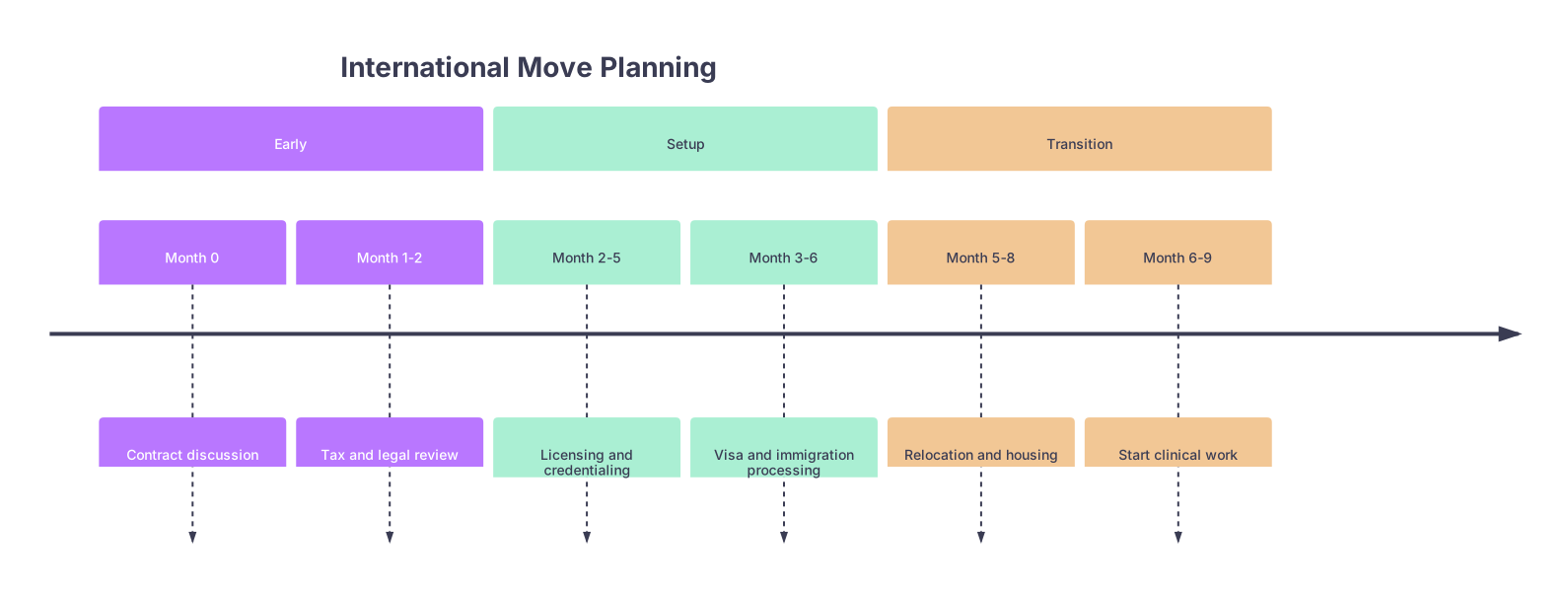
| Period | Event |
|---|---|
| Early - Month 0 | Contract discussion |
| Early - Month 1-2 | Tax and legal review |
| Setup - Month 2-5 | Licensing and credentialing |
| Setup - Month 3-6 | Visa and immigration processing |
| Transition - Month 5-8 | Relocation and housing |
| Transition - Month 6-9 | Start clinical work |
The gap between “signing the offer” and “first paycheck in the new country” can be 6–12 months. You need to:
- Negotiate a start date that fits realistic visa and licensing timelines.
- Ask about bridge income if you’ll be doing non‑clinical work (research, orientation) before full licensing.
- Clarify whether you can moonlight or work locums in your home country during the transition without jeopardizing visa status.
If there’s a lengthy unpaid gap, your signing/relocation package needs to reflect that. This is not a $5,000 moving stipend situation. This is “cover 3–6 months of income loss” territory.
Step 7: Adjust Benefits for Cross‑Border Reality
Salary is one line item. Benefits, in an international move, can be worth a shocking amount if you negotiate properly.
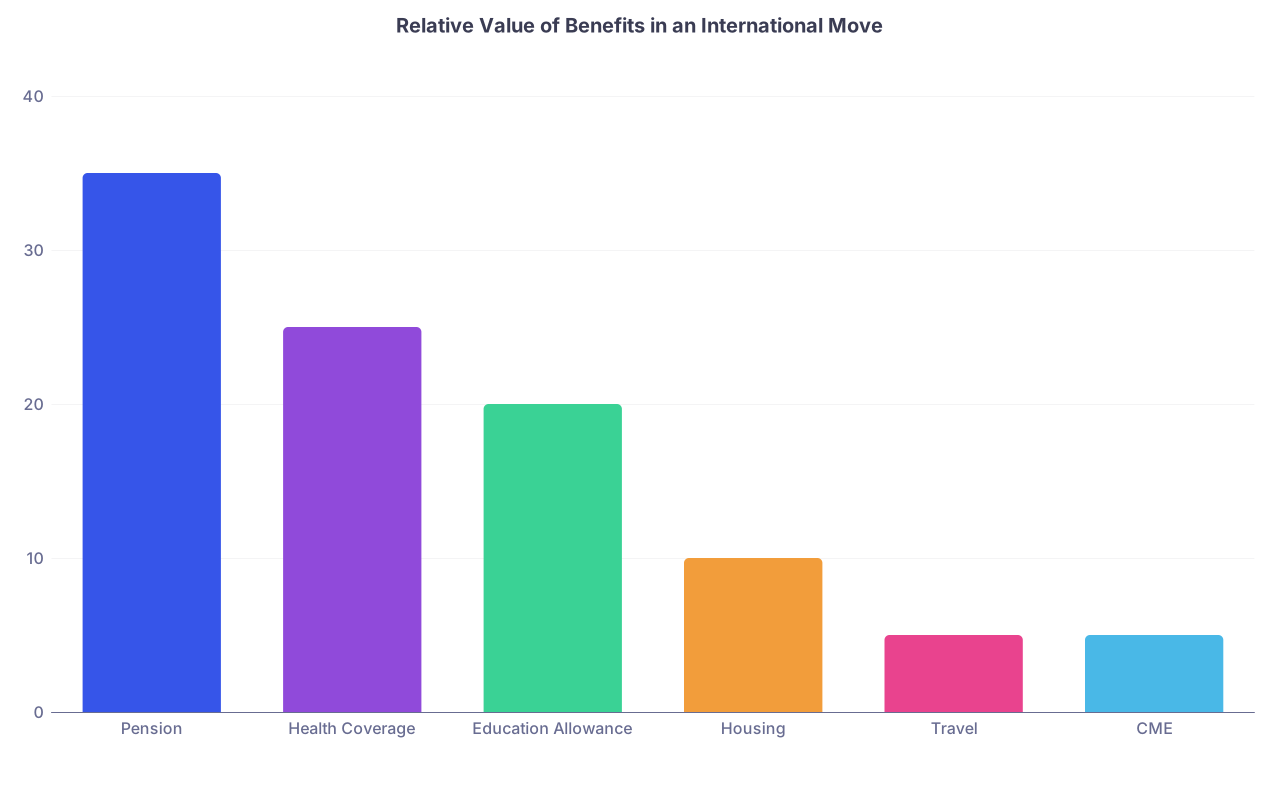
| Category | Value |
|---|---|
| Pension | 35 |
| Health Coverage | 25 |
| Education Allowance | 20 |
| Housing | 10 |
| Travel | 5 |
| CME | 5 |
A. Pension and retirement
Ask:
- Are you eligible for the national pension? From day one or after a vesting period?
- Is there an employer supplemental pension? What’s the contribution rate?
- Can you continue contributing to your home country retirement accounts in any form?
Sometimes the pension system is generous (e.g., some Scandinavian countries), but it only pays off if you stay a long time. For a 3–5 year stint, you might be better off negotiating more cash and less pension you’ll barely vest into.
B. Health insurance and malpractice
Do not assume “universal healthcare” fully covers you.
You need to know:
- What will your out‑of‑pocket costs be for yourself and your family?
- Does the employer provide private supplemental coverage?
- Malpractice coverage – scope, limits, and tail coverage if you leave.
For high‑risk specialties (OB, surgery, anesthesia), you want explicit malpractice language, not a vague “you’ll be covered under our insurance.”
C. Education and housing
If you have kids, this is huge.
Ask for:
- International school tuition support (many large employers have standard policies with caps per child).
- Temporary housing for the first 3–6 months plus help securing long‑term housing.
If they say “we do not do that,” you respond with “then the base salary needs to go up by X amount to cover this real cost.”
Step 8: How to Actually Negotiate Without Getting Stonewalled
You are not just asking for “more money.” You are trading risk and commitment.
You say something like:
“This is not a local move. I’m committing my career and my family to a new country. That comes with real financial and legal risk—taxes, currency, relocation, schooling. I’m excited about the role, but for this to make sense long‑term, I need the package to reflect those realities.”
Then you anchor your asks:
- Higher base or structured bonus
- Larger, prorated signing/relocation bonus
- Clear repayment and termination terms
- Help with taxes (at least an annual consult paid by employer)
- Education/housing allowances or higher salary in lieu
Most serious international employers expect some back‑and‑forth. If they treat any pushback as outrageous, ask yourself why they’re in such a hurry to close you with the first draft.
Step 9: Get Professional Eyes on Everything (Yes, Really)
Two people you should pay before you sign:
- An employment or contract lawyer in the destination country. Someone who regularly reviews physician contracts, not a cousin who does real estate law.
- A cross‑border tax advisor who works with people moving between your specific two countries.
You want them to look for:
- Non‑compete clauses that might trap you in a region or system
- Weird termination provisions that let them fire you cheaply
- Unenforceable or illegal clauses (which tells you about the employer)
- Tax disasters hiding in the way the bonus or relocation is structured
- Treaty interactions that affect your first 1–2 years
Yes, it costs money. Yes, it’s annoying. But you are moving your entire income stream to a new legal and tax system. Saving $1,500 on professional advice and then losing $50,000 to bad structure is not smart.
Step 10: Decide With Your Eyes Open, Not Just Your Hopes
By the time you’re ready to decide, you should have:
- A realistic, side‑by‑side net income and cost of living comparison
- Clarity on tax residency for the first two years
- A contract adjusted for:
- Relocation and bonus timing and repayment
- Currency/tax risk where possible
- Exit and termination that doesn’t destroy you financially
- A benefits picture that matches your actual life (kids, spouse, loans, retirement plans)
At that point, the decision is still personal. Maybe the pay is slightly worse but the lifestyle is dramatically better. Maybe the pay is much better but you’re taking on risk and hassle—that can be worth it too, if you admit you’re buying opportunity, not just income.
What you avoid is the worst‑case scenario: realizing 18 months in that your “big raise” is actually a pay cut after tax, inflation, currency, school fees, and debt payments. That situation is preventable if you do the hard, boring work upfront.
Do that, and your international move stops being a gamble and becomes a calculated step in your career and financial life.
With that foundation in place, your next problems become more interesting ones—career trajectory, academic opportunities, long‑term citizenship or permanent residency. But those are battles for later. First, get the money, taxes, and contract right.