
The average dual-physician couple massively underestimates how hard coordination will be.
Not emotionally. Logistically. Jobs, income, call, childcare, visas, malpractice, 401(k)s, student loans—if you do not plan this intentionally, the system will chew you up.
You’re not “just two doctors.” You’re a tiny, two-person corporation with two high-volatility jobs and very real financial leverage. Act like it.
Here’s how.
Step 1: Decide Your Couple Strategy First, Not Last
Most couples skip this and jump straight to job boards. That’s backwards.
You need a couple-level strategy before you touch contract offers. Otherwise every negotiation is chaos.
Have this explicit conversation (out loud, not implied):
What is our priority for the next 3–5 years?
- Maximizing total income?
- Protecting lifestyle/time?
- Training opportunities (fellowship, academic ladder)?
- Geography / family proximity?
- Immigration stability (if either is on a visa)?
Who is “anchor” vs “flexible”?
- Anchor = the career that’s harder to move: rare specialty, fellowship track, visa constraints, tenure clock, or the one that truly matters more to that person’s identity right now.
- Flexible = more portable specialty (IM, FM, EM, peds, hospitalist), telemedicine options, or easier market.
If you both pretend you’re equal anchors, you’ll get stuck. In reality, at any given phase, one of you should be the primary driver:
Example: She’s heme/onc on a J‑1 waiver tied to a rural site. He’s hospitalist with broad options.
- She’s the anchor. His job must wrap around her waiver site, even if it means hospitalist nights or locums for a few years.
Example: He’s applying for competitive fellowship. She’s already an attending in a very in-demand field (anesthesia).
- For 3 years, his match location drives the decision. She finds the best possible role in that city, even if temporarily suboptimal.
Your “anchor” might switch over time. That’s fine. The point is: you always know whose job sets the map right now.
Step 2: Pick Jobs as a Package Deal, Not Two Independent Hunts
If both of you just apply randomly and accept separate offers, you lose leverage and control. You want to be marketed and negotiated as a dual-physician unit whenever possible.
Here’s the playbook.
A. Target employer types that love dual-physician couples
Some systems quietly prioritize dual hires because:
- They know you’re more likely to stay.
- They get two FTEs with one recruitment cycle.
- It helps with call coverage and growth.
Examples that often play ball:
- Mid-size health systems in secondary cities.
- Rural or semi-rural hospitals desperate for coverage.
- Academic centers in less “sexy” locations.
- Large multi-specialty groups with flexible staffing.
Avoid assuming that big-name coastal institutions will bend for you. Many won’t. You’re interchangeable there.
B. Open with the fact you’re a dual-physician couple
Do not hide this until late. It’s actually leverage.
Use something like:
“We’re a dual-physician couple—my partner is [specialty], also looking in this region. We’re ideally hoping to find roles in the same system or at least coordinated schedules.”
This signals: “If you help us both, your chance of landing and keeping us goes way up.”
C. Use combined leverage in negotiations
You can negotiate as a package:
- Two sign-on bonuses
- Relocation for both
- Coordinated start dates
- Help with childcare search, school info
- Academic vs community hybrid positions
I’ve watched systems bend over backward for a dual IM + EM couple in a rural market: custom shifts, flexible FTE, ridiculous sign-on, even help securing a nearby daycare spot. Why? Because two long-term doctors are worth millions to them.
Step 3: Design Your Income Strategy Like a Business Plan
Two physician incomes can be a blessing or a trap. You can coast and feel “comfortable” forever. Or you can use a 5–7 year window to build permanent freedom.
First, understand your income volatility.
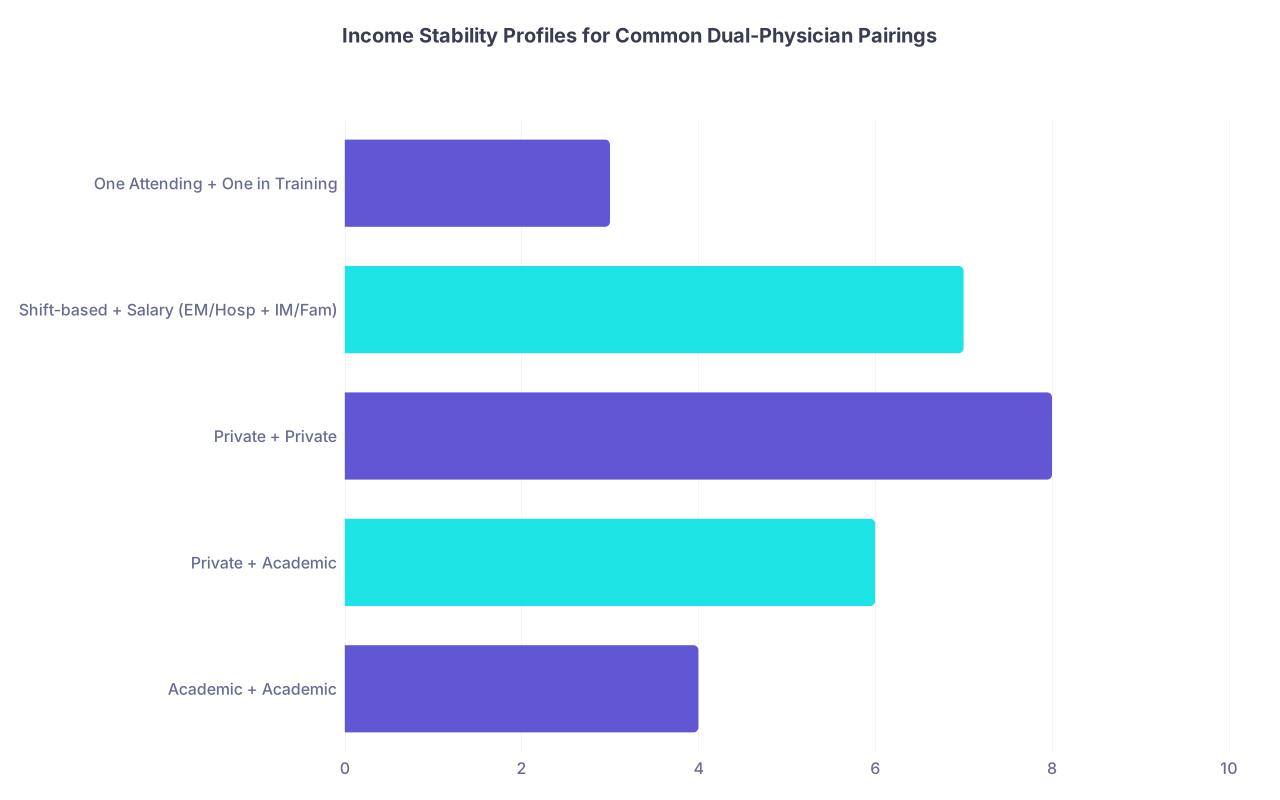
| Category | Value |
|---|---|
| Academic + Academic | 4 |
| Private + Academic | 6 |
| Private + Private | 8 |
| Shift-based + Salary (EM/Hosp + IM/Fam) | 7 |
| One Attending + One in Training | 3 |
(Scale 1–10: higher = more volatile, more tied to productivity or shifts)
Now choose a strategy intentionally:
Stability First
- At least one of you in a stable salary-based job (academic, large group, VA).
- The other can do RVU-heavy or call-heavy work for extra upside.
- You base your lifestyle only on the stable income.
Aggressive Wealth Build (5–7 year sprint)
- Both of you in high-earning, high-intensity roles (private practice, partnership track, extra call).
- Live like a one-income couple.
- Crush loans, save 40–60% of net income, then downshift.
Lifestyle/Time First
- One or both at 0.6–0.8 FTE.
- Trade top-line income for time, sanity, and childcare coverage.
- Still powerful financially because you have two physician incomes.
Be explicit. Decide: “We’re doing Strategy X from 2026–2031.” Then align jobs and call to match that.
Step 4: Coordinate Call Schedules Like They’re Flight Plans
Here’s where couples crumble: call. Nights. Weekends. Post-call. Childcare. The calendar is where theory meets pain.
A. Before signing, ask the ugly, specific questions
For each potential job, you both want answers like:
- How many calls per month, nights, weekends, holidays?
- Is call in-house or from home?
- What’s realistic post-call? Are people actually going home?
- How far in advance is the call schedule made?
- Can I request certain weekends off (spouse also on call, no childcare, etc.)?
- How easy is it to trade call? Is there a culture of helping each other?
If a group flinches when you ask detail about call, mark that as a red flag. “We all pitch in; it’s a team effort” often means “We exploit whoever is too polite to say no.”
B. Negotiate structure, not just numbers
You may not get to cut total call volume. But you can sometimes shape the structure:
- Request your calls be:
- Clustered so you can plan recovery weeks.
- Opposite from your partner’s weekends for childcare.
- Or synchronized if you have strong childcare backup and want shared off-weekends.
Many couples do best with:
- One partner more call-heavy but more predictably scheduled.
- The other lighter call with more evening/weekend flexibility.
Example: she’s OB/GYN with 1:4 call, known 6 months ahead. He’s hospitalist doing 7-on/7-off. She front-loads her call into his “on” weeks; during his off weeks they have real family time.
C. Build a shared calendar that treats call like a third person
You need one master calendar. Not separate lives.
Use:
- A shared Google Calendar with:
- Call (distinct color for each of you)
- Clinic days
- Post-call (blocked and respected)
- Kid events / appointments
- Travel / conferences
Once a month, do a 20-minute “operations meeting”:
- Scan the next 4–8 weeks
- Identify:
- Red zones (both on call, no coverage)
- Orange zones (one on call, one with full clinic)
- Green zones (one or both off—protect these)
You’re not micromanaging your life; you’re preventing predictable disasters.
Step 5: Use Your Combined Income Intelligently (Not Just Comfortably)
The financial mistakes I see dual-physician couples make are remarkably consistent:
- Lifestyle creep to match combined income
- No deliberate debt strategy
- Underutilized tax-advantaged accounts
- Redundant, expensive insurance through each employer
You can fix all of that with a simple framework.
A. Treat one income as “life,” one as “future”
Pick:
- Income A = pays all fixed lifestyle costs (rent/mortgage, food, utilities, childcare, routine travel).
- Income B = wealth building (loans, retirement, taxable investments, big goals).
You do not need a spreadsheet deity to make this work. You just need discipline:
- Automate:
- Loan payments from B’s account.
- Retirement maxing from payroll.
- Automatic monthly transfers to brokerage.
If you can live on 60–70% of your combined take-home, you’ll be financially independent dramatically faster than your peers.
B. Max every tax-advantaged space you can reach
Dual-physician couples often have absurd access to sheltered accounts and never use them all.
Common buckets:
| Account Type | Typical Access |
|---|---|
| 401(k) / 403(b) | One each, sometimes both have match |
| 457(b) | Often for academics / hospitals |
| HSA | If either has HDHP plan |
| Backdoor Roth IRA | One for each of you |
| 529 Plan | If planning kids |
Sequence:
- Get full employer match on both 401(k)/403(b).
- Max both 401(k)/403(b).
- Contribute to 457(b) if it’s a governmental or otherwise safe plan.
- Do backdoor Roth IRAs for both of you yearly.
- Fund HSA if available (and use it as long-term stealth IRA, not just a health checking account).
- 529s if kids are likely and you’re ahead on your own retirement.
C. Coordinate benefits, don’t duplicate blindly
Do not just both click all the default HR benefits and move on. That’s how you bleed thousands.
Decide:
- Which employer has the better health plan (network, premiums, deductibles).
- Who carries family coverage vs who takes employee-only or opts out.
- Disability insurance: group vs own-occupation individual plans. Typically, you’ll want at least one of you with strong individual own-occupation coverage, then decide if the other truly needs full coverage or can be partially “self-insured” by your combined assets and partner’s income.
- Life insurance: especially if kids or one income is relied upon.
- Term policies (20–30 year) for each of you, coordinated with debt and kids’ ages.
- Group life alone is not enough.
Step 6: Handle Legal, Malpractice, and “Worst-Case” Scenarios Like Adults
You’re two high-liability professionals under one financial roof. You don’t get to ignore the worst-case planning.
A. Malpractice realities for dual-physician couples
You each need:
- Tail coverage if you leave claims-made policies.
- Clarity about coverage across locations if you moonlight.
- Awareness of high-risk procedures / roles from a liability standpoint.
What matters to you as a couple:
- If one of you is in a particularly high-risk specialty (OB, neurosurg, etc.), consider:
- Keeping the other in a more stable, lower-risk employment environment.
- Asset protection strategies (titled accounts, possibly trusts depending on state law—talk to an attorney who works with physicians, not generic estate planners).
B. Basic asset protection moves that are not overkill
You do not need offshore trusts. You probably do need:
- Adequate umbrella insurance (often $2–5M) over your home/auto.
- Separate professional liability covered by employers or your own policies.
- Proper titling of house / non-retirement accounts per your state’s laws.
- Keeping most savings inside protected accounts (401(k)/403(b)/IRA) which are often shielded from creditors.
C. Estate planning is non-optional
Especially if:
- You have kids.
- You own a home.
- One or both of you has a private practice or partnership interest.
Bare minimum:
- Wills for both.
- Medical and financial powers of attorney for both.
- Guardianship decisions for kids written down and legal.
- Beneficiaries correct on all retirement and insurance accounts.
You are not immortal just because you wear white coats.
Step 7: Family Planning + Call + Income: Make a Coherent Plan
Kids change the equation more than anything else. Not emotionally—logistically and financially.
Here’s the hard truth: two full-time, high-call jobs plus no family nearby plus infants is a recipe for burnout or resentment.
You need to pick your combination instead of drifting into it.
A. The classic options
Both full-time clinical, outsource heavily:
- Full-time daycare/nanny.
- Maybe night nanny during newborn period.
- Housekeeper, grocery delivery, meal services.
- Pros: Keep both incomes and careers at full speed.
- Cons: Expensive and emotionally hard for some; requires ruthless call and calendar coordination.
One downshifts (0.6–0.8 FTE) for a few years:
- Often the one with the more flexible specialty or lower marginal income.
- Pros: More slack in the system; less childcare spend; more backup for sick days, random call disasters.
- Cons: Slower income growth; potential career trajectory changes (promotions, leadership, partnership track).
Both adjust modestly:
- Both cut a small amount of work: fewer committees, less extra call, perhaps both at 0.8–0.9 FTE.
- Pros: More balanced; protective of both careers.
- Cons: May slightly delay big savings goals unless you keep lifestyle lean.
Decide this before pregnancy or adoption if you can. Especially who will handle what during:
- Postpartum period.
- Night feeds if you’re both on call.
- Sick kids while both have full clinics.
B. Calendar rules that protect your sanity
Practical rules I’ve seen work:
- Never both on in-house call the same night unless you have a rock-solid overnight childcare plan.
- Protect at least 1–2 weekends per month where neither of you has call. Non-negotiable.
- For school-age kids: one parent always “light” on the critical days (first days of school, big events, etc.).
You will break these rules sometimes. But if you do not have them, work will fill every crack.
Step 8: What to Do When Offers Come In (Real-World Sequence)
Let’s say you’re both finishing training and starting the first attending jobs. Here’s the order of operations that actually works.

| Step | Description |
|---|---|
| Step 1 | Clarify couple priorities |
| Step 2 | Choose anchor vs flexible |
| Step 3 | Target regions and systems |
| Step 4 | Apply as dual-physician couple |
| Step 5 | Interview and ask detailed call questions |
| Step 6 | Compare offers as a package |
| Step 7 | Negotiate schedule and benefits |
| Step 8 | Run financial plan with both incomes |
| Step 9 | Sign contracts and set calendar rules |
Concrete steps:
- You agree on geography + anchor career.
- Anchor partner targets best possible job in that geography first.
- As anchor’s interview process heats up, flexible partner:
- Reaches out to the same system.
- Or nearby systems within workable commute distance.
- Explicitly frames this as a dual-physician opportunity.
- Once you have 2–4 real offers on the table:
- Build a side-by-side comparison:
- Base salary
- Bonus structure
- Call expectations
- Benefits
- Location/commute
- Visa / contract length (if relevant)
- Build a side-by-side comparison:
- Then ask: “As a couple, which combination gives us the best 3–5 year life and finances?”
Not “which job individually excites me more on paper?”
You’re optimizing for the joint outcome, not for each of you to maximize prestige independently.
Step 9: Checkpoints to Rebalance Over Time
This isn’t one decision forever. Good couples treat their plan like a dynamic process.
Once a year, ask each other:
- Are we still okay with who’s the anchor right now?
- Is our call schedule situation sustainable?
- Are we on track with big financial goals (loans, savings, house, etc.)?
- Do we need to renegotiate FTE, call, or shift patterns?
- Are we getting enough actual time together that’s not just trading off childcare?
Every 3–5 years, consider a bigger reset:
- One of you moves jobs for better hours/income.
- You relocate to a different market that values you more.
- You adjust from “wealth build mode” to “lifestyle mode” or vice versa.
The couples who last don’t assume that what worked during fellowship will work with two kids in school. They change the structure to fit the new reality.

| Category | Value |
|---|---|
| Years 1-2 | 60 |
| Years 3-4 | 55 |
| Years 5-6 | 50 |
| Years 7-8 | 45 |
| Years 9-10 | 40 |
(Think of that as “percent of waking hours dominated by work.” The whole point of coordinating jobs, income, and call is to push that number down over time, not up.)
FAQs
1. Should we ever work at the same hospital or same group, or is that a bad idea?
It can be excellent or awful. It works best when:
- Your specialties don’t directly compete (e.g., IM + anesthesia is easier than two cardiologists).
- There’s a professional culture that respects boundaries—your relationship isn’t gossip fodder.
- You’re both clear on how you’ll handle conflict (one of you loves the job, the other doesn’t).
I’ve seen couples thrive when they share an employer: aligned schedules, shared holidays, easier understanding of each other’s work stress. I’ve also seen divorces where one person felt trapped because leaving the job also meant blowing up the shared professional world. If you do choose the same employer, keep your CVs strong and portable so either of you can leave if you need to.
2. Is it smart for one of us to drop to part-time early in our careers?
It can be, but only if it’s part of a plan, not just “I’m tired.” Early-career years are prime time for loan repayment, partnership tracks, and career capital. If one of you goes to 0.6 FTE right out of training, know exactly what you’re trading: slower savings, different promotion timelines, maybe weaker negotiating power later.
That said, if part-time work is the difference between staying married and burning out vs imploding by PGY-7 of life, then yes, it’s smart. Run the numbers: if your combined full-time income is $500–600k+, you can often afford one person at 0.7–0.8 FTE and still hit aggressive financial goals—as long as lifestyle stays controlled.
3. How do we handle huge differences in income between our specialties?
You name it. Out loud. And you build systems that don’t quietly punish the lower earner. For example:
- All shared expenses (housing, food, kids, base travel) come from a joint account funded in proportion to income or simply from both paychecks with no scoreboard attached.
- You avoid using “my money vs your money” around big decisions.
- You agree that career value is not identical to annual salary—an academic pediatrician married to an orthopod is not “less important.”
If resentment around income shows up, take it seriously. That’s not “just numbers”; that’s identity and fairness. Fix the system (how you budget, save, talk about money) so it supports you both.
4. Is it overkill to hire a financial planner and lawyer just for this?
Not if you pick the right ones and limit the scope. A flat-fee, fiduciary planner who actually understands physicians can help you:
- Map both incomes, loans, and benefits into one coherent plan.
- Optimize retirement accounts and insurance.
- Set a 5–10 year savings and debt payoff strategy.
A lawyer with physician experience can:
- Review both contracts with an eye on non-competes, call, and outs.
- Help with basic asset protection and estate planning.
You’re a two-physician entity. Spending a few thousand once to avoid six-figure mistakes and years of headache is not overkill; it’s responsible.
Key points:
- Treat yourselves like a two-person enterprise: one anchor at a time, one shared strategy, one master calendar.
- Use your combined leverage and income to build freedom deliberately, not to fund mindless lifestyle creep.
- Revisit the plan yearly; adjust jobs, call, and priorities as your life changes, instead of waiting for burnout or crisis to force your hand.