
You’re leaving the hospital after another 12‑hour day. Your partner texts: “Talk tonight? I’m ready to quit my job if we can make the money work.”
You’re the physician. You’re the one with the big income. You’re also the one who sees attendings in their 50s still grinding nights because they “can’t afford” to slow down.
You don’t want to be that story. But a single‑income physician household is exactly how that happens if you structure it wrong.
Let’s walk through how to structure your career and salary so your family can safely live on one physician income—without chaining you to the treadmill forever.
Step 1: Be Honest About the Risk You’re Taking
A one‑income physician household is not just “we make plenty, we’re fine.” You’re concentrating risk in one person, one license, one body.
Here’s what you’re actually betting against:
- Job loss (group buys, loses, or merges your practice)
- Illness or injury (back injury, cancer, long COVID, pregnancy complications)
- Burnout (you can’t keep doing 1.5 FTE forever)
- Contract changes (RVU thresholds jump, comp plan “restructured”)
- Geographic lock‑in (you’re in a one‑hospital town)
So before you let your spouse/partner quit or go to truly minimal income, you need to answer four questions clearly:
- What happens if my income drops by 50% for 6–12 months?
- What happens if I can’t work at all for 1–2 years?
- What happens if I have to change jobs and move?
- What happens if they leave me or I leave them? (Yes, this one matters legally and financially.)
If your current answer is “we’d be screwed,” you’re not ready for a single‑income setup yet. That doesn’t mean never. It means not now.
Step 2: Decide What Kind of Single‑Income Household You Actually Are
“Single‑income” covers a lot of ground. These are not the same:
- You make $380k as a hospitalist, spouse earns $40k part‑time.
- You make $260k in primary care, spouse is fully home with two kids.
- You make $550k in ortho, spouse runs a very inconsistent small business that sometimes loses money.
You structure things differently depending on which you are. Use this quick categorization:
| Type | Description | Risk Level |
|---|---|---|
| True Single | Partner has no income, fully dependent | High |
| Soft Single | Partner has small but steady income | Moderate |
| Volatile Second | Partner has irregular or business income | High |
| Transitional | Partner planning to leave work soon | Very High |
If you’re in “Transitional” or “True Single,” you need to be the most conservative—on contracts, insurance, and lifestyle. “Soft Single” gives you a tiny buffer, but not enough to skip the basics.
Step 3: Pick the Right Job: Safety Over Bragging Rights
Single‑income physicians do not get to be cavalier with job stability.
I’ve watched people take “sexy” jobs—new private equity groups, startup telemed companies, tiny single‑hospital contracts—while their spouse was about to quit. Six months later, contract flipped, income slashed, chaos.
You’re not just choosing a job. You’re choosing the foundation under your entire family.
When evaluating offers, your priorities shift:
1. Stability beats peak salary
You’re better off with:
- A $280k–320k job with stable RVUs, guaranteed base, long‑standing group
than - A $380k job where 60% is production‑based with moving goalposts
Watch for:
- History of contract churn at the site
- Frequent leadership turnover
- “We’re growing really fast” (often code for chaos)
- No clear written RVU schedule or bonus structure
2. Location and job density matter
Single‑income physician in a one‑hospital town = trapped.
You want:
- Multiple systems or groups in your specialty within commuting distance
or - A skill set that travels well (telemed, locums‑friendly, high‑demand specialty)
If there’s only one employer within 100 miles, your negotiating leverage is basically zero the second your partner stops working.
3. Read your contract like your life depends on it (because it kind of does)
Non‑compete + single‑hospital town + dependent spouse = disaster recipe.
You need to know:
- Non‑compete radius and duration
- How termination works (without cause notice, typically 60–180 days)
- What happens to bonuses, sign‑on, relocation if you leave early
- Call requirements and how often they can change your schedule
If the contract is vague on compensation or “we’ll work it out later,” that’s a no for a single‑income situation. Or you get it clarified in writing before signing.
Step 4: Build a Floor Under Your Income With Insurance
This is the part most single‑income physicians screw up. They carry mediocre disability insurance, tiny life insurance, and assume their job is permanent.
Then they find out what “own‑occupation” and “elimination period” actually mean while they’re already in crisis.
You do not want to learn disability insurance vocabulary while you’re inpatient.
Disability Insurance: Non‑negotiable, and it needs to be good
You want:
- True own‑occupation coverage (ideally specialty‑specific)
- Benefit that replaces 60–70% of your gross physician income
- Residual/partial disability coverage (for reduced hours, not just total disability)
- COLA (cost of living adjustment) rider if you’re early‑career
Most hospital “group” policies are not enough. They’re cheap for a reason. Get an independent disability policy in your own name. Yes, it’s expensive. So is your mortgage.
Standard setup I see that actually works when life goes sideways:
- Group policy from employer (whatever they give you)
- Individual policy you bought yourself, stacked on top
Life Insurance: Think “replacement engine,” not “funeral costs”
If someone depends on your income, your life insurance should be:
- Term, not whole life (you’re not building cash value, you’re buying protection)
- Enough to replace you financially for at least 10–15 years
Rough ballpark: 10–15x your annual income if you have young kids and a non‑earning spouse. Less if the house is paid off and kids are almost out.
You can tweak, but don’t play games with tiny policies when your entire household runs on your paycheck.
Step 5: Structure Your Lifestyle Like Your Job Might Vanish
Here’s where the physician ego gets in the way.
“I make $400k, we can afford it.”
Yes. You can afford almost anything if you assume your current salary is guaranteed forever. It’s not.
The question isn’t “Can we afford it with today’s salary?”
It’s “Can we survive if my income drops or disappears for a while?”
A sane single‑income structure looks like this:
1. Live on 50–60% of your take‑home
After taxes, retirement contributions, and benefits, your net pay might be, say, $18k/month on a $350k salary. You do not spend $18k/month.
You build a budget where:
- Core living expenses (mortgage/rent, food, utilities, insurance, basic childcare, transportation) fit in ~50–60% of your net income.
- The rest goes to:
- Student loans (aggressively, if high interest)
- Retirement accounts
- Taxable investments
- Extra cushion / sinking funds
If your lifestyle eats up 80–90% of your take‑home, your family will panic the moment anything shakes your job.
2. Get an actual emergency fund, not a theoretical one
Single‑income household means a bigger emergency fund. Not 1–2 months.
You’re aiming for:
- At least 6 months of total household expenses
- 9–12 months is even better if you’re:
- In a narrow specialty
- In a one‑employer town
- On a visa
- The sole earner with kids and a non‑working spouse
This is dull. It’s also what keeps you from grabbing the first terrible job when something goes wrong.
3. Be ruthless about fixed costs
You can cancel Netflix in 30 seconds. You cannot un‑buy:
- The massive doctor house with the jumbo mortgage
- The private school for three kids you “can’t pull them out of now”
- Three leased luxury cars
Single‑income life works if your fixed monthly burn is low. Rent/mortgage and tuition are the killers. Be conservative there and you can relax everywhere else.
Step 6: Get Your Legal House in Order Before Anyone Quits
You’re in the “financial and legal” phase for a reason. A lot of well‑intentioned physicians create legal and power imbalances in their marriages without meaning to once one partner stops earning.
You have to think about:
- What happens in a divorce
- What happens if you die
- What happens if you’re incapacitated
Yes, these are uncomfortable. Do them anyway.
1. Basic estate planning is not optional
Single‑income with dependents? You need, at minimum:
- A will (who gets what, who raises kids)
- Guardianship designation for minor children
- Powers of attorney (financial and medical)
- Beneficiary designations updated on:
- 401(k)/403(b)/457
- IRAs
- Life insurance
If you have assets in multiple states, a business, or a complex family situation (second marriage, stepkids), talk to a real estate/estate attorney. Not LegalZoom.
2. Marital agreements: Not always, but more often than you think
Here’s where people get emotional. But I’ve seen enough ugly divorces with one partner out of the workforce for a decade to be blunt.
If:
- You are significantly higher earning, and
- Your spouse is about to leave a career permanently because of that, and
- You’re in a state with unpredictable alimony/property laws
…you at least discuss a postnuptial agreement with a lawyer. Something that:
- Acknowledges the non‑earning spouse’s contribution
- Clarifies how assets and support would work if things fall apart
If your marriage is solid, this is just grown‑up planning. If your marriage is fragile, you definitely shouldn’t be shifting to single‑income without knowing the implications.
Step 7: Don’t Box Your Career Into a Corner
The other half of “safety” here is not turning yourself into a bitter, burned‑out paycheck machine. You’re structuring a life, not just a budget.
Think about future‑proofing your career:
1. Avoid maxing out your schedule from day one
If you’re solo breadwinner, it’s tempting to say yes to everything:
- Extra shifts
- More call
- Weekend work
The problem isn’t year 1. It’s year 5 when you hate your job but your family now depends on that inflated income.
Start at 0.8–1.0 FTE with reasonable call and build your financial life on that. Extra shifts are gravy, not baked into the mortgage.
2. Keep optionality: skills and reputation
You want to be hireable, and relatively quickly, if your current job goes sideways.
That means:
- Stay clinically sharp in core skills for your specialty
- Maintain good relationships with colleagues (your future references)
- Avoid burning bridges on the way out of roles
- Don’t narrow so much you’re only usable in one ultra‑niche setting unless it’s truly secure
Side note: if you’re early‑career, sometimes the best “safety” is spending 2–3 years at a high‑earning but stable job, packing away cash, then intentionally stepping down later.
Step 8: Coordinate With Your Partner Like It’s a Business Decision
Because it is.
Your partner stepping out of the workforce is not just “you’ll be home more with the kids.” It’s:
- Loss of their retirement contributions and Social Security earnings
- Their career capital decaying (skills, references, relevance)
- Increased financial and psychological pressure on you as the physician
You two need an explicit plan, not vague vibes.
Here’s a basic sequence that actually works:
Run the numbers together.
Real budget. Real emergency fund target. Real insurance quotes.Set specific benchmarks before they quit, like:
- “We will have $X in emergency fund”
- “We will have disability and life insurance in place”
- “We will have paid off high‑interest loans above Y%”
Decide time frames and checkpoints:
- “We’ll try single‑income for 12 months”
- “We’ll meet every 3 months to review finances and stress level”
- “We’re open to you doing part‑time/PRN if needed”
Document this somewhere, even just in a shared note. It turns an emotional jump into an intentional move.
Step 9: Watch Your Taxes and Benefits Like a Grown‑Up Business
Single‑income physicians often leave money on the table or step into traps here.
A few specifics:
Max retirement accounts aggressively:
- 401(k)/403(b)
- 457(b) if you have access (but know the creditor risk)
- Backdoor Roth IRA for you, and probably a spousal backdoor Roth
Know your marginal tax rate.
Single‑income at $350k is not the same as dual‑income at $175k each. The brackets hit differently, and child tax benefits phase out faster.Use dependent care FSA if you still pay for childcare.
Don’t assume “stay‑at‑home spouse = no childcare costs.” Often you’ll still have preschool, part‑time care, or occasional help.Health insurance:
If your partner was the one carrying the family’s benefits, price out moving everyone onto your plan before they leave. Some hospital plans are surprisingly bad for families.
This is where a good CPA who actually understands physician comp is worth the money, especially the first year you switch to true single‑income.
Step 10: Be Ready for the Psychological Shift
No spreadsheet prepares you for the emotional part of being the only earner.
Common things I’ve seen:
- You feel trapped in a job you would otherwise leave.
- Resentment builds quietly when your days are chaos and your partner’s look “easier.”
- Your partner feels guilty spending money or taking time for themselves because “you earned it.”
- Every contract renegotiation or rumor at work spikes anxiety at home.
You need to treat this like another domain to manage:
Have explicit conversations about:
- How decisions over money get made
- What happens if you want to change jobs or cut back
- How you both value unpaid labor (childcare, housework, emotional work)
Normalize financial check‑ins: 20–30 minutes monthly, phone off, numbers open, no blame. Just: where are we, what changed, what needs adjusting.
Have an exit plan for you: “If I hit X level of burnout, here’s the sequence: reduce FTE, change schedules, or we revisit your working.”
Single‑income is sustainable when you both see it as a joint project, not you as the walking ATM and them as “lucky to be home.”
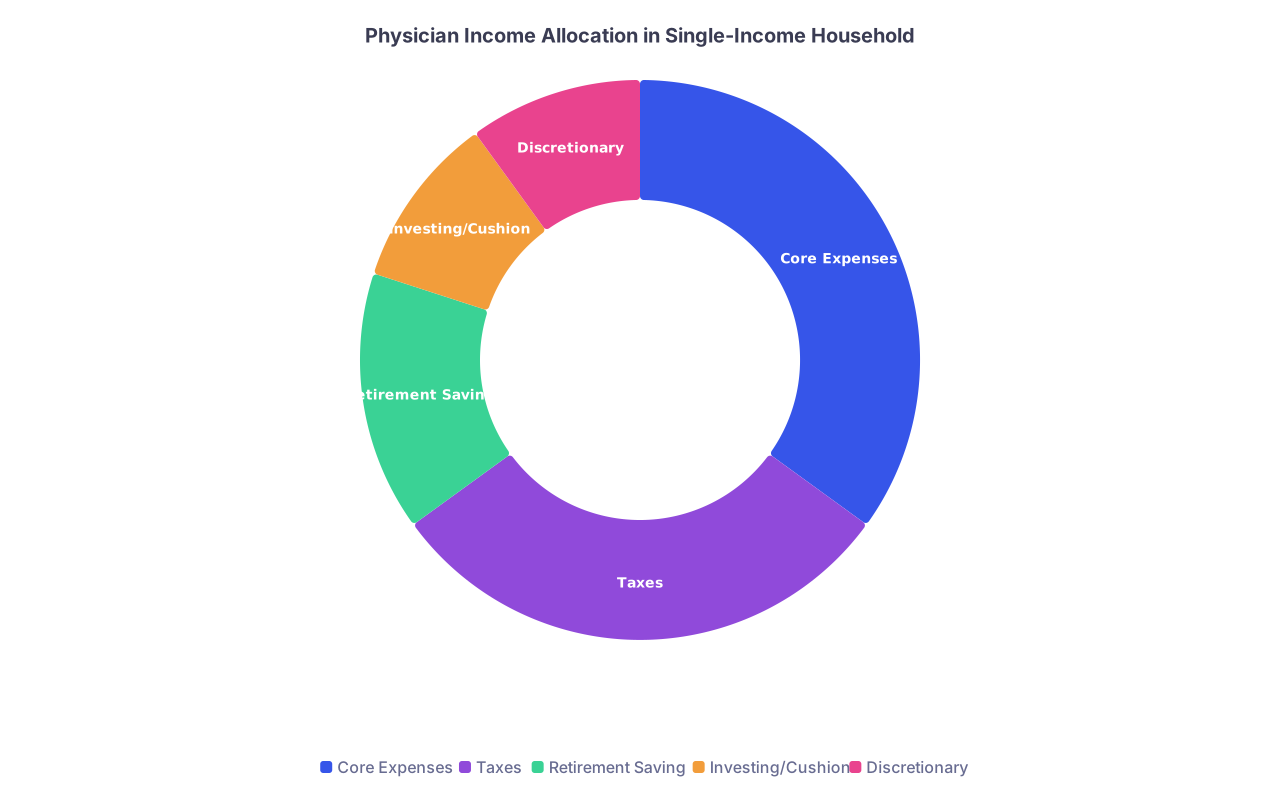
| Category | Value |
|---|---|
| Core Expenses | 35 |
| Taxes | 30 |
| Retirement Saving | 15 |
| Investing/Cushion | 10 |
| Discretionary | 10 |
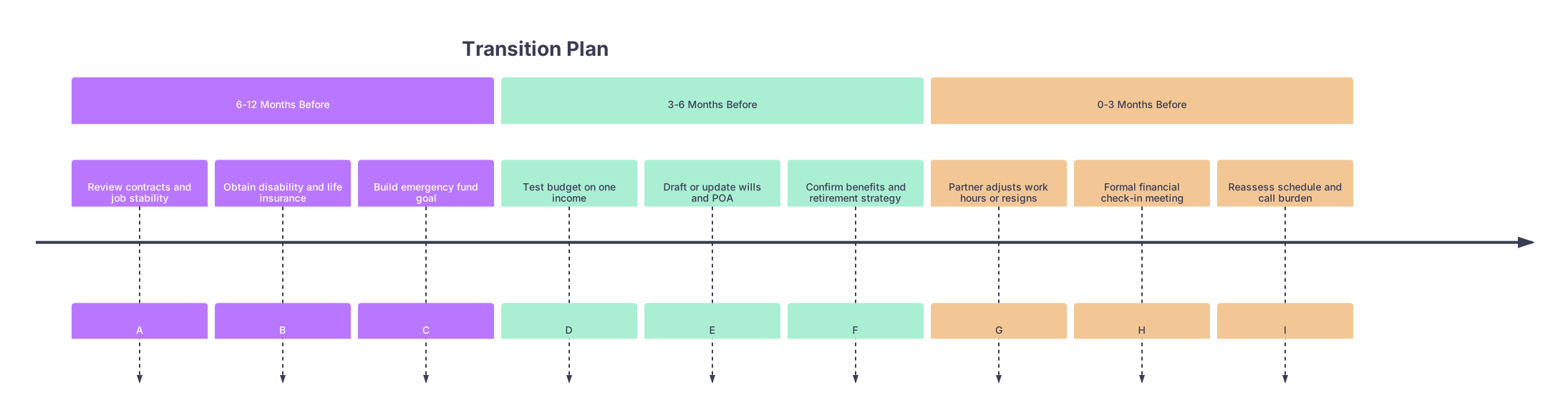
| Period | Event |
|---|---|
| 6-12 Months Before - Review contracts and job stability | A |
| 6-12 Months Before - Obtain disability and life insurance | B |
| 6-12 Months Before - Build emergency fund goal | C |
| 3-6 Months Before - Test budget on one income | D |
| 3-6 Months Before - Draft or update wills and POA | E |
| 3-6 Months Before - Confirm benefits and retirement strategy | F |
| 0-3 Months Before - Partner adjusts work hours or resigns | G |
| 0-3 Months Before - Formal financial check-in meeting | H |
| 0-3 Months Before - Reassess schedule and call burden | I |
Putting It All Together: A Concrete Example
Let’s make this less abstract.
You’re a 35‑year‑old hospitalist making $320k W‑2 at a large health system. Your spouse is a teacher making $55k but is burned out and you’ve got a toddler plus another baby on the way. You’d like them to stay home for at least a few years.
Here’s a sane sequence:
You review your contract.
Non‑compete is 20 miles/1 year, but there are three hospitals in the system. Reasonable. Income is 70% base, 30% RVU. Group stable for 10+ years.You get real disability and life insurance quotes.
- Individual own‑occ disability: $8–10k/month benefit
- Term life: $3M 20‑year term You adjust your planned budget to include those premiums.
You calculate target emergency fund.
Monthly total spending (with one working spouse) estimated at $10k/month. You aim for $60–80k in cash.You test‑run the one‑income budget for 3–6 months.
Spouse keeps working. You live as if they aren’t. Their paycheck goes to:- Emergency fund
- Student loans
- Extra savings
Once:
- Emergency fund hits $60k+
- Disability and life insurance are in force
- Wills and guardianship docs are signed
…they give notice.
You both agree to:
- Monthly money meetings
- Revisit the arrangement in 12–18 months
- Be open to them taking part‑time work later if needed
That’s what “structured safely” looks like. Not perfect, not risk‑free, but controlled.
You’re not just trying to survive on one physician income. You’re trying to set up a life where:
- One bad back injury doesn’t blow up your mortgage.
- One toxic new administrator doesn’t own your soul.
- One life change—new baby, illness, burnout—doesn’t turn into a financial tailspin.
If you handle your contract, insurance, legal documents, and lifestyle before your household becomes truly single‑income, you’re building a system that can flex when life inevitably changes.
And once that foundation is solid, you can start thinking about the next phase: using that physician income not just to tread water, but to actually buy your time back later—through investments, partial retirement, or a completely different schedule.
But that’s the next chapter. First, make sure the structure you’re standing on can actually hold your family.