
You just got the email.
“Would you be interested in becoming Associate Medical Director / Section Chief / Department Chair?”
There’s a stipend. Some “protected time.” A vague promise it’ll be “good for your career.”
But you’re also staring at your RVU report, your kids’ daycare bill, and your call schedule. You know taking on leadership means less clinical time, new headaches, and—if you get this wrong—potentially less pay and more stress.
This is where you are: tempted by a leadership role, but you don’t trust the math or the politics yet.
Good. You shouldn’t. Let’s walk through how to actually decide if this makes sense for you—and how to negotiate it so you don’t get burned.
1. Get Clear: What Exactly Are They Asking You to Do?
Before you talk salary or FTE, you need to define the job. Admin titles are famously vague. That vagueness is how people get trapped doing free labor.
You want specifics, in writing. Ask for a draft job description or create one yourself and send it back.
Push them to clarify:
Scope
- How many people are you responsible for?
- Just your section? Whole department? Multiple sites?
- Are you responsible for APPs, residents, fellows?
Core responsibilities (with time expectations)
Examples:- Monthly scheduling – ~6–10 hours/month
- Quality metrics / dashboards – ~4–6 hours/month
- Peer reviews / incident reports – variable, but estimate
- Hiring / interviews – seasonal, but still time
- Meetings: medical executive committee, department leadership, hospital ops, etc.
Decision authority
- Can you hire/fire?
- Can you set schedule rules?
- Do you control any budget?
- Or are you just a messenger between admin and clinicians?
If they can’t explain the role beyond “help coordinate” and “represent the group,” that’s a red flag. You’re being asked to be a buffer and a shield, without clear power.
You want a written description that you can later compare to reality when the role balloons.
2. Do the Math: Admin Time vs Lost Clinical Income
Now we talk money. Because if you skip this, you will almost definitely underprice yourself.
You need to calculate:
- What 1 clinical hour is worth to you
- How many clinical hours you’ll actually lose
- Whether the admin pay covers that loss—with a margin, not just breakeven
Start with your clinical value:
If you’re RVU-based:
- Take your average annual RVUs × your RVU rate = clinical comp
- Divide by clinical hours/year to get an hourly value
If you’re salary-based with defined FTE:
- Base salary / (clinical FTE × 2080 hours for full-time) = rough hourly clinical value
Example:
You’re a hospital-employed internist:
- Base: $260,000 at 1.0 FTE, full clinical
- 1.0 FTE = 9 half-day clinics/week → ~36 hours patient-facing + 4 admin = 40 hours/week
Rough hourly: $260,000 / (40 × 47 working weeks) ≈ $138/hour
They offer:
- 0.8 clinical + 0.2 admin
- Admin stipend: $25,000/year
So you’re losing 0.2 of clinical FTE.
Lost clinical value: 0.2 × $260,000 = $52,000
Admin stipend: $25,000
You are effectively volunteering $27,000/year of your time in that scenario.
That’s the conversation you need to have.

| Category | Value |
|---|---|
| Lost Clinical Value | 52000 |
| Admin Stipend | 25000 |
You want one of these situations:
- Admin pay at least equals lost clinical pay
- Or admin pay is slightly lower, but:
- You gain lifestyle improvement (better schedule, less call)
- You gain genuine career leverage or stepping stone to a significantly better role
But if it’s “more work, more meetings, less money,” that’s not a leadership role. That’s a loyalty tax.
3. Understand the Three Levers: Time, Salary, Clinical Work
You’re really balancing three levers, and you cannot move one without affecting the others:
- Admin time (FTE or hours/week)
- Total compensation (base + incentives + stipend)
- Clinical work (sessions/clinics, call, RVUs)
You want to see the package as a whole, not in pieces. Put it on paper.
| Component | Current Role | Proposed Leadership Role |
|---|---|---|
| Clinical FTE | 1.0 | 0.8 |
| Admin FTE | 0 | 0.2 |
| Base Salary | $260,000 | $260,000 |
| Admin Stipend | $0 | $25,000 |
| Call Frequency | 1 in 5 | 1 in 6 |
Now ask:
- Are they actually reducing your clinical FTE, or just slapping on admin work “on your own time”?
- Are they treating admin as true FTE (benefits, PTO, etc.) or as a side gig?
- How will productivity bonuses be calculated with reduced clinical volume?
If they won’t reduce your clinical expectations despite adding admin duties, walk carefully. That is the most common bait-and-switch: “We value your leadership” = “Do more work for free.”
4. Salary Models: How Leadership Really Gets Paid
Leadership comp is all over the map, but there are a few common structures. You need to know which game you’re playing.
Typical models:
Stipend + Same Base
- Example: You keep your $260k base, plus $20–40k/year leadership stipend.
- Risk: Clinical expectations may not drop appropriately. You end up doing leadership on evenings and weekends.
Reduced Clinical FTE + Same Total Pay
- Example: You go from 1.0 clinical to 0.8 clinical / 0.2 admin, but stay at ~$260k total.
- In practice, your hourly goes down a bit, but lifestyle may be better.
Increased Base + Adjusted Incentive
- Example: Base goes up to reflect leadership; productivity bonus threshold is lowered because of less clinical work.
- This is more common in formal roles like Medical Director, CMO, Chair.
Hybrid employment + stipend from hospital or system
- Example: You’re in a private group, but the hospital pays you separately as Medical Director.
- Watch for:
- Double-counting your time
- Compliance issues (Stark, Anti-kickback) – your hourly rate must be “fair market value”
If they can’t clearly tell you:
- How your bonus will be calculated
- What happens if RVUs drop because you’re doing meetings
- Whether leadership duties count toward productivity or incentives
…then they haven’t thought it through. Make them.
5. Protect Your Clinical Identity (Or Don’t—But Decide Intentionally)
Leadership can slowly squeeze out your clinical work if you’re not careful. Some people want that. Others hate it and feel their skills atrophy.
So decide what kind of physician-leader you want to be:
Mostly clinician, light admin:
- 0.9 clinical / 0.1 admin, 1–2 meetings/week
- You’re more of a “lead doc” than a true admin
Split role:
- 0.6–0.8 clinical / 0.2–0.4 admin
- You still see patients regularly, but own some major service lines, committees, strategic projects
Primarily admin:
- 0.2–0.4 clinical / 0.6–0.8 admin
- You’re effectively an executive who also happens to see patients
Problems I’ve seen:
- Physician becomes “the fixer” and every problem, complaint, and escalation ends up in their inbox
- Their clinical colleagues now see them as “management,” not one of them
- They lose their procedural skills or clinical edge faster than they expected
Have a hard stop in your mind:
“I will not go below X clinics per week” or “I want to maintain my procedural volume at Y level.”
Then tie your agreement to that. If they want more admin from you later, you revisit everything, including comp and clinical expectations.
6. Negotiating Without Being a Doormat
Too many physicians treat leadership roles like an “honor” instead of a business proposition. That’s how you get underpaid and burned out.
Here’s how you push back like a professional, not a problem child.
Step 1: Anchor with Data
Come in with:
- Your current comp and clinical metrics
- Your calculated “lost clinical” value for any FTE change
- Rough market ranges for similar roles from MGMA/AMGA or specialty societies if you can access them
You might say:
“I’m currently generating about X RVUs/year and getting $Y total comp. If I move from 1.0 to 0.8 clinical, that’s roughly a $Z drop in production value. I’m excited about the role, but I need to see how the leadership comp makes up for that gap.”
Straight, factual, not emotional.
Step 2: Define Time First, Money Second
Don’t let them lowball your admin time.
If they say: “It’s 0.1 FTE” but you estimate it’s 8–10 hours/week, you respond:
“Based on the expected meetings, quality work, peer reviews, and incident follow-ups, this looks closer to 0.2 FTE in practice. I’d like to start there and revisit at 6 months with actual time tracking.”
Once you nail down realistic FTE, then you price it.

| Step | Description |
|---|---|
| Step 1 | Offered Leadership Role |
| Step 2 | Define Duties and Time |
| Step 3 | Increase FTE or Decrease Duties |
| Step 4 | Calculate Lost Clinical Value |
| Step 5 | Compare to Stipend/Comp |
| Step 6 | Renegotiate Comp |
| Step 7 | Accept with Written Terms |
| Step 8 | Admin FTE realistic? |
| Step 9 | Fair or Better? |
Step 3: Lock It Down in Writing
You want:
- Title
- Reporting structure (who you answer to)
- FTE split: clinical vs admin
- Expectations for:
- Clinics per week / shifts per month
- Meetings you must attend
- Committees you must lead
- Compensation:
- Base, bonus, stipend, and which part is tied to what
- Term and review:
- 1–3 year term with formal review and the option to step down or adjust
If they say, “Let’s just see how it goes,” that’s not a plan. That’s them reserving the right to keep dumping tasks on you.
7. Politics, Risk, and Burnout: The Stuff Nobody Puts in the Contract
Money and time are only half the story. Leadership changes your daily stress, your relationships, and your risk profile.
Things you need to eyeball honestly:
Culture fit
- Are you going to be the “yes person” to bad decisions from higher up?
- Or do you actually have leaders who listen to physician input?
Conflict load
- You will be pulled into:
- Physician vs nurse conflicts
- Patient complaints
- “This doc isn’t pulling their weight” conversations
- If you hate conflict, this might eat you alive.
- You will be pulled into:
Blame risk
- When metrics go bad, is leadership support solid?
- Or do they throw “the medical director” under the bus?
Exit ramp
- If you hate the role, can you step back to full clinical gracefully?
- Is that spelled out, or are you taking a one-way door?
I’ve seen this too many times: doc takes leadership role, admin changes, new CMO comes in, suddenly that doc is on the wrong side of a political divide. Title gone, stipend gone, clinical schedule messed up.
This is why you want a clear path back to a pure clinical role if things sour.
8. When Saying “No” Is the Smartest Leadership Move
You’re allowed to decide leadership is not worth it. That doesn’t make you “unambitious.” It makes you clear.
Red flags where I’d strongly consider walking away:
- They refuse to reduce clinical expectations at all
- The stipend is laughable compared to the work (e.g., $5–10k/year for clearly 0.2 FTE worth of headache)
- No clarity on decision authority—you’re responsible but powerless
- Leadership above you is unstable: frequent turnover of chairs, CMOs, CEOs
- You’re already on the edge of burnout
Here’s the script for a clean no that preserves relationships:
“I appreciate the offer and I’m honored you thought of me. After thinking it through, I need to prioritize my clinical work and my current commitments. I’m not able to take this on right now in a way that would be fair to the team or to my patients.”
If you might want it later, add:
“If the structure or expectations change in the future, I’d be happy to revisit and see if there’s a version of the role that’s a better fit.”
9. If You Say Yes: First 6 Months Game Plan
You accept. Now you need to keep it from taking over your life.
First 6 months:
Track your time ruthlessly
- Keep a simple spreadsheet of meetings, emails, incident reviews
- After 3–6 months, compare actual admin time to the FTE you’re being paid for
- If there’s a mismatch, schedule a formal check-in
Set communication boundaries
- Decide: Are you available nights/weekends for non-urgent admin stuff?
- If you don’t set a boundary, everyone will assume you’re always on
Clarify your “no” list
- You do not need to be on every committee
- You don’t have to personally solve every operational problem
- Learn to say: “That’s out of my scope; here’s the right person.”
Protect your clinical days
- Minimize meetings on heavy clinic/OR days
- Push for admin days that are truly blocked for leadership work
This is the difference between a sustainable leadership role and being the department’s emotional garbage disposal.
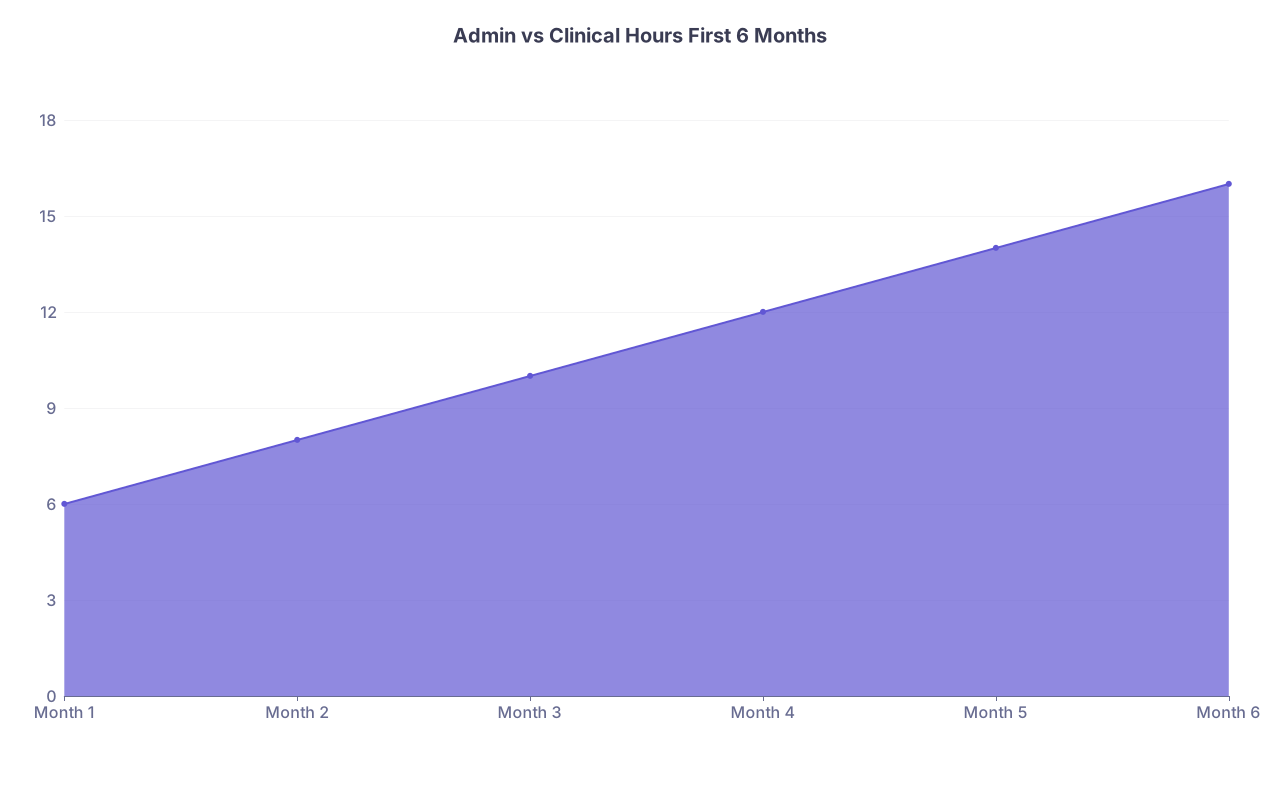
| Category | Value |
|---|---|
| Month 1 | 6 |
| Month 2 | 8 |
| Month 3 | 10 |
| Month 4 | 12 |
| Month 5 | 14 |
| Month 6 | 16 |
FAQ – 5 Common Questions
1. Is it ever worth taking a pay cut to accept a leadership role?
Yes—but only under specific conditions. It can be worth it if the role meaningfully improves your schedule or call burden, protects you from burnout, or clearly sets you up for a short-path promotion (e.g., section chief to department chair with real authority and pay). A small pay cut in exchange for more control and less chaos can be a win. Just don’t accept a big cut for a vague “career advancement” promise with no defined path.
2. How much admin FTE is typical for a section chief or medical director?
Rough ballpark (and it varies wildly by institution):
- Small section chief (10–15 docs): 0.1–0.2 FTE
- Larger service line director (20–40 clinicians, multiple sites): 0.2–0.4 FTE
- Department chair in large system: 0.4–0.8 FTE admin
If they offer 0.05 FTE for a 25-person service line, they’re either clueless or hoping you don’t do the math.
3. Should I get a lawyer to review the leadership contract?
If it’s a formal director/chair role with significant comp tied to it, yes, at least once. You don’t need a 20-email back-and-forth, but having a healthcare attorney scan for landmines—vague performance metrics, termination clauses, non-competes that expand with the new title—can save you later. For a small stipend addendum with clear terms, you may be fine without, but read every line like it’s binding. Because it is.
4. How do I avoid becoming “the bad guy” to my colleagues once I’m in leadership?
Communicate like crazy and be transparent about constraints. Don’t surprise people. Share what decisions are yours vs coming from above. When you have to say no, give a brief honest reason instead of hiding behind “administration says.” And don’t stop doing some of the grind yourself—take call, do nights, rotate through less-desirable slots at least occasionally. People smell hypocrisy fast.
5. What if I accept and realize 6 months later I hate it?
This happens more than anyone admits. Go back to your agreement. If there’s a term or review built in, use that to reset or step down. Frame it as: “The role needs more bandwidth than I can give while maintaining my clinical work and personal commitments. For the good of the group, I think someone with more interest in the administrative track should take this on.” Then negotiate a clean transition back to your prior clinical setup. Do it before you burn out or start resenting everyone.
Key points:
- Treat leadership like any other job change: define the work, do the math, and get the terms in writing.
- Your admin time, pay, and clinical load must line up—or you’ll pay for it with burnout and resentment.
- Saying no to a bad leadership deal is not failure; it’s self-preservation.