

Most PGY‑1s wait way too long to test side hustles—and then burn out trying to build a startup in a weekend.
You cannot brute-force a business between 28‑hour calls and ICU weeks. You need a timeline. Guardrails. And a ruthless testing mentality.
Here is how to run your first side hustle experiment during PGY‑1 without wrecking your training, your evaluations, or your sanity.
Big Picture: Your PGY‑1 Side Hustle Timeline
Before I zoom into weeks and days, you need the year framed correctly.
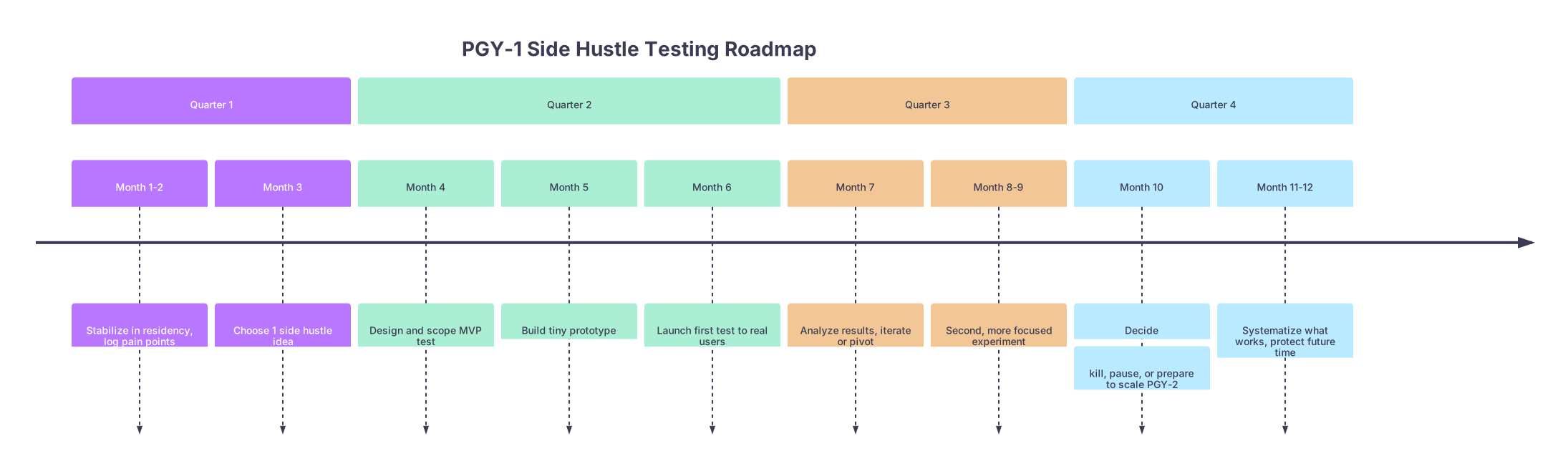
| Period | Event |
|---|---|
| Quarter 1 - Month 1-2 | Stabilize in residency, log pain points |
| Quarter 1 - Month 3 | Choose 1 side hustle idea |
| Quarter 2 - Month 4 | Design and scope MVP test |
| Quarter 2 - Month 5 | Build tiny prototype |
| Quarter 2 - Month 6 | Launch first test to real users |
| Quarter 3 - Month 7 | Analyze results, iterate or pivot |
| Quarter 3 - Month 8-9 | Second, more focused experiment |
| Quarter 4 - Month 10 | Decide |
| Quarter 4 - Month 11-12 | Systematize what works, protect future time |
At each point in the year, the question is not “How do I make extra money?” but:
“What is the smallest possible experiment I can run this month to see if this idea deserves more of my time?”
Quarter 1 (Months 1–3): Stabilize, Observe, Then Commit to One Idea
Month 1: Zero Building. Only Survival and Observation.
This is where most ambitious residents mess up. They arrive July 1 saying, “I’m going to start a medical education YouTube channel and a telehealth startup.”
No. Month 1 is about:
- Not getting written up.
- Not missing orders.
- Not crying in stairwells every other day.
At this point you should:
Lock down your non-negotiables
- Sleep minimum (e.g., “I do not go below 6 hours on average per 24 hours over a week”).
- Weekly reset block (half day off for groceries, laundry, and actual rest).
- Critical relationships (spouse, kids, or one close friend you will not neglect).
Start a “friction log” on your phone One Notes/Google Doc titled: “Annoyances / Problems / Skills”. Divide it into three running bullet lists:
- Problems I see repeatedly at work
- Things co-residents ask me for help with
- Skills I have that are rare in this hospital
Examples:
- “Everyone is confused about how to write discharge summaries in Epic.”
- “I keep getting asked to explain personal finance basics.”
- “I know Python and can pull data from Epic reports.”
That log will feed your side hustle ideas later.
Set a hard rule: nothing that requires >2 hours/week yet You are still calibrating to call schedules and your service culture. Any more than 2 hours and you will pay for it on your evaluations.
Month 2: Light Exploration, No Execution
By now you are not completely lost. You know which attendings are intense, which rotations crush you, and when your brain is mush.
At this point you should spend 1–2 hours per week on:
Idea mining from actual demand Re-read your friction log weekly. Ask:
- What do people complain about constantly?
- Who is already paying for a workaround?
- Where have I already created a quick fix informally?
Quick market sanity checks Use short, focused searches:
- “Physician coaching rates”
- “EMR tip sheets for residents”
- “Locum tenens telemedicine” You are not looking for a full market analysis. You just want to see if money changes hands in that space.
Write down 3–5 side hustle shapes
Example shapes for physicians:- One‑on‑one service (coaching, tutoring, consulting)
- Small product (Notion template, PDF guide, checklist pack)
- Small digital service (call coverage scheduling, EMR macros library)
- Content with monetization potential (newsletter, micro-course)
Month 3: Choose One Idea and Set Guardrails
By Month 3, you must pick one idea to test. Not design the LLC. Not write a 20‑page plan. Just choose the experiment.
At this point you should:
- Apply three filters
| Filter | Question to Ask |
|---|---|
| Time | Can I test this in 10 hours or less? |
| Risk | Zero impact on patient care / program? |
| Demand | Has anyone already asked for this? |
If an idea fails any of those, park it for PGY‑2+.
Decide your “PGY‑1 Test Scope” Typical viable PGY‑1 test scopes:
- 3‑session mini-coaching package for 3 people.
- 1‑page landing page + interest form.
- One PDF guide sold to a tiny audience.
- A single weekend freelancing shift on an existing platform.
Informal reality check with one trusted senior Pull aside a PGY‑2/PGY‑3 who has their life together. Example script:
- “I’m thinking about testing a 3‑session intern finance coaching package with residents at other programs. I’d cap it at 3 clients. Do you see any red flags with timing or perception?”
If they say, “During ICU month? Absolutely not.” Then you move the test start date, not your sanity.
Quarter 2 (Months 4–6): Design, Build, and Run Your First Tiny Test
Now we move from “idea” to “actual test.” Not full hustle. Just an experiment with real people and real money (even if it is small).
Month 4: Design the Experiment
You are still a resident. Your side hustle timer is two 60–90 minute blocks per week. That is it.
At this point you should:
Define a crystal-clear test question Examples:
- “Will 5 people pay $75 each for a 2‑hour crash course on residency finances over Zoom?”
- “Will 10 interns give me their email for an EMR macro cheat sheet?”
- “Will one clinic pay me $300 to create a custom call schedule template?”
Set success / failure thresholds up front For example:
- Success: 5+ paying customers within 4 weeks.
- Neutral: 2–4 customers → maybe iterate.
- Failure: 0–1 customer → kill or totally rethink.
Plan your MVP (Minimum Viable Product)
MVP for PGY‑1 must be embarassingly small:- Coaching: A Calendly link, an intake Google Form, Zoom, and 3 session outlines.
- Guide/Product: 5–10 pages max, written in Google Docs, exported as PDF.
- Service: One-page description of the service + a way to collect payment.
Choose your distribution channel Keep it simple and close to your world:
- GroupMe / WhatsApp resident groups.
- A private email to med school friends at other programs.
- A tiny audience on Twitter / Instagram / LinkedIn if you already use them.
No ads. No complicated funnels. You do not have time.
Month 5: Build the Bare Minimum
Now you spend 3–6 hours this month creating only what is required to run the test.
At this point you should:
Create the product/service skeleton Example for a PGY‑1 finance coaching test:
- 1 Google Doc: outline of three sessions (budget, loans, investing basics).
- 1 Google Form: short intake questionnaire.
- 1 simple payment method (Stripe link, PayPal, or Venmo Business if appropriate).
Write a simple offer message Maximum 5–6 sentences, for example:
“I’m piloting a 3‑session 1:1 ‘Intern Money Setup’ specifically for first-year residents at other programs. We meet on Zoom for three 60‑minute sessions and cover (1) basics of cash flow on a resident salary, (2) student loan strategy, and (3) starting investing without losing your mind on nights. I am testing this with 3 people at a beta rate of $75 total in exchange for honest feedback. If you are interested, reply ‘INTERESTED’ and I will send details.”
Schedule your “hustle windows” Protect them like call shifts:
- Example: Wednesday 20:00–21:30, Sunday 10:00–11:30.
- No charting. No doom scrolling. Only side hustle work.
5–6 focused windows in a month are enough to get a tiny MVP finished.
Month 6: Run the Test With Real People
Now you actually launch. This is where residents freeze and never send the message.
At this point you should:
Send the offer to a controlled audience
- Direct messages to 10–20 people you know (med school classmates, residents at other programs).
- A single post in one relevant group chat (if allowed by norms).
Track every response in one sheet Columns like:
- Name
- How they heard about it
- Yes / No / Maybe
- If no: reason (too expensive, wrong timing, not interested)
Actually deliver the thing
- Hold the Zoom sessions.
- Deliver the PDF.
- Complete the one-off service. Do not tweak mid-delivery. Take notes, but finish what you promised.
End each engagement with structured feedback Three quick questions work:
- “What was the most valuable part?”
- “What was confusing or not worth your time?”
- “If I charged full price ($X), would you recommend this to a co-resident?”
You are collecting signal, not ego boosts.
Quarter 3 (Months 7–9): Analyze, Iterate, or Kill
By now you have real data. Payment, participation, or deafening silence. Time to be brutally honest.
Month 7: Decide if the Idea Deserves a Second Test
At this point you should:
Measure your tiny test against your thresholds Examples:
- Target 5 signups, got 7 → strong signal.
- Target 5 signups, got 3 → some signal, probably pricing/positioning problem.
- Target 5 signups, got 0 → your friends like you, but nobody wants this.
Time and energy post‑mortem Ask:
- How many actual hours did I spend?
- Did this meaningfully hurt my performance or rest?
- Would I do this again during a harder rotation?
Label the outcome
- Green light: Exceeded target and felt sustainable.
- Yellow light: Some traction, but off on price, scope, or audience.
- Red light: No traction or clearly not sustainable with PGY‑1 demands.
Month 8–9: Second, Sharper Experiment (if Green or Strong Yellow)
If your first test is Green/strong Yellow, you run a more focused second experiment.
At this point you should:
Narrow the audience or offer
- From “residents” → “surgery interns on Q4 call.”
- From “EMR tips” → “Epic templates for heme-onc notes.”
- From “coaching anyone” → “IMGs applying to IM in the Midwest.”
Adjust pricing slightly upward If people paid with little objection, you probably underpriced. Bump 20–50% and watch if demand collapses or holds.
Shift toward repeatable elements Examples:
- Turn your 3 live sessions into 1 live + 2 pre-recorded modules.
- Turn custom macros into a template pack with small customization.
- Turn 1:1 sessions into small-group cohorts.
Cap your total client load For PGY‑1, I rarely recommend more than:
- 3–5 1:1 clients per month, or
- 1 small-group cohort per quarter, or
- 1 micro-product launch per quarter.
You are still a resident. Your “business” is still a lab experiment, not a second job.
Quarter 4 (Months 10–12): Decide, Systematize, or Shut It Down
By the final quarter of PGY‑1, you are staring down Step 3, fellowship thoughts, and maybe new leadership roles. Time to make a call.
Month 10: Decide the Fate of This Idea
At this point you should choose one of three paths:
Scale slowly in PGY‑2 Conditions:
- Clear evidence of demand (people pay on time, low refunds).
- You can define exactly what you do in one sentence.
- You have at least one repeatable process (template, script, or module).
Put in a holding pattern Conditions:
- Interesting results but poor timing (heavy rotations ahead).
- Good idea, but you personally do not enjoy the work. You keep assets (domain, templates, emails) and pause active marketing.
Kill it cleanly Conditions:
- Weak demand after two honest tests.
- High stress / low joy. You stop talking about it, archive the docs, and move on. No drama.
Month 11–12: Systematize (if Continuing)
If you choose to keep going, your priority is to remove brain cycles from repetitive tasks.
At this point you should:
Document three repeatable workflows Examples:
- Lead > booking > payment > calendar invite > reminder.
- “New client” onboarding checklist.
- “Weekly content” checklist if you are doing any public writing.
Automate only the most annoying 1–2 steps For PGY‑2:
- Calendly instead of back‑and‑forth messaging.
- Email templates for onboarding and follow‑up.
- Simple Notion/Sheets database for clients.
Set a hard monthly ceiling
- E.g., “No more than 8 paid client hours per month.” If you max out that ceiling with a waitlist, you can reconsider price or scope.
Weekly and Daily Rhythm: How to Fit This Into PGY‑1
Residents fail not because the idea is bad, but because their execution pattern is chaos. Let us fix that.
Your “Side Hustle Week” Template
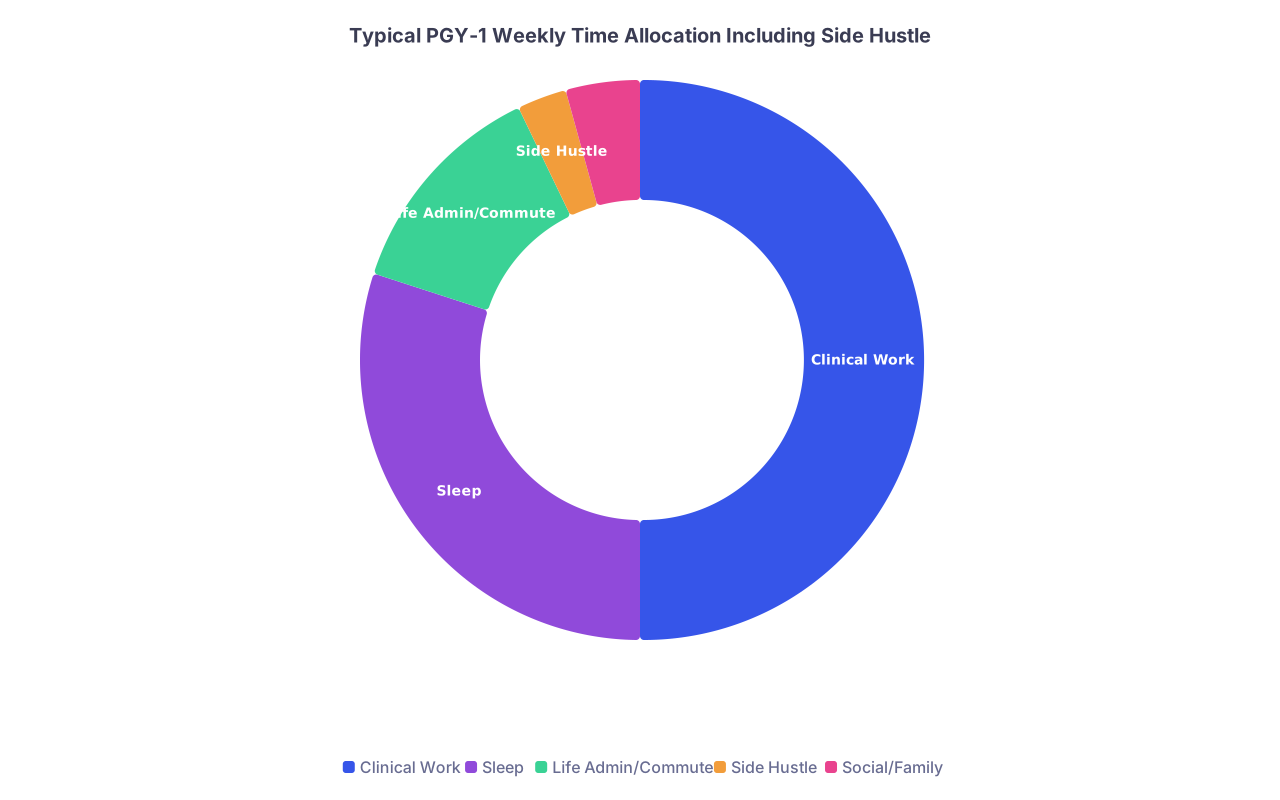
| Category | Value |
|---|---|
| Clinical Work | 70 |
| Sleep | 42 |
| Life Admin/Commute | 18 |
| Side Hustle | 4 |
| Social/Family | 6 |
You might not love the numbers, but they are realistic.
At this point you should structure a typical non-call week like this:
- 2 x 60–90 minute side hustle blocks
- One weekday evening, one weekend morning.
- 1 x 30 minute “review and plan”
- Usually Sunday evening.
- Zero hustle during golden hours after brutal calls
- Post‑call is for food, shower, and horizontal time, not entrepreneurship.
A Sample PGY‑1 Day with a Hustle Block
On a reasonable day (not call, not ICU):
- 06:00–07:00 – Wake, commute, coffee.
- 07:00–18:00 – Clinical work.
- 18:00–19:30 – Commute, dinner, decompress.
- 19:30–21:00 – Protected hustle window (or rest if you are wrecked).
- 21:00–22:30 – Light reading, wind down, sleep.
Your rule: If you are below your sleep minimum for the last 3 days, you cancel the hustle block. Protect the machine.
What Not to Do as a PGY‑1 Side Hustler
Let me be blunt. I have watched residents implode on these mistakes:

No LLC, no complex business structure in PGY‑1 A sole proprietorship with clean records and a separate bank account is enough to start testing.
No big code projects unless you are already a developer You will not build the next EPIC competitor at 2 a.m. as an intern.
No public complaining about your program or hospital as “content” This is how careers die.
No more than one simultaneous idea in active testing Parallel experiments are a luxury for people who are not cross-covering 40 patients.
Good PGY‑1 Side Hustle Test Ideas (and Bad Ones)
| PGY-1-Friendly Test | High-Risk / Bad Idea |
|---|---|
| 3-client coaching pilot | Building a full startup app |
| Selling a short PDF guide | Launching a full online course |
| Creating EMR templates/macros | Starting a brick-and-mortar clinic |
| Weekend telehealth shifts | Signing long, inflexible contracts |
| Small-group Zoom workshop | Daily content grind across 4 apps |
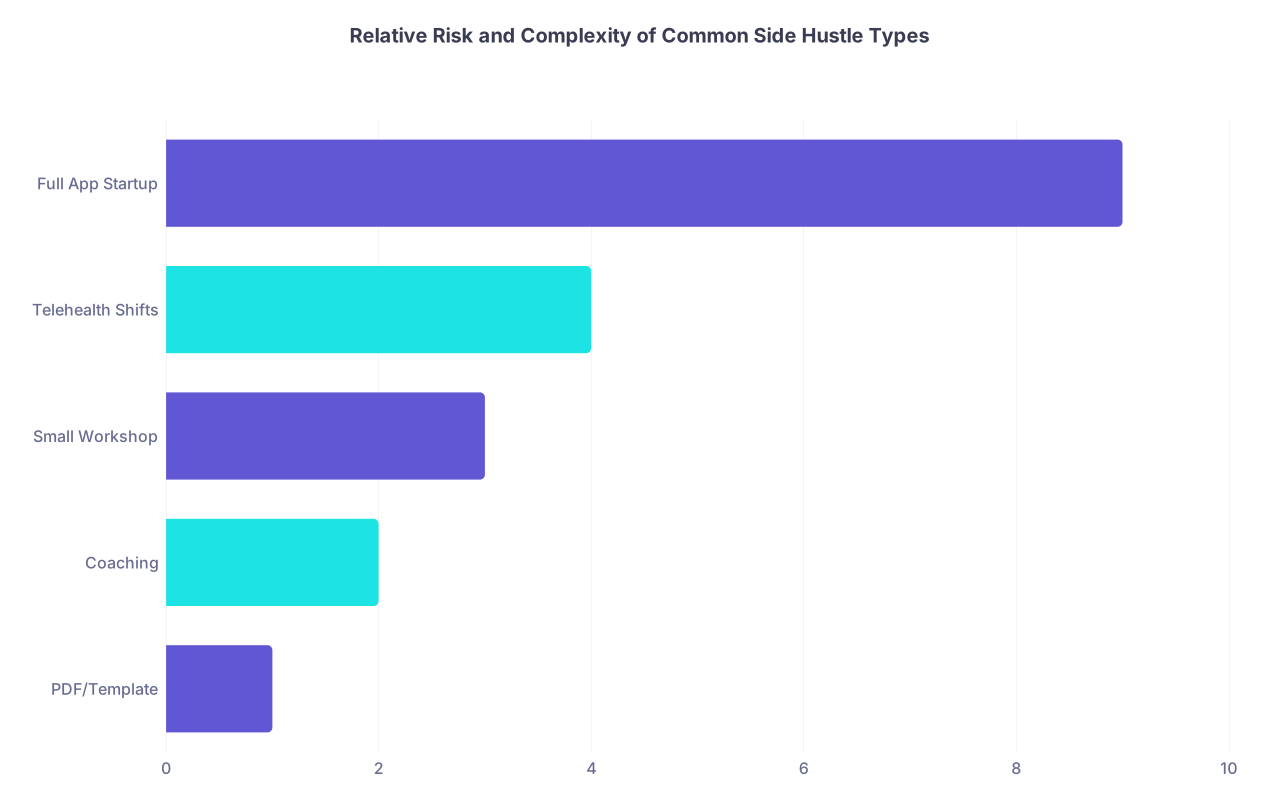
| Category | Value |
|---|---|
| PDF/Template | 1 |
| Coaching | 2 |
| Small Workshop | 3 |
| Telehealth Shifts | 4 |
| Full App Startup | 9 |
Safeguards: Protecting Your License, Program, and Sanity
You are not just any 26‑year‑old trying experiments. You are under institutional and professional scrutiny.
At this point you should have:
Program and institutional compliance awareness
- Read your contract clauses on outside employment and conflict of interest.
- Some programs require disclosure or approval for moonlighting or business activity.
Hard ethical line: nothing that touches your own patients
- Do not upsell anything to current or recent patients.
- Do not use hospital data, logos, or systems for your hustle.
Malpractice clarity
- Coaching ≠ medical care.
- Avoid specific personal medical advice in non-clinical settings. When in doubt, you frame it as education, not diagnosis or treatment.
Ruthless boundary on professional performance If attendings or chiefs start commenting on:
- Late notes.
- Recurrent lateness.
- Inattentiveness. You immediately downshift or pause the side hustle. Career first.
Frequently Asked Questions

1. When is the earliest in PGY‑1 I should actually charge money?
Not before Month 4 for most people.
Months 1–2 are for survival and observation. Month 3 is for choosing and scoping the idea. Charging in Month 4 (or later) gives you enough time to understand your schedule, avoid stepping on program rules, and design something you can actually deliver.
Could you technically charge in Month 2? Sure. But I have watched interns underestimate their call realities and end up rescheduling with their first paying clients three times. That destroys trust and confidence right when you are trying to build both.
2. How much income should I realistically aim for in PGY‑1?
Very little. Think “signal, not salary.”
If you make $500–$2,000 total across a few months from a test that feels sustainable, you have already beaten most interns. The point is not to replace resident income; the point is to learn:
- What people will pay you for.
- What work you enjoy doing repeatedly.
- How much time you can safely allocate while training.
The residents who actually succeed long-term are the ones who treat PGY‑1 as R&D, not a cash grab.
3. What is the one metric that matters most in my first side hustle test?
I would pick this: “Number of people who pay you twice or explicitly ask for more.”
One sale can be a fluke or a favor. When people come back or ask for additional ways to work with you, that is genuine product–market fit at a tiny scale. Track:
- Repeat clients.
- Referrals (“I told my co‑resident about you.”)
- People asking, “Do you have anything else I can buy / attend / use?”
Those signals tell you if this deserves a second, sharper experiment or if you should shut it down and move on.
Open your notes app today and title a page “Friction log – PGY‑1.” For the next seven days, write down every problem you see and every time someone asks for your help. That list is the raw material for your first side hustle test.


