
The average physician massively misprices their startup equity.
Not by 5–10%. By factors of 5–20x. I have seen cardiologists trade away 10% of a promising digital health company for a $25,000 “consulting retainer” that effectively valued the company at less than a typical angel round. Six years later, the same company raised at a $150M valuation. Do that math.
Let us fix that.
You want clear numbers: typical equity percentages for physicians, how vesting really works, what is “market” versus predatory, and how your leverage changes depending on whether you are a consultant, cofounder, or late add-on “medical advisor.” This is all quantifiable. And the data is fairly consistent across early‑stage health tech and med device deals.
Below I will walk through actual ranges, example cap tables, and vesting patterns that repeat over and over in physician-involved startups.
1. The Core Equation: How Valuable Is a Physician to a Startup?
Strip the emotion away. A startup asks: how much incremental value does this physician bring, and how replaceable is that?
Practically, physicians get equity for a few distinct buckets of value:
- Clinical credibility and trust (especially in B2B health, payers, and hospital sales).
- Regulatory and clinical trial design input.
- Network access: intros to systems, KOLs, payers, academic partners.
- Ongoing product and workflow design, plus early adoption pilots.
- Full-time executive leadership (CMO, cofounder, etc.).
The data from angel groups, accelerator term sheets, and common stock option plans show a pretty stable pattern:
- “Logo-only” advisors: 0.1–0.25%
- Active physician advisor (monthly engagement): 0.25–0.75%
- Part-time but critical physician cofounder: 2–8%
- Full-time physician cofounder: 10–30%
- Non-founder but early executive CMO: 0.5–3% stock or options, plus salary
The variance depends on stage (idea vs. post-Series A), risk, and actual time commitment. But those are the bands you are really dealing with.
2. Typical Equity Percentages by Role
Let us get precise. Here is how equity typically shakes out for different physician roles across pre-seed and seed-stage health startups.
| Role | Pre-Seed Equity Range | Seed Equity Range |
|---|---|---|
| Logo-only advisor | 0.05–0.2% | 0.05–0.15% |
| Active clinical advisor | 0.25–1.0% | 0.2–0.5% |
| Part-time physician cofounder | 3–10% | 2–6% |
| Full-time physician cofounder | 15–30% | 10–20% |
| Early CMO (non-founder) | 1–3% | 0.5–2% |
These are ranges I have seen repeated across:
- Digital health SaaS
- Med device startups pre-FDA clearance
- AI/ML decision support tools
- Specialty-focused platforms (oncology, cardiology, ortho, etc.)
“Logo-only” physician advisor: 0.05–0.25%
You see this a lot. A well-known academic or hospital brand name who:
- Shows up on the deck
- Does 1–2 calls per quarter
- Maybe attends an annual advisory board meeting
Equity: usually a one-time grant of 0.05–0.25% vesting over 1–2 years, very light expectations.
If you are offered 0.01% with a 4-year vest and no cash? That is closer to “we want your name for free” than a real advisory role.
Active physician advisor: 0.25–0.75% (occasionally to 1%)
This is what most working physicians should aim at when they are doing real work but not founding:
- 1–4 hours per month
- Regular product feedback
- Beta site facilitation / pilot support
- Some network introductions
Market equity here clusters around 0.25–0.5% at pre-seed, tailing off as the company raises more capital. Above 1% you are approaching “cofounder-level impact,” and the expectations usually ramp accordingly.
Part-time cofounder: 3–8% is the realistic band
Scenario I keep seeing: a software founder pulls in a practicing physician as “cofounder” while the physician stays clinical 0.8–1.0 FTE.
If the physician is genuinely essential—owning clinical direction, data strategy, and key early relationships—3–8% is standard pre-seed:
- 2–4% if they are more of a strategic advisor with a cofounder label
- 5–8% if they are deeply involved in build, pilots, sales
Anything under 2% for a true cofounder at formation is a red flag. At that point you are just a glorified advisor with a vanity title.
Full-time physician cofounder: 15–30% at formation
If you quit practice and join on day zero, you are not a “consultant.” You are a real founder. Typical early cap table (two founders) looks like:
- Technical / business founder: 50–70%
- Physician founder: 30–50%
Investors often like one founder with a bit more control (say 60/40 or 70/30), but 10/90 splits are usually dysfunctional and unstable over time.
By the time the company closes a seed round, dilution will hit both founders. That is normal. But your starting point should still reflect actual cofounder risk.
Early CMO (non-founder): 0.5–3%
Joining post-seed or Series A as a CMO with a salary and benefits? Equity resembles other C-level hires:
- 0.5–1% for Series A/B
- 1–3% for seed/late pre-seed
If someone offers you 0.1% options as founding CMO with below-market pay, that is not a competitive startup package. That is a discount hire trying to use your MD as cheap marketing.
3. How Vesting Actually Works (And How It Should)
Equity is meaningless without vesting details. Vesting decides how much of that percentage you keep if you walk, get pushed out, or the company changes direction.
Standard tech vesting pattern looks like this:
- 4-year vesting
- 1-year cliff
- Monthly or quarterly vesting after the cliff
For physicians, there are three common variants.
Common vesting patterns for physicians
| Engagement Type | Typical Vesting | Cliff |
|---|---|---|
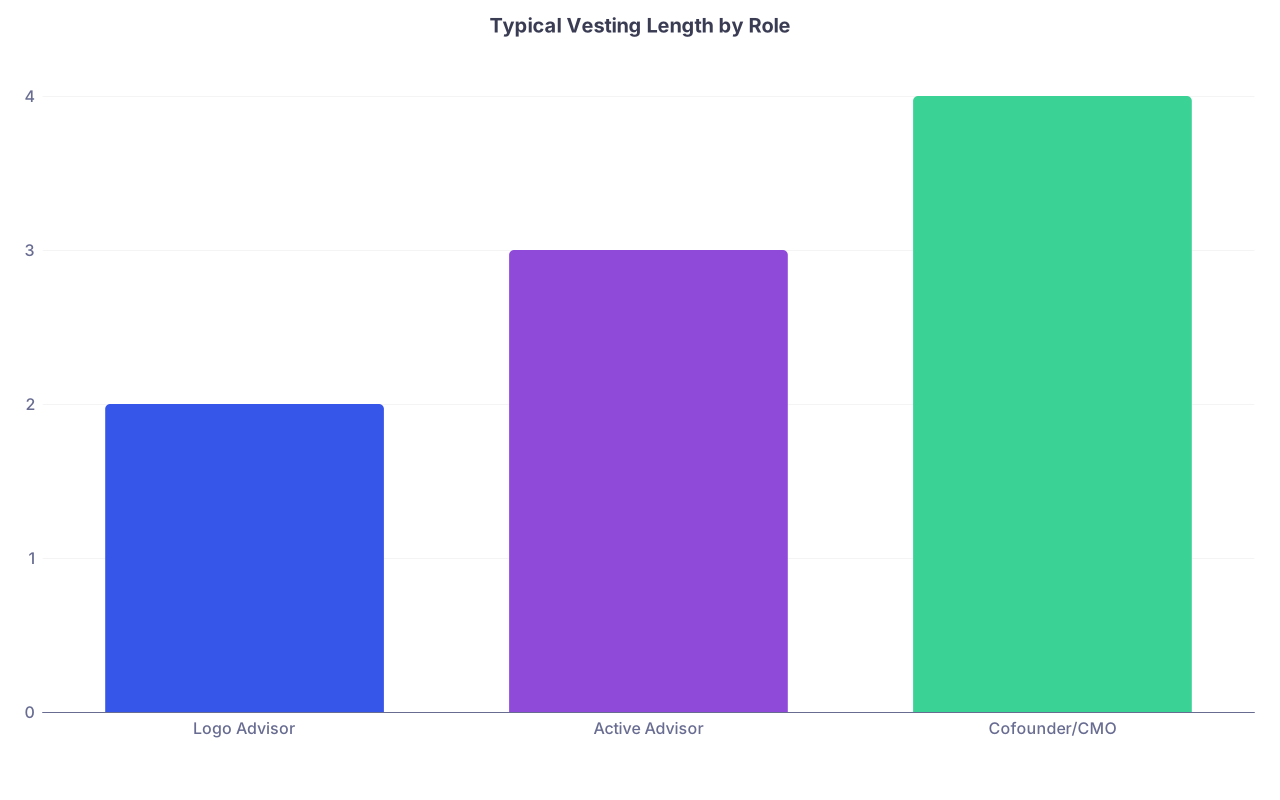
| Logo-only advisor | 1–2 years, quarterly | 3–6 months |
| Active advisor (0.25–1%) | 2–4 years, monthly/qtrly | 6–12 months |
| Cofounder / CMO | 4 years, monthly | 12 months |
The data is straightforward:
- ~80% of early-stage equity grants I see to advisors use 2–3 year vesting
- Founder and executive grants overwhelmingly use 4-year vesting with a 1-year cliff
- Physician “project contributors” sometimes get milestone-based vesting instead of time-based (more on that below)
| Category | Value |
|---|---|
| Logo Advisor | 2 |
| Active Advisor | 3 |
| Cofounder/CMO | 4 |
Those numbers are years of vesting. Shorter is not always better—you want vesting that matches how long your contribution actually matters.
Time-based vs. milestone-based vesting
Most startups default to time-based vesting: you earn equity by staying engaged. But for physicians, milestone-based vesting can be more rational, especially if:
- You are designing a trial protocol
- You are securing IRB approval and first 2–3 clinical sites
- You are committing to a defined pilot period (e.g., 12–18 months at one institution)
An example milestone schedule for a 0.6% equity advisory grant:
- 0.2% vests when protocol and endpoints are finalized and accepted
- 0.2% vests on first patient enrolled in pilot
- 0.2% vests when 100 patients have been enrolled and data lock occurs
If the startup balks at this and insists on “4 years, standard, trust us,” they are prioritizing their control over aligning equity to your real impact.
4. Stage Matters: 0.5% at Pre-Seed vs. Series B
A physician with 0.5% at pre-seed is not the same as a physician with 0.5% at Series B. The later-stage equity is usually far more valuable per percentage point, because the risk has dropped and the valuation is higher.
Here is a simplified comparison.
| Stage | Typical Valuation | 0.5% Equity Value (Paper) |
|---|---|---|
| Pre-seed | $5M–$10M | $25k–$50k |
| Seed | $15M–$30M | $75k–$150k |
| Series A | $40M–$100M | $200k–$500k |
| Series B | $100M–$300M | $500k–$1.5M |
Obviously this is paper money, not cash. Many companies go to zero. But the ratios matter. Saying “I want 1%” without reference to stage and risk is like quoting a salary without specifying hours or responsibilities.
5. Common Scenarios (With Numbers)
Abstract ranges are nice. Concrete scenarios are more useful. Here are real-world style setups I have seen in health tech and med device.
Scenario 1: You are the first serious physician advisor
Company: early digital health startup, 2 non-physician founders, pre-seed, pre-revenue.
Your role: 2–4 hours/month, helping shape clinical workflow, buyer persona, and doing a few warm introductions.
Market-range equity:
- 0.25–0.5% common stock
- 2–3 year vesting, quarterly
- 3–6 month cliff
If they offer 0.05% over 4 years with a 12-month cliff, that is below market. You are being paid with lotto tickets, not real equity.
Scenario 2: You are a part-time cofounder while staying clinical 0.6–0.8 FTE
Company: pre-seed, pre-product. Technical founder wants your domain expertise and hospital access.
You are:
- Meeting weekly 2–4 hours
- Guiding product specs
- Planning early pilots at your institution
- On the pitch deck as a cofounder
Reasonable equity:
- 5–10% at formation
- 4-year vesting, 1-year cliff
- Possibly double-trigger acceleration on change of control (e.g., 12–25% of remaining unvested equity accelerates if company is acquired and you are terminated without cause)
Under 3% here is a major undervaluing of your risk and contribution.
Scenario 3: You join a funded Series A company as CMO
Company: Series A, $50M post-money valuation, 20 employees.
You quit your job. You are full-time. You are not a founder.
Typical compensation:
- Market salary for your geography (say $280–$400k depending on specialty and location)
- 0.7–1.5% in stock options, 4-year vest with 1-year cliff
The options might be priced at a strike equal to fair market value (e.g., $2–5 per share). Expected fully diluted shares could put you in the 0.7–1.5% band. Less than 0.5% for a true early CMO is on the low side unless the salary is dramatically above market.
6. Liquidation Preferences: Why 1% Is Not Always 1%
Equity percentage alone lies. The real economic outcome is shaped by:
- Funding raised and at what terms
- Liquidation preferences (1x, 2x, participating, etc.)
- Option pool expansions and later dilution
Here is a simple distribution example for a physician with 1% fully diluted.
Company outcome: $100M exit after raising $30M with a standard 1x non-participating preference.
Capital stack:
- $30M investors with 1x preference
- 20% option pool fully allocated
- 50% to founding CEO
- 29% to other founders, employees
- 1% to you
At exit:
- First $30M goes back to investors (1x preference)
- Remaining $70M is shared pro rata based on ownership
Your 1% of fully diluted equity gets 1% of $70M = $700,000 gross, before taxes.
Now change just one parameter: a 2x participating preference on that $30M (ugly but not unheard of in desperate rounds).
- Investors first take $60M (2x)
- Then they also share in the remaining $40M according to their equity percentage
Your slice shrinks fast. Same “1% equity” on paper, radically different cash.
For physicians: unless you are putting serious capital in, your leverage to negotiate preference stacks is low. But you absolutely can ask for:
- Confirmation of current capitalization table
- Summary of existing preferences
- A simple modeled outcome table for low, medium, and high exit scenarios
Any team that refuses to walk through this at a high level is waving a red flag.
7. Equity vs. Cash: What the Data Shows on Tradeoffs
Physicians often get asked to discount cash in exchange for equity. Sometimes this is smart; often it is a stealth way for cash-strapped founders to externalize risk onto you while preserving their own stake.
One data-backed heuristic:
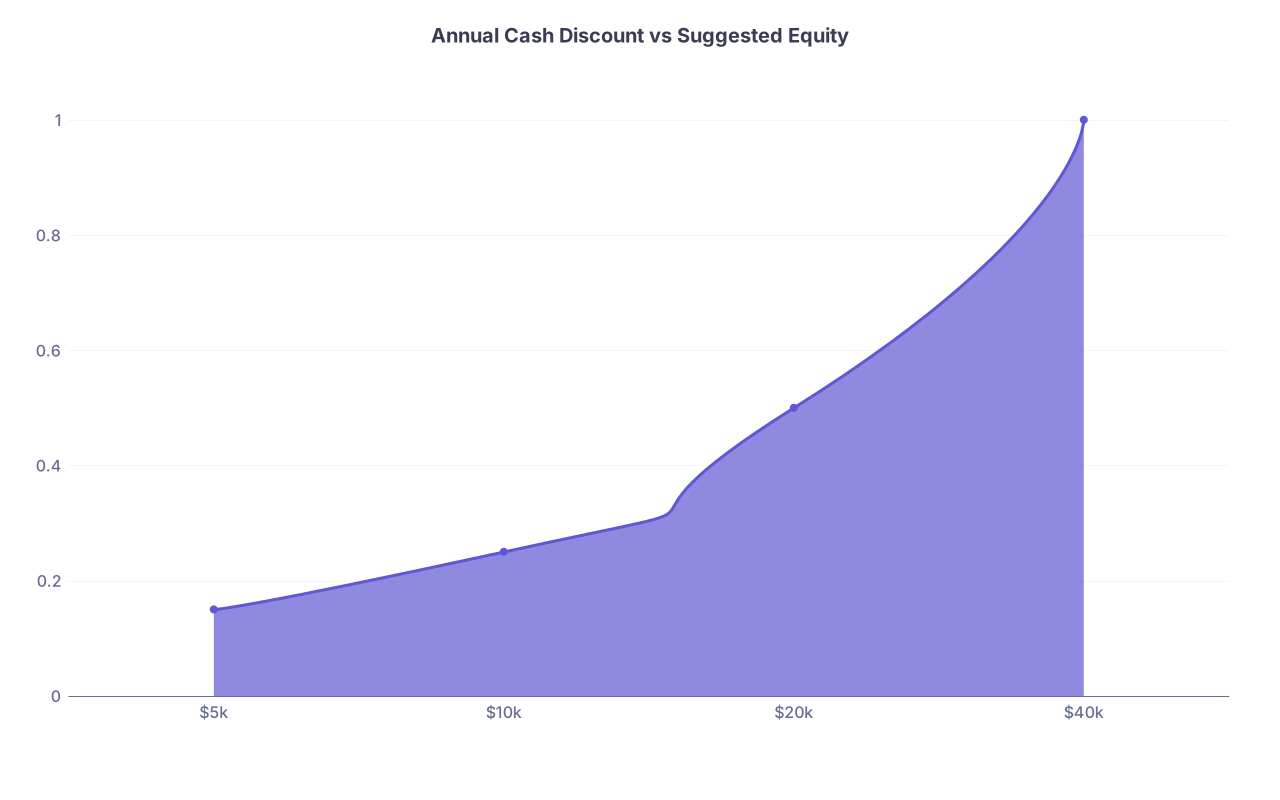
If your annual cash discount is more than 20–30% of fair market rate, you should be getting equity that, at a realistic exit, compensates for that risk.
Say fair market consulting for you is $400/hour. You agree to do 5 hours/month at $150/hour instead, a $250/hour discount. That is:
- 5 hours × $250 discount × 12 months ≈ $15,000/year you are leaving on the table
For that level of risk contribution at pre-seed, equity in the 0.25–0.75% range is fairly standard. If you are being asked to do something closer to 10 hours/month at a massive discount, your target should push toward the upper end of that range or into cofounder territory.
| Category | Value |
|---|---|
| $5k | 0.15 |
| $10k | 0.25 |
| $20k | 0.5 |
| $40k | 1 |
Rough mapping: as your annual effective discount rises, a “fair” equity grant climbs quickly from 0.1–0.2% into the 0.5–1% band at early stages.
8. Pitfalls I See Physicians Walk Into (Repeatedly)
Patterns repeat. Here are the most common mistakes, all fixable once you see the numbers.
Confusing vanity titles with ownership
I have seen dozens of “Chief Medical Officer” roles with 0.05% equity and no real decision power. That is not an executive position. That is a paid advisory role with branding.Accepting extremely long vesting with token percentages
0.1% over 4 years with a 12-month cliff for a physician actively engaged is not market. It is a cheap way to rent your credibility. Push for either more equity or shorter vesting, or both.Ignoring dilution math
If you are joining after a large option pool expansion, your 0.5% might already be heavily diluted, with more dilution coming. Ask for the fully diluted cap table, not just “ownership today.”Signing without IP and conflict clarity
For academic physicians, institutional IP policies and conflict-of-interest rules can wipe out your “equity” later. I have seen university tech transfer step in and demand a chunk of a startup after the fact because the physician used institutional data or resources.No post-termination exercise window awareness
For options, many plans default to a 90-day exercise window after you stop working with the company. If you leave and the stock is worth something, you might have to write a large check quickly to exercise—or lose everything. This is not abstract; it happens constantly.
9. Negotiation Anchors That Actually Work
You do not need to become a venture lawyer. But you should anchor around a few numeric points that are very hard to argue against:
- Comparable advisor ranges: “Other digital health startups I advise have granted 0.25–0.5% for this level of engagement at this stage, with a 2–3 year vest. I would like to be in that band.”
- Time commitment to equity ratio: “At 5–10 hours per month, this is materially beyond logo-only advisory. That level of time usually corresponds to 0.5–1% at pre-seed.”
- Co-founder parity: “If we are both on day zero putting in significant time, a 90/10 split does not match the risk profile. Most founder teams split closer to 60/40 or 70/30.”
Founders who understand market norms will not be offended. They may not give you everything you ask for, but they will recognize those numbers as data-backed.
10. The Future: How Physician Equity Will Likely Shift
As more physicians get involved in AI, data platforms, and remote care startups, two trends are already showing up in the data:
Smaller individual grants, more physicians on the cap table
Instead of one “star” KOL with 1–2%, you see 5–10 physicians each with 0.1–0.3%. This diversifies clinical input and de-risks reliance on one individual.More milestone-based vesting tied to data and access
Equity tied to delivering a de-identified dataset, activating pilot sites, or recruiting patients for real-world evidence is becoming more common. Time is not the only metric anymore.
The net effect: average equity per physician advisor shrinks slightly, but the number of physicians holding equity expands. The big upside goes to those who step into founder or early CMO roles, not those who sprinkle their name on a dozen pitch decks.
Key Takeaways
- The data across health tech deals is clear: active physician advisors usually land between 0.25–0.75% at pre-seed, part-time cofounders 3–8%, and full-time physician cofounders 15–30% at formation. Anything far below these bands deserves scrutiny.
- Vesting terms matter as much as percentages. A reasonable pattern is 2–3 years for advisors, 4 years with a 1-year cliff for founders and CMOs, with milestone-based vesting when your contribution is tied to specific trials, pilots, or data deliveries.
- Do not price your equity blindly. Map your time and cash discount to realistic equity ranges, look at fully diluted numbers and preference stacks, and be willing to walk away from vanity titles with token ownership.