
The biggest lie in physician side hustles is that everyone’s being transparent. They’re not. The best stuff never makes it to Twitter threads, conference talks, or cute “passive income” podcasts.
Let me tell you what actually happens behind closed doors.
Attendings with truly lucrative side hustles almost never broadcast the real details. You get sanitized versions. Half-truths. Or total smokescreens. And if you do not understand why, you will chase shadows and waste years trying to replicate a story that was never complete to begin with.
You’re in the “future of medicine” phase of this conversation, so let’s be blunt: the future is physicians with diversified income. But the people already there? They’re not laying out the blueprint on Instagram.
I’ll walk you through why.
The Real Reason Attendings Stay Quiet
The official reasons they’ll give you at a networking dinner sound noble: “I don’t want to distract residents from training” or “Focus on being a good clinician first.”
That’s about 20% truth and 80% cover story.
The real drivers are much less pretty:
- They don’t want competition.
- They’re afraid of institutional or legal backlash.
- Their income depends on asymmetric information.
- Their side hustle narrative doesn’t match the social-media version.
- They don’t fully trust you—or their colleagues.
Yes, even the ones who like you. Even the “mentor” who buys coffee for the team.
I’ve heard this verbatim from an attending hospitalist who quietly pulls in mid-six figures outside clinical work:
“If I give you my playbook, you’re my competition in three years. Why would I do that? I worked a decade to figure it out.”
That’s not rare. That’s normal.
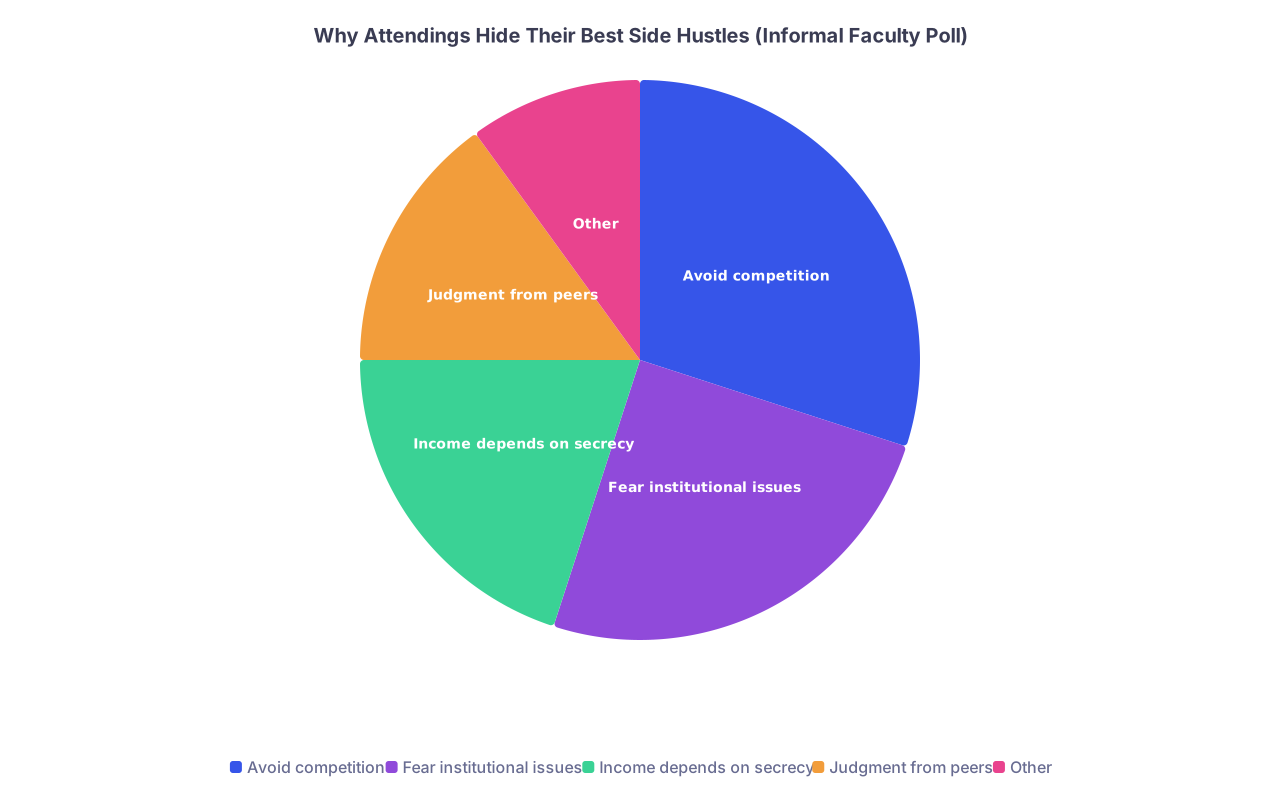
| Category | Value |
|---|---|
| Avoid competition | 30 |
| Fear institutional issues | 25 |
| Income depends on secrecy | 20 |
| Judgment from peers | 15 |
| Other | 10 |
Asymmetry Is the Business Model
A lot of the most profitable physician side hustles run on information asymmetry. One person knows something other people in the system don’t—or don’t understand well enough to monetize.
Let me give you a few concrete patterns I’ve seen:
1. Niche consulting built on obscure expertise
The cardiologist who consults for a mid-size device company isn’t going to post a thread: “Here’s exactly how I negotiated $40K/quarter for advisory work.”
Why? Because the whole reason he’s valuable is that:
- He’s one of maybe ten people in the region who understands a particular device workflow deeply.
- The company believes he has unique access to clinicians and hospital leadership.
- He can quietly influence adoption patterns.
If suddenly twenty people from his own institution start pushing themselves as “advisors” to similar companies, his leverage drops. His rate drops. His exclusivity evaporates.
So what does he say publicly?
“I do some industry consulting on the side. It’s nice extra income.”
That’s it. No numbers. No process. No actual path you could copy.
2. Exploiting broken systems (legally, but barely)
Some of the most profitable plays sit in the gray areas of billing, staffing, or call coverage.
Examples I’ve personally seen:
- Anesthesia group that structured a separate company to “provide” certain services, then billed in a way the hospital administration barely understood, but that was technically permissible at the time.
- An EM doc who locked in a sweetheart telemedicine contract in the early days, negotiated before anyone knew how to price it, and then quietly scaled coverage using junior docs.
Do you think they’re going to present this at Grand Rounds? Of course not.
The entire arrangement depends on:
- Other docs not realizing how underpriced their own time is.
- Admin not understanding the true economics of the contract.
- Competitors not replicating the model and driving down margins.
So publicly you’ll hear: “I’m involved in some telehealth work and administrative roles.” Which is like saying Tesla “makes vehicles.”

Fear of Administrative and Legal Blowback
Let’s talk about the elephant in the room: institutions and compliance departments.
Many attendings are more afraid of their hospital lawyers than of losing a side hustle. And they’re not crazy.
Typical hidden worries:
Conflict of interest:
The hospital finds out an attending is advising or partly owning a company that wants contracts with the same hospital. Suddenly there’s a committee, disclosures, maybe lost privileges.Stark, Anti-Kickback, and similar laws:
Anything involving referrals, ownership in imaging centers, labs, surgery centers can get complicated fast. Even if it’s legal, nobody wants to be “that doctor” under “review.”Reputation with leadership:
A chair who’s gunning for a deanship isn’t going to love his star faculty publicly talking about how they built a business that makes more than their academic salary.
I sat in on one departmental meeting where the chair literally said:
“If you’re doing side work that would embarrass the institution if it hit the news, stop. Now.”
That lands differently when you’re the associate professor with a quiet seven-figure stake in an ASC.
So what do they do? They keep it quiet. Or they rebrand it as something vague like “entrepreneurship interests” or “advisory roles.”
They’re not going to teach a lunch-and-learn called: “How I used hospital politics to secure my own imaging center partnership.”
The Money vs. Image Problem
Here’s another messy truth: the hierarchy of academic prestige doesn’t always match the hierarchy of income.
The guy with the big R01 grant and national name recognition might make less than the relatively unknown hospitalist who bought three urgent care centers at the right time.
No one on the academic conference stage wants to say:
“Yeah, my real income is from my clinics and real estate. The research is my expensive hobby.”
So the incentives are:
- Flaunt the prestige work.
- Understate or omit the boring, extremely profitable stuff.
When they do talk about “side hustles,” it’s often the safe, publicly acceptable ones: writing, speaking, maybe some consulting, sometimes a startup that already got press coverage.
The less glamorous but more powerful things—strategic real estate near hospitals, owning chunks of local service companies, high-level B2B work—stay off the slides.
I know a radiologist whose public persona is “educator and podcaster.” His actual engine? A telerad group, a quietly negotiated contract with an imaging network, and a highly optimized schedule that lets him arbitrage time zones. He’s never broken that down publicly with real numbers. If he did, a dozen copycats would be calling the same networks within a month.
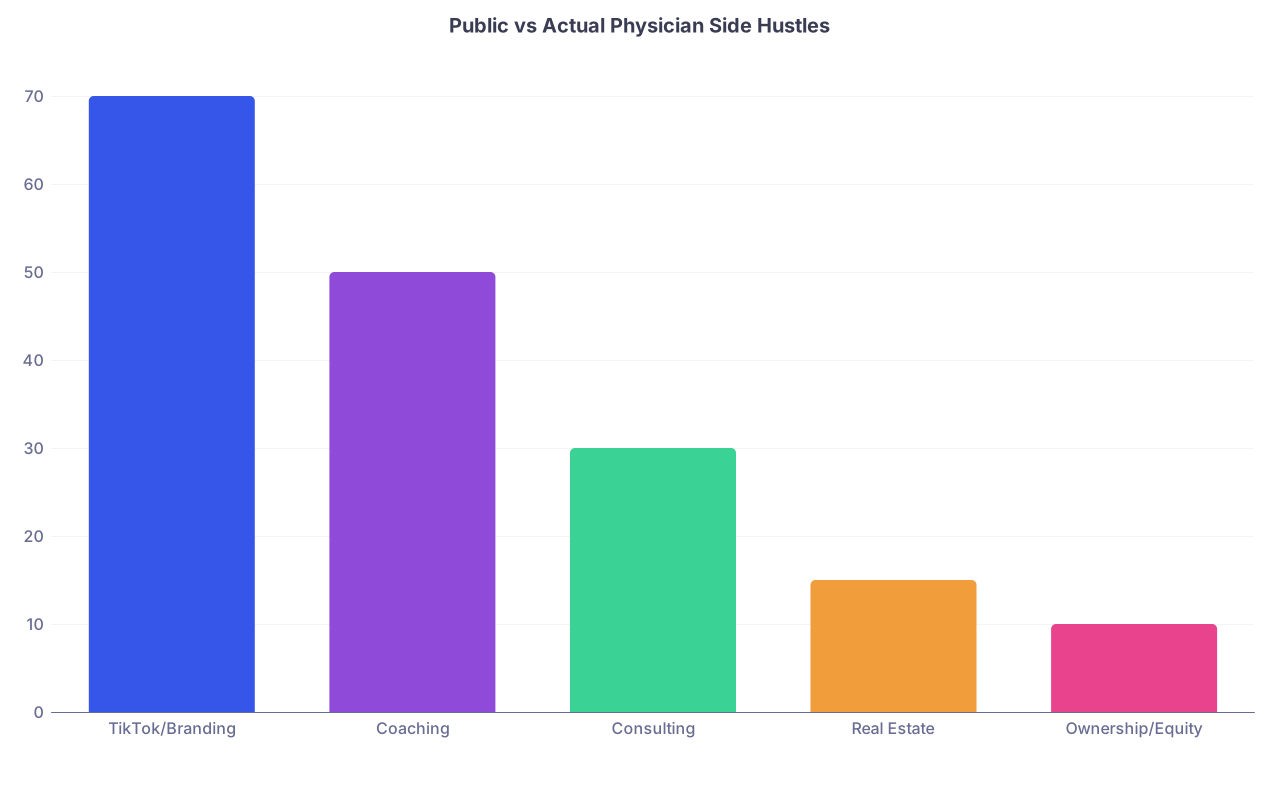
| Category | Value |
|---|---|
| TikTok/Branding | 70 |
| Coaching | 50 |
| Consulting | 30 |
| Real Estate | 15 |
| Ownership/Equity | 10 |
(Percent of what gets talked about heavily online, not what makes the most money.)
The loudest side hustles are not usually the best-paying ones. They’re just the easiest to talk about without consequences.
Why They Don’t Trust You With the Real Playbook
Let’s attack the personal side. It isn’t just systems and laws. It’s people.
There are three kinds of “learners” attendings worry about:
The Talker
The resident who would “accidentally” tell everyone on the team about the attending’s side business details. That’s how word leaks to admin, competitors, and jealous colleagues.The Shortcut Hunter
The person who wants the end result but not the grind or risk. They’ll try to replicate the play without understanding it. When it blows up, they blame the mentor: “Dr. X told me this was a good idea.”The Competitor
The bright, hungry fellow who will actually out-execute them and go pitch the same clients, the same hospital, the same niche… but cheaper, faster, more aggressively.
You might think, “I’m not that person.” Maybe true. But they’ve met all three types and got burned at least once.
I’ve heard attendings say this privately about residents:
“I’ll tell them concepts. I’m not handing over my contracts, contacts, or numbers. I worked for those.”
You’re getting philosophy, not tactics. Stories, not spreadsheets.

Sanitized Stories vs. What Actually Happened
Here’s how the side hustle story usually gets rewritten for public consumption.
Real version:
- They got lucky on timing.
- They had a pre-existing network (spouse in finance, friend in tech, old classmate now a VC).
- They took risk that would make most residents nauseous.
- They worked off-hours for years before seeing real money.
- They made some ethically gray decisions around referrals, influence, or insider knowledge.
Public version:
“I was always interested in business, so I started consulting with some companies on the side, and then it grew. Anyone can do it with consistency and passion.”
Notice the missing parts:
- No mention of equity grants, vesting schedules, dilution.
- No disclosure that the first contract came because they knew the CEO personally.
- No talk of the first two failed ventures.
- Zero detail on exact revenue, margins, and deal terms.
This isn’t just modesty. It’s self-protection.
Because if they say:
“I used my role as medical director to structure a mutually beneficial deal with an outside vendor where I also had a financial interest”—
they’ve just written an email exhibit for some future investigation.
So they sanitize. Heavily.
The Types of Side Hustles That Stay Hidden
Let’s put names to the categories that stay in the shadows. You won’t see these dissected in resident noon conference talks.
| Category | Why It Stays Quiet |
|---|---|
| Equity in local clinics/ASCs | COI concerns, referral optics, legal gray zones |
| Consulting for payors/vendors | Fear of peer judgment, admin scrutiny |
| High-level expert witnessing | Colleague backlash, ethical perception |
| Healthcare real estate plays | Seen as “profiteering” off the system |
| Owning service companies (billing, staffing, IT) | Direct competition with hospital vendors |
Are they illegal? Not necessarily. Some are textbook case studies in smart strategy.
But they’re politically radioactive. If you brag, you bleed.
So the attending who owns 15% of a local surgery center doesn’t tell the residents: “Here’s my pro forma, here’s my annual K-1, here’s exactly how we structured buy-ins.”
He just says: “I’m involved in some outpatient work.”
The Social Penalty of Being “Too Businessy”
Inside many academic centers, there’s an unwritten rule: clinical excellence and research are noble; overt business focus is suspect.
You’ve probably heard some version of:
- “He’s more businessman than doctor now.”
- “She’s always chasing the next gig.”
- “He sold out.”
So attendings create a split identity:
- Public: Dedicated clinician, teacher, researcher.
- Private: Operator, investor, negotiator.
They’ll talk about grant funding all day. They’ll glow when a resident asks about their last paper. Ask them exactly how they negotiated their royalty structure with a device company, and the energy changes.
You’ll see it: a pause, a deflection, a vague answer like, “It’s complicated contracts stuff, but the lawyers handle most of it.”
Often that’s not true. Often they fought hard for those terms. But admitting that erodes the “pure academic” persona they’ve spent years cultivating.
So you get stories about passion and curiosity, not negotiations and leverage.
What You Should Actually Do Instead of Chasing Secrets
Here’s the part nobody tells you: You don’t need their specific secret to build something impressive. You need their pattern—the way they think about opportunity.
Stop asking, “What’s your side hustle?”
Start asking, “How do you see leverage in your day-to-day work?”
The truth is, their exact model is probably:
- Dependent on local hospital politics.
- Based on contracts from years ago.
- Built on relationships you do not have yet.
Even if they told you everything, you couldn’t cut-and-paste it.
You’re better off learning:
- How they identified an underpriced skill or position.
- How they positioned themselves as the “obvious” person to solve a problem.
- How they handled risk—what they bet, what they refused to gamble with.
The attendings who respect you will sometimes share that if you show seriousness and discretion. Not in a crowded hallway. Not in a WhatsApp group of 30 residents. Over years. In pieces.

| Step | Description |
|---|---|
| Step 1 | Curious Resident |
| Step 2 | Do Excellent Clinical Work |
| Step 3 | Show Genuine Business Interest |
| Step 4 | Protect Small Confidences |
| Step 5 | Get Invited to Real Conversations |
| Step 6 | See Actual Numbers and Deals |
| Step 7 | Build Your Own Playbook |
You don’t shortcut your way into the room where spreadsheets and contracts are open on the screen. You earn your way there by not being a liability.
How the Future of Medicine Changes This (But Not Completely)
Let’s zoom out.
The macro trend is obvious:
- Reimbursement pressure increases.
- Corporate medicine expands.
- Autonomy shrinks for pure clinicians.
The logical response?
More physicians will build non-clinical income streams. More will own infrastructure. More will sit on both sides of the exam room and the boardroom.
So you might think: “Well, then this secrecy will go away. It’ll be normal.” Up to a point.
You’ll see more content around side hustles. That’s already happening—podcasts, courses, physician coaches, masterminds. But here’s what you need to understand:
The most profitable models tend not to scale to thousands of people.
They rely on scarcity, local advantage, or timing.People who build scalable info-businesses (courses, communities, etc.) are often not the ones running the highest-margin, hard-to-copy plays.
They’re monetizing teaching, not execution.The doctors who are genuinely ahead of the curve in B2B healthcare, infrastructure, and complex deal structures will stay selective.
They might mentor a handful of people. They won’t blast the blueprint on YouTube.
So yes, the culture will shift. It’s already more acceptable for a resident to say “I’m interested in healthcare startups” without getting side-eye.
But the true insider strategies? Those will always be behind doors, on encrypted chats, in small dinners at conferences where everyone at the table already has something to lose.
Your job is to become someone people can talk to without regretting it later.
How to Position Yourself as Someone They’ll Actually Open Up To
You want the real version, not the Instagram version? Then stop acting like an audience member and start acting like a future peer.
Do this over the next few years:
- Get financially literate. Not “I read one book.” Understand basic accounting, equity, contracts, valuations. Attendings open up more when they don’t have to explain every term.
- Prove you’re discreet. If someone shares even a small number or detail, it never leaves your mouth. Word gets around fast about who can’t keep things quiet.
- Show staying power. Don’t bounce from crypto to day trading to ten different startup ideas in a year. Serious people avoid that chaos.
- Create value first. Maybe you help with a small project, connect them to someone, or contribute meaningfully to a paper or initiative. People share more with people who’ve actually helped them.
That’s how you eventually hear, in a side conversation after dinner:
“Alright, here’s how I really structured it. Don’t repeat this widely.”
And then, finally, you see the thing nobody’s ever posted about.