
Strong connections do not magically erase a weak application after the Match. They help—sometimes a lot—but they are not a cheat code. And believing they are is how people waste critical weeks post-Match while others quietly take the jobs you wanted.
You’re in the post-Match wilderness. Maybe you didn’t match. Maybe you SOAP’d into a backup you hate. Maybe you’re trying to lateral into a different specialty. I’ve heard the same line a hundred times from students and prelims:
“But I have really strong connections at [program]. My mentor knows the PD really well. I think I’ll be fine.”
That belief is responsible for more preventable career damage than a low Step score.
Let’s dismantle the mythology and talk about what “connections” really buy you, what they absolutely do not, and how to play the game like an adult who understands power, risk, and incentives—not like a fourth-year clinging to “my letter writer said I’m great.”
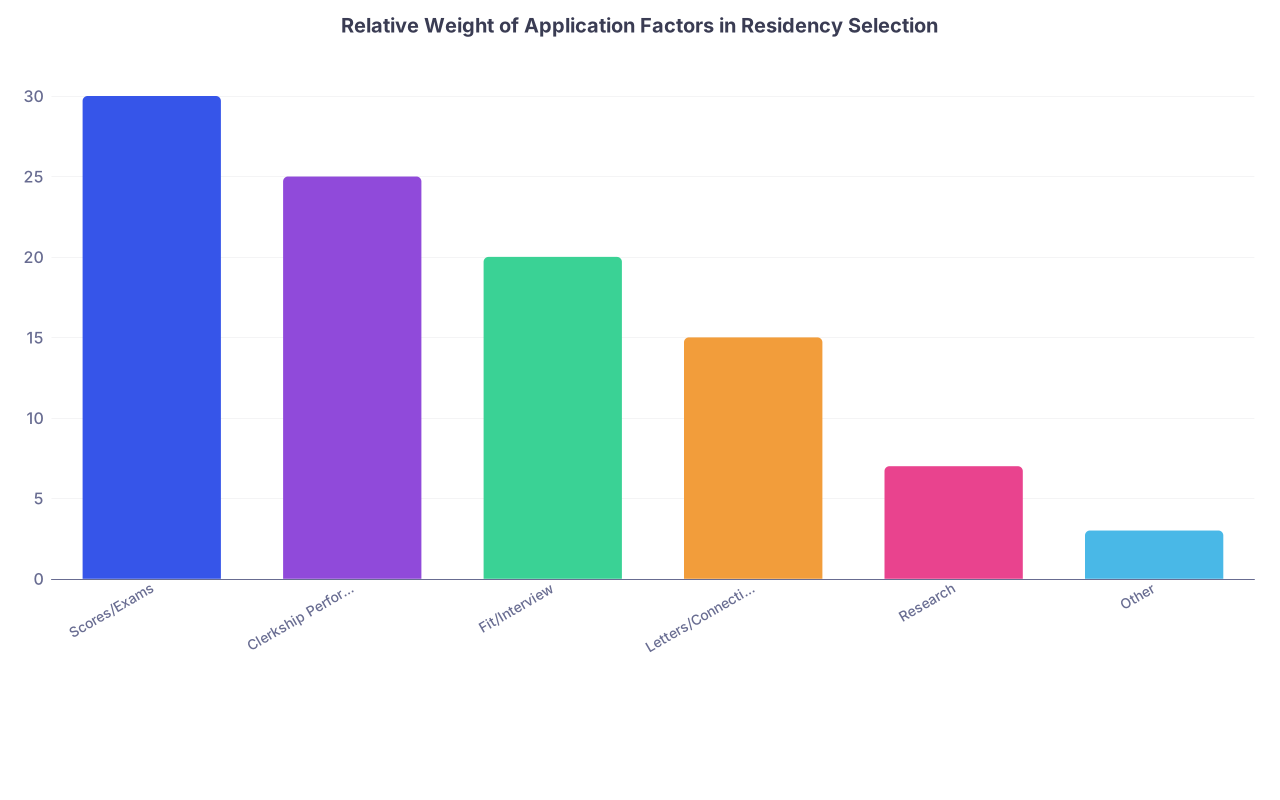
| Category | Value |
|---|---|
| Scores/Exams | 30 |
| Clerkship Performance | 25 |
| Fit/Interview | 20 |
| Letters/Connections | 15 |
| Research | 7 |
| Other | 3 |
The Big Myth: “If I Have Connections, My Application Doesn’t Matter”
Here’s the core myth: once you’re in the post-Match world—SOAP, off-cycle positions, prelim to categorical jumps, second attempts—personal connections somehow trump all the usual metrics.
Wrong.
Connections are a force multiplier, not a force substitute. They amplify an application that is already borderline or decent. They almost never resurrect one that is clearly below a program’s risk tolerance.
I have watched this exact scenario:
- Applicant doesn’t match into categorical internal medicine.
- Has a mentor who “knows everyone” in the region.
- CV: mediocre school, one failed board attempt, sparse narrative letters, nothing disastrous but nothing compelling.
- Applicant spends March–May “waiting to hear back” because “Dr. X is talking to a few PDs for me.”
Result in July: no categorical spot, no structured plan, and now they’re a reapplicant with a gap and still no clear story, while peers with worse “connections” but stronger, cleaner applications grabbed open PGY‑1 positions in April.
The mentor’s “connections” didn’t fail.
The application did.
Connections will not:
- Rewrite your board history.
- Turn a string of 3rd year marginal evals into “top 10% of students I’ve worked with.”
- Fix professionalism flags, major gaps, or a scattered narrative.
- Make a PD ignore that you have zero documentation of reliability and work ethic.
What they can do is:
- Get your file actually read, instead of lost in a pile of 200 “Interested in PGY‑2?” emails.
- Get you an interview when you’re slightly below their usual metrics.
- Give you a chance to explain a red flag in person.
- Make a PD more willing to “take a chance” when you’re in the gray zone.
That “gray zone” phrase matters. Programs are not flipping a coin between you and a ghost. They’re managing risk. Connections move you from the “no” pile to the “maybe” pile. The rest is still your record.
What Post-Match Decisions Actually Look Like Behind the Curtain
You need to understand what’s happening in their inbox before you put all your chips on “my attending knows the PD.”
Post-Match, especially in SOAP week and the months after, programs are dealing with three brutal realities:
- Patient care does not stop because the Match screwed you.
- Coverage gaps are dangerous and expensive.
- Every new hire is a reputational and financial risk.
So when they’re considering you for an unexpected PGY‑1 or PGY‑2 spot, they’re not asking, “Whose student is this?” first.
They’re asking:
- Can this person safely cover nights in three months?
- Are they going to pass Step 3/boards and keep our ACGME status clean?
- Are they likely to quit, implode, or need heavy remediation?
- Will our current residents hate us for adding this person?
This is where your application strength still runs the show. PDs have very crude but real heuristics:
| Applicant Profile | PD Gut Reaction |
|---|---|
| No failures, solid evals, decent scores | Safe, low-risk maybe |
| One failure, strong narrative letters | Risky but consider |
| Multiple failures or professionalism issues | Only if desperate |
| Strong academic plus trusted connection | Seriously consider |
| Weak record plus vague “connection” | Likely ignore |
The “trusted connection” part is important. Not all “connections” are equal.
When a PD hears from:
- Their co-resident from ten years ago: “I worked directly with this person. I’d take them in my program.”
- Versus: “This is a former student of mine who is very nice and hardworking.”
Those are not the same level of influence. The first one can push a borderline app past the line. The second one barely changes the equation if your file looks messy.
The Hierarchy of “Connections” (You’re Overrating the Wrong Ones)
People throw around “strong connections” like it’s a single category. It’s not. There’s a rough hierarchy of who actually moves the needle.
From strongest to weakest influence in the post-Match chaos:
Internal stakeholders at the same program
- Chief residents, current residents, faculty, APD, PD.
- If a current senior says, “We rotated with her, she’s solid, please interview her,” that matters more than a famous name from across the country.
Close professional peers of the PD
- Former co-residents, trusted co-authors, people they talk to at conferences and actually respect.
- These are the “if you vouch, I’ll look hard at their file” people.
Well-known regional faculty with a specific, detailed endorsement
- “I supervised him directly on a busy inpatient month; he handled autonomy well, excellent with nurses, not a problem child.”
- These can tip a borderline app upward.
Your med school dean’s office / generic letters from “big names”
- Often surprisingly weak post-Match, unless the dean and PD have a prior relationship.
- Famous researcher who never saw you touch a patient? That name impresses you more than it impresses them.
“Connections” that are basically just acquaintances
- “My mentor knows their PD” but really they just served on the same committee once.
- “My uncle is friends with a surgeon there.”
- These do almost nothing if your record is below threshold.
The harsh part: most students who say “I have strong connections” are talking about tiers 4 and 5. Programs smell that immediately.

Does a Strong Connection Ever Beat a Weak Application?
Sometimes. But those stories are the exceptions people cling to, not the norm you should plan your life around.
There are a few situations where a powerful connection can override weaknesses:
- You rotated at that program, worked your tail off, they saw you perform, and your “weakness” is something they already know and have emotionally normalized (e.g., Step 1 fail but flawless clinical performance with them).
- You’re filling a very specific niche they badly need (e.g., they lost two PGY‑2s unexpectedly, you have excellent IM PGY‑1 reviews somewhere else, and your PD calls them and essentially guarantees your reliability).
- You’re at a small or newer program where the PD heavily trusts a very small network; their personal impressions matter more than published metrics.
Even then, the application can’t be a disaster. It can be “weaker than they usually take,” not “riddled with red flags.”
The more competitive the specialty and the more established the program, the less often you’ll see “weak file + big connection = spot.” Plastics, derm, ortho, ENT—post-Match miracles there are vanishingly rare. Medicine, psych, FM, peds—there’s more flexibility, but not infinite.
Where Connections Do Change the Game Post-Match
You shouldn’t throw out connections. You should use them correctly. Here’s where they’re actually powerful.
Getting moved from the void into the conversation
Programs with an unexpected vacancy can get 100+ unsolicited emails within days. Many never get opened.
What a real connection does is force at least one person to actually open your file and look at it for more than 10 seconds. The difference between “never read” and “seriously considered” is massive.
I’ve seen PDs say explicitly: “I’m full on emails, but if [trusted colleague] sends me a name, I’ll look.”
That’s realistic influence.
Buying you an interview despite being slightly off their usual metrics
Program’s unofficial bar might be:
- No Step failures.
- Step 1/2 usually above [X].
- No major professionalism concerns.
You with a connection might look like:
- One Step 1 failure years ago, strong subsequent scores.
- Evaluations that say “hardworking, reliable” even if not “brilliant.”
- A former faculty of theirs says, “I trust this person clinically.”
Without the connection, file goes to the “too risky” pile. With it, you get an interview. That’s where you can win.
Reframing a red flag into a known, contained issue
If your “weak” application is anchored by a single big problem—a Step failure, a leave of absence, a personal crisis—a trusted connection can pre-frame this:
“He had a rough year due to family illness; everything since then has been solid. No reliability issues, no attitude problems. I’d take him.”
That doesn’t erase the failure, but it moves it from “unknown black box risk” to “known but manageable risk.” Again, gray zone.
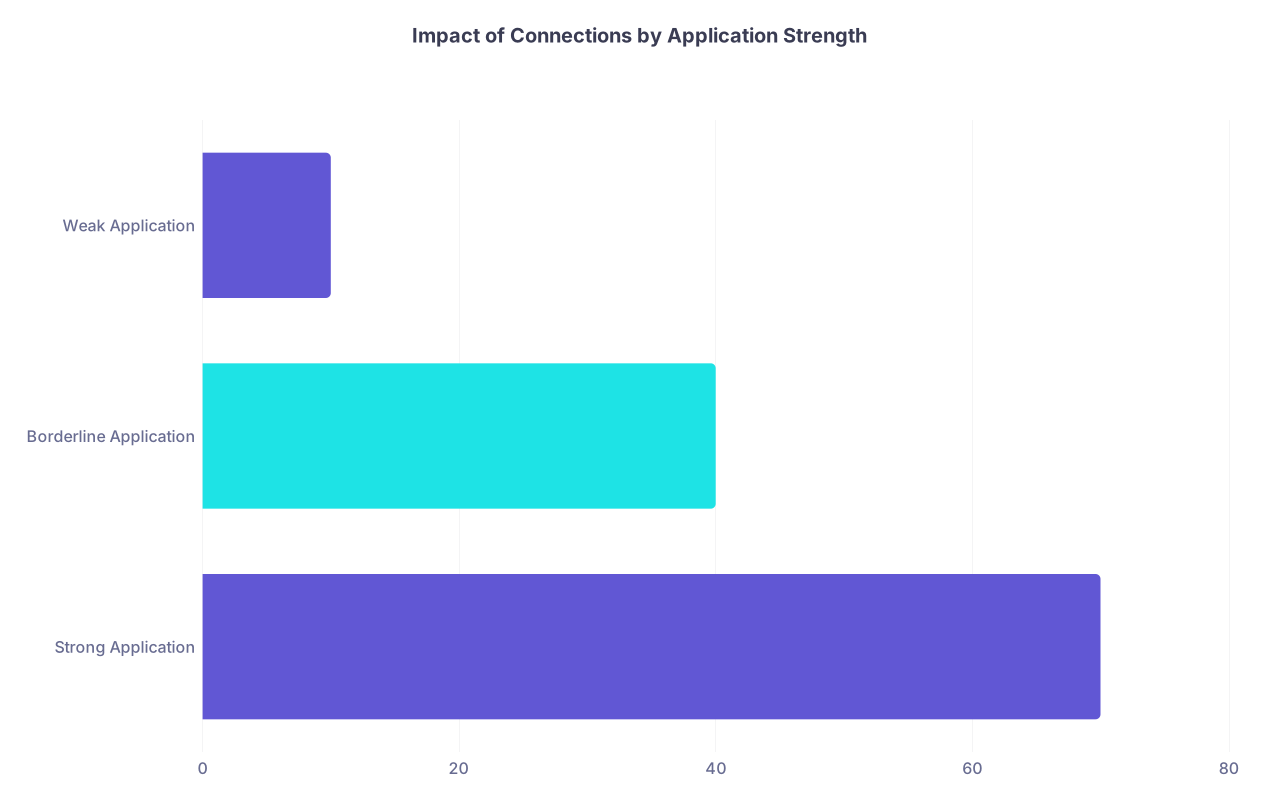
| Category | Value |
|---|---|
| Strong Application | 70 |
| Borderline Application | 40 |
| Weak Application | 10 |
The Bigger Problem: People Use “Connections” as an Excuse to Avoid Fixing Anything
The worst thing about the “connections beat a weak application” myth isn’t that it’s factually wrong. It’s that it paralyzes people when they should be aggressively improving their position.
Post-Match, you have three levers. Only one of them is “who can I get to email someone.”
Upgrade your objective risk profile
- Pass Step 3 early if eligible.
- Fix any paperwork gaps: complete notes of good clinical evaluations, updated CV, clean explanation letters.
- If you’re rematching, shore up your performance in your current program and get explicit, strong new letters.
Clarify your narrative
- Why you didn’t match or why you’re switching has to be coherent and accountable.
- “I had personal challenges but took responsibility and have since done X, Y, Z” is different from “the Match is broken.”
Deploy connections strategically
- Prepare a tight, professional email + CV package before you ask anyone to forward your name.
- Ask for very specific advocacy: “Would you be comfortable emailing Dr. Y and, if you truly can, stating whether you’d take me in your own program?”
- Focus on programs where your metrics are at least within shouting distance of their usual range.
What most people do instead is:
- Send vague, generic emails to 50 programs.
- Tell themselves, “My mentor knows a lot of people, so I’ll probably be fine.”
- Passively wait.
Then July 1 shows up, and they’re not in orientation. They’re sitting at home refreshing Gmail.

| Step | Description |
|---|---|
| Step 1 | Did not match or want to switch |
| Step 2 | Assess application honestly |
| Step 3 | Plan repair year or structured gap |
| Step 4 | Targeted late-PGY or SOAP-like positions |
| Step 5 | Upgrade profile - exams, letters, evals |
| Step 6 | Identify real connections |
| Step 7 | Have mentors contact specific PDs |
| Step 8 | Interviews and follow up |
| Step 9 | Major red flags? |
SOAP vs Post-SOAP: Connections Have Different Power
Another nuance people miss: the Match/SOAP window versus true post-Match months.
During SOAP week, programs are under tight rules and intense time pressure. They can’t just hand-pick whoever their friends recommend. The system is more constrained and they’re processing huge volumes quickly.
In SOAP:
- Connections might get your application truly read in a 4-hour review window.
- They might help nudge your name when they’re making their SOAP preference list.
- But if you’re not in the NRMP SOAP pool, or your application is structurally too weak, there’s only so much they can do.
After SOAP, in the wild-west months (April–September):
- Rules loosen a bit.
- Programs with unexpected losses (visa issues, resignations, failures to progress) scramble to fill.
- Now a PD can say, “I’m just going to interview the three people my colleagues vouch for and pick one.”
This is the moment when genuine, high-tier connections can matter most. But again: they’re picking among people who can plausibly do the job. Not anyone with a pulse and a famous letter writer.

So What Should You Actually Do If Your Application Is Weak?
Let me be blunt: if you look at your record and it’s objectively weak—multiple failures, poor narrative comments, professionalism flags—you should stop fantasizing about a “connection save” and make a repair plan.
That might mean:
- Taking a structured research year with heavy clinical exposure and clear supervision where someone can honestly say, “They have changed. I’d rehire them.”
- Completing a prelim year and absolutely crushing it, then rematching with new, glowing letters and a clean track record.
- Being willing to pivot to a less competitive specialty where your metrics land above their floor, not right at or below it.
Connections will make those improved efforts yield better results. They will not replace those efforts.
If you’re borderline rather than truly weak:
- Clean your materials. Brutally edit your personal statement to sound like an adult taking responsibility, not a victim of fate.
- Get concrete, behavior-based letters: “She consistently stayed late to help close charts” means more than “He is a pleasure to work with.”
- Then, yes, deploy your best connections—especially anyone who has seen you work clinically and is known to the program.
And if you’re sitting on a genuinely strong application that somehow didn’t match (it happens), then connections are gasoline on a good fire. Those are the people who often do land excellent post-Match spots because the PD looks at the file and says, “Why were you unmatched? This looks fine,” and the connection just removes the doubt.
The Truth in Three Sentences
Strong connections do not beat a truly weak application post-Match; they only amplify whatever is already there. Programs still care first about risk, reliability, and basic competence, and no amount of “knowing someone” consistently overrides that in 2026. If you want connections to work for you, fix what you can in your file, be realistic about where you stand, and use your advocates surgically—not as a fantasy parachute.