

It is the evening of Match Day. The email is open. One of you matched. The other did not. The room is quiet in that strange way where both of you are trying to figure out whether you are allowed to feel anything at all—relief, grief, anger—without making the other person feel worse.
You are “half-matched” as a couple. And nobody really prepares you for this.
Let me break down what actually matters in the first 2–4 weeks, what is salvageable in the first 3–6 months, and how you protect your relationship, your careers, and your sanity.
1. Define Your Exact Half‑Match Scenario
“Half-matched” is not one thing. The details change your playbook.
| Scenario ID | Matched Partner | Unmatched Partner | Typical Complexity |
|---|---|---|---|
| A | Categorical position | Full SOAP failure | High |
| B | Preliminary only | Unmatched | Very High |
| C | Categorical, wrong region | Unmatched | High |
| D | Categorical, couple unlinked late | Unmatched | Moderate |
| E | Research year already arranged | Unmatched | Moderate |
You need to answer, concretely, these questions:
Who matched into what, where, and with what start date?
– Specialty, categorical vs prelim, program reputation, geographic desirability.Who did not match, and how far did they get?
– SOAP offers? Any pending research offers? Prior degrees, visas, “red flags” (failures, gaps)?What are your hard constraints as a couple?
– Visa needs, financial situation, dependents, caregiving responsibilities.How serious is the relationship and what are you willing to do for it?
– I will say the blunt version: would you actually live apart for 1–2 years for each other’s careers, or is that not on the table?
Do this on paper, not in your heads. You are not brainstorming. You are building a decision matrix.
2. First 72 Hours: Stabilize, Then Gather Data
Your first instinct may be to start emailing every program director in the country. That is not the first move.
Step 1: Emotional Triage
I have seen couples implode in the first week because they tried to fix the entire problem while both were in shock.
You must:
Let each partner have their own emotional space.
The unmatched partner is dealing with identity-level shame and fear. The matched partner is dealing with guilt plus pressure to be “grateful.” Both are real.Explicitly say out loud: “We are going to make a 3–6 month plan, not a 10-year prediction.”
Long-term catastrophizing kills rational planning.Agree not to make irreversible relationship decisions in the first 2 weeks.
No ultimatums. No “maybe we are not compatible” speeches. Put those on a 3–month moratorium.
Step 2: Hard Facts – No Spin
You need a brutally honest inventory of the unmatched partner’s profile:
- USMLE/COMLEX performance: pass/fail history, score patterns if applicable.
- Number and type of programs applied to. Any clear strategic errors? (Too competitive specialty, ultra-narrow geographic focus, etc.)
- Clinical issues: professionalism write-ups, leaves, weak MSPE, questionable letters.
- Citizenship and visa constraints.
- CV strengths: research, prior career, unique skills, languages, niche interests.
Then you add the matched partner’s reality:
- Program type: community vs academic, malignant vs supportive, size of program.
- PD reputation: responsive and flexible vs rigid.
- City cost of living and job market for a potential research year or non-clinical job.
You are not blaming anyone here. You are diagnosing the situation like a complex patient. If you gloss over the “red flags” now, your plan will be fantasy.
3. Core Decision Fork: Stay Together vs Physically Separate
This is the ugly, central tension. You cannot plan anything until you decide your bias.
There are 3 main models couples end up in:
- Same city from year one (ideal, often impossible).
- Different cities for 1–2 years, then reunite.
- One person sacrifices optimal training to preserve co-location.
There is no universally “correct” answer. But I will tell you what tends to go wrong.
Couples that refuse any distance at all often force the unmatched partner into poor-fit options (like a random prelim, predatory research year, or weak non-ACGME position) that actually make future matching harder.
Couples that default to “we will figure it out later” distance with no timeline or milestones often drift apart and then end up with two suboptimal careers and a broken relationship.
So you pick a bias, on purpose:
- “Our first priority is both of us securing solid training, even if that means 1–2 years apart.”
OR - “Our first priority is staying physically together; we will accept career inefficiencies to do that.”
Write that at the top of your shared planning document. It will anchor every subsequent choice.
4. The Unmatched Partner: Immediate Strategy Grid
Now to the meat: what the unmatched partner does in the next 3–12 months.
A. Understand Your Position in the Market
You need an honest category:
High-potential, unlucky applicant
Decent scores, realistic specialty, normal CV, simply got squeezed in a competitive year or poor application strategy.Borderline objective metrics
Step failures, low scores, weak clinical evaluations, limited US experience (for IMGs), or very narrow geographic focus.Systemic barrier case
Visa limitations, serious professionalism issues, repeated failures, or major non-traditional paths that scare PDs.
Your path changes substantially between these.
B. Main Track Options for the Next Year
Most unmatched partners in a half-matched couple will fall into one of these interim categories:
- Research position (preferred if you want academics or competitive specialties).
- Non-ACGME clinical job (hospitalist extender, clinical research associate with patient contact, etc.).
- Dedicated re-application year with observerships/externships (for IMGs especially).
- Another degree (MPH, MBA, etc.) – used far more than it is helpful. Often a mistake.
- SOAP again next year with a rebuilt application.
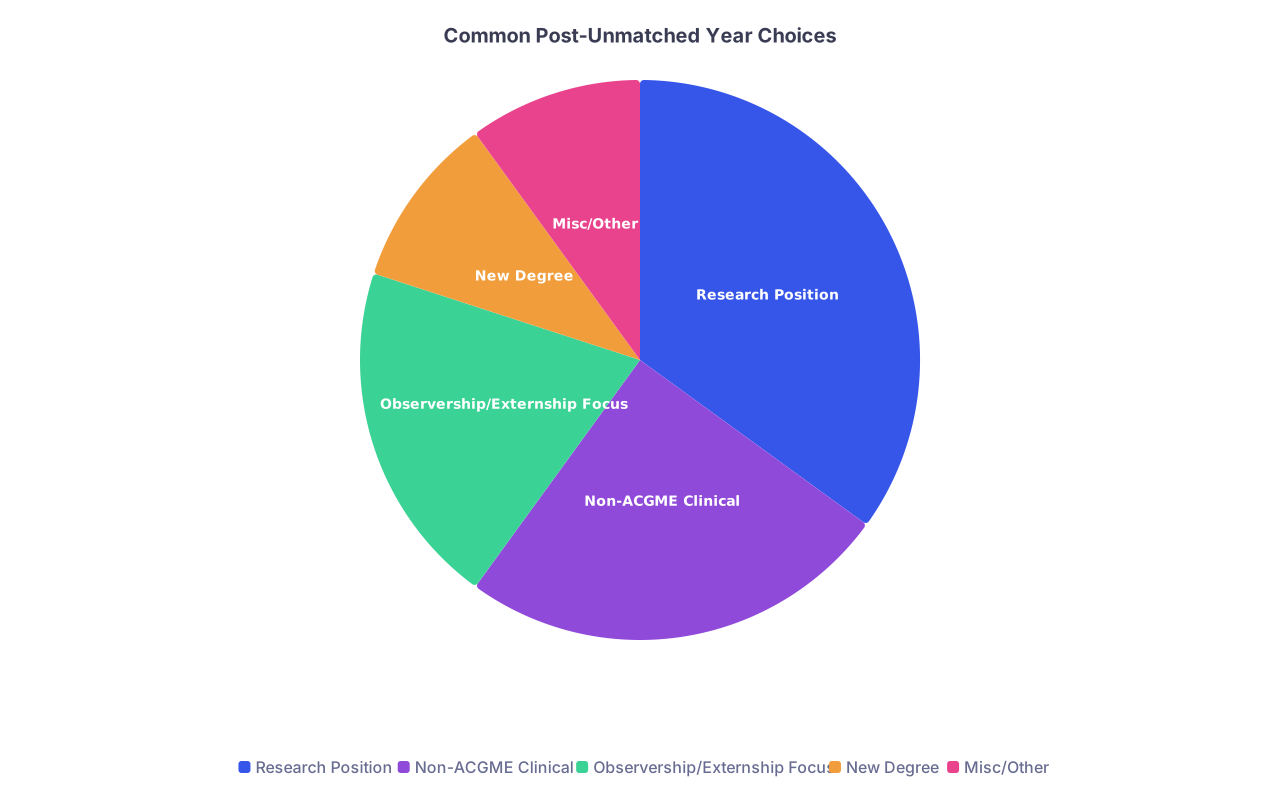
| Category | Value |
|---|---|
| Research Position | 35 |
| Non-ACGME Clinical | 25 |
| Observership/Externship Focus | 20 |
| New Degree | 10 |
| Misc/Other | 10 |
Here is my take:
Research year is usually the best default if:
- You can get something at or near the matched partner’s institution or city.
- You are interested in IM, neuro, anesthesia, EM, surgery, or any academic-leaning specialty.
- You can produce tangible output (posters, abstracts, manuscripts) within 12 months.
Non-ACGME clinical jobs are useful if:
- You want to maintain hands-on clinical experience.
- You are aiming for fields like FM, IM, psych, or prelim-to-categorical transitions.
- Visa and licensing logistics allow it.
Degree programs are overrated:
- They help in academic or public health-oriented careers.
- They rarely fix bad scores or professionalism issues.
- They can trap you financially and geographically.
C. Geographic Synchronization with the Matched Partner
You should systematically evaluate whether the unmatched partner can:
- Get a research / clinical / educational position in the same institution as the matched partner.
- If not, at least in the same city.
- If not, within 2–3 hours travel.
This is where you start using the matched partner’s new institutional footprint.
- Ask: Does the program have a research core facility, outcomes group, or health services research unit that regularly hires post-grads?
- Subspecialty divisions: Cardiology, GI, pulm/crit, oncology often have large research infrastructures.
- Education offices: simulation centers, curriculum development roles, OSCE coordination.
Your email should not be “please help my partner find something.” It should be:
- One-page CV of the unmatched partner.
- Concise summary of their interests and skills.
- Specific ask: “Is there anyone in [internal medicine outcomes research / surgical education / clinical trials office] who might be open to a research assistant or postdoc for 1 year?”
The matched partner can and should send a direct, professional note to their PD or APD, asking who to contact. Program leadership is often more willing to help than applicants expect, especially if you frame it as strengthening the pipeline.
5. Specialty Strategy: Pivot, Hold, or Downshift?
The unmatched partner has 3 real choices:
- Re-apply to the same specialty.
- Pivot to a less competitive specialty that still fits some interests.
- Downshift to a significantly less competitive safety specialty for security.
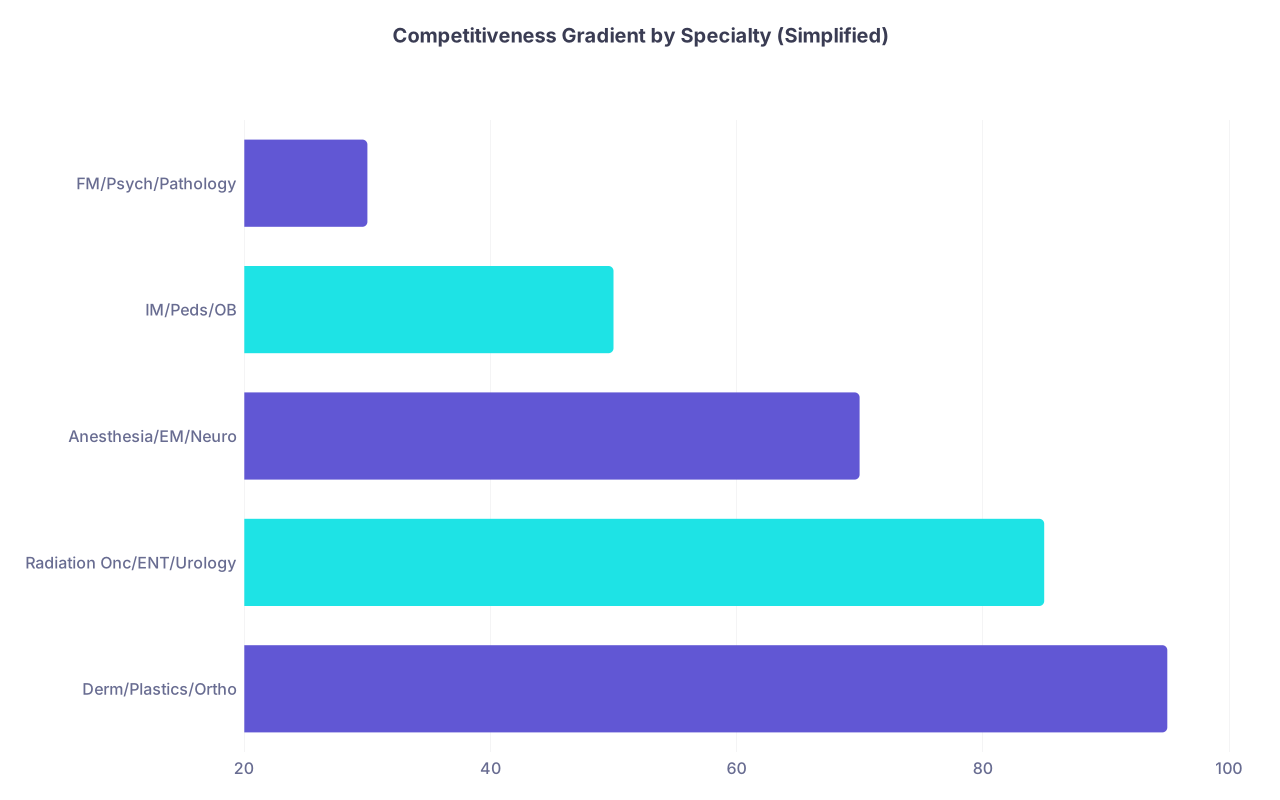
| Category | Value |
|---|---|
| Derm/Plastics/Ortho | 95 |
| Radiation Onc/ENT/Urology | 85 |
| Anesthesia/EM/Neuro | 70 |
| IM/Peds/OB | 50 |
| FM/Psych/Pathology | 30 |
(The numbers are illustrative “competition intensity,” not match rates.)
Here is how I decide, case-by-case:
If your metrics are within 1 standard deviation of matched applicants in your field and your only problem was timing/strategy, then re-applying to the same specialty with a strong gap year is reasonable.
If you are more than 1–2 SD below in Step performance or have repeated failures, trying the same hyper-competitive specialty again is usually self-sabotage. Pivot or downshift.
If your relationship is heavily constrained geographically (you must be in the same city as the matched partner), you probably have to be more flexible specialty-wise. Fewer programs in a radius means less room to be picky.
A useful exercise:
Make three lists for the unmatched partner:
- “Hell yes” specialties (true passion, long-term fit).
- “I can see myself content” specialties.
- “I would be miserable” specialties.
You do NOT pivot into category 3 just to be together. That is how people end up hating both their job and their partner.
6. Leverage the Matched Partner’s Position (Without Torching It)
A lot of half-matched couples underuse the matched partner’s new status.
Here’s what the matched partner can reasonably do:
Ask PD/APDs:
- “Are there any research or pre-residency clinical roles my partner could apply for here?”
- “Do you know of nearby programs that have taken re-applicants in [specialty] successfully?”
Network horizontally with senior residents and fellows:
- Many know of quiet opportunities: QI projects, small clinical trials, coverage roles.
Identify internal transfer possibilities:
- Large IM programs may occasionally add an extra intern if funding appears.
- But do not assume a transfer will save you; treat it as a low-probability bonus.
The line you cannot cross: the matched partner should not badger the PD to create a residency position that does not exist or pressure them to take the unmatched partner against normal standards. That backfires. People remember.
7. Application Repair: What Must Change Before Next Cycle
If the unmatched partner plans to re-enter the Match next year, you need a very specific repair plan.
A. Fix the Obvious Deficits
Common problems and corresponding fixes:
Weak or generic letters:
- Solution: arrange 6–12 months with strong clinical supervisors who can write detailed, behavior-based letters.
No recent US clinical experience (for IMGs):
- Solution: targeted observerships / externships, ideally at academic or large community programs that actually match IMGs.
Limited research in academic-leaning specialties:
- Solution: join a productive lab or outcomes group, aim for at least 2–3 abstracts or one manuscript submission.
Poor personal statement and application narrative:
- Solution: rewrite with help from someone who has read thousands of them (faculty, advisors, not just friends).
Skewed application list:
- Solution: broaden geographic regions, include more mid-tier and community programs, stop fetishizing “top 10” lists.
B. Timeline for the Next 12 Months
You should back-plan from next ERAS:
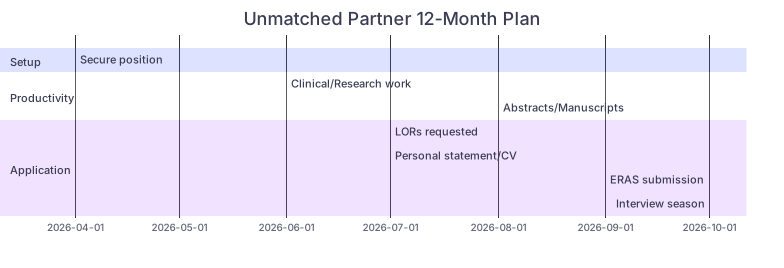
| Task | Details |
|---|---|
| Setup: Secure position | a1, 2026-04, 2m |
| Productivity: Clinical/Research work | a2, 2026-06, 8m |
| Productivity: Abstracts/Manuscripts | a3, 2026-08, 6m |
| Application: LORs requested | a4, 2026-07, 3m |
| Application: Personal statement/CV | a5, 2026-07, 3m |
| Application: ERAS submission | a6, 2026-09, 1m |
| Application: Interview season | a7, 2026-10, 4m |
You want substantial productivity by July–August:
- At least one strong new letter.
- Evidence of consistent work in your chosen specialty.
- A coherent story: “Last year I did not match because X. Here is what I did intentionally to address that.”
8. Relationship Logistics: Money, Housing, and Reality
This is the stuff that quietly breaks couples while they are busy worrying about specialties.
A. Financial Structure
One of you is about to start residency at $60–70k. The other may be on a low-paid research stipend or nothing.
You should:
- Build a 12-month joint budget assuming worst-case scenario for the unmatched partner (no income for 3–6 months).
- Decide how you will handle:
- Moving costs.
- Separate rentals (if different cities).
- Loan payments and deferments.
- Health insurance for the unmatched partner (critical).
Do not hide money stress from each other. It will surface anyway.
B. Housing Choices
If you are in the same city:
Consider living slightly closer to the hospital even if it means a smaller place. The matched partner will be exhausted; commute time multiplies suffering.
The unmatched partner must have functional workspace if doing research or applications. Laptop at the kitchen counter is not sustainable.
If in different cities:
- Be concrete: how often will you visit?
- Every 2 weeks? Monthly?
- Who pays for travel? Where do you stay?
Abstract “we’ll see each other when we can” almost always translates to “we never see each other and resentment piles up.”
9. Soap, Off-Cycle Spots, and Lateral Moves
You are probably wondering: is there anything to do this year beyond waiting?
Sometimes.
SOAP Aftermath
If the unmatched partner also struck out in SOAP:
Debrief with your dean’s office or an advisor who understands SOAP mechanics. Many applicants completely misplay SOAP (bad specialty choices, late responses, poor communication).
Record what programs showed any interest. They may be targets next year if you substantially strengthen your profile.
Off-Cycle PGY‑1/Premil Positions
Throughout the year, vacancies appear:
- Residents resign, get dismissed, or transfer.
- Programs lose funding lines or gain them unexpectedly.
These appear on:
- AMA FREIDA vacancy lists.
- Specialty society job boards.
- Listservs and WhatsApp groups (especially for IMGs).
These can be a bridge. But:
- They are often less structured, higher-risk environments.
- Many come with short notice and expect you to move fast.
Treat any off-cycle position as a serious commitment, not a one-year “trial,” unless explicitly stated.
10. Communication Script Between Partners
You are both about to be under maximum stress. Miscommunication will explode small issues.
Some conversations you should have early, on purpose:
“What is our 1-year goal, in one sentence?”
Example: “By next Match, we want both of us in training or in a clearly productive gap year, with a plan to co-locate by year 3.”“What is non-negotiable for each of us?”
- For one: “I cannot stay more than 2 years outside clinical training.”
- For the other: “I am willing to do 1–2 years of long distance, not 5.”
“How will we handle resentment?”
- Say explicitly: “We are not competing; the system pitted us against each other.”
- Agree to bring up feelings early, not let them fester until a 2 a.m. blowup post-call.
“At what checkpoints will we re-evaluate the plan?”
- Good times: after the unmatched partner secures a gap-year role, after ERAS submission, after interview season.
11. Case Examples – How This Actually Plays Out
Let me walk you through three fairly typical patterns I have seen.
Case 1: IM Categorical + Unmatched Future IM Resident
- Partner A: Matches categorical IM at a large Midwest academic center.
- Partner B: US grad, mid-220s Step 2, limited research, applied narrowly to Northeast IM only. Goes unmatched.
Plan:
- Partner B moves to Partner A’s city.
- Partner A’s PD connects B to a hospitalist group research/patient safety role.
- B spends the year working on QI projects, obtains strong letter from the hospitalist chief, presents 2 posters at regional meetings.
- Next cycle, B applies broadly in IM across multiple regions, including community programs.
- B matches IM at a community hospital 40min away. They live in between.
This is a classic “you were unlucky and too narrow” story. Fixable.
Case 2: EM Match + Unmatched Former EM Applicant Pivoting to IM
- Partner A: Matches EM in a West Coast urban program.
- Partner B: Repeatedly attempted EM with 2 SOAP cycles, one Step failure, decent SLOEs but limited interviews.
Plan:
- After discussion, B accepts EM is now extremely uphill.
- They pivot to IM with an EM-flavored niche (critical care, ED observation, etc.).
- B cannot find a research role in A’s city quickly; instead, they take a one-year non-ACGME hospitalist-extender role 2 hours away in a small city, with strong supervision from IM faculty.
- They do long distance with scheduled visits; B gets strong IM letters, cleans up narrative: “I realized my interests fit best within internal medicine with an acute care focus.”
- Next Match, B applies to IM broadly. Matches a community IM program within 1 hour of A. Commute is painful but workable.
Here, the key was being willing to pivot specialties and tolerate 1–2 years of medium-distance.
Case 3: Visa-Limited IMG Couple, Only One Matches
- Partner A: IMG, matches IM in mid-size Southern community program. On J‑1.
- Partner B: IMG, similar scores, no US research, limited USCE, does not match and fails SOAP.
Constraints:
- Both need visa sponsorship.
- City has limited research infrastructure.
- Financial situation tight; cannot afford unpaid observerships long-term.
Plan:
- B secures a paid research assistant role at a nearby university hospital (1 hour commute), with H‑1B sponsorship. Focus on cardiology outcomes research.
- B does weekend observerships and clinics within A’s program when possible, building relationships.
- After a year of publications and USCE, B reapplies to IM and FM, focusing on programs with IMG histories and J‑1 sponsorship.
- B matches FM in the same state but different city. Long distance for 3 years, with plan for joint job search later.
This is where the “perfect co-location” fantasy must be dropped. Visa and structural realities dominate.
12. What Not To Do
A short, brutal list:
Do not re-apply with essentially the same application next year. Programs remember. It looks unserious.
Do not immediately “couples match” again next cycle without a clear benefit. Sometimes the unmatched partner needs maximum flexibility alone.
Do not drag the matched partner down with resentment about them “abandoning” you when they go to orientation, interns’ dinners, etc. They also did not design this system.
Do not disappear from the professional world for a year out of shame. That gap is very hard to explain later.
Do not chase random, non-structured clinical roles that skirt regulations or are essentially shadow work with no letters or official affiliation. Predatory positions are common.
13. Visual Overview: Couples Half-Match Decision Flow
Use this as a sanity check, not a rigid algorithm.

| Step | Description |
|---|---|
| Step 1 | Half match result |
| Step 2 | Prioritize strong positions for both |
| Step 3 | Prioritize same city options |
| Step 4 | Research or clinical role near program |
| Step 5 | Strong role elsewhere with distance |
| Step 6 | Reconsider distance or specialty pivot |
| Step 7 | Year of productivity and new letters |
| Step 8 | Reapply with adjusted specialty and program list |
| Step 9 | Both willing to live apart 1 to 2 years? |
| Step 10 | Unmatched partner can get city job? |
| Step 11 | City has options? |
FAQ (Exactly 6 Questions)
1. Should we still use couples match next cycle, or should the unmatched partner go solo?
If the matched partner is already locked into a program, repeating couples match rarely adds value. It usually restricts the unmatched partner’s options and can hurt both sides. I generally recommend the unmatched partner apply solo, targeting the region of the matched partner but not hard-linking ranks. Use geographic preference signals instead.
2. Is it ever smart for the matched partner to give up their spot and reapply with the other partner?
Almost never. Giving up a secured residency position in this market is reckless unless the job is truly toxic or unsafe. You are throwing away a bird in the hand for a statistically uncertain future. There are better ways to support your partner than both being unemployed.
3. How much does a research year really help for a non-competitive specialty like FM or psych?
For family medicine and psychiatry, a research year is rarely necessary and can be a poor return on investment unless it is bundled with clear clinical exposure and strong letters. What helps more is direct clinical work, USCE, and an expanded, realistic program list. I only push research-heavy years in these fields when the person is dead-set on an academic niche.
4. My partner matched at a malignant program. Should that affect my decision to follow them geographically?
Yes. If your partner is walking into a known malignant or unstable environment, betting both careers on that institution is foolish. In that case, I would prioritize your own best training environment, even at the cost of distance, so that at least one of you has a stable anchor. You can regroup later.
5. Will programs judge me for being in a relationship with someone in another specialty or city?
No. Programs care about your reliability, professionalism, and fit. Mentioning your partner briefly in an interview as part of your geographic story is fine. Making your entire narrative about your relationship is not. You are applying as an individual applicant who happens to have a partner, not half of a fused entity.
6. How many years can I be out of medical school before my chances collapse?
For most US programs, beyond 5 years out from graduation with no structured clinical role, your odds drop sharply, especially in core fields like IM, FM, and peds. That does not mean impossible, but every year lost without meaningful clinical or research engagement makes it harder. In a half-matched couple, I strongly prefer plans that keep the unmatched partner meaningfully engaged in medicine every single year.
Key points, no fluff:
- Half-matched couples need a brutally honest 12-month plan centered on the unmatched partner’s realistic options, not wishful thinking.
- Decide explicitly: training quality vs immediate co-location. You cannot maximize both in most cases.
- The unmatched partner must change something substantial—letters, experience, specialty, or geography—before reapplying, or you are just reenacting the same failure one year older.


