
It’s two weeks before the hearing. Your email is still open on the screen: “We’d be honored if you would provide testimony…” Your heart is pounding just reading it. Your first thought wasn’t, “What a privilege.” It was, “Oh my god, I’m going to choke in front of everyone and ruin this.”
You’re not imagining a noble moment of civic duty. You’re imagining your hands shaking so badly the paper rustles into the microphone. The committee chair staring at you while you blank on a basic statistic. Your voice cracking right as you say the one sentence that actually matters.
And under all of that: this suffocating fear that saying yes will expose you as a fraud — professionally, ethically, personally. That you’ll hurt the cause instead of helping it.
You’re wondering how worried you should be. About the public speaking part. About the medical ethics part. About the policy implications if you mess it up.
Let me say this straight: you’re not crazy for feeling this way. But you are probably misjudging the actual risks.
Let’s walk through the worst-case scenarios you’re secretly running in your head — and what’s real vs. what’s just your brain being dramatic.
What’s Actually at Stake When You Testify
Forget the inspirational LinkedIn versions of this. Here’s what’s really on the line when a nervous clinician or trainee gets asked to testify on a public health issue:
- Your personal anxiety and dignity
- Your professional credibility
- The ethical weight of representing patients/public health
- The actual policy outcome (which, spoiler, doesn’t hinge only on you)
Most people massively overestimate #1 and #2 and underappreciate #3 and #4.
You’re probably thinking:
- “If I sound nervous, they won’t take me seriously.”
- “If I misspeak, I could mislead policymakers.”
- “If I oversimplify, am I being dishonest?”
- “If I say something outside my exact lane, is that unethical?”
Those are reasonable fears. But here’s the uncomfortable truth: garbage, overconfident testimony does far more damage than shaky, honest testimony from someone clearly trying to be careful.
The ethical risk isn’t that you’ll stutter. It’s that you’ll:
- Exaggerate for effect
- Speak beyond your expertise
- Ignore uncertainty
- Hide conflict of interest
If you’re already worried about those, good. It means your ethical compass is on.
How Bad Can the Public Speaking Part Actually Get?
Let’s get your nightmare reel out on the table.
You’re imagining:
- Voice trembling
- Face flushing
- Hands visibly shaking
- Losing your place
- Getting a hostile question you can’t answer
- Video of your worst 10 seconds circulating forever
So… how likely are those? And if they happen, what then?
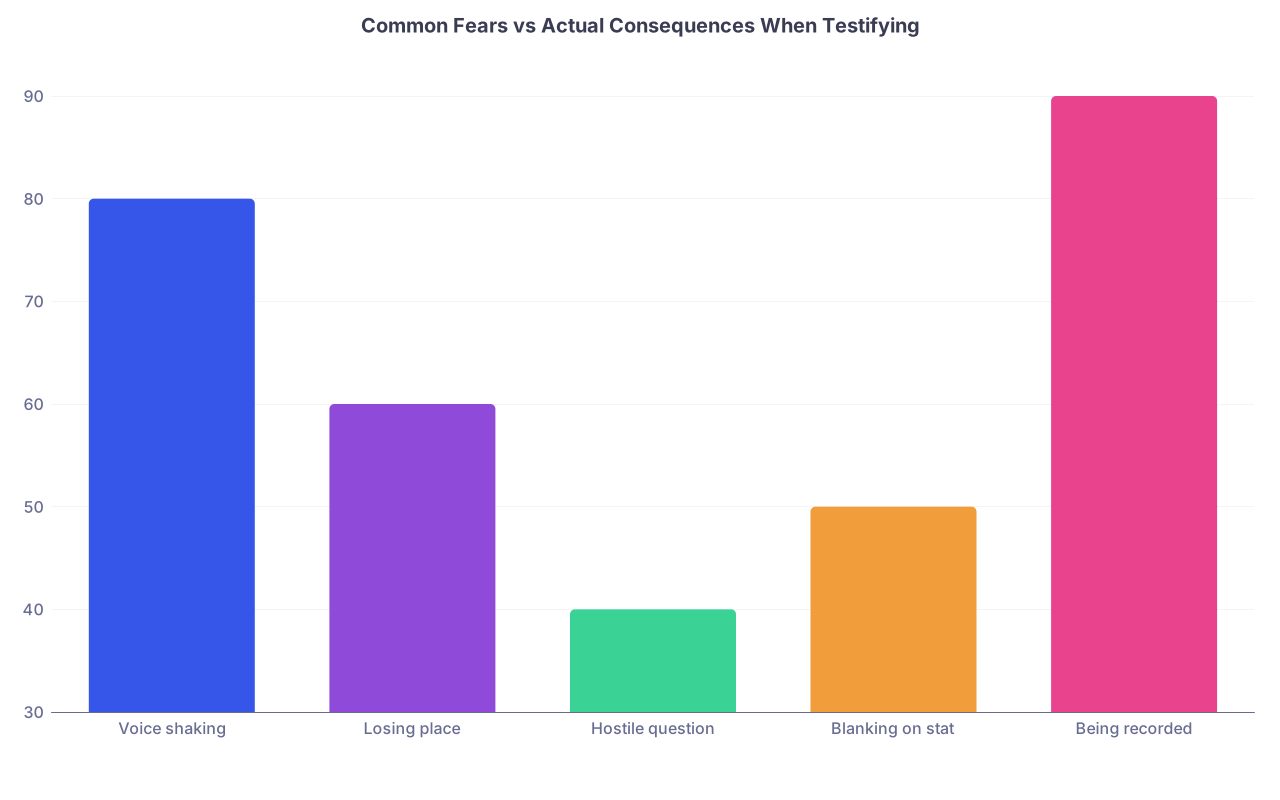
| Category | Value |
|---|---|
| Voice shaking | 80 |
| Losing place | 60 |
| Hostile question | 40 |
| Blanking on stat | 50 |
| Being recorded | 90 |
Interpretation (not scientifically precise, but based on real people I’ve seen testify):
- 70–90% chance you feel nervous physiologically
- 40–60% chance you’ll have some minor “glitch” (lose place, mis-say a word)
- 5–10% chance it matters to anyone but you
I’ve watched physicians testify at city council, state legislatures, FDA advisory committees. Here’s what actually happens when they’re nervous:
- The panel is used to it. They don’t care. They’ve seen people cry, ramble, get angry. Your shaking hands are background noise.
- Staffers and advocates are actively rooting for you to get through your testimony. They literally whisper “you’re doing great” to people.
- The transcript is what gets used later — not how elegantly you delivered it. The content matters, not your TED Talk vibe.
The public speaking horror scenario you’re picturing — the room laughing, the chair shutting you down, your institution disowning you — that’s fantasy-level unlikely if you’re even moderately prepared and honest.
The Only Speaking Outcomes That Actually Matter
There are only a few real dangers:
- You go wildly off script and say something factually wrong on the record.
- You misrepresent your role (e.g., implying you speak for your hospital when you don’t).
- You disclose patient info inappropriately.
- You sound so disorganized that your core message never actually lands.
Notice what’s not on the list: sweating, shaking, reading from notes, asking to repeat a question. None of those are career-ending. They barely register.
The Ethics Piece: Where You Should Actually Be Worried
Here’s where your worry is justified — and actually useful.
You’re entering a setting where your words can influence:
- Funding
- Regulations
- Access to care
- Public trust in medicine/science
That comes with ethical obligations. If you want to worry about something, worry about these — and then fix them.

| Step | Description |
|---|---|
| Step 1 | Invited to testify |
| Step 2 | Review evidence |
| Step 3 | Clarify limits in testimony |
| Step 4 | Decline or suggest other expert |
| Step 5 | Proceed with testimony |
| Step 6 | Address before proceeding |
| Step 7 | Is topic in my lane |
| Step 8 | Conflicts of interest |
1. Are you staying in your lane?
You don’t have to be the world’s top expert. But ethically, you do have to:
Be clear what your expertise actually is
“I’m a PGY-2 in internal medicine at X hospital, and I work primarily with patients with Y.”
“I’m a community pediatrician who has treated hundreds of kids with asthma, mostly from low-income neighborhoods.”Draw lines explicitly
“I’m not a health economist, so I can’t speak to the detailed cost modeling, but in clinic I see…”
Where it goes wrong:
People start saying “we know this policy will reduce mortality by X%” when what they really mean is “some modeling from another country suggests…” That’s ethically sloppy.
2. Are you honest about uncertainty?
Policymakers like simple, confident statements. Science doesn’t.
You have to resist the urge to:
- Overstate certainty to sound authoritative
- Downplay limitations because “the other side” is already spinning everything
Ethically strong testimony sounds more like:
- “The best available evidence suggests…”
- “In my clinical experience, which is limited to [X setting], I’ve seen…”
- “There is disagreement on the magnitude of benefit, but virtually no serious debate that [harm] is happening.”
You might think admitting uncertainty makes you weaker. In these rooms, it usually has the opposite effect. It separates you from the lobbyists.
3. Are you disclosing conflicts of interest?
This part isn’t optional. If you:
- Receive funding from a relevant company/organization
- Hold a leadership role in an advocacy group
- Work for an institution that stands to gain or lose money from the policy
…you disclose it. Briefly. Clearly.
Not disclosing because “it’s not that big a deal” is how your testimony becomes ammunition for the other side later.
Balancing Public Health Advocacy With Not Destroying Your Nervous System
Let me say something a bit harsh: you can’t claim to care deeply about public health and then refuse every opportunity to speak up because your heart races.
You don’t need to become a charismatic speaker. But you do need to get functional. Good enough.
Here’s the practical line I’d draw:
You should be worried enough to prepare seriously.
Not so worried that you say no automatically.
| Fear | Real Impact Most of the Time |
|---|---|
| Shaky voice | Briefly noticeable, then forgotten |
| Reading from notes | Totally acceptable in hearings |
| Needing water / pause | Normal, often seen as human |
| Saying “I don’t know” | Increases credibility if used appropriately |
| Admitting uncertainty | Ethically correct, usually respected |
Tactical prep that actually helps (and doesn’t pretend you’re fearless)
Forget the “imagine everyone naked” nonsense. You’re not doing stand-up comedy. You’re delivering data and stories under time pressure.
What actually helps:
Write a tight, short script
2–3 main points. That’s it. If your testimony is a wall of text with 9 arguments and 14 statistics, you will get lost when your adrenaline hits.Highlight your “anchor sentences”
One sentence per key point that you could say even if the room caught fire.
Example: “I’m here because I’ve watched preventable overdose deaths in my clinic that this bill would almost certainly reduce.”Practice out loud to the point of boredom
Not to become charismatic. Just so the words feel familiar enough that your mouth can coast even if your brain tightens up.Have a “freeze plan”
One default line you use if you blank:
“Let me just take 10 seconds to find the specific number here.” (then look at your notes)
Or: “I’ll be honest, I’m nervous because this matters a lot. The key point I want you to hear is…”
You’d be surprised how much people lean in when they see you visibly care.
How Much Power Do You Actually Have In That Room?
This part you’re probably also overestimating.
Your brain:
“If I do badly, this bill fails and everyone suffers.”
Reality:
- Policy decisions are a huge messy mix of lobbying, party politics, staffer memos, prior commitments, media pressure, and yes, testimony.
- One shaky delivery won’t derail a major policy unless you’re literally the central linchpin expert in the entire country. (If you were, you wouldn’t be reading this.)
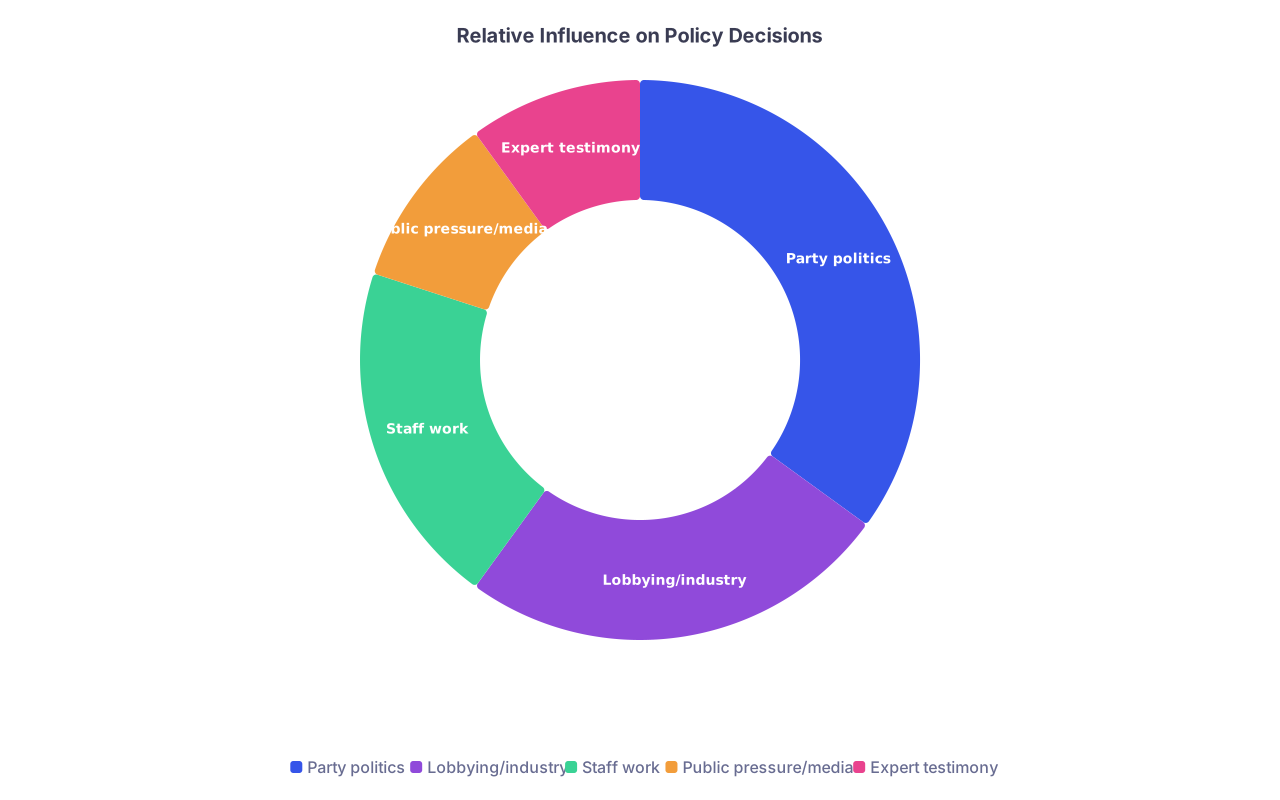
| Category | Value |
|---|---|
| Party politics | 35 |
| Lobbying/industry | 25 |
| Staff work | 20 |
| Public pressure/media | 10 |
| Expert testimony | 10 |
Is your testimony meaningless? No. It’s one piece of evidence, one story, one professional voice. It might:
- Give cover to a legislator who wants to vote yes
- Put a human face on an abstract problem
- Get quoted in a staff memo or article
But you’re not single-handedly steering the ship. Which means you can take some pressure off yourself.
Your ethical obligation is to:
- Be accurate
- Be honest about your scope
- Show up for your patients/communities as best you can
Not to be perfect. Not to carry the entire policy on your back.
When Is It Reasonable To Say No?
There are times “I’m too anxious” is just a cover for “This is actually a bad idea.”
You should strongly consider declining or reshaping your role if:
- The topic is far outside your expertise and they clearly want your white coat, not your mind
- You’re being pushed to take a position you don’t actually agree with
- You’re explicitly being asked not to disclose conflicts
- Your institution is forbidding you from clarifying that you don’t speak for them
- Your mental health baseline is already hanging by a thread (e.g., severe panic attacks, current crisis)
You can offer alternatives:
- Submit written testimony only
- Co-testify with a more experienced advocate
- Do a pre-recorded statement if allowed
- Help prepare data/stories for someone else to deliver

If your only reason is “I’m scared I’ll be awkward,” that’s not enough. That’s avoidant behavior dressed up as humility. And it’s unfair to the patients whose stories you’re carrying.
How Worried Should You Be?
So, answering the actual question:
“Afraid of public speaking but asked to testify: how worried should you be?”
My honest take:
About public embarrassment: maybe 3/10
You’ll feel like it’s a 9/10 before you stand up. In reality, the bar for “acceptable” testimony delivery is lower than you think.About ethical accuracy: 7/10
This deserves real attention. You’re putting your clinical credibility into a political process. That should feel heavy enough that you check yourself.About harming the cause: 2–4/10
If you’re prepared, honest about your limits, and not freelancing outside your lane, your presence will almost certainly help more than hurt. Even if you’re visibly nervous.

Bottom line: your nervous system is overreacting to the performance aspect and underreacting to the content and ethics. Shift your worry accordingly.
Quick Mental Reframes Before You Go In
A few things to have loaded in your brain the day of:
- “I’m not here to be impressive. I’m here to be useful.”
- “Nervous and honest beats smooth and misleading every time.”
- “If they remember one sentence I say, that’s a win.”
- “It’s okay to read. It’s okay to pause. It’s okay to say ‘I don’t know.’”

And if you’re still thinking, “What if I actually freeze?” then give yourself an explicit script:
“If I get overwhelmed, I’m going to say:
‘I apologize, I’m a bit nervous because of how important this is to me. Let me just regroup for a second. The core thing I want you to understand is…’”
That line alone can save you.
FAQ (Exactly 6 Questions)
1. What if I actually have a panic attack while testifying?
Then you stop. Ask for a brief pause. Nobody wants to watch someone suffer at the microphone. Say something like, “I’m sorry, I’m feeling a bit overwhelmed, can I take a moment?” Worst case, you cut your remarks short. Embarrassing? Sure. Catastrophic? No. Policy doesn’t live or die on that moment. If panic attacks are frequent, talk to a therapist before the hearing and consider meds or grounding strategies specific to that day.
2. Is it unethical to read my entire testimony word-for-word?
No. Hearings are not improv contests. Many excellent experts read prepared statements. It’s actually ethically safer because you’re less likely to ad-lib something inaccurate. The key is that the written statement itself is honest, clear about scope, and transparent about conflicts. If anything, reading can make you less likely to say something you regret.
3. What if I’m pressured to stick to talking points I don’t fully agree with?
That’s a red flag. Ethically, you can’t just be a mouthpiece for an organization if their stance doesn’t match your own understanding of the evidence. You can push back: “I’m comfortable saying X and Y, but I don’t feel the evidence supports Z as strongly.” If they insist, you decline. Better to be absent than to say things you believe are misleading on the public record.
4. Can I get in trouble with my institution for testifying?
Possibly, if you misrepresent yourself. The safe route: clear it with your institution’s legal/communications office if you’re naming them, and specify in your testimony: “I’m speaking today in my personal capacity, not on behalf of [Institution].” If your institution tries to silence you on legitimate public health issues entirely, that’s a separate ethical and professional problem — but the usual issue is just clarity about who you represent.
5. How much data do I actually need to include?
Less than you think. One or two key statistics, clearly sourced, plus your clinical/field experience is usually more powerful than a data dump. You’re not presenting a full grand rounds; you’re giving lawmakers a reason to care and remember. Overloading them with numbers increases your risk of errors and makes you easier to tune out.
6. What if someone challenges my testimony or twists my words later?
That’s baked into the territory. The defense is: be precise, avoid exaggerations, and stay within your lane. If you’re misquoted publicly in a way that seriously distorts your meaning, you can sometimes submit a written clarification or correction. But honestly, if your original testimony was careful and measured, most reasonable observers can see the spin for what it is. Your job is to make sure the transcript shows you were acting in good faith.
Key takeaways:
- Your fear of public speaking is wildly overestimating the performance risk and underestimating your ability to be “good enough.”
- The real ethical stakes are about accuracy, scope, and honesty — not whether your voice shakes.
- Saying yes, preparing seriously, and testifying imperfectly but ethically is almost always better than staying silent because you’re scared.