
It’s 9:42 pm on a Wednesday.
Your kid is finally asleep after a meltdown over math homework, there are dishes in the sink, and your partner just went to bed without saying much because they’re tired of “one more late meeting.”
You open your laptop anyway. Because tomorrow morning you’re briefing the health department director on a contentious policy proposal, and you’re nowhere near ready. The email pings keep coming: “Need your edits tonight,” “Can you jump on a quick call?” “Urgent – media talking points.”
You believe in this work. You also keep having the same sinking thought: I cannot do both like this. Not forever.
If that’s where you are, this is for you. Not some vague “work-life balance” nonsense. Actual moves you can make when you’re knee-deep in public health policy work and your family—not your imaginary ideal family, your actual complicated one—needs you too.
We’re talking about:
- Long legislative sessions that blow up evenings and weekends
- Emergency responses that turn into 16-hour days
- Task forces, coalitions, and advisory boards that all somehow meet at 6 pm
- The creeping guilt that you’re failing at home or phoning it in at work—or both
Let’s sort out what’s actually in your control, what isn’t, and how to make decisions you can live with ethically, not just logistically.
Step One: Get Clear on the Actual Pressures (Not the Vague Story in Your Head)
You cannot solve “I’m overwhelmed.” It’s too big and too fuzzy. You can solve: “I’m in 5 standing evening coalitions and on call two nights a week; my partner works shifts; my parents are starting to need more help; my kids have set times they need me.”
Start brutally concrete.
| Category | Hours/Week |
|---|---|
| Core job (8–5-ish) | 40 |
| After-hours meetings | 4–10 |
| Commute | 5–8 |
| Email/admin at home | 5–7 |
| Childcare/parenting | 20–35 |
| Elder care/support | 3–10 |
If your life feels unsustainable, it probably is. You might be sitting at 60–70 hours of combined work + invisible work at home, pretending it’s “just a busy season” that never ends.
Here’s what to do this week:
- For 7 days, track your time in 30-minute chunks. Work and home. No judgment, just data.
- Mark:
- “Fixed” items (school pickup, clinic, legislative hearing you must attend)
- “Flexible” items (which meeting you attend vs delegate, when you respond to email)
- Circle the things that are:
- Mission-critical for your job or a time-bound crisis
- Guilt-driven but not truly required
- Habit-driven (e.g., agreeing to every coalition that asks)
Most people discover 3 ugly truths:
- Their job has silently expanded to fill every available hour.
- A lot of evening “requirements” are norms, not rules.
- Family time is treated as the most flexible thing—even when it’s not.
You can’t renegotiate what you haven’t made visible. Get the map first.
Step Two: Decide What You’re Ethically Willing to Sacrifice—and What You’re Not
Public health attracts people with a martyr streak. “The work is important” easily turns into “my needs don’t matter” and then quietly into “my family can wait.”
That’s how people burn out, blow up their marriages, or wake up 10 years later realizing they barely remember their kids at age 8.
You need explicit non-negotiables. Not aspirational ones. Real ones you’ll actually defend.
Examples that are reasonable for someone in time-intensive policy work:
- You will miss some dinners. But you will not miss every school performance.
- You will work some nights. But you will not work every night.
- You will take some emergency calls. But you will not be on-call 7 nights a week by default.
- You will step up heavily in a genuine public health emergency—but not treat routine policy cycles like a constant crisis.
Write 3–5 statements like:
- “I will not accept standing meetings after 6 pm more than twice a month.”
- “I will protect Sunday as a no-work day except in declared emergencies.”
- “I will attend at least 75% of my kid’s medical appointments or major events. If I miss one, I will say no to something else that week to balance.”
That may sound rigid in a political environment where everyone acts like everything is urgent. It’s not. It’s the minimum needed to keep your life from getting eaten alive by “just this one more thing.”
And from an ethics point of view:
You have obligations to populations, yes. You also have real obligations to actual named people—your partner, your kids, your aging parents. Those are not morally optional.
Step Three: Have the Hard Conversations at Home (Not the Performative Ones)
A lot of conflict at home comes from unspoken assumptions:
- Your partner thinks: “If you really wanted to be here more, you’d say no.”
- You think: “If you understood what’s at stake, you’d stop complaining.”
Both of you are half right and half wrong.
You need a sit-down conversation that’s not at 11 pm when everyone is fried. 30–45 minutes, phones away.
Here’s a structure that works:
Start with the reality, not the defense.
“The last 3 months have been brutal. I’m working a lot of nights. I’m missing bedtime too often. You’re carrying more at home. It’s not sustainable.”Ask what hurts the most, specifically.
Not “Are you mad I work so much?”
Better: “What are the 2–3 things that bother you the most about how this is playing out?”Maybe it’s you checking email during dinner. Or never committing to being home one predictable night. Or missing medical appointments.
Share what you feel is non-negotiable in your work.
“I can’t step away from this legislative push until May; I can cut some things, but not the core hearings or late edits the night before a vote.”Make one concrete change in the next 2 weeks.
Not a grand plan. Just one visible change, like:- “No meetings after 6 on Tuesdays and Thursdays; that’s dinner and homework night.”
- “I’ll do Saturday morning alone time with the kids; no laptop until noon.”
Set a date to re-evaluate.
“Let’s check back in 3 weeks. If this still feels terrible, we’ll re-cut.”
Same approach if you’re supporting aging parents or other family. You’re not promising the impossible. You’re saying: I see the impact, I’m not going to pretend this is fine, and I will actually shift things, not just apologize.
Step Four: Draw Boundaries at Work Like a Professional, Not a Martyr
This is where most people flinch. They think:
“If I say I can’t do late nights, I’ll be sidelined.”
“If I set limits, they’ll just give the good projects to someone else.”
Sometimes that’s true, especially in toxic environments. But more often, people keep piling responsibilities on you because you’ve silently trained them that you’ll take it.
Time to retrain.
You communicate boundaries with three elements:
- Clear constraints
- Willingness to do high-value work
- Concrete alternatives
Examples that actually work in public health policy teams:
On evening meetings
“Evening meetings are hard for me with my caregiving responsibilities. I can do one evening commitment a week. For others, I’m happy to prep materials or debrief the next morning, but I can’t be there live.”
On last-minute ‘urgent’ work that isn’t truly urgent
“I can turn this around by 10 am tomorrow and it will be good. If you need it tonight, it will be rushed and sloppy. Given that this briefing is Friday, I’d strongly prefer to do it right by tomorrow morning.”
On joining every single task force
“I’m at capacity on standing committees. If this new task force is higher priority, I can step off X or Y, but I can’t keep adding without dropping something.”
Is there risk? Yes. Someone will think you’re less dedicated. Some people will test your boundaries. But here’s the alternative: quiet resentment, exhaustion, and eventually, leaving the field entirely.
The field loses more good people to burnout than to honest boundary-setting.
Step Five: Use Triage Thinking, Not All-or-Nothing Thinking
In policy work, you understand triage. Apply the same framework to your time.
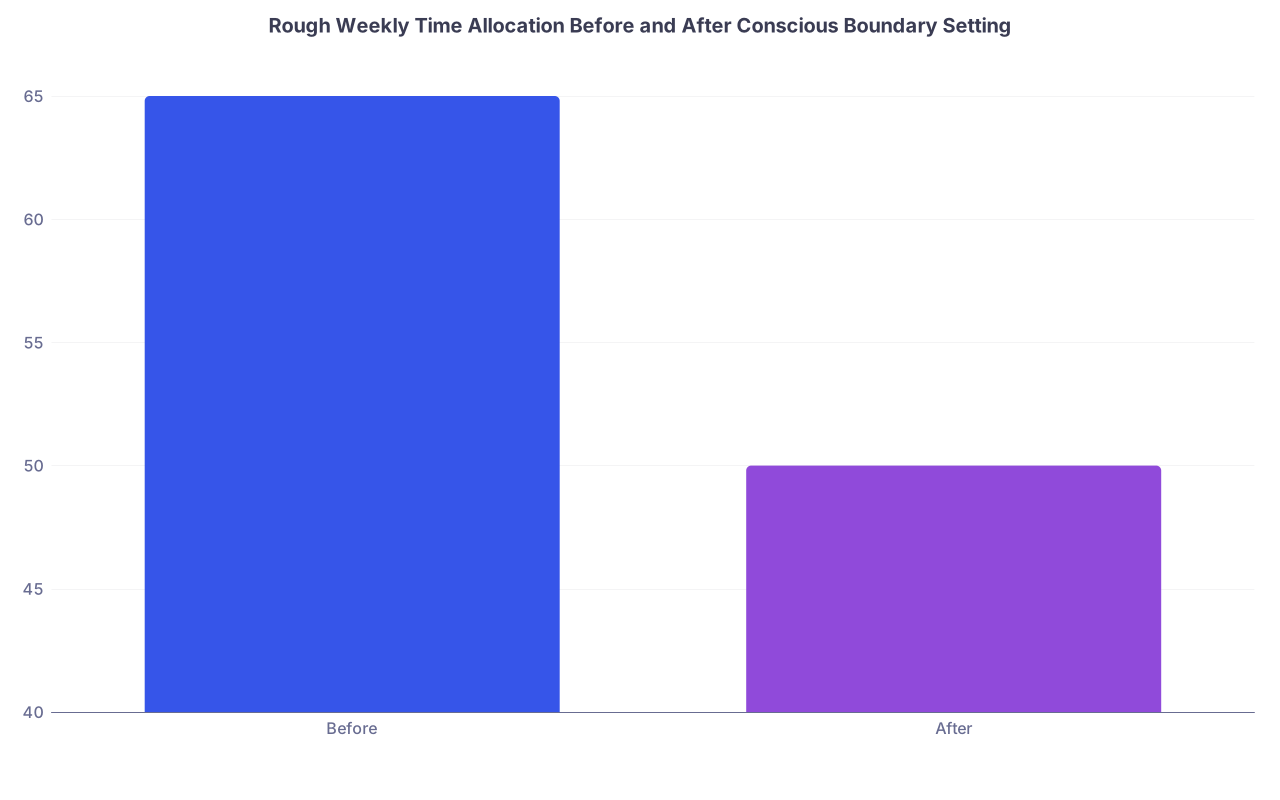
| Category | Value |
|---|---|
| Before | 65 |
| After | 50 |
Think like this:
Emergent (drop almost everything): True crises—outbreak response, wildfire smoke emergency, water contamination, major media crisis. These are rare. When they happen, you tell family explicitly, “This is one of those weeks. It’s not forever.” You also compensate afterward, not just move on.
Urgent but expected: Legislative session peaks, budget deadlines, grant submissions. These should be planned around in your family calendar. Less social time, more frozen dinners, more child-care support. Not mysterious chaos—predictable surges.
Important but chronic: Strategy development, community coalition work, writing policy briefs. These must be paced. No one will do that pacing for you.
For each week, pick:
- 1–2 work things that are truly non-negotiable
- 1–2 family things that are truly non-negotiable
Everything else is flexible. People who try to treat 10 things as “must do” have no triage. They go under.
Step Six: Protect Micro-Blocks of Real Presence with Family
You are not going to get perfect, Instagram-friendly “quality time.” You might get 20 unbroken minutes. You can make those 20 minutes matter.
Concrete, low-drama moves:
20-minute no-phone window when you walk in the door. Coat off, bag down, phone in another room. You ask your kid or partner two real questions: “What was the stupidest thing that happened today?” works better than “How was your day?”
One protected recurring ritual:
- Saturday pancakes
- Sunday walk
- Reading a chapter with your kid every night at a predictable time
People remember rituals. They do not remember the random night you happened to be home but were half on email.
- Name the tradeoff out loud:
“I have to miss bedtime tonight because of a community meeting. That means Saturday afternoon is just for us. We’ll go to the park / movie / build Legos.” Then actually do it.
You’re teaching your family: When work takes, I give back. Not equally, but consciously.
Step Seven: When Policy Ethics Clash with Family Needs
This is the uncomfortable part.
Sometimes the disagreement at home is not about time. It’s about content.
You might be:
- The visible face of a vaccine mandate in a community where your in-laws are anti-vax
- Working on harm reduction and supervised consumption sites while your partner’s sibling died of overdose and the family blames “soft drug policies”
- Pushing mask mandates in schools while your teenager resents you because their friends think “you ruined senior year”
You’re not just juggling time. You’re sitting in an ethical crossfire.
Here’s how to handle it like an adult, not a debater:
Clarify your own ethical grounding.
Can you explain—in two minutes—why you’re doing this work, to someone who strongly disagrees, without getting defensive? If not, you’re not ready for the kitchen-table version of this fight.Respect emotional reactions at home as valid, even if you think they’re wrong on the facts.
“I get that this policy feels like it hurt you. I’m not going to dismiss that. I still believe, looking at the whole population, that it saves more lives than it harms. That’s the tension I live with daily.”Set limits on disrespect, not disagreement.
You can tolerate “I think your job is misguided.” You do not have to tolerate “You’re a monster” or “You care more about strangers than your own family.”Know when to step back from being the face.
Sometimes, the right move is to say at work: “I’d like to support this from the background. Being the public spokesperson on X has become unmanageable in my personal life.” That’s not cowardice. It’s prudence.
Step Eight: Use Systems, Not Just Willpower
You’re not going to “remember to set boundaries” when you’re exhausted. You need systems that default you toward sanity.
Examples that work in high-intensity policy roles:
Calendar blocks that are real:
- “No meetings” blocks around kid pickup or elder care.
- One evening a week permanently blocked as “unavailable” to your team.
Do not call it “family time” on shared calendars; call it “held” or “unavailable.” People respect vague blocks more than “family dinner” for some reason.
Email rules on your phone:
- Turn off push notifications.
- Create VIP alerts for only 2–3 people (your director, your core partner in crisis response). Everyone else can wait until you check manually.
A simple decision rule for after-hours asks:
- If it doesn’t affect tomorrow morning or an active emergency, it waits.
- If it’s not coming from your direct supervisor or a clearly designated lead in a crisis, it’s probably not truly urgent.

| Step | Description |
|---|---|
| Step 1 | After hours request |
| Step 2 | Respond now |
| Step 3 | Schedule for next available work block |
| Step 4 | Defer to next workday |
| Step 5 | Active emergency? |
| Step 6 | Affects next morning deliverable? |
| Step 7 | From supervisor or crisis lead? |
Systems beat good intentions. Every time.
Step Nine: Recognize When the Job Itself Is the Problem
Sometimes the issue is not your boundaries or your communication. It is the job.
Red flags I’ve seen over and over:
- “Emergencies” every week that are actually just poor planning
- Leaders who brag about 80-hour weeks and shame anyone who leaves “early” at 6 pm
- Zero backup structure—if you’re out, things just don’t happen
- You’re leaving work at 9 pm several nights a week outside of real crises or narrow legislative windows
- People with families are sidelined or mocked as “less serious”
You cannot fix a culture that’s proud of burning people out.
At that point, the ethical choice is either:
- Stay and knowingly sacrifice large parts of your family life, or
- Leave or shift to a different role/agency that’s demanding but not extractive.
Do not kid yourself that “it’ll be better after the next big thing” if it’s been like this for 2+ years.
Step Ten: Playing the Long Game—in Policy and at Home
Balancing family obligations with time-intensive policy work is not a one-time optimization. It’s a moving target.
Kids grow. Parents age. Elections change your workload overnight. You’ll have years you can push harder and years you need to pull back.
If you stay in this field, your impact will be measured over decades, not months. Same at home.
What matters long-term:
- You’re honest with yourself and your people about the tradeoffs.
- You don’t let “the work is important” become a blanket excuse for neglecting the few people you’re uniquely responsible for.
- You build enough structure around your time that you’re not always solving the same crisis of “how is this all supposed to fit?” every Sunday night.
That’s the actual ethical standard: not perfection, not constant presence, but conscious tradeoffs you can defend—both to your population and to your kid in 15 years when they say, “You were gone a lot. What were you doing all that time?”
You want an answer that makes sense. To them and to you.
With these pieces in place—clarity about your non-negotiables, honest conversations at home and at work, and some actual systems instead of wishful thinking—you’re not solving everything. But you’re out of pure reaction mode.
That frees up enough mental space for the next layer: building a sustainable career in public health policy where your ambition, your ethics, and your family life are pointed in the same general direction. Not perfectly aligned, but not at war either.
Getting that alignment—that’s the longer story. The promotions you do or don’t take. The roles you seek out or walk away from. The mentors you choose.
We’ll get there. For now, if tonight you can close the laptop 30 minutes earlier and be fully present with whoever is in your house, you’re already changing how this story ends.
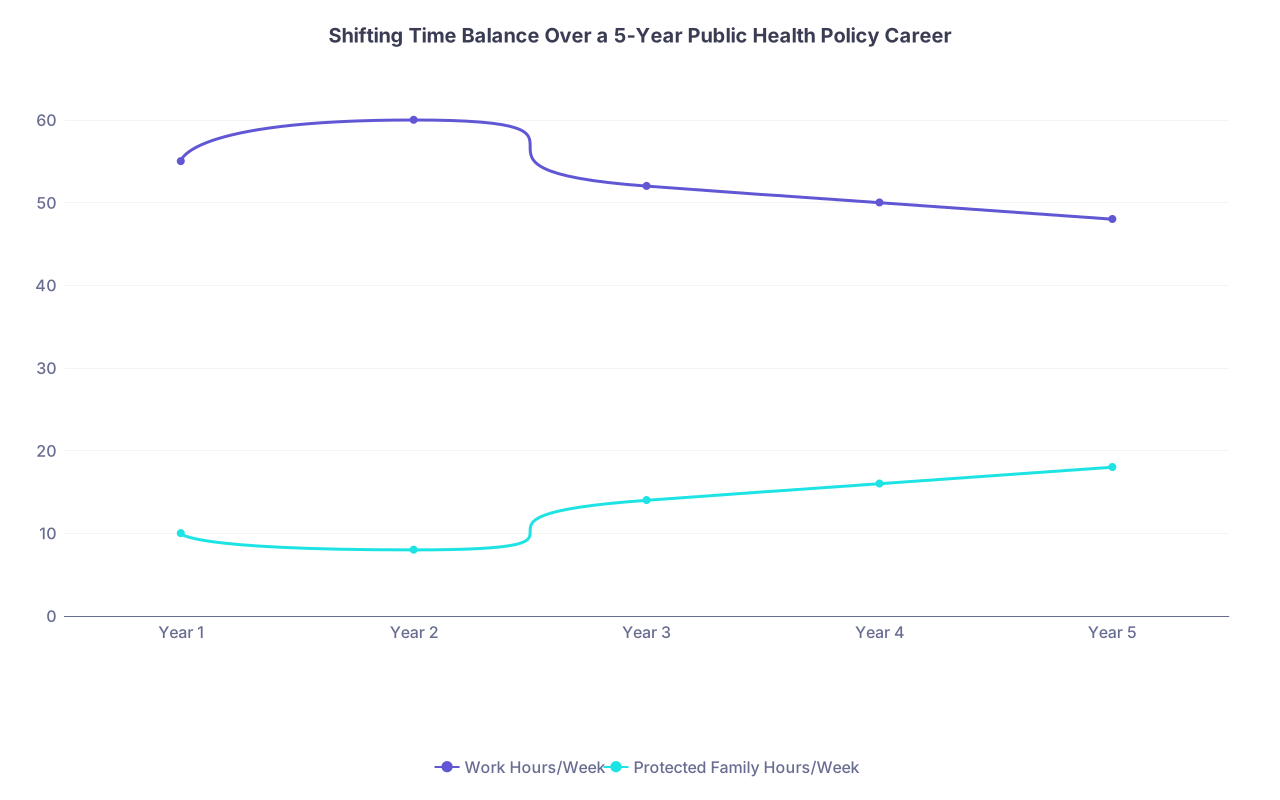
| Category | Work Hours/Week | Protected Family Hours/Week |
|---|---|---|
| Year 1 | 55 | 10 |
| Year 2 | 60 | 8 |
| Year 3 | 52 | 14 |
| Year 4 | 50 | 16 |
| Year 5 | 48 | 18 |