
It’s Tuesday evening. You’re skimming your email between patients and a “Policy Update” memo pops up from Administration. You open it expecting the usual fluff—documentation tweaks, new parking rules. Instead, you read a few lines and your stomach drops.
Maybe it’s a new restriction on gender‑affirming care. Or a directive about discharging uninsured patients faster. Or a rule limiting end‑of‑life options you believe are humane. Whatever it is, it’s not just “I don’t like this.” It hits that internal line: This is wrong.
Now you’re standing in the hallway with a vitals printout in your hand, and the question isn’t theoretical ethics anymore. It’s: “What do I do tomorrow when this goes live?”
Let’s walk through this like a real situation, not an ethics exam.
1. First 48 Hours: Slow Down, Get Clear, Protect Yourself
You do not have to decide your entire career in 24 hours. But you do need to avoid three dumb moves: reacting in anger, ignoring it and hoping it goes away, or signing something you do not understand.
Step 1: Get the actual text and read it like a lawyer
Do not rely on the summary line or gossip from the group chat.
Print the policy or save a PDF. Read the actual language. Highlight phrases like:
- “shall” / “must” (mandatory)
- “may” / “encouraged” (optional)
- “exceptions” / “at the discretion of”
- “failure to comply may result in…”
You’re looking for:
- What exactly is being required?
- Who is responsible for doing it?
- What happens if you don’t?
Half the time, what people are panicking about is the interpretation, not the text. The other half, the text really is as bad as you think.
Step 2: Separate “I don’t like this” from “This violates my core ethics”
Ask yourself bluntly:
- Is this something I think is suboptimal but still ethically tolerable?
- Or is this something I genuinely cannot do in good conscience?
Examples of each:
- Annoying but tolerable: Extra documentation, a new consent form, some stupid throughput metric.
- Core ethical conflict: Being required to misrepresent facts, deny evidence‑based care solely for non‑clinical reasons, violate informed consent, discriminate.
If it’s in that second category, that’s when you start planning serious steps.
Step 3: Document your reaction privately
Create a note (personal, secure, not on the hospital server) with:
- The date you saw the policy
- A brief summary of your concern in plain language
- Any immediate questions you have
Keep it factual. No rants. This becomes useful later if this escalates—shows your concerns were early, consistent, and grounded.
2. Map the Conflict: Legal, Institutional, and Personal Lines
Before you act, you need to know what battlefield you’re on. Because “this feels wrong” is not enough to stand on, legally or professionally.
Step 4: Check if the policy conflicts with law or standards
Look at three levels:
Law and regulation
- Does the policy contradict federal or state law?
- Example: A state ban on certain abortions vs EMTALA obligations in emergencies.
- Example: Policy that could violate anti‑discrimination law.
Professional guidelines
Compare it with:- AMA Code of Medical Ethics (or specialty equivalents)
- Your specialty society’s position statements
- Board or licensing standards
Hospital’s own mission and values
Yes, this sounds fluffy, but it matters if you end up challenging the policy. If they claim “we champion patient autonomy” and this policy obviously undermines it, that’s a point in your favor.
You’re trying to categorize the conflict:
| Type of Conflict | What It Means | Your Leverage |
|---|---|---|
| Illegal | Violates law/regulation | Highest |
| Violates professional standards | Conflicts with widely accepted ethics | Moderate–High |
| Institutional hypocrisy | Conflicts with hospital’s stated values | Moderate |
| Personal conscience only | Unique to your beliefs | Lower (but still valid) |
This helps you decide whether to aim for policy change, seek accommodation, or plan an exit.
3. Build Quiet Allies and Get Real Advice
This is where a lot of clinicians make the mistake of firing off a long email to “All Staff.” Don’t. You need information and allies, not a reputation as the loose cannon in week one.
Step 5: Talk to 2–3 trusted colleagues, not 20
Pick people who:
- Have good judgment
- Aren’t chronic complainers
- Don’t run to admin with every whisper
Ask them:
- “How are you reading this policy?”
- “Am I over‑interpreting this, or are you seeing the same ethical issue?”
- “Have you heard anything about possible exceptions?”
You’re pressure‑testing your reaction. If three sharp colleagues also see a serious ethical problem, that’s a signal this is real, not just your idiosyncratic issue.
Step 6: Get legal and professional advice quietly
Two angles here:
Malpractice / personal attorney
- Call your malpractice carrier’s risk management line. They exist for this.
- Ask: “If I follow this policy and it hurts a patient or violates a guideline, what’s my exposure?”
- If it’s serious, consider a brief consult with a healthcare attorney—especially if the issue edges into whistleblowing, EMTALA, discrimination, or patient rights.
Professional bodies
- Some specialty societies have ethics hotlines or committees. Use them.
- They can point you to position statements or give you language to use when pushing back.
Do this before you confront leadership. Walking into a meeting with “I spoke with risk management and here’s their concern” is different from “I think this is bad.”
4. Engage Internally: How to Push Back Without Self‑Destructing
If you’re going to challenge the policy, you need to do it in a way that’s strategic, not just cathartic.
Step 7: Start at the lowest effective level
Do not begin with a letter to the CEO. Start where you have real relationships:
- Department chair
- Service line director
- Ethics committee chair
- Medical staff office or medical executive committee
Request a short, focused meeting, not a rambling complaint session. Three parts:
Describe the conflict concretely
“Under Policy X, we must do Y. In situation Z, that means I’d be required to [deny care / mislead patients / act against guidelines]. I cannot ethically do that.”
Name the standards you’re relying on
“This conflicts with [AMA Code section ___ / specialty guideline / state law].”
Ask a direct, specific question
“How does the hospital expect clinicians to handle this scenario?”
“Is there a conscience exception process?”
“Can we bring this to the ethics committee for review?”
Notice what you’re not doing: you’re not attacking motives, calling people immoral, or threatening lawsuits. You’re forcing clarity.
Step 8: Put key things in writing—carefully
After the meeting, send a short follow‑up email to the person you spoke with:
- Thank them for their time
- Summarize the issue in 3–4 lines
- State any agreed‑upon next steps or clarifications
This creates a paper trail without coming off as hostile. If later someone claims, “Nobody raised concerns,” you have proof.
5. Decide Your Personal Line: Refuse, Accommodate, or Exit
At some point, you may need to choose. I’ve seen clinicians stall for months in this uncertainty and it burns them out. You need a plan.
Step 9: Define your personal red lines in crisp language
Write down, in one or two sentences each:
- “I will not ___.”
- “I can accept ___ only if ___.”
- “If the hospital requires ___ with no exceptions, I will leave.”
Example:
- “I will not deny medically indicated emergency care based on insurance or immigration status.”
- “I can accept documentation changes, but I will not falsify records.”
- “If I am ordered to misinform patients about available legal treatments, I will not comply and will begin looking for other employment.”
Vague lines are easy to cross. Clear ones are not.
Step 10: Ask formally for accommodation (if applicable)
If this is a conscience issue (religion, deep moral belief), you may have a right to accommodation, as long as:
- Patient access to standard care is preserved
- Your objection doesn’t discriminate against protected groups
- It’s operationally feasible
Think: refusing to personally perform a certain procedure, while still arranging safe, timely transfer to a willing provider.
Request in writing:
- State the specific acts you cannot perform
- Reference any relevant legal protections (conscience clauses, etc.)
- Emphasize commitment to patient safety and continuity of care
- Propose concrete solutions (coverage arrangements, call swaps, referral pathways)
You’re giving them a way to say “yes” without chaos.
Step 11: Be ready to refuse a direct order—once you’ve prepared
This is the nuclear option, but sometimes it’s required.
If you’re going to say, “I’m not doing that,” you should:
- Understand the possible consequences (from a written reprimand to termination)
- Have documented your concerns and attempts to resolve it
- Be prepared to explain your refusal calmly and briefly:
“I cannot do that; it violates my ethical and professional obligations. I can offer [alternative] that maintains patient care.”
Do not grandstand in the nurse’s station. Do not give a speech. Say as little as necessary, then take it up through formal channels.
6. Whistleblowing vs. Walking Away
Sometimes the issue is so serious it goes beyond personal conscience. It’s about patient harm or illegal behavior. Then you’re in whistleblower territory.
Step 12: Know when this is bigger than you
Red flags for potential external reporting:
- The policy likely causes significant harm or death
- Clear violation of federal / state law (EMTALA, civil rights, fraud, etc.)
- Internal avenues have been exhausted or obviously blocked
- There’s active retaliation against people raising legitimate concerns
If you’re in that territory, do not freelance this. Bad whistleblowing is career‑suicide without fixing the problem. Smart whistleblowing uses counsel.
You need:
- An attorney who knows healthcare whistleblower law
- A clear understanding of protected vs unprotected disclosures
- Documentation that’s factual, not emotional
In some cases you may report to:
- State medical board or health department
- CMS or OCR (for federal programs / civil rights)
- Accrediting bodies (Joint Commission, etc.)
This is slow, painful, and not guaranteed to succeed. I won’t sugarcoat that.
Sometimes, the best you can do is: refuse to personally participate, document your stance, and then leave for a place where practicing ethically is possible.
7. Protect Your Career and Your Sanity
While all this is happening, you still have patients, notes, night shifts. If you’re not careful, this kind of conflict eats you alive.
Step 13: Tighten up your clinical practice
Nothing gives admin more leverage than sloppy practice. While you’re pushing back:
- Be ruthless about documentation quality
- Follow existing policies that you can ethically comply with
- Avoid behavior that makes you an easy target (chronic lateness, unprofessional emails, outbursts)
You want your only “problem” to be that you raised a legitimate ethical concern.
Step 14: Quietly open exit doors
Even if you hope it resolves, start exploring alternatives:
- Update your CV
- Reach out discreetly to contacts at other institutions
- Consider different practice settings (VA, FQHC, academic center, different state)
Do this early, not when you’re desperate. A credible exit option makes you less anxious and, ironically, more powerful in negotiations. You’re not bluffing when you say, “I cannot practice like this.”
8. Long Game: Integrate This Into Your Professional Identity
You’re not just surviving a policy fight. You’re shaping the kind of clinician you’re going to be for the next 20–30 years.
You will see this pattern again: institutional priorities vs patient‑centered ethics. Not always dramatic. Often subtle. Metrics over meaning. Throughput over thinking. Compliance over conscience.
Every time, you will either:
- Move your line to fit the institution, or
- Push the institution to move closer to your line, or
- Leave and find a better match.
The only big mistake is drifting without deciding.
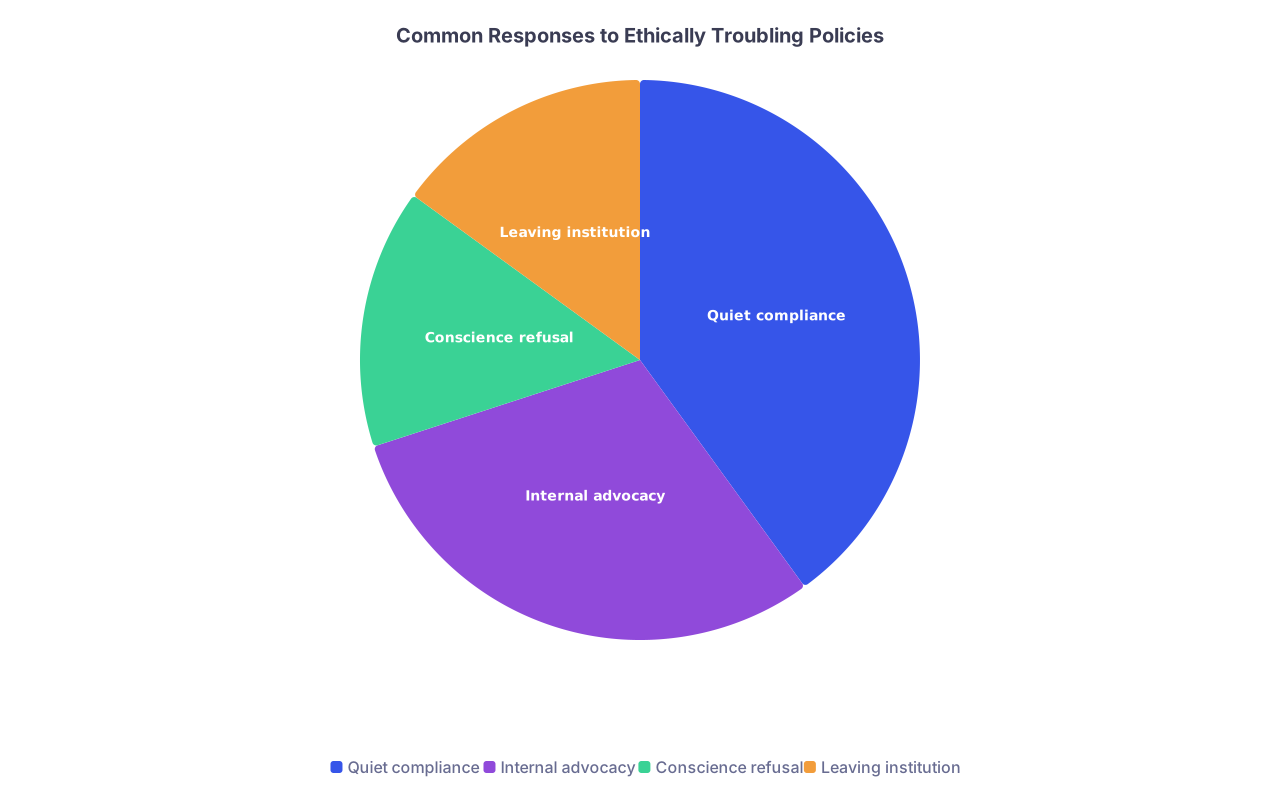
| Category | Value |
|---|---|
| Quiet compliance | 40 |
| Internal advocacy | 30 |
| Conscience refusal | 15 |
| Leaving institution | 15 |

| Step | Description |
|---|---|
| Step 1 | Policy conflicts with ethics |
| Step 2 | Clarify policy text |
| Step 3 | Assess legal and ethical standards |
| Step 4 | Discuss with trusted colleagues |
| Step 5 | Engage leadership and ethics committee |
| Step 6 | Document and continue with safeguards |
| Step 7 | Limited compliance with monitoring |
| Step 8 | Refuse specific actions and plan exit |
| Step 9 | Consult attorney and consider reporting |
| Step 10 | Transition to new role |
| Step 11 | Satisfactory accommodation? |
| Step 12 | Core red line crossed? |
| Step 13 | Serious harm or illegality? |

What You Can Do Today
You’re probably somewhere between “I just got the email” and “I’ve been stewing about this for months.” Either way, here’s a concrete thing you can do today that moves this from vague dread to structured action:
Print or open the policy.
On a blank page, write three headings:
- “What this actually requires me to do:”
- “Why this conflicts with my ethics / standards:”
- “My non‑negotiable red line is:”
Fill those in with blunt, simple statements.
That one page becomes your anchor. It will shape what you say to colleagues, to leadership, to yourself.
Do that before the next shift starts. Then you’re not just a clinician trapped under a policy. You’re a professional with a clear stance and a plan.