
What do you actually do when your program tells you, with a smile, “We encourage safety reporting,” and then quietly crushes anyone who actually files a report?
I’ve seen that movie. Different hospitals, same script: a resident flags an unsafe staffing pattern or a dangerous policy; next thing you know, that person’s “professionalism” is under review, schedules change mysteriously, or their fellowship letter cools off. So let’s not pretend this is theoretical.
If you’re in a program that says it values safety but acts like criticism is treason, you’re dealing with a culture problem that has ethics, legal, and personal-career implications.
Here’s how to move in that environment without being naive—and without becoming complicit.
Step 1: Get Extremely Clear About What’s Actually Happening
Before you do anything loud, you need receipts. Not vibes.
There’s a huge difference between:
- “My attending looked annoyed when I brought up safety,” and
- “After I reported that three ‘observation’ patients had pressors on the floor, my program director called me in and said, ‘People who complain a lot don’t do well here.’”
Start by cataloguing reality.
Build a quiet fact pattern
On your own device (not hospital-owned, not your work email):
- Write down specific incidents: date, time, location, people present, what was said/done.
- Capture exact phrases when you can. E.g., “You’re not a culture fit if you keep sending incident reports against your colleagues.”
- Note any follow-up: schedule changes, negative feedback, being removed from committees, etc.
- Separate safety concern from retaliation behavior. Both matter, but they are different issues.
You’re building a timeline, not a manifesto.

| Step | Description |
|---|---|
| Step 1 | Notice retaliation after safety concern |
| Step 2 | Escalate urgently to higher authority or external body |
| Step 3 | Document and analyze pattern |
| Step 4 | Identify allies and protections |
| Step 5 | Choose internal vs external paths |
| Step 6 | Execute plan and protect yourself |
| Step 7 | Immediate patient danger? |
If you can’t concretely describe what “punishment” looks like, you’re not ready to act. You’re just mad. Acting from anger with no evidence is how you get labeled “unprofessional” in a way that actually sticks.
Step 2: Learn Your Real Rights (Not the Poster on the Wall Version)
Every hospital has glossy posters about “just culture” and “safety first.” Those are marketing. You need the enforceable stuff.
Here’s where to look:
- ACGME Common Program Requirements
- Your state’s whistleblower and patient safety laws
- Your hospital’s official policies (not just slides from orientation)
| Source | What You’re Looking For |
|---|---|
| ACGME Common Program Requirements | Language about resident safety, supervision, duty hours, non-retaliation for reporting |
| GME Policies (Institutional) | Grievance process, reporting channels, non-retaliation policies |
| Hospital HR Policies | Whistleblower, anti-retaliation, code of conduct |
| State Law (website or board) | Healthcare whistleblower protections, mandated reporter rules |
Does this mean the program will automatically respect those rules? No. But if they don’t, you have leverage—and in some cases, real legal protection.
Key concept: protected activity
You are often legally protected when you:
- Report unsafe patient care through appropriate channels
- Participate in an investigation about safety/quality
- Refuse to perform clearly unsafe or illegal orders
So when a program punishes you because you did those things, that’s not just “unfair,” it can be legally risky for them.
Do not dramatize this when you talk about it. You don’t need to say “I have rights.” You just need to quietly know you’re not powerless.
Step 3: Separate the Safety Issue from the Culture Problem
You’re dealing with two battles:
- The actual safety concern (e.g., “We keep boarding ICU-level patients in the hallway.”)
- The retaliation/culture problem (e.g., “Residents who speak up later get slammed on evals.”)
You will not fix both with one email. Stop trying.
Think through them separately.
For the safety issue
Ask yourself:
- Is there an immediate, ongoing risk of serious harm or death?
- Is it a one-off incident or a repeating pattern?
- Is it a policy-level problem (staffing ratios, expectations) or an individual error?
The more immediate and severe the risk, the less you worry about politics. You escalate harder and faster, even if it costs you politically. That’s the job.
If it’s chronic but not immediately lethal, you have more strategic room.
For the culture/retaliation issue
This is slower and dirtier. You’re not going to “fix” the culture in a few months of PGY-2. But you can:
- Reduce the harm to yourself and your co-residents.
- Make it more expensive for them to retaliate.
- Create a record that will bite later if they go too far.
Two different problems, two different plans. Keep them separate in your head.
Step 4: Decide What You Actually Want, Not What You Think You “Should” Want
You have options. None are perfect. But pretending you have none is how you become bitter and stuck.
Be explicit with yourself:
- Do you want to stay, finish, and protect your future fellowship/job as priority #1?
- Are you genuinely willing to risk your career here to push on this?
- Would you actually transfer programs if it got bad enough? Or leave medicine?
There is no morally pure answer. I’ve seen excellent residents decide, “I will do the minimum to not be complicit and then get out,” and that’s valid. I’ve also seen people blow themselves up trying to be the lone hero for a system that swallowed them and moved on in a week.
Say your goal out loud:
“I want to get through this program with my license intact and not sell my soul in the process.”
or
“I want to force this into the open even if it hurts me.”
Your strategy flows from that.
Step 5: Build Quiet Support Before You Go Loud
Speaking up alone in a hostile culture is like walking into a storm with an umbrella: symbolic, but you’re still getting soaked.
You need people and structures around you.
Potential allies
- Senior residents who are blunt off the record
- Faculty with a reputation for being residents’ advocates
- The GME office (sometimes truly neutral, sometimes not—test the waters)
- Risk management / patient safety officers (they care when liability shows up)
- Your own PCP or therapist (if this is wrecking your mental health, and it might)
How to test an ally without exposing yourself fully:
You don’t lead with “My PD is retaliating against me.” You start small:
“Have you ever seen residents get pushback for using the safety reporting system?”
or
“I noticed some residents feel hesitant to speak up about policies. Is that something you’ve seen?”
Their face and first sentence tell you a lot. If they go, “Oh yeah, you’ve got to be careful, they don’t like that,” file that. If they say, “No, that’s never been an issue here,” in a too-bright tone while looking over their shoulder, also informative.
Do not dump your whole story into the first person who seems sympathetic. Test, then escalate.

Step 6: Use Internal Channels Strategically, Not Naively
You’ve got a menu of internal options. Each has pros and cons.
Common internal paths:
- Direct report to attending/PD
- Anonymous (or “anonymous”) safety reports
- GME office or Designated Institutional Official (DIO)
- Hospital “hotline” or compliance line
- Chief residents (sometimes safe, sometimes absolutely not)
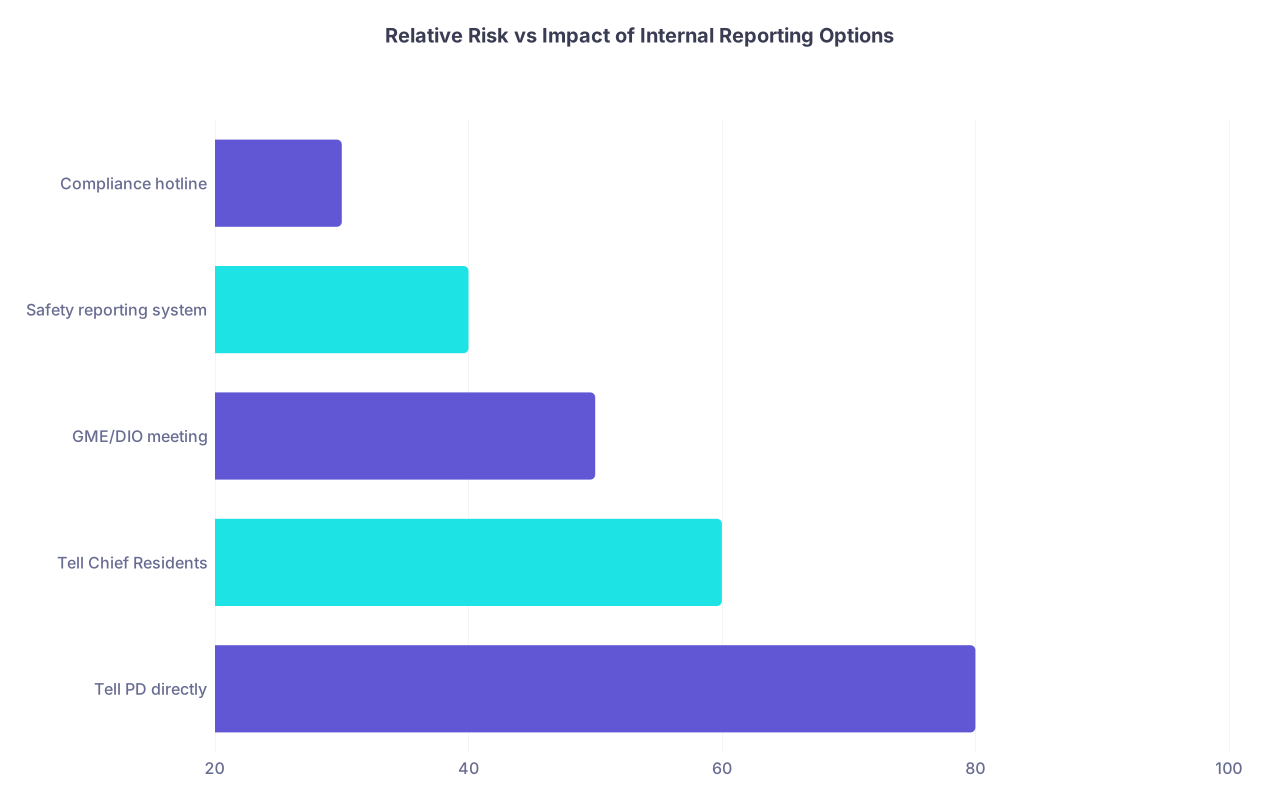
| Category | Value |
|---|---|
| Tell PD directly | 80 |
| Tell Chief Residents | 60 |
| GME/DIO meeting | 50 |
| Safety reporting system | 40 |
| Compliance hotline | 30 |
(Think of those numbers as a rough “retaliation risk” score—higher is riskier, not a formal metric, obviously.)
How to move smartly:
With your PD: Never go in cold and emotional. Go in with specific facts. Tie everything to patient safety, not “I feel disrespected.”
- Bad: “You’re punishing me for speaking up.”
- Better: “Since I submitted a report about overnight coverage, I’ve noticed a pattern of negative evaluations that mention my ‘attitude’ around safety. I’m concerned that this could discourage residents from reporting problems that affect patients.”
With GME/DIO: Frame it in ACGME language. They understand accreditation threat more than moral outrage.
- “Residents have started avoiding safety reports because they believe it affects evaluations. That’s impacting our ability to provide safe care and may conflict with non-retaliation standards.”
With anonymous systems: Assume they are only partially anonymous. Write like it might be read aloud in a committee that knows exactly who you are. Fact-based, calm, focused on patient harm.
If you’re in a truly toxic program, internal channels may be more about creating a record than actually solving your problem. That matters later if you go to ACGME, a state board, or a lawyer.
Step 7: Decide When to Go External—and How Hard
There are three big external levers residents forget they have:
- ACGME / accrediting body
- State/federal regulators (e.g., health department, OSHA, sometimes CMS)
- Legal counsel
You don’t start here for everything. But when:
- There’s clear, ongoing patient harm
- Internal attempts have been stonewalled or retaliated against
- You have documentation showing a pattern
…it’s time to at least consider it.
ACGME
You can file complaints individually, often anonymously. They take patterns seriously, especially around:
- Retaliation for reporting problems
- Systemic supervision or safety issues
- Work hours violations linked to safety
Your job is to be specific and boring. ACGME does not care about your PD’s “vibes.” They care about:
- Numbers: duty hours, staffing, ratios
- Policies: written versus actual practice
- Patterns: “Residents who file safety reports are consistently receiving below-average professionalism scores, with no prior history.”
Regulators
If we’re talking about things like:
- Chronically unsafe nurse-to-patient ratios being hidden
- Falsified documentation
- Orders from leadership to not report certain things
Then you’re in regulatory or even legal territory.
Each state has a different flavor:
- Some have hotlines for unsafe patient care or hospital conditions.
- Some protect healthcare workers very explicitly from retaliation.
A 20-minute consult with an employment/healthcare attorney can clarify a lot. No, that doesn’t mean you’re “suing.” Talking to a lawyer to understand risk is just basic adult self-protection.

Step 8: Protect Your Career While You Protect Patients
Here’s the uncomfortable part. Programs that retaliate on safety will absolutely weaponize “professionalism” and “team player” language against you. They’ve done it before.
You have to play defense.
On paper, you look like this:
- Shows up on time
- Does notes, calls, follow-up reliably
- Has no big gaps in performance they can point to
- Doesn’t blow up in public or send rage emails
Because if they can legitimately call you sloppy or unreliable, your retaliation story looks like a cover.
So, whether you like it or not, you:
- Triple-check your own charting and signouts
- Answer pages and texts professionally, even when you’re seething
- Avoid sarcastic or hostile comments in email or WhatsApp that can be screenshot
- Keep your venting offline or with people you’d trust with your life
This is not about being fake. It’s about not handing ammo to people who are already not acting in good faith.
Step 9: Have an Exit Strategy (Even If You Never Use It)
You sleep better when you know you’re not trapped.
Think through:
- Could you switch programs?
- Could you change specialties if this one is particularly toxic?
- Could you do a preliminary year then reapply?
- If worst comes to worst, do you have a plan outside this institution?
You don’t need to execute any of this. But knowing:
“If they cross X line, I will do Y,”
turns you from prey into an adult making choices.
For example:
- “If they put me on a remediation plan clearly tied to my safety complaint, I will:
- Document every meeting,
- Consult a lawyer,
- Reach out to programs I interviewed at last cycle to feel out transfer options.”
That’s power. Quiet, unflashy power.
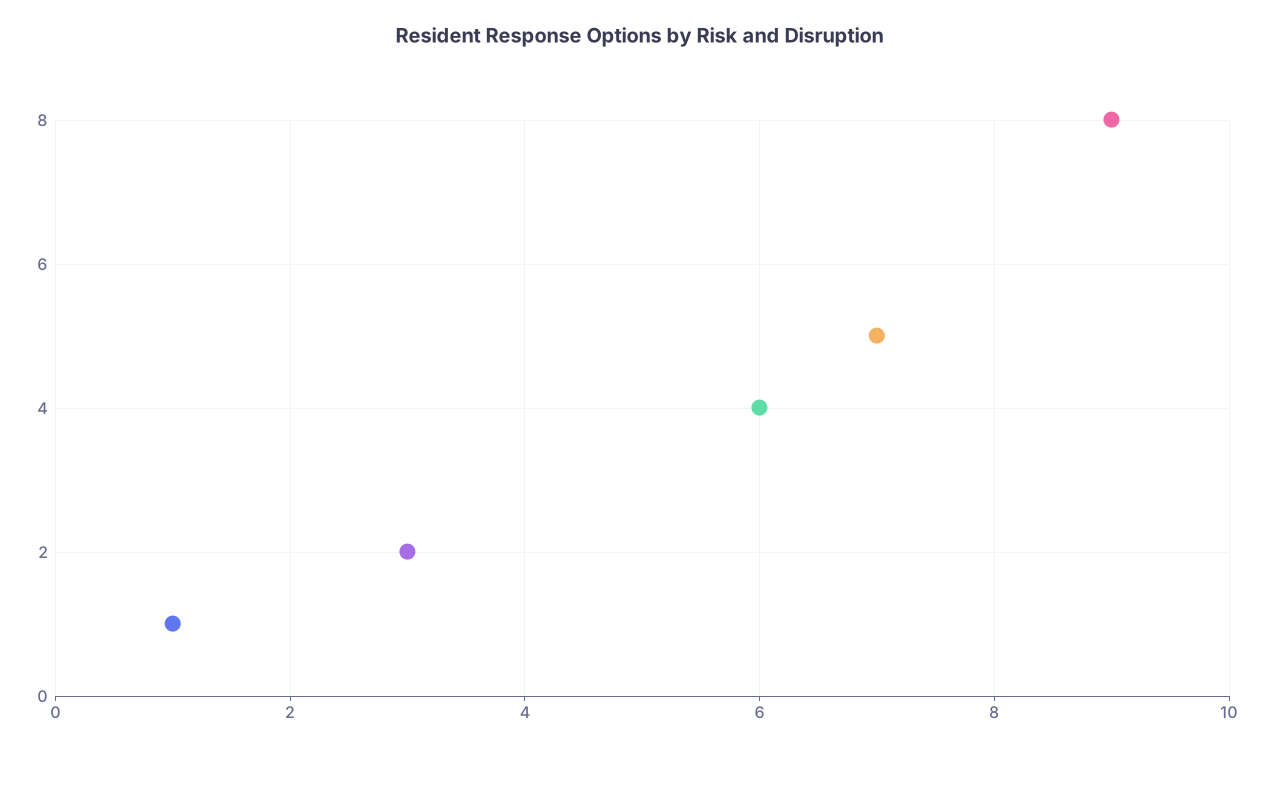
| Category | Value |
|---|---|
| Stay quiet | 1,1 |
| Internal reporting only | 3,2 |
| ACGME complaint | 6,4 |
| Legal counsel | 7,5 |
| Program transfer | 9,8 |
(X-axis ~ career disruption, Y-axis ~ institutional risk perceived)
Step 10: Keep Your Ethics Intact Without Setting Yourself on Fire
You went into medicine to help people, not to argue about staffing matrices and safety dashboards. But here you are.
The ethical tension is real:
- You know patients are being put at avoidable risk.
- You know that speaking too bluntly can harm your ability to keep helping patients long term.
There’s no formula that removes that tension. But there are some anchors:
You’re not obligated to martyr yourself
Blowing up your career for a system that will barely notice is not inherently “more ethical.” Sometimes the most ethical move is to survive training, get into a better-positioned role, and then do the work from a place of power.You are obligated to not lie
Don’t falsify documentation, don’t hide adverse events, don’t help leadership cover up safety failures. That’s the line that will follow you forever.You’re obligated to act when there’s immediate grave risk
If you truly believe harm or death is imminent and preventable, you do more than shrug and think “fellowship apps.” You escalate.Everything else is graded gray
Reporting vs not-reporting chronic-but-diffuse unsafe policies? How loud to be? How many battles to pick? That’s discretion, judgment, and your own risk tolerance.
Talk this through with someone not inside your institution if you can—a mentor from med school, a physician in another system, a therapist who understands HCW burnout. You need a mirror that’s not distorted by your local politics.

Final Reality Check
If your program punishes residents for speaking up about safety, here’s the blunt truth:
You are not crazy. You are not “too sensitive.” The system actually is misaligned with its own stated values.
You don’t fix that by being loud and sloppy. You fix it—if at all—by being:
- Documented, not dramatic – facts, timelines, patterns.
- Strategic, not naive – know your rights, choose your channels, protect your career.
- Ethical, not suicidal – refuse to lie or cover up harm, act decisively in true emergencies, and accept that some battles are long-game fights.
You deserve to train in a place where speaking up about safety is valued, not punished. Until you’re there, play smart.