
When Your Attending Discourages Advocacy: How to Respond Strategically
“Are you here to take care of patients, or to be an activist?”
If an attending has thrown some version of that line at you after you spoke up about prior auth delays, unequal access, or unsafe discharge plans, you are not alone. And you’re probably wondering: How much do I push back without getting destroyed on my evaluation or tanking my letter?
Let’s walk through how to handle this in real life, not in ethics textbook fantasy land.
First: Diagnose the Situation Before You React
Most people either shut down completely or escalate immediately. Both can backfire.
You need to know what kind of resistance you’re facing before you decide what to do.

1. Figure out what your attending is actually saying
Common versions:
- “We don’t do politics here.”
- “That’s not your role as a trainee.”
- “You’re wasting time; focus on the patient in front of you.”
- “Be careful, advocacy can come across as unprofessional.”
Each of these implies something different:
- Content rejection: They disagree with what you care about (e.g., harm reduction, gender-affirming care, abortion access).
- Method objection: They’re okay with the idea, but not how you raised it (timing, tone, email to leadership, social media).
- Power reminder: They’re reminding you where you sit in the hierarchy. Charming, but common.
- Fear-based: They’re afraid for you (or themselves) about institutional or political blowback.
Do not respond the same way to all four. You’ll waste energy or piss off the wrong person.
2. Do a quick risk scan
In your head, run a 10-second check:
- Is this attending writing a key letter for you?
- Are they rotation director or on the CCC/P&T committee?
- Have you seen them retaliate against others?
- Are you a student, intern, or resident with some insulation?
- What’s the institution’s public stance on advocacy? (Big “social justice” marketing but hostile internally? Very common.)
You’re not “selling out” by doing this. You’re doing basic risk-benefit analysis. A destroyed MS3 eval or non-renewed contract does not help anybody’s public health.
How to Respond in the Moment Without Torching Yourself
You’ll rarely win an ideological battle in front of the treatment team at 8:15 a.m. This part is about surviving the moment, preserving your integrity, and setting up your next move.

| Step | Description |
|---|---|
| Step 1 | Attending discourages advocacy |
| Step 2 | De-escalate now |
| Step 3 | Brief values-based response |
| Step 4 | Clarify priorities |
| Step 5 | Request follow up later |
| Step 6 | High retaliation risk |
1. De-escalate verbally, not ethically
You can de-escalate without agreeing.
Options that work:
- “I hear you. For this patient, I’ll focus on what we can do today.”
- “Got it. Let’s handle the immediate medical issues first.”
- “Understood. I don’t want to derail rounds. Can we talk offline later?”
What you’re doing:
- Signaling you’re not trying to hijack the workflow.
- Buying time.
- Avoiding a public power struggle you will lose.
Notice what you’re not doing: apologizing for caring or admitting you were out of line. You’re just re-focusing.
2. Keep facial expression and tone boringly neutral
It’s unfair, but you know the game: if you look angry or sarcastic, you become “unprofessional,” “emotional,” or “difficult.”
Treat it like an OSCE:
- Voice slightly slower and lower.
- No eye-rolling. No smirking.
- Short sentences. No legal argument.
You’re not trying to fix them right now. You’re keeping your record clean.
3. Park the topic, but don’t drop it entirely
If the situation allows, neutral line to leave the door open:
- “I care a lot about how system issues impact our patients, but I don’t want to disrupt rounds. Maybe we can circle back.”
If they shut it down again in front of others, let it go for that moment. You gain nothing by pushing when they’ve already flexed authority in public.
Private Follow-Up: Where Strategic Advocacy Actually Starts
The real work happens off-stage. If you’re going to advocate under hostile or skeptical leadership, you need to think like someone doing quiet organizing inside a rigid system.

1. Ask for a one-on-one
Assuming the attending isn’t obviously unsafe, send a short, disarming message:
“Hi Dr. Singh, thanks again for your teaching on service this week. I’d really value your perspective on something we touched on during rounds about discharge barriers. Do you have 10 minutes sometime this week to chat?”
You’re doing three things:
- Acknowledging their role as teacher.
- Framing this as seeking guidance, not confrontation.
- Narrowing the topic (discharge barriers, not “the entire healthcare system”).
2. Reframe advocacy as clinical excellence
Many attendings resist “advocacy” as a political word but accept “systems-based practice,” “patient safety,” or “social determinants.”
Use their language. For example:
“I wanted to clarify something from rounds. When I brought up that our uninsured patients are waiting weeks for follow-up, I was thinking in terms of systems-based practice and continuity of care. I’m trying to understand the right way, as a trainee, to bring these issues up. I’d appreciate your advice.”
You:
- Connect your advocacy to ACGME competencies.
- Show you’re coachable.
- Make it about your learning, not their morality.
If they double down with “Just don’t bring that up,” fine. You’ve learned who they are and that they are not an ally. That’s useful data.
3. Extract information, not validation
Stop trying to make every attending agree with you. Focus on what you can learn:
Ask:
- “If you were in my position and concerned about this, how would you approach it?”
- “Are there people here who work on these issues that you’d recommend I talk to?”
- “Are there institutional processes for raising recurring safety or access problems?”
Sometimes a resistant attending will still drop critical intel. They may tell you about:
- A crusty but powerful QI committee chair.
- A social work leader who actually moves mountains.
- A hospital policy that exists but nobody uses.
You can later document patterns and route them through safer channels.
4. Protect yourself in writing if things feel off
If the conversation gets weird (“You’re being unprofessional,” “You’re making us look bad”), you may want a paper trail—quietly.
Afterwards, send a bland, factual summary:
“Thank you for meeting with me today. To summarize what I heard: at my level of training it’s best to focus on addressing access issues by working with social work and case management, and to avoid raising broader policy concerns during rounds. Please let me know if I misunderstood.”
No opinions. No accusations. Just a record of what they advised. If they retaliate later and you need GME or ombuds support, this matters.
Choosing Your Advocacy Battles on Each Rotation
You cannot fight every single war on every single service. That’s how you burn out and become cynical before PGY-2.
You need a rotation-specific advocacy strategy.
| Rotation Situation | Risk Level | Advocacy Style |
|---|---|---|
| Core clerkship with key eval | High | Quiet, relationship-based |
| Away rotation for residency | Very High | Minimal, observe and learn |
| Elective with ally preceptor | Low | Direct, project-based |
| Continuity clinic | Medium | Long-game, incremental |
| Research/public health block | Low | Structural and policy work |
1. High-risk environments
Core clerkships, away rotations, small departments where everyone talks. Here you:
- Prioritize your evals and career survival.
- Channel advocacy into “safe” lanes: case management, social work, quiet emails to QI.
- Build relationships with non-physician staff who actually run the system.
Examples of “safe” advocacy:
- Working with social work to prevent an unsafe discharge and documenting it clearly.
- Submitting an anonymous or non-accusatory patient safety report.
- Framing issues in M&M as “system opportunities” not “leadership failures.”
2. Low-risk or supportive settings
Electives with known champions, public health rotations, longitudinal clinics with supportive preceptors. Here you can:
- Propose small QI projects about access, readmission due to cost, language barriers.
- Collect data on inequities you’re seeing (e.g., time-to-follow-up by insurance).
- Present at resident conference or grand rounds using institutional language.
Use these spaces to build your track record as “the person who does something with their concern,” not just the person who complains on rounds.
Using Institutional Structures Instead of Solo Crusades
You are not going to fix prior auth or Medicaid policy from the workroom. But you can move things if you plug into existing channels instead of yelling into the wind.
, [QI Projects](https://residencyadvisor.com/resources/public-health-policy/how-academic-promotions-quietly-reward-or-ignore-policy-work), DEI Committees, Union/House Staff, External Orgs](https://cdn.residencyadvisor.com/images/articles_svg/chart-common-advocacy-channels-used-by-trainees-2015.svg "Common Advocacy Channels Used by Trainees")
| Category | Value |
|---|---|
| [Safety Reports](https://residencyadvisor.com/resources/public-health-policy/the-hidden-politics-of-hospital-quality-metrics-and-public-reporting) | 45 |
| [QI Projects](https://residencyadvisor.com/resources/public-health-policy/how-academic-promotions-quietly-reward-or-ignore-policy-work) | 30 |
| DEI Committees | 25 |
| Union/House Staff | 20 |
| External Orgs | 35 |
1. Safety and quality reporting
If your concern involves:
- Delayed care due to insurance.
- Unsafe discharges because of lack of DME/home health.
- Recurrent readmissions due to medication cost.
You can:
- File safety reports naming the system issue.
- Keep your narrative extremely factual, non-blaming.
- Look for patterns—same payer, same barrier, same unit?
Later, you or someone else can use that data to argue for structural changes.
2. QI and scholarly projects
If an attending blocks “advocacy” but loves CV lines, use that.
Examples:
- Project on “30-day readmissions for patients with transportation barriers.”
- EMR-based intervention to automatically flag patients needing charity meds.
- Standardized screening for food insecurity with embedded referral.
You frame it as quality, efficiency, patient satisfaction. It still is advocacy. It’s just coded in a language the system funds.
3. Use committees and working groups, not just Twitter
Real power often hides in boring places:
- Pharmacy & therapeutics.
- Discharge planning committees.
- Diversity, equity, and inclusion councils (some are toothless; some are real).
If you’re serious about policy-level change, show up there. It’s slow. It’s painful. But that’s where policies and protocols actually change.
When Your Attending Is Ethically Wrong, Not Just Annoying
Sometimes it’s not “we don’t do advocacy.” It’s “we don’t treat [group] the same,” “we avoid these patients,” or outright discriminatory behavior. Different ballgame.

Examples:
- Dismissing a patient’s pain or symptoms based on race, gender identity, or substance use history.
- Explicitly saying they won’t prescribe standard-of-care treatment to certain groups.
- Mocking patients with limited English proficiency or disabilities.
Here’s how to approach it more carefully.
1. Write down exactly what happened
Same day, privately. No editorializing. Just:
- Date, time, location.
- Exact phrases used as close as you can recall.
- Who else was present.
- What was done or not done clinically.
You can’t rely on memory months later if this escalates.
2. Seek one confidential sounding board
Options:
- Trusted faculty who has shown ethical backbone.
- Ombuds office.
- Resident union rep or housestaff council member.
- Office of GME or student affairs with a track record of protecting trainees.
You’re not “reporting” yet; you’re asking, “Here’s exactly what I saw. How have you seen this handled? What are the risks?”
3. Decide on your line in the sand
You don’t have to report every problematic remark. But you should be clear with yourself:
- “If I see active harm / discriminatory denial of care, I will escalate.”
- “If it’s biased language but not clearly impacting care, I will document and seek coaching first.”
It’s not cowardice to triage. It’s survival. You’re building a 30–40 year career. Do not let one attending end it if you can avoid that while still minimizing harm.
4. Use escalation ladders, not catapults
Jumping straight to external media or licensing boards is almost always a last resort.
More realistic path:
- Direct private conversation (if safe and power differential isn’t insane).
- Trusted faculty ally or mentor.
- Clerkship director / program director.
- GME, ombuds, Title IX/EO office for discrimination cases.
- Only then: outside institutions, if the system is truly ignoring dangerous behavior.
At each step, reassess risk and document.
Protecting Your Career While Staying True to Your Values
You’re playing a long game. The goal is not to win every argument with every attending. The goal is to still be here in 10 years, in a position to influence policy, lead departments, run programs, and actually change how care works.
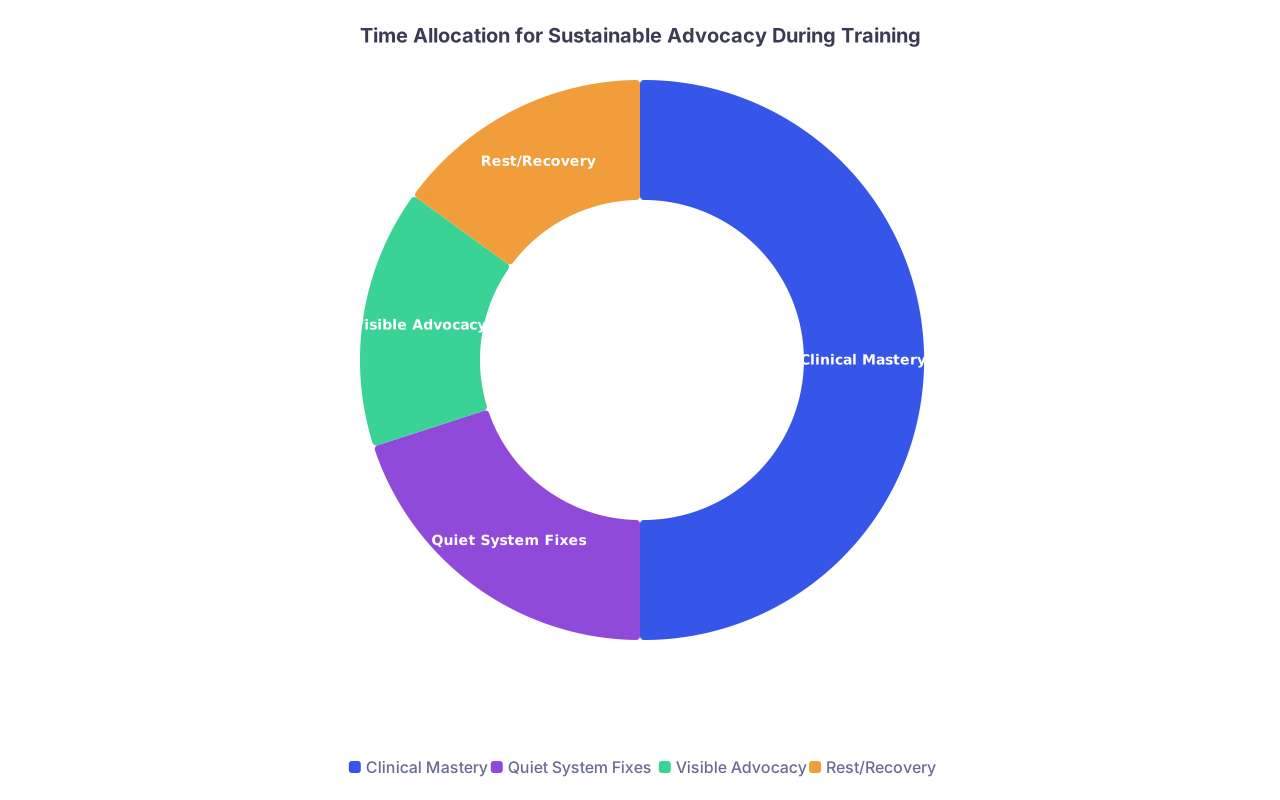
| Category | Value |
|---|---|
| Clinical Mastery | 50 |
| Quiet System Fixes | 20 |
| Visible Advocacy | 15 |
| Rest/Recovery | 15 |
1. Anchor your credibility in clinical excellence
This is harsh but true: your advocacy will be taken far more seriously if you’re known as clinically strong.
Make this non-negotiable:
- Notes and orders on time.
- Show up prepared on rounds.
- Know your patients cold.
Then when you say, “Our uninsured patients keep bouncing back because they can’t afford meds,” people don’t dismiss you as the “sloppy idealist.”
Advocacy without competence looks like noise. Competence plus advocacy looks like leadership.
2. Build allies outside your immediate team
Do not anchor your entire sense of possibility to the most conservative attending on your rotation.
Find:
- That one hospitalist who teaches about social determinants.
- The community health or public health faculty who does policy work.
- Residents one or two years ahead of you who’ve managed to speak up and survive.
Ask explicitly: “How do you choose when and how to push on systemic issues without getting crushed by the eval system?”
You’ll hear very specific tactics for your institution.
3. Separate your identity from one rotation
Students and residents make this mistake constantly: “If I stay quiet here, I’m a sellout.” No. You’re a person in a temporary, profoundly unbalanced power structure, making tactical decisions.
You can:
- Breathe.
- Journal what happened and how you wish you could respond if you were the attending.
- Commit that when it’s your name on the door, you’ll make it safe for trainees to speak.
That promise to your future self matters. It’s how you don’t go numb.
What To Say To Yourself After a Demoralizing Encounter
Because let’s be honest: even if you handle it perfectly, it still feels gross when someone in power tells you to shut up about injustice.

Three internal moves help:
Name the conflict:
“I believe medicine includes advocating for systems that don’t harm my patients. Today, someone with more power told me that’s not my role. That’s a real ethical conflict.”Reclaim your intention:
“My goal isn’t to be ‘the loud one.’ My goal is to reduce harm. Sometimes that means visible advocacy. Sometimes that means quiet groundwork. Both count.”Plan one concrete next step instead of stewing:
- Email a mentor about what happened.
- Start a small data log of the problem you raised.
- Look up an institutional committee that touches the issue.
You don’t fix the entire injustice. You keep yourself moving.
Looking Ahead
Right now, you’re trapped in someone else’s hierarchy, watching decisions that affect your patients get made for reasons that are often political, financial, or just lazy. And when you speak up, some attendings will tell you to sit down.
You don’t have to accept their version of “professionalism.” But you also don’t have to blow yourself up on every rotation to prove you care.
If you can learn to read the room, pick your battles, document what matters, and build a network of allies, you’ll get through training with both your career and your conscience intact. Then the power dynamic flips, and you’re the one setting the tone for what advocacy looks like on your team.
When you get there—the first time a student looks at you, hesitates, and then decides to speak up about a systemic injustice in front of you—you’ll remember exactly how this felt. And you’ll have a chance to respond in a way that makes their path a little less narrow than yours is right now.
That phase—moving from surviving hostile pushback to building truly advocacy-friendly teams—is the next step in your development as a physician and a public health actor. And that’s where your real policy impact starts.