
What do you do when you wake up, open your email, and see your school or hospital has taken a political or advocacy position “on behalf of all students/residents/faculty”…and that includes you?
I’ve seen this play out more times than I like: med students finding their names on a “coalition letter” they never signed, residents listed under a “house staff council” statement they didn’t vote on, faculty counted as “supporters” of a policy they actively oppose. Public health, especially in crisis moments, gets political fast. Institutions move quickly. Consent gets sloppy.
If you’re in that mess, here’s how to handle it like an adult who’s protecting both your ethics and your career.
Step 1: Get Extremely Clear on What Actually Happened
Do not fire off an angry email based on a screenshot in the group chat.
First, collect facts. You need to know exactly how your name or affiliation is being used.
Check all the places this advocacy might live:
- Official institutional email blast (“On behalf of the Department of X, including all residents and fellows…”).
- Public-facing website statement.
- Social media posts using photos/names of “our trainees” to support a stance.
- Coalition letters listing “Medical Students at [School]” or “Residents at [Hospital]” as a single signatory group.
- Press coverage quoting “the institution” in ways that strongly imply all trainees agree.
You’re looking for:
- Is your actual name used? Or just your group (e.g., “The Class of 2026”).
- Is your role used (e.g., “pediatric resident at Children’s X”) in connection with this stance without your specific consent?
- Is the statement reasonably interpreted as representing your personal opinion?
Screenshot everything. Save PDFs. Do this before anything gets quietly edited.
Now ask yourself three questions, bluntly:
- Is the content factually wrong, ethically troubling, or politically misaligned with your values?
- Is the problem that they spoke at all, or that they claimed you support this?
- Would you be okay if this email/statement showed up in your residency or job file as something “you signed”?
If your honest answer is: “I don’t endorse this and I don’t accept them using my name/affiliation like this,” then you’ve got an advocacy consent problem, not just a vibes problem.
Step 2: Distinguish Between “Institutional Voice” and “Speaking For You”
This part matters legally, ethically, and strategically.
Institutions are allowed to have positions. A medical school can say, “We support vaccination mandates.” A hospital can say, “We oppose legislation X.” That’s institutional speech.
What crosses the line is when they:
- Claim you personally “signed,” “support,” or “stand behind” a stance when you didn’t.
- Use your individual name, photo, or quote from a totally different context to frame you as a supporter.
- Aggregate you into a falsely unanimous group: “All 3rd-year students of [School] endorse…”
You need to categorize your situation:
Pure institutional statement, no implied unanimity.
Example: “The Department of Internal Medicine opposes Bill 1234.” No one is listed. No “on behalf of all staff.” That’s not “using your name,” that’s your institution talking.Group representation with implied consent.
Example: “The Resident Council of X, representing all 54 residents, supports…” You never heard about any vote. They’re folding you in. This is gray zone but still real.Explicit misrepresentation of your personal support.
Example: Your name under a letter, your photo next to the statement, or “our residents, including Dr. [You], have come out in support of…” This is the serious category.
Your response level depends on which bucket you’re in. Reserve your nuclear energy for category 3. Do not treat every generic institutional press release like a personal attack. You’ll burn social capital you may need later.
Step 3: Quiet, Professional First Response (Within 24–48 Hours)
You want a record that you did not consent. Written. Calm. Targeted.
Start with the lowest appropriate level that still has authority. For most trainees, that’s:
- Program director (for residents/fellows).
- Dean of Students or Office of Student Affairs (for med students).
- Chair or division chief (for faculty).
- The named contact at the bottom of the advocacy letter/email if there is one.
Do not start with Twitter. Or Threads. Or whatever app you like to vent on. That’s how people turn a fixable internal problem into a reputational disaster.
Here’s a template you can adapt:
Subject: Clarification and Removal Request – Advocacy Statement Dated [Date]
Dear [Name],
I’m writing regarding the [statement/letter] titled “[Title],” distributed on [date] and currently posted at [link / attached].
In its current form, the message appears to represent my personal endorsement (as [“a member of X group” / “a resident in Y program” / “by listing my name under the signatories”]). I was not consulted and did not provide consent for my name, role, or group membership to be used in support of this specific advocacy position.
I respectfully request:
- Clarification that this statement does not represent the views of every individual trainee/faculty member, and
- Removal of any language, listing, or implication that I personally endorsed this position.
I fully support the institution’s right to communicate its own positions. My concern is limited to being represented as a supporter of a stance I do not endorse.
Please confirm once this has been addressed or let me know who is the appropriate contact to resolve this.
Sincerely,
[Your Name]
[Your Title/Program]
This does a few things:
- Puts a timestamped record in your file that you did not consent.
- Signals you understand institutional rights but are drawing a boundary.
- Gives them concrete requests, not just “I’m upset.”
Save the sent email and any replies. This becomes important if things escalate.
Step 4: Decide How Far You’re Willing to Push
This is where ethics meets career calculus. No way around that.
Here’s the ugly truth: if you go scorched-earth against your institution during training, they can make your life miserable. With subtle things: fewer opportunities, cooler letters, ambiguous “professionalism concerns.”
So you want a tiered escalation strategy:
Tier 1 – Internal resolution only
If the advocacy is annoying but not career-threatening (e.g., “Residents as a group support Nutrition Policy X”), you might:
- Ask for clarification language (“not all may agree individually”).
- Ask that future statements require explicit opt-in voting or signatures.
- Let it go after a good-faith response, but keep your email record.
Tier 2 – Internal escalation
If your name was literally used or the stance seriously conflicts with your ethics:
- Loop in:
- GME office (residents/fellows).
- Dean of Ethics, Ombuds office, or Office of Professionalism.
- Institutional legal/compliance if it’s a blatant misuse of your identity.
You can say:
I’ve raised this with [X] but remain concerned about the ongoing public use of my name and role to support a position I don’t hold. Given the ethical implications, I’d like guidance from [GME/Ombuds/Legal] on appropriate next steps.
Tier 3 – External support
If the institution stonewalls you, or if you face retaliation:
Consider talking (quietly, initially) with:
- Your specialty’s national trainee organization.
- AMA, ACP, AAFP, or other large professional groups with ethics/legal resources.
- A lawyer if your personal name, image, or words were used without consent in a way that could reasonably harm you.
Notice I didn’t say “go to the press” or “blast them on social media.” That is last-resort territory when everything is already burned down anyway and you’ve accepted the risk.
Step 5: Use this as a Crash Course in Boundaries and Medical Ethics
This isn’t just a PR headache. It’s an ethics case.
You’re dealing with:
- Autonomy: Your right not to be used as a prop for someone else’s advocacy.
- Integrity: Whether you’ll allow your public identity as a clinician-in-training to be tied to positions you reject.
- Professional responsibility: How you push back without burning down relationships you actually need.
Ask yourself, bluntly: What line, if crossed, would you absolutely not tolerate, even if it cost you politically?
Examples I’ve seen:
- A Muslim student included on a “campus Jewish–Muslim alliance” statement they were never part of, taking a very specific stance on a foreign policy conflict.
- A Black resident’s photo used on a “we support police” campaign after a high-profile police killing, despite them having publicly spoken about racism and policing.
- A rural primary care doc’s name put on a letter supporting closure of the only nearby clinic offering reproductive services.
Those are not “I slightly disagree with the wording” situations. Those are existential integrity violations.
If your case is closer to that end of the spectrum, you owe it to yourself to take it seriously, not just roll your eyes and move on.
Step 6: Protect Your Future Self (Residency, Jobs, Boards)
You have to think six steps ahead:
- Will this statement show up if someone Googles you?
- Will future employers assume you hold that position?
- Could this conflict with licensing board disclosures or Board exam professionalism issues later if someone complains?
You can do a few concrete things:
Create your own paper trail.
Keep that email where you objected. If your name is on a public letter, keep the version + your later request for removal or clarification.Control your own professional narrative.
If you maintain a professional website, LinkedIn, or public-facing profile, consider a short, neutral stance:My views are my own and may not reflect those of my employer or training institution. Likewise, institutional or group statements should not be assumed to represent my personal views unless explicitly signed by me.
That’s not drama. That’s standard in many fields.
Be ready with a one-line explanation.
If someone later says, “Hey, I saw your name on that [controversial] letter from your institution,” you can calmly respond:The institution issued that statement, but I didn’t personally sign or endorse it. I actually raised that concern at the time.
Then change the subject. You don’t want this to become your entire professional identity.
Step 7: Change How You Engage in Institutional Advocacy Going Forward
You will see this again. Better to adjust your habits now.
A few rules I’ve seen smart people adopt:
Never let anyone “sign for the group” in your name without clear process. If a student council president says, “I’ll just sign on behalf of all of us,” stop them. Get a formal vote or individual signatures.
Opt out visibly when you disagree.
When a “we’re signing as the Class of 2027” email goes out:- Reply-all is rarely your friend.
- But you can reply to leadership: “Please note that I do not wish to be represented as a supporter of this letter.”
Demand clarity on representation.
Any time you’re in a committee meeting and someone says, “We’ll issue a statement from the residents,” speak up:- “Please specify that not all residents were consulted or may agree individually.”
Be cautious with media and photo consents.
Those generic “media release” forms? They can be stretched. If you’re signing one, draw a line:- “This consent does not extend to using my image or name to endorse political or advocacy positions.”
Read before you “support.”
Lot of student leaders and residents co-sign group advocacy letters they didn’t really read. That’s how they lose moral authority when something goes sideways.
A Quick Reality Check: When It’s Not Worth a War
Sometimes the healthiest move is: register your objection, accept a mediocre fix, and move on.
If the statement is:
- Time-limited (an email, not a permanent press page).
- Not searchable by your name.
- Vaguely institutional, not personally tied to you.
- Mildly misaligned but not in fundamental conflict with your ethics.
Then consider this path: send a short internal objection so you can sleep at night, then put your energy into work that actually matters. Clinical care. Real policy change. Your own advocacy projects.
Not every institutional misstep deserves your full crusade. You have limited time, limited reputation capital, and likely plenty of other battles in front of you.
Visual: Levels of Response vs. Severity
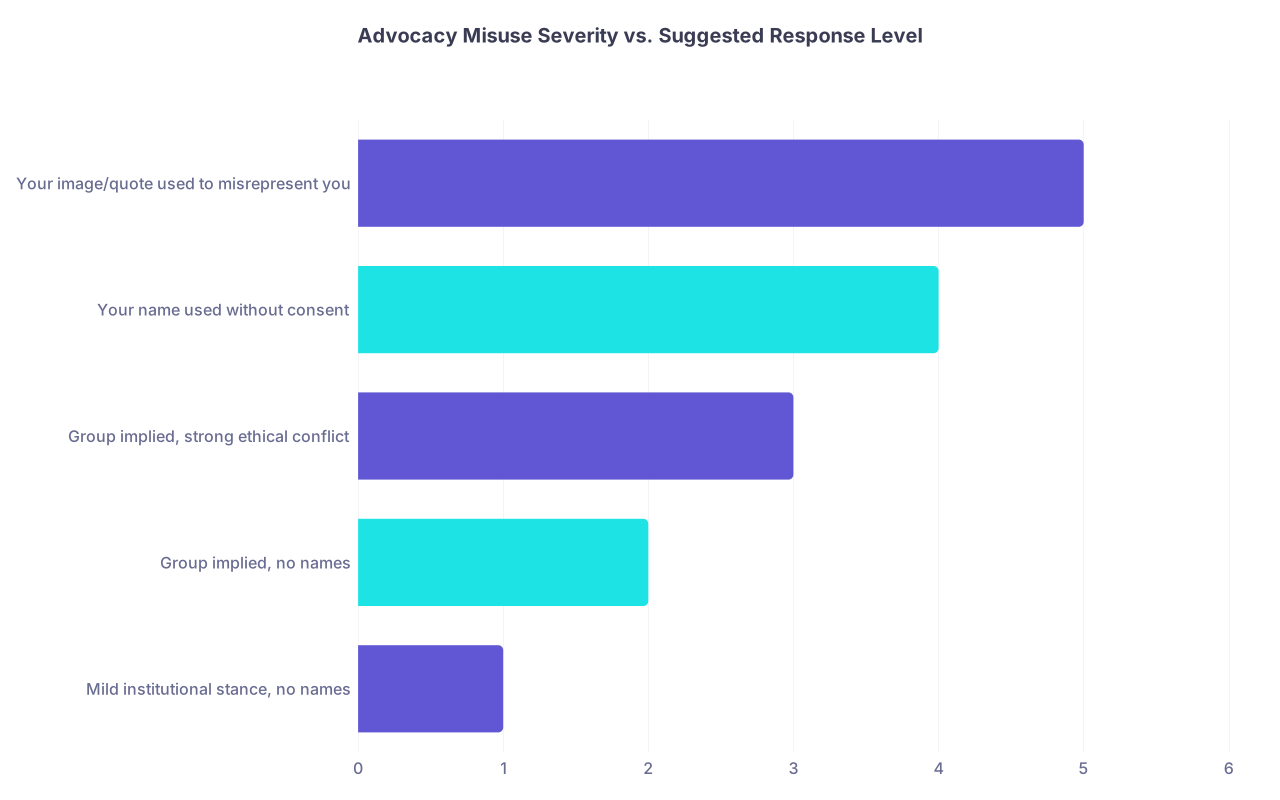
| Category | Value |
|---|---|
| Mild institutional stance, no names | 1 |
| Group implied, no names | 2 |
| Group implied, strong ethical conflict | 3 |
| Your name used without consent | 4 |
| Your image/quote used to misrepresent you | 5 |
Think of 1 as “note it, shrug, adjust next time” and 5 as “potential legal and ethics escalation.”
Example Scenarios and Concrete Scripts
Let me give you three real-world-style scenarios and exactly what I’d say in each.
Scenario 1: Med student, group letter, vague stance
Your med school sends out: “As the medical students of [School], we fully support City Ordinance 123 on sugar-sweetened beverages.” You’re against nanny-state policies and didn’t sign anything.
Email to Student Affairs:
Dear Dr. X,
I saw the recent message describing the statement on Ordinance 123 as coming from “the medical students of [School].” I wanted to clarify that I did not participate in any vote or sign a letter about this, and I don’t wish to be represented as a supporter.
For future communications, I’d appreciate if advocacy statements from student groups could be described as coming from “a group of students” rather than implying all students were consulted and agree.
Thank you,
[Name], MS3
Low-key, clear, and it plants a seed.
Scenario 2: Resident, explicit name on controversial letter
You open a PDF letter circulating on social media: “Residents of [Hospital] Oppose State Abortion Ban.” Your name, with “PGY-2 Internal Medicine,” is right there. You’re personally pro-choice, but deeply uncomfortable being publicly listed in that specific political context without consent.
To Program Director + GME:
Dear Dr. X and Dr. Y,
I became aware today of the letter titled “Residents of [Hospital] Oppose State Abortion Ban,” which lists me by name and program. I did not review or sign this letter, and I was not informed that my name would be included.
Regardless of content, I’m very uncomfortable having my name publicly used on a political statement I did not personally endorse. I’m concerned about the professional and licensing implications of being tied to public advocacy I did not consent to.
I respectfully request that my name and identifying details be removed from any online versions of this letter and that any future advocacy statements rely on explicit opt-in signatures.
I’d appreciate written confirmation once this has been addressed.
Sincerely,
[Name], PGY-2 Internal Medicine
If they drag their feet, that’s when you consider Tier 2 escalation.
Scenario 3: Faculty, misused quote and image
You once gave a quote for a wellness campaign: “Our hospital supports trainees.” Now your face and quote appear on a landing page for “Why We Support Legislation 789,” which has nothing to do with wellness.
You go to Marketing and Legal together:
I gave this quote and photo for a wellness campaign in [Year]. I did not consent to their use in a political advocacy context like the current “Legislation 789” page. This repurposing misleads viewers into thinking I personally support that legislation.
Please remove my image and quote from that page and confirm that my prior media consent will not be used to support political or legislative positions. I’m happy to discuss where my quote can be appropriately used, but not in this way.
That’s a boundary, not drama.
One More Tool: A Personal Ethics “Pre-Commitment”
You can make life easier by deciding before the next blow-up what you will and will not accept.
Write this somewhere private:
- “I am okay with my institution taking public positions I don’t share, as long as they don’t attach my name or imply my personal endorsement.”
- “I am not okay with any use of my name, likeness, or role to promote advocacy I haven’t explicitly signed.”
- “If X happens, I will [email/meet/escalate]. If Y happens, I will let it go after logging my concern.”
That pre-commitment keeps you from overreacting to small stuff and underreacting to big stuff.
A Simple Table: What Happened vs What To Do
| Situation | Your Main Move |
|---|---|
| Generic institutional stance, no names | Log it mentally, adjust expectations, no action |
| Group implied, no names, minor issue | Quiet email asking for future wording clarification |
| Group implied, major ethical conflict | Email + meeting with leadership, documented |
| Your name listed without consent | Formal written objection + request removal |
| Your image/quote misused in advocacy | Formal objection + involve Marketing/Legal if needed |
Diagram: Your Decision Flow in This Situation

| Step | Description |
|---|---|
| Step 1 | Discover statement |
| Step 2 | Email leadership requesting removal |
| Step 3 | Note and move on |
| Step 4 | Email leadership for clarification |
| Step 5 | Document and stop |
| Step 6 | Escalate to GME/Ombuds/Legal |
| Step 7 | Is your name or image used? |
| Step 8 | Does it strongly misrepresent you? |
| Step 9 | Response adequate? |
Closing: What Actually Matters Here
Three things you should walk away with:
You’re allowed to draw a hard line when your name, image, or “membership” is used to sell advocacy you don’t endorse. That’s not being difficult. That’s protecting your integrity.
Start quiet, but start on the record. A short, calm email within 24–48 hours is your best tool: it creates documentation, gives leadership a chance to fix things, and keeps you in control.
Save your fire for the real violations. Not every institutional stance is worth a crusade. But when they cross into speaking as you without consent—that’s when you act, quickly and deliberately.