
The pressure to sign public letters in medical school is getting out of control.
You are not wrong to feel uneasy when your inbox fills with “SIGN BY MIDNIGHT” messages, classmates post screenshots of their signatures on Instagram, and a resident casually says, “We’re all signing this, right?”
Let me be blunt: your name is professional currency. You do not put it on anything you have not actually thought through.
This is the guide I wish more students had before their first “Open Letter From Medical Trainees” made the rounds.
1. First Rule: You Don’t Owe Anyone Your Signature
You’re a medical student. Not a rubber stamp for other people’s politics, ethics, or brand-building.
The biggest mistake I see? Students treating public letters like a club flyer—“doesn’t really matter, everyone’s signing anyway.” It matters.
Here’s what you’re really doing when you sign:
- You’re attaching your real name, searchable online, to a public position.
- You’re implicitly claiming, “This reflects my professional judgment as a future physician.”
- You’re giving people—faculty, programs, patients—a data point about how you think, decide, and handle conflict.
You are never obligated to sign because:
- Your classmates are signing.
- A student group you belong to helped draft it.
- A resident or attending forwarded it “for visibility.”
- You’re afraid of being perceived as “not supportive enough.”
If you remember nothing else from this article, remember this:
Silence is not dishonesty. Signing something you don’t fully support is.
2. Step 1: Slow the Situation Down
Most pressure around public letters is artificial urgency—deadlines, social media posts, DMs: “We really need numbers.”
Before you decide, you create space.
Here’s the quick script you can use when someone asks you directly:
“Thanks for sending this. I take putting my name on public letters seriously, so I need a little time to read and think about it.”
That’s it. They can deal with it.
Now give yourself a simple 4-checkpoint process.

| Step | Description |
|---|---|
| Step 1 | Receive Letter |
| Step 2 | Slow down |
| Step 3 | Read full text carefully |
| Step 4 | Do not sign |
| Step 5 | Assess consequences |
| Step 6 | Decline politely |
| Step 7 | Sign |
| Step 8 | Understand and agree? |
| Step 9 | Still comfortable? |
If you’re under so much time pressure that you “have” to decide in 5 minutes, the answer is no. I’ve yet to see a letter that genuinely required trainee signatures that fast.
3. Actually Read the Thing (Like a Doctor, Not a Fan)
Most people skim. You cannot afford to.
Here’s how to read like your name depends on it—because it does.
A. Identify what the letter is actually asking for
Not the vibes. The asks. Usually they’re somewhere near the bottom in bullet points or numbered sections.
Common patterns:
- “We call on [institution] to…” (policy change)
- “We demand that [group/person]…” (punitive action, resignations, sanctions)
- “We urge [government/body] to…” (legislation, funding, public positions)
Write them out in your own words on a scrap of paper. If you can’t explain what the letter wants in two sentences, you don’t understand it well enough to sign.
B. Separate facts, emotions, and speculation
Most letters mix:
- Solid facts (dates, published policies, publicly verifiable events)
- Interpretation (“this reflects a pattern of systemic X”)
- Emotion (“we are outraged,” “we are horrified”)
- Predictions or accusations about motives
You’re not required to agree with every emotion word. But you should be comfortable with the factual claims and the overall narrative.
If the letter states:
- “X institution has a long history of…” – Do you know that? Or are you taking their word?
- “This unquestionably caused harm to…” – Is that a fact you can verify, or an interpretation?
You’re signing as a future professional, not as a fan of a cause. Precision matters.
C. Spot landmines
Red flags that should make you slow way down:
- Personal attacks on named individuals’ character (not actions, but character: “racist,” “corrupt,” “dangerous”)
- Sweeping institutional accusations without clear evidence
- Legal claims (“violated the law,” “discriminatory,” “criminal”) without referencing any process or findings
- Absolutist language: “any dissent is unacceptable,” “all who disagree are complicit”
If your name is under text that crosses into defamation or reckless accusation, that’s on you. Even if “everyone signed it.”
4. Map It to Your Core Values (Not Your Class Group Chat)
You’re not just deciding “Is this popular among my peers?” You’re asking, “Does this align with the physician I’m trying to become?”
Use three anchors:
Patient-centered ethics: Does this letter ultimately aim to reduce harm and improve health for patients or communities? Or is it mostly about scoring political points or punishing individuals?
Professional duties: Would you feel comfortable if a residency PD said, “Walk me through why you signed this letter, and how it reflects your understanding of professional responsibility”?
Intellectual honesty: Do you genuinely believe what this letter says? Or are you signing to avoid friction?
A quick self-test:
If you had to defend this letter line-by-line in front of a skeptical attending tomorrow morning, would you feel:
- Calm and grounded?
- Uneasy but still standing by it?
- Sick to your stomach because you never really read it?
You want to be in the first or second category. Never the third.
5. Think Explicitly About Future Consequences
No, you are not “too small” for this to matter. Screenshots last. PDFs circulate. People search your name.
Let’s be concrete.
| Area | Possible Impact |
|---|---|
| Residency apps | Interview questions, silent bias, extra scrutiny |
| Institutional | Tension with administration or faculty |
| Peer relationships | Conflict with classmates, labeling, division |
| Online presence | Search results show your name + controversial text |
| Internal | Regret, anxiety, feeling pressured or used |
This is not to scare you into silence. It’s to force conscious decision-making.
Ask yourself:
- “Am I okay being publicly associated with this position 5–10 years from now?”
- “If a patient looked this up and asked me about it, would I stand by it?”
- “Would I feel hypocritical later if my views evolved?”
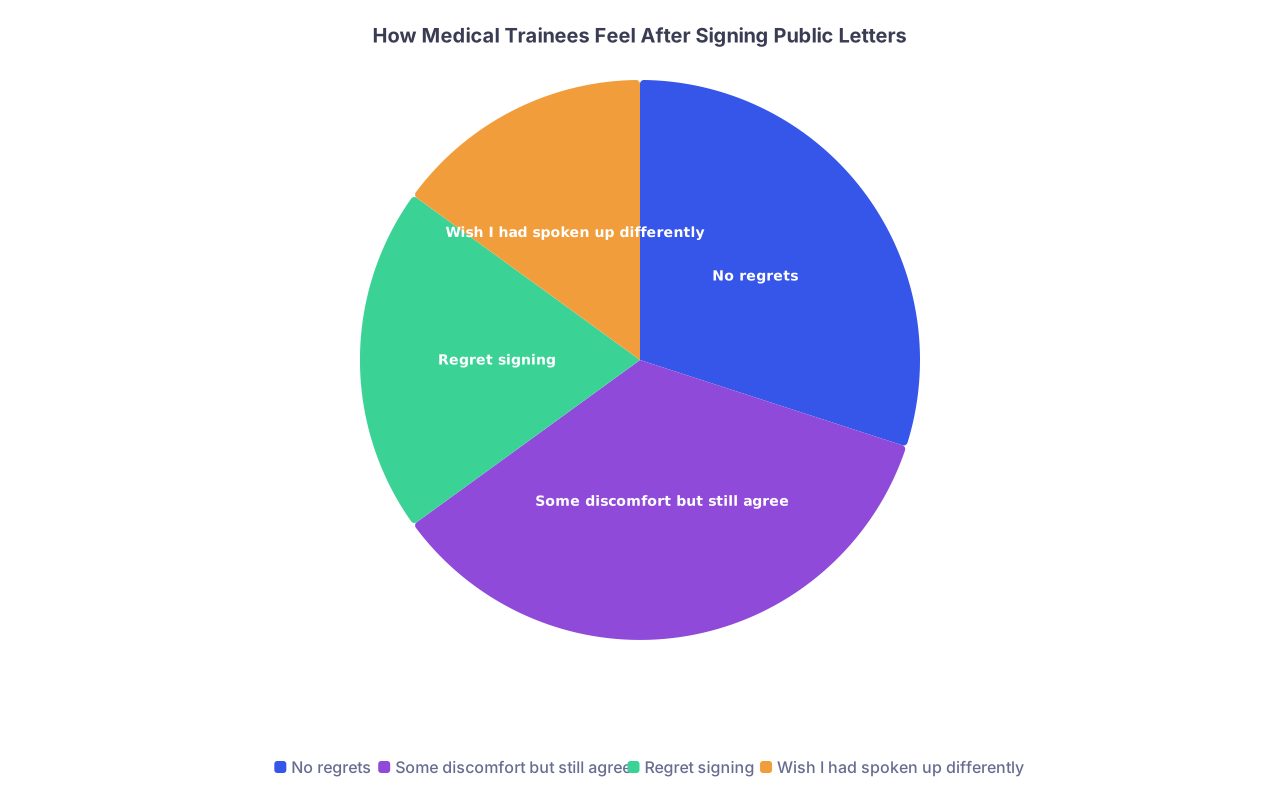
| Category | Value |
|---|---|
| No regrets | 30 |
| Some discomfort but still agree | 35 |
| Regret signing | 20 |
| Wish I had spoken up differently | 15 |
From what I’ve seen, the people who regret it most weren’t wrong about the issue itself. They were rushed, didn’t read carefully, or signed something more extreme than they realized.
6. Social and Power Pressure: Call It What It Is
You’re not deciding in a vacuum. You’re deciding in a small, political ecosystem.
Classic pressure sources
- Student orgs you care about: “As members, we should stand together on this.”
- Residents/attendings you respect: “We’d really like med student support.”
- Class culture: Group chats, Instagram posts, whispered “Did you sign yet?” in the lounge.
- Fear of labels: “If I don’t sign, will people think I’m [uncaring / bigoted / apathetic / disloyal]?”
Here’s the uncomfortable truth: some people will judge you either way. You don’t control that. What you do control is whether your signature is honest.
How to say no without lighting everything on fire
You don’t owe everyone your full ethical reasoning. For most situations, keep it short:
- “I’ve read it and decided not to sign, but I appreciate you sharing it.”
- “I have some concerns about the wording and the specific asks, so I’m going to pass.”
- “I prefer to engage on this issue in other ways—direct advocacy, conversations, etc.—rather than public letters.”
If someone keeps pushing:
“I really do not want to debate this. I’ve made my decision.”
You’re allowed to have boundaries. Even in med school.
7. When Signing Makes Sense (And How to Do It Well)
I am not telling you never to sign public letters. That would be cowardly advice.
Some letters are exactly the kind of thing physicians should stand up for:
- Protecting patient access to evidence-based care
- Speaking out against clear, documented discrimination or harm
- Supporting marginalized communities with specific, realistic asks
- Calling for transparency and accountability after well-documented institutional failures
Signs you’re dealing with a solid letter:
- It cites specific events, policies, or data.
- It distinguishes between facts and opinions.
- It avoids personal attacks and unprovable claims.
- Its proposed actions are realistic and proportional.
- It was clearly reviewed by people who understand institutional processes, not just anger.
If you decide to sign:
- Write down why you signed (for yourself). Two or three sentences. This becomes your anchor later if you’re ever asked.
- Save the text of the letter as a PDF with the date. Do not trust links to stay alive.
- Avoid performative posting (“Proud to sign this!!”) unless you genuinely want that to become part of your professional online brand.
You can support something quietly and still mean it.
8. What If You Already Signed and Now Regret It?
Happens more often than people admit.
Common situations:
- You signed quickly after a charged event.
- New facts emerged that make the letter look unfair or one-sided.
- You finally read the entire thing and realized you disagree with major pieces.
Your options:
Ask if signatures can be removed.
Email the organizers:“After further reflection I’m no longer comfortable having my name on this letter. Please remove my name from any publicly posted versions and any future copies.”
They may or may not comply, but you’ve at least clarified your stance.
Clarify your position privately.
If a mentor or PD ever asks, you can calmly say:“I signed quickly because I agreed with the core concern, but in hindsight I wish I’d pushed harder on some of the wording and demands. I’ve learned to be more cautious with public letters.”
That’s not a career-ender. That’s growth.
Adjust your threshold going forward.
Many students need one “I signed too fast” incident to recalibrate. Fine. Just do not repeat it.
9. Alternative Ways to Act on Your Values
Saying no to a letter does not mean you do not care. It means you’re choosing your methods carefully.
Here are other ways to live your ethics:
- Talk directly with course directors or administration about your concerns.
- Join (or build) a working group that does policy work beyond statements.
- Work with community organizations actually serving the populations in question.
- Write your own, more precise statement (alone or with others) and decide how and whether to share it.
- Focus on the patients in front of you and the systems you can touch directly.
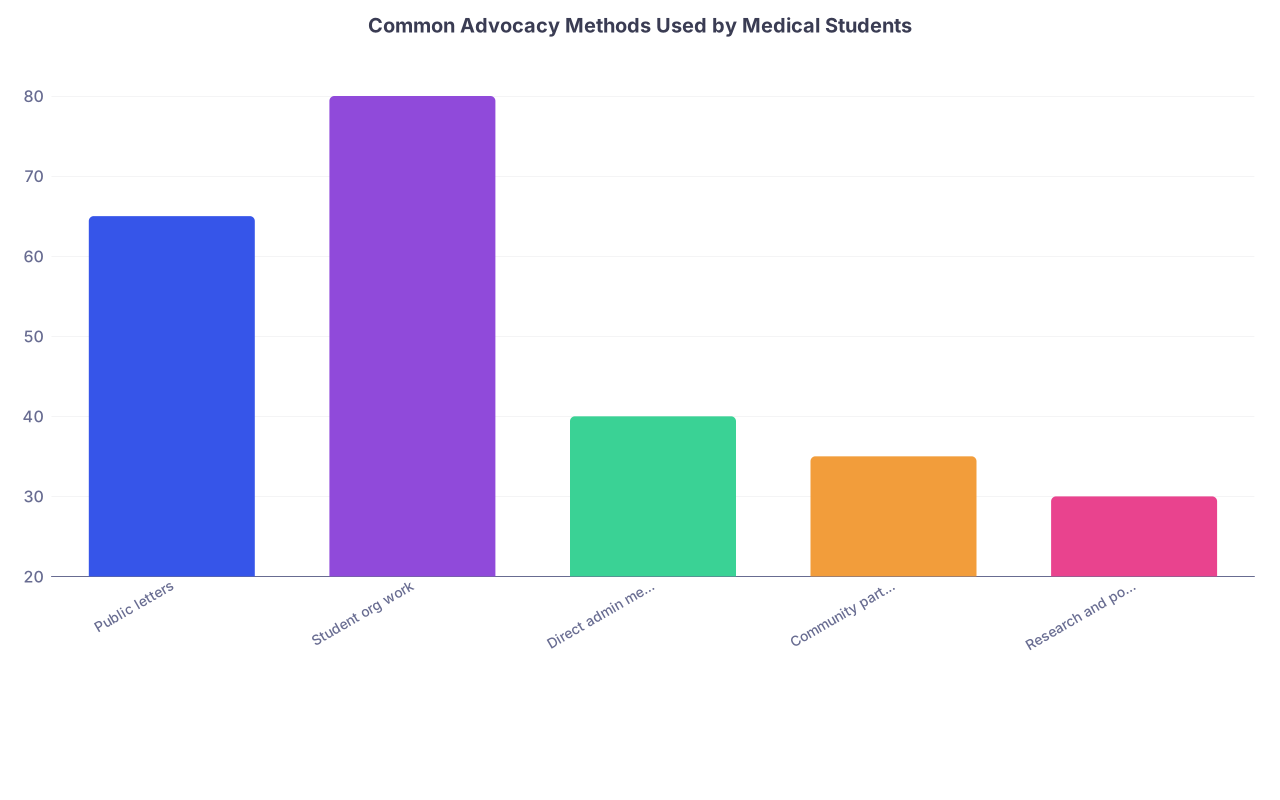
| Category | Value |
|---|---|
| Public letters | 65 |
| Student org work | 80 |
| Direct admin meetings | 40 |
| Community partnerships | 35 |
| Research and policy writing | 30 |
Letters feel big because they’re dramatic and public. Real change often happens off-stage, in meetings, committees, and long, boring policy documents.
Do not confuse visibility with impact.
10. Quick Decision Checklist (Use This Every Time)
Here’s your practical, no-BS checklist. If you cannot say yes to every item, do not sign.

- I have read the entire letter carefully.
- I understand what specific actions the letter is asking for.
- The facts presented are either well-cited or I’ve independently verified what I can.
- The tone and wording align with how I believe professionals should speak publicly.
- I can explain, in my own words, why I signed, and I’d feel okay doing that in an interview.
- I’m comfortable being associated with this statement 5–10 years from now.
- I’m signing because it reflects my true position, not because I feel forced or afraid.
If you hit all seven, sign in peace.
If you’re stuck at number 3 or 4, you’re not ready. Either give feedback to the organizers or pass.
11. A Few Real-World Scenarios and How to Handle Them
Let’s run a few typical cases.
Scenario A: “We Need Numbers By Tonight”
A classmate messages: “We’re sending this letter to the Dean tomorrow about the recent incident. Can you sign tonight so we have more med student support?”
You haven’t read the letter. You’re on call. You’re tired.
Response:
“I’m on service and don’t have capacity to read this carefully tonight. I’m not comfortable signing anything I can’t fully review, so I’ll have to pass for this version.”
You’ve defended your standard without debating content.
Scenario B: Letter Mostly Good, But One Paragraph Goes Too Far
You agree with 90% of the letter, but one section makes claims about motives (“administration does not care about X patients”) that you think are too strong.
Options:
Email the organizers:
“I agree with the main points, but I’m not comfortable signing unless we soften or remove this paragraph about motives. I’d be happy to sign if that’s revised.”
If they won’t change it and it still bothers you, you do not sign. It’s that simple.
Scenario C: You’re in a Leadership Role
You’re on the board of a student group. Others assume you’ll sign, maybe even that your name will appear near the top.
You read the letter and think: “The issue is real, but this letter is sloppy and punitive.”
You need to separate role from individual consent.
You can say, in the group meeting:
“As a board, we can decide whether the organization endorses this. Separately, each of us needs to personally decide whether we’re comfortable signing. I’m not comfortable putting my name on this version, but I support us continuing to work on this issue in other ways.”
Leadership is not blind loyalty. It’s modeling thoughtful dissent.
12. A Simple Mental Reframe
Stop thinking:
“Do I want to be someone who cares about X issue?”
You already are that person, or you wouldn’t be reading this.
Start thinking:
“What is the most honest, sustainable, and professional way for me to act on my values in this situation?”
Sometimes that answer is: sign and own it.
Sometimes it’s: push for edits.
Sometimes it’s: decline, and do your work elsewhere.
Knowing which is which is part of your formation as a physician.
You’re not just learning how to read EKGs and manage CHF. You’re learning how to attach your name—carefully, deliberately—to words that might outlive your training.
With that judgment muscle in place, you’ll be ready for the bigger platforms and harder choices that come later—speaking to media, testifying, publishing op-eds. But that’s a story for another day.
FAQ (Exactly 5 Questions)
1. Will residency programs really care if I signed a controversial public letter as a med student?
Sometimes yes, sometimes no—but assume they might. Program directors do occasionally Google applicants, especially for competitive specialties. If your name ends up attached to a very inflammatory or polarizing document, it can trigger questions. The key is this: if you’d be comfortable explaining your reasoning calmly in an interview, you’re probably okay. If just imagining that conversation makes your stomach drop, you should think twice before signing.
2. What if my school administration informally expects students to support certain letters?
That happens. You might get heavily “encouraged” to sign without it being officially mandatory. The line you hold is the same: no one can compel your personal endorsement. You can express support for the underlying concern and still decline to sign a specific letter because of wording, tone, or factual concerns. If you’re worried about retaliation, talk with a trusted mentor, ombudsperson, or advisor and document any interactions that feel coercive.
3. Can I sign “as a private individual” and not as a medical student?
On the internet, that distinction is mostly fiction. If your name is Googleable and your LinkedIn, school bio, or publications tie you to “John Smith, medical student at X,” people will read your signature through that lens. You can drop your institutional affiliation in the signature block if allowed, but understand that your professional identity and personal identity are already linked in most searchable contexts.
4. How do I handle it if classmates judge me for not signing?
You don’t need to give a grand speech. A simple, consistent line is enough: “I try to be very cautious about what I sign publicly. I care about the issue, but I wasn’t comfortable with parts of this specific letter.” Some people will respect that; a few might not. Let them. Over time, your pattern of thoughtful, consistent behavior will matter more than any one person’s opinion in M2.
5. Is it ever appropriate to help draft a strong, critical letter as a student?
Yes—if you’re willing to do the work properly. That means: check facts carefully, avoid personal attacks, distinguish clearly between evidence and interpretation, and run the draft by at least one trusted faculty or mentor who understands institutional processes and potential fallout. Strong critique is not the problem. Sloppy, reckless critique is. If you draft a letter, you’re responsible not just for your own name, but for everyone else who trusts you enough to put theirs underneath.