
What do you do when you open a news article and see your name next to a quote you either never said or that guts your actual point?
If you work in public health long enough, this will happen. Especially if you speak on anything remotely political: vaccines, mask mandates, overdose policy, trans health care, abortion, school closures, environmental hazards. The higher the stakes, the higher the chance someone will slice your words into a headline-friendly sound bite that makes you look reckless, partisan, or incompetent.
Here is the damage control plan. Step-by-step. No theory, no PR fluff. This is what you do in the first hour, the first 24 hours, and the first week after a misquote or distorted framing hits the public.
Step 1: Slow Down and Document Exactly What Happened
Do not start with outrage. Start with evidence.
Capture the article/broadcast as it is.
Take screenshots of:- The headline
- The paragraph(s) mentioning you
- The quote block
- Any caption under your photo or video
If it’s video, record the relevant clip or at least note the timestamp and program name.
Write down what is wrong. Be specific.
Not “they misrepresented me.” Instead:- “They attributed this direct quote to me, which I never said.”
- “They removed the qualifying phrase ‘for immunocompromised individuals’ which reverses my meaning.”
- “They used a partial quote without context so it appears I’m minimizing risk.”
Pull your original words.
Where did you actually say this?- Email Q&A with the reporter
- Recorded Zoom interview
- Panel talk that was live-streamed
- Written statement you provided
If you don’t have a record, note that too. It affects how hard you can push.
You cannot run an effective damage control plan if your complaint is fuzzy. Be precise. Editors respond to specific, verifiable issues, not “this feels unfair.”
Step 2: Triage the Actual Risk – Not Your Ego
Your feelings will be louder than the facts for the first hour. You need to look past them.
Ask yourself four blunt questions:
Who actually saw this?
Front page of the city paper? Viral tweet from the outlet? Or a mid-depth sidebar that only insiders read?What’s the real-world risk?
- Could patients follow unsafe advice because of the misquote?
- Could it damage trust in your department, hospital, or program?
- Could it undermine a public health campaign (e.g., vaccination uptake)?
What’s the professional risk?
- Could employers or licensing boards view this as irresponsible?
- Does it conflict with your institution’s officially stated policy?
- Does it make you look partisan in a role that must be apolitical?
Is this factually wrong, or just unflattering?
You go to war over factual distortion, safety, and ethics. You usually don’t go to war over, “wow, they made me sound less insightful than I hoped.”
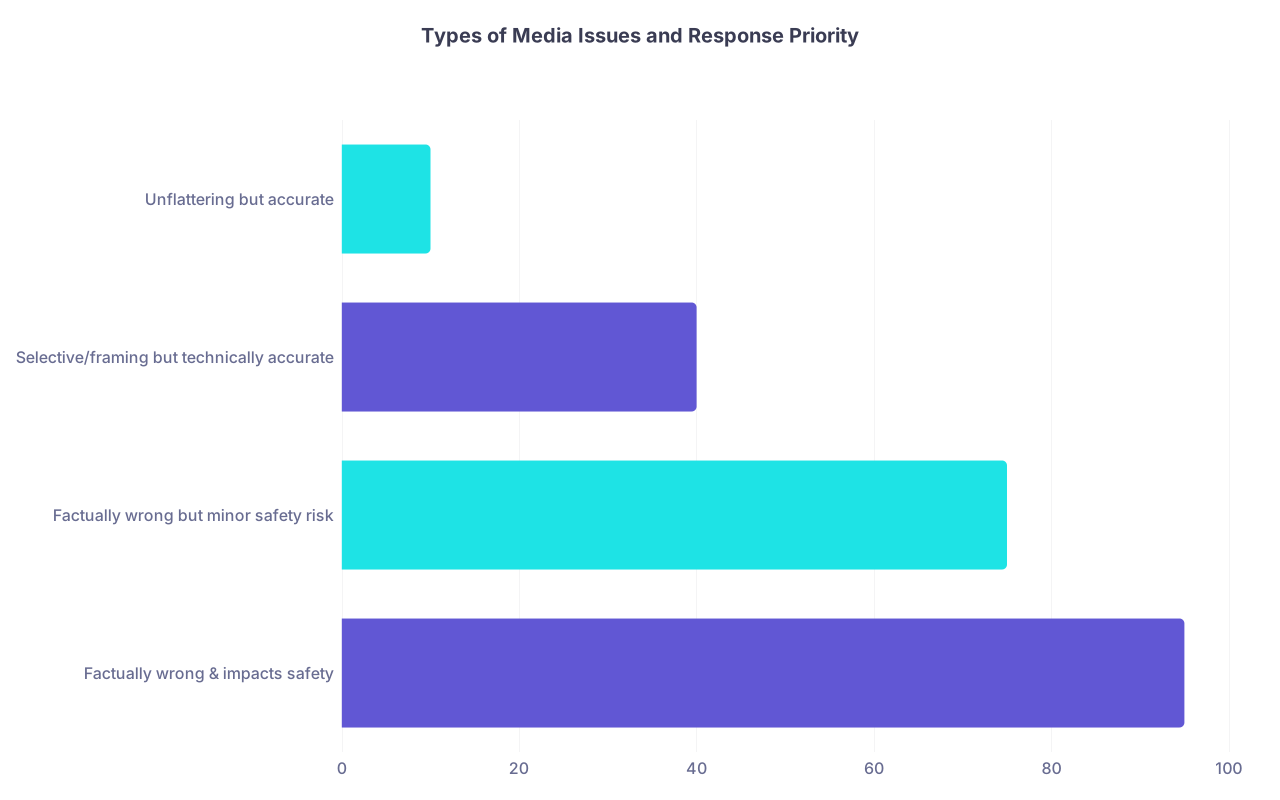
| Category | Value |
|---|---|
| Factually wrong & impacts safety | 95 |
| Factually wrong but minor safety risk | 75 |
| Selective/framing but technically accurate | 40 |
| Unflattering but accurate | 10 |
If it’s serious (public safety or professional integrity), you act fast and publicly. If it’s moderate, you go through more measured channels. If it’s mostly your pride, you make a note and learn for next time.
Step 3: Alert Your Institution Before You Do Anything Public
If you’re tied to an institution—health department, hospital, university, NGO—loop them in immediately. Before you tweet, before you email the reporter, before you talk to another journalist.
Send a short, factual email to:
- Your direct supervisor
- Your communications/PR office
- If relevant, legal/compliance for your organization
Subject line: “Urgent: Misquote in [Outlet] on [Topic] – Need Guidance”
Content (trim this to what applies):
One-sentence description:
“Today’s [Outlet] story on [topic] includes an inaccurate quote attributed to me that contradicts [our policy / best practices].”Link and screenshots
Your assessment of risk:
“I believe this could mislead patients into thinking [X]. This differs from CDC/state/local guidance, which states [Y].”What you want:
“I’d like to request a correction/clarification and plan a brief public clarification via [Twitter/LinkedIn/department site] after we align on messaging.”
Why this order? Because institutions hate surprises. You do not want your PR office learning about the controversy from a journalist calling them “for comment” on your angry tweet.
Step 4: Contact the Journalist – The Right Way
Now you go to the source.
You do not start with Twitter. You start with the reporter and possibly the editor.
How to write the correction request
Subject: “Correction request re: quote in your [date] article on [topic]”
Body:
Be polite and direct:
“I appreciate your coverage of [topic]. Unfortunately, the quote attributed to me is inaccurate as published and could mislead readers.”Quote their line exactly:
“The article currently states: ‘Dr. Lee said, “Masks are no longer necessary for anyone.”’”State the problem precisely:
“I did not say this sentence. What I said was: ‘For most healthy adults in low-risk settings, masks are no longer strictly necessary, but they still provide protection and are recommended in crowded indoor spaces or for high-risk individuals.’ The current wording removes the qualifiers and reverses the meaning.”Provide evidence where possible:
“Here is the full transcript of our exchange from [date]…”
Or: “The interview was recorded on Zoom, and I can share the full clip if helpful.”Request a specific action:
“Given the potential impact on public understanding and alignment with local health guidance, I respectfully request:- A correction to the quote in the online version, and
- A brief editor’s note indicating the previous version misstated my comments.”
Keep the tone professional, not emotional. No accusations about “bad journalism,” even if you’re furious.
When to escalate to an editor
If the issue is high-stakes (vaccination, outbreak, major policy change) or the reporter is unresponsive within ~24 hours (or faster if it’s going viral), cc or separately email the relevant editor:
- News editor, health editor, or managing editor
- Copy your institution’s PR person if they’re involved
Editors, not reporters, formally approve corrections.
Step 5: Decide on Public Clarification vs. Quiet Fix
Sometimes the outlet corrects quickly and cleanly. Sometimes they do a stealth edit. Sometimes they dig in. You need to decide how public you’re going to be.
Here’s how I’d frame it:
| Situation | Recommended Response |
|---|---|
| Minor nuance error, low reach | Quiet correction request only |
| Moderate distortion, online story, modest reach | Ask for correction + brief, factual clarification on your professional platform |
| Major distortion on safety-critical issue | Aggressive correction request + institutional statement + your own public clarification |
| Outlet refuses to correct a dangerous misquote | Public clarification, institutional escalation, possibly legal consultation |
If you do go public, your post should be:
- Short
- Factual
- Calm
- Focused on the correct information, not on venting
Example for Twitter/LinkedIn:
A recent [Outlet] article on [topic] attributes a quote to me that does not accurately reflect my views or current public health guidance.
My position is: [clear, accurate, 1–3 sentences with the correct guidance].
I’ve requested a correction and appreciate efforts to keep public health communication accurate.
You’ll notice what is missing: you don’t drag the reporter by name, you don’t rant about “the media.” That might feel good for 10 minutes. It rarely helps you or the public.
Step 6: Protect Patients and the Public First
If the misquote could drive unsafe behavior, your ethical duty is to correct the substance fast, even if the “who did what wrong” piece is still being worked out.
Examples:
- They make it sound like you said “Don’t worry about that contaminated water” when you clearly advised bottled water.
- They quote you implying vaccines are “optional if you’re healthy” when local guidance is universal vaccination.
- They suggest you said “ER is open for everyone now, no restrictions,” when you were talking about a narrow triage protocol.
In these cases, do three things quickly:
Issue clear safety messaging on your channels.
Website, clinic portal, email list, social media. Focus on: “Here is the correct, safe behavior.”Coordinate with your institution.
Align on exact language. Let them issue the main statement if possible, with you as a quoted source. Institutions often have more reach and credibility with local media.Offer a brief corrective quote to key partners.
For example:- Local health department newsletter
- Hospital patient portal banner
- Community organizations serving affected populations
This is not about your reputation. This is about preventing bad public health outcomes because some editor wanted a punchy line.
Step 7: Do a Short Internal Debrief – What Did You Contribute?
This part might sting, but it’s where you actually grow.
Ask yourself:
- Did I speak in sound bites without enough qualifiers?
- Did I trust a journalist who has a track record of sensational framing?
- Did I let them interview me without email confirmation of the angle or focus?
- Did I say anything that could reasonably be clipped to mean something different?
Sometimes you did nothing wrong and they still butchered it. That happens. But sometimes you gave them sloppy raw material.
Going forward, tighten your own media hygiene:
Insist on clear topics beforehand.
“What specifically are you hoping I can speak to?” If they’re vague or say “just general thoughts,” red flag.Avoid casual, jokey phrasing on serious topics.
I’ve watched offhand sarcasm get quoted deadpan in print. Suddenly you’re the doctor who said, “Well, we can’t protect everyone.”Use stock, clear statements for high-risk topics.
Have 1–3 written, tightly worded sentences for:- Vaccines
- Masking
- Emergency care access
- Overdose and substance use
- Reproductive health policies
Repeat them verbatim. Boring is good when risk is high.
Ask them to read back your most sensitive quote.
At the end of the interview: “Can you read back how you’re capturing my comments on [X]? I want to make sure the wording is accurate.”
Will every reporter agree? No. But many decent ones will.
Step 8: Know When to Walk Away From a Bad-Faith Outlet
There’s a difference between:
- A rushed reporter who clipped your nuance too much, and
- A partisan outlet that cherry-picks experts to validate a pre-decided narrative.
If you’ve been burned more than once by the same outlet, or you see a pattern like:
- Headlines that inflame rather than inform
- Quotes consistently stripped of qualifiers
- Corrections refused, delayed, or buried
Stop giving them your time. You are not obligated to talk to everyone with a microphone.
You can say:
“Thank you for reaching out. Based on prior experience, I prefer not to be interviewed by [Outlet]. I’m happy to recommend other sources or written public health guidance on this topic.”
Yes, that might mean less exposure. It will mean fewer disasters.
Step 9: Build Your Own “Source of Record”
One of the best protections against misquotes is having your own stable, easily accessible record of what you actually believe.
This is what I mean:
A personal or lab/department site with a short page:
- “My approach to COVID-19 risk communication”
- “My position on vaccination and mandates”
- “My guidance on overdose prevention services”
Regular, short posts on LinkedIn, a professional blog, or your institution’s website clearly stating your views on key issues.
Then if you get misquoted, your clarification can link there:
“For my full position and updated guidance on [topic], see: [link].”
You’re not just saying, “I didn’t say that.” You’re saying, “Here is the consistent, transparent record of what I do say.”
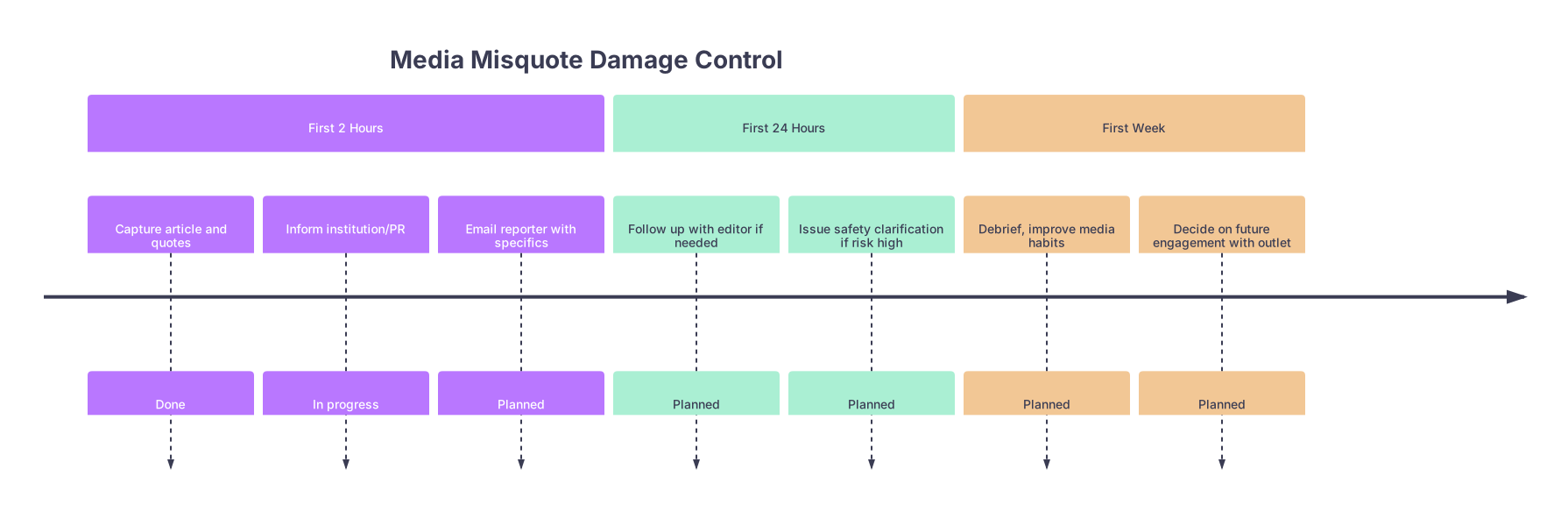
| Period | Event |
|---|---|
| First 2 Hours - Capture article and quotes | Done |
| First 2 Hours - Inform institution/PR | In progress |
| First 2 Hours - Email reporter with specifics | Planned |
| First 24 Hours - Follow up with editor if needed | Planned |
| First 24 Hours - Issue safety clarification if risk high | Planned |
| First Week - Debrief, improve media habits | Planned |
| First Week - Decide on future engagement with outlet | Planned |
Step 10: Protect Your Mental Bandwidth
Public health work already grinds people down. Add getting misrepresented in front of your community or peers and it can feel humiliating.
Some basic guardrails:
- Do not doomscroll the comments section. Public commenters are not your patients, not your colleagues, and not your evaluators.
- Talk to one or two trusted colleagues who understand media. They’ll tell you if this is reputationally serious or just your perfectionism flaring.
- Remember that most people see a headline, half-skim the article, and move on in 10 seconds. You will remember this for months; they won’t.
Fix what needs fixing. Learn what you can. Then go back to the actual work.
Quick Case Example: Vaccine “Hesitancy” Disaster
You: Infectious disease fellow at a county hospital.
Real quote in a 20-minute interview:
“I understand that some people feel hesitant about a new vaccine. My role is to listen to their concerns and then share what we know from the data: that the vaccine is safe, effective, and our best tool to keep people out of the ICU.”
Published quote:
“Even doctors admit people are ‘hesitant about a new vaccine.’”
Headline: “Local doctor acknowledges ‘hesitation’ about new COVID shot.”
Damage control:
You document everything. You have the Zoom recording.
You alert your hospital communications and ID chief.
You email the reporter with exact quotes and full context.
You formally request:
- Updated paragraph including your full sentence
- Editor’s note that prior wording lacked context
Hospital issues a short statement:
- “Dr. [Name] strongly recommends vaccination as safe and effective…”
- Correct, concrete guidance and scheduling info.
You post a short clarification on LinkedIn and X:
- “In a recent article, part of a longer comment about listening to concerns was quoted without the clear statement that I strongly recommend vaccination. To be clear: I advise all eligible patients to receive the COVID vaccine. It is safe, effective, and our best tool to prevent severe disease.”
Result: The error doesn’t vanish, but it’s contained. Anyone who Googles you later sees a clear record of your actual stance, not just the mangled quote.
FAQs
1. Should I ever threaten legal action if a misquote is really bad?
Occasionally, yes—but carefully and usually through your institution, not personally. If an outlet attributes to you something false and clearly damaging to your reputation (e.g., that you endorsed fraud, denied care, encouraged harmful behavior), that edges into defamation territory. In those cases, you talk to your institution’s legal counsel or, if you’re independent, a media/defamation attorney. But don’t throw around “I’ll sue you” in an email to a reporter. It makes you look unprofessional and can harden their position. Let a lawyer decide if this is worth escalating; your job is to document facts and impact.
2. What if the reporter refuses to change anything but offers to run a follow-up quote from me?
That’s a partial win at best. A follow-up quote can help clarify your position, but it doesn’t erase the original framing. I’d typically say: “Thank you, I’d appreciate space to clarify my position, but I still believe the original quote requires correction due to [specific factual issue].” Use their offer strategically: give a tight, clear, boring quote that states the correct guidance and your actual stance. Assume this new quote may also be trimmed—write something that survives trimming.
3. I’m a trainee (med student, resident, fellow). Should I even be talking to media about public health issues?
You can, but do it with guardrails. Run any media request by your program leadership and institutional PR first. Clarify your role: you’re speaking as an individual clinician-in-training, not “on behalf of” the institution, unless explicitly approved. Stick to your actual expertise and current guidelines; don’t freelance policy opinions. And be extra cautious on politicized issues—your name is Google-able, and those clips will be around when you’re applying for jobs or fellowships. If your gut says “this is above my pay grade,” it probably is. Defer to senior colleagues and offer to help behind the scenes instead.
Open the last message you sent or received from a journalist—email, DM, anything. Read it once and ask yourself: if they misquoted you tomorrow, do you have enough in writing or on record to prove what you actually said? If not, fix that before your next interview.