
The fastest way to destroy your impact as an advocate is to treat your hospital like Twitter.
The Real Problem You’re In
You’re training in a politically divided environment. That’s not abstract “polarization.” That’s:
- An attending who makes a snide comment about “woke medicine” when you mention health equity.
- A co-resident who posts anti-trans memes on Instagram but is beloved by the PD.
- Nursing staff split on vaccines, masks, or public health mandates.
- Faculty group chats lighting up after the hospital posts a Black Lives Matter statement.
- Patients bringing Fox, MSNBC, or TikTok takes straight into the exam room.
You’re trying to practice ethically, advocate for patients and communities, and not blow up your career in the process.
Here’s the core tension: you are both a trainee and a professional. You have obligations to patients and society, but you’re also at the bottom of the hierarchy. Power dynamics are not in your favor. If you pretend they are, you’ll get burned.
So let’s treat this like what it is: a set of concrete situations that require tactical, not theoretical, responses.
Step 1: Get Clear On Your Non‑Negotiables
Before you argue with anyone, you need to know where you won’t bend. Otherwise, you’ll end up fighting over everything and winning nothing.
There are three tiers to think about:
- Ethical non‑negotiables (you must act)
- Professional boundaries (you should act, but style is flexible)
- Personal preferences (you can often let these go)

1. Ethical non‑negotiables
These are things where doing nothing would violate basic medical ethics or institutional policy. Examples:
- A senior resident mocking a suicidal patient and suggesting they “don’t deserve” treatment.
- A nurse refusing pain meds because “these people are all drug seekers,” coded racism and all.
- An attending telling you to chart a physical exam you did not perform.
In these cases, you are not in “political disagreement” territory. You’re in patient safety / ethics territory. You must act, but you can choose how:
- In the moment if patient harm is imminent.
- Afterwards with documentation and escalation if needed.
2. Professional boundaries
These are issues where care could be compromised or equity is at stake, but it’s less clear-cut:
- A colleague consistently misgenders a trans patient even after being corrected.
- An attending dismisses social determinants: “They just need to try harder.”
- Team members making “jokes” about certain groups (Muslim patients, undocumented patients, etc.).
Here you still should act, but you have options: quiet correction, private conversation, looping in allies, or leveraging policies.
3. Personal preferences
These feel big in the moment but are more about values expression than direct harm:
- Whether to wear a BLM, Pride, or pro-choice pin on your badge.
- Whether to tweet about your hospital’s policy.
- Whether to sign your name publicly on a contentious letter.
Here, strategy matters more. You can be selective. You can delay. You can sometimes say more once you’re established or off service with certain people.
If you don’t sort these tiers early, a politically divided environment will drain you. You’ll either be silent when you shouldn’t be, or loudly right and professionally isolated.
Step 2: Read the Room Like It’s Clinical Data
You’d never start chemo without staging the cancer. Same idea here. Before you engage in advocacy, assess the environment.
, Grand rounds Q&A, Small team room, 1:1 with ally, Anonymous feedback](https://cdn.residencyadvisor.com/images/articles_svg/chart-perceived-safety-levels-for-advocacy-settings-2797.svg "Perceived Safety Levels for Advocacy Settings")
| Category | Value |
|---|---|
| Public [social media](https://residencyadvisor.com/resources/public-health-policy/if-media-misquote-you-on-a-public-health-issue-damage-control-plan) | 2 |
| Grand rounds Q&A | 4 |
| Small team room | 6 |
| 1:1 with ally | 8 |
| Anonymous feedback | 9 |
Think about four dimensions:
Power dynamics
Who can affect your evaluations, schedule, letters, and future jobs? That’s not paranoia. That’s realism.- Program Director, Chair, core faculty → high risk to confront directly in public.
- Chief residents, senior residents → medium to high, context-dependent.
- Co-residents, nurses, students → safer to challenge, but still not “no risk.”
Institutional culture
Look at what people actually do, not what’s written in glossy DEI brochures.Signs it’s safer to advocate more openly:
- Recent, specific support for marginalized staff/patients.
- Faculty who publicly back trainees who spoke up.
- Clear anti-retaliation patterns actually enforced in past incidents.
Signs you need to be surgical:
- People who raised concerns were labeled “unprofessional” or “difficult.”
- “We don’t talk about politics here” used as a club to silence equity issues.
- DEI work consistently dumped on trainees of color without credit or protection.
Issue volatility
Some topics are live wires at certain institutions:- Police violence and hospital security.
- Reproductive rights in conservative states.
- Trans care, gender-affirming care for youth.
- COVID policies and vaccination.
High-voltage topic + powerful audience + poor institutional culture = you need a more layered strategy.
Timing
Right before rank lists, fellowship interviews, or promotion? That doesn’t mean you stay silent, but you may choose different channels (document, allies, formal complaints) instead of gladiator match at grand rounds.
Step 3: Separate “Values Signaling” From “Actual Impact”
A lot of political advocacy in training environments is performance. People giving long speeches in noon conference that change exactly nothing about patient care.
Do not confuse being seen as a “good advocate” with actually improving anything.
Ask yourself bluntly:
- Will saying this, in this room, change a policy, a behavior, or a patient outcome?
- Or am I mostly proving to myself (and maybe Twitter) that I’m on the right side?
Sometimes visible stance is the point. For example:
- A Black med student speaking up about racist comments to show other trainees they’re not alone.
- A queer resident publicly supporting trans care so patients see at least one visible ally.
That’s real. But you still want to be conscious and not reflexive.
A useful split:
- High-visibility, low-leverage advocacy: Tweet threads, heated Q&A, calling someone out in front of others.
- Low-visibility, high-leverage advocacy: Quiet policy work, committee participation, building data, finding legal hooks, supporting specific patients.
If your environment is politically divided, the second category often gets you farther with less blowback.
Step 4: Script-Level Responses For Common Scenarios
Let’s get into the weeds. Here’s what to actually say and do in real moments.
Scenario A: Attending says something biased in front of the team
Example:
Attending: “These undocumented patients just use the ED like primary care. They don’t pay anyway.”
You’re a PGY-1. What now?
Option 1 – Micro-correction in the moment (lower risk phrasing):
“Sometimes it helps me to remember most folks don’t have access to any other care, especially if they’re undocumented. It’s kind of the only safety net they’ve got.”
You’re reframing, not accusing. You’re modeling a different frame for students and staff.
Option 2 – Patient-centered redirection:
“For this patient, the main issue seems like lack of primary care follow-up. Maybe we could loop in social work for options they can access without insurance?”
You don’t let the comment stand uncontested, but you redirect to concrete action.
Option 3 – Private follow-up (for higher-power attendings)
“Dr. Smith, I wanted to circle back to something from rounds. I worry that comments about undocumented patients might make the team less likely to see their problems as legitimate. I know that’s not your intent, but as a trainee I’m still learning from the way these things are framed.”
Frames it as shared concern + impact on education, not moral indictment.
If the attending doubles down with something hostile, you document the interaction in your own notes and consider discussing with a trusted mentor or chief. Pattern matters.
Scenario B: Colleague’s “joke” crosses the line
Senior resident in the workroom: “Of course he’s noncompliant, he’s from [insert stereotyped group].”
Peer-level power, semi-private environment. You can be more direct.
One-liners that work without a TED Talk:
- “Not funny.”
- “Let’s not do that.”
- “Come on, man.”
- “That’s not cool.”
If you have more room:
“Hey, can we not stereotype patients like that? It seeps into how we treat them, even if we don’t mean it to.”
If you’re not up for a direct challenge in that moment, talk to them 1:1 later:
“Hey, earlier when you said X about that patient group, it really landed as racist to me. I know this stuff gets normalized in medicine, but it’s not harmless.”
If they get defensive: “I’m not calling you a bad person, I’m saying that comment is not okay and we’re all learning to do better.”
Scenario C: Your program publishes a controversial policy statement
Example: Statement about law enforcement presence in the ED, or about abortion access. Staff are divided; the group chat is a mess.
Here’s a practical path:
Do not react first on public social media. Capture your initial response privately. Sleep on it.
Look for where actual decision-making is happening: is there a task force, medical staff committee, DEI council?
Find out if there are trainee reps. If there are none, that is an advocacy point: “Residents/Fellows need representation in these conversations.”
Write a short, specific email to the relevant leader:
“I’m a PGY-2 in Internal Medicine. Several residents have concerns and questions about the recent [policy/statement] on [topic]. We’d appreciate a chance to provide structured feedback and understand how this will affect our daily work with patients. Is there a forum or working group where resident input would be helpful?”
You’re not writing a manifesto. You’re opening a door into the room where decisions happen.
Then, prepare 2–3 concrete, outcome-focused asks for when you’re actually in that room:
- “Will there be protected reporting mechanisms if we feel law enforcement presence is interfering with patient care?”
- “Can we include language clarifying that residents are not required to disclose immigration status to outside agencies?”
- “Can we pilot a training module for staff on how this policy intersects with EMTALA/mandated reporting/etc.?”
Scenario D: You’re pressured to “stay apolitical”
Someone (often an older faculty member) says, “Medicine shouldn’t be political. Don’t bring that into the hospital.”
Here’s the move: separate partisanship from structural reality.
Short response:
“I agree we shouldn’t campaign for parties at the bedside. But things like who gets insurance, who can access abortion, who gets policed—those decisions shape who shows up in our ED and who dies. Ignoring that doesn’t make it apolitical, it just makes us less honest.”
If you need a more neutral framing:
“For me, naming social and structural factors isn’t about politics, it’s about accurate diagnosis. Leaving out major drivers of disease because they’re controversial would be like leaving out smoking history because tobacco companies are powerful.”
You’re not going to convert everyone. You’re drawing a line that your clinical reasoning includes structural reality.
Step 5: Protect Yourself While You Advocate
Idealistic advice that ignores retaliation is useless. You have to think like a grown professional with a career to protect.
Build your “safety net” early
You want three categories of people on your side:
- At least one faculty mentor who is respected and aligned with your values. Someone who has survived there a while.
- A chief or senior who has quietly navigated similar issues.
- Peers across PGY levels who share your concerns.
| Role | What You Use Them For |
|---|---|
| Faculty mentor | Reality-check, cover, strategy |
| Chief/senior | Culture intel, escalation advice |
| Peer allies | Solidarity, documentation, numbers |
Loop these people in before a major confrontation, not after.
Document like a lawyer, not like a ranter
When something serious happens:
- Date, time, location.
- Who was present.
- Exact phrases used, as close as you can recall.
- Your response and others’ reactions.
- Any follow-up or retaliation.
Keep this in a personal, secure file (not on hospital email, not in Epic).
If you eventually go to GME, ombuds, or legal, this matters more than your feelings will.
Know your formal channels—and their limits
Most places have:
- GME office
- Office of Professionalism
- DEI/Equity office
- University ombuds
- In some places, a house staff union
These can help, but they’re not magic. Use them strategically:
- To create a paper trail when there’s clear misconduct or discrimination.
- To seek advice when something feels off but you’re not sure if it’s reportable.
- To push for structural change when you can’t get traction informally.
If you’re from a marginalized group, assume extra bias in how your “tone” will be interpreted. That’s not fair. It’s real. Use that knowledge to choose written over spoken when stakes are high and keep your language calm and factual in official complaints.
Step 6: Choose Your Advocacy Arena
Not all advocacy has to happen inside your program’s most toxic conference room.

| Step | Description |
|---|---|
| Step 1 | Identify issue |
| Step 2 | Use formal channels |
| Step 3 | Internal committees |
| Step 4 | External orgs and op-eds |
| Step 5 | Peer education and support |
| Step 6 | Patient safety/ethics? |
| Step 7 | Institution willing to engage? |
| Step 8 | Policy/community angle? |
Options you probably have more control over than you think:
- Teaching small-group sessions for students on bias, social determinants, or structural issues.
- Working with community orgs on projects that don’t require hospital permission.
- Writing de-identified op-eds about policy impacts on patients (follow your institution’s media policy).
- Joining national specialty societies’ trainee sections that are pushing policy work.
- Quality improvement projects that embed equity changes into workflows (screening, referrals, algorithms).
If your department is hyper-polarized, sometimes the smartest move is to shift your advocacy energy to spaces where it can actually stick—while doing minimal necessary pushback to not be complicit internally.
Step 7: Take Care of Your Stamina and Sanity
You are not the Department of Justice. You are a person in training with finite emotional bandwidth.
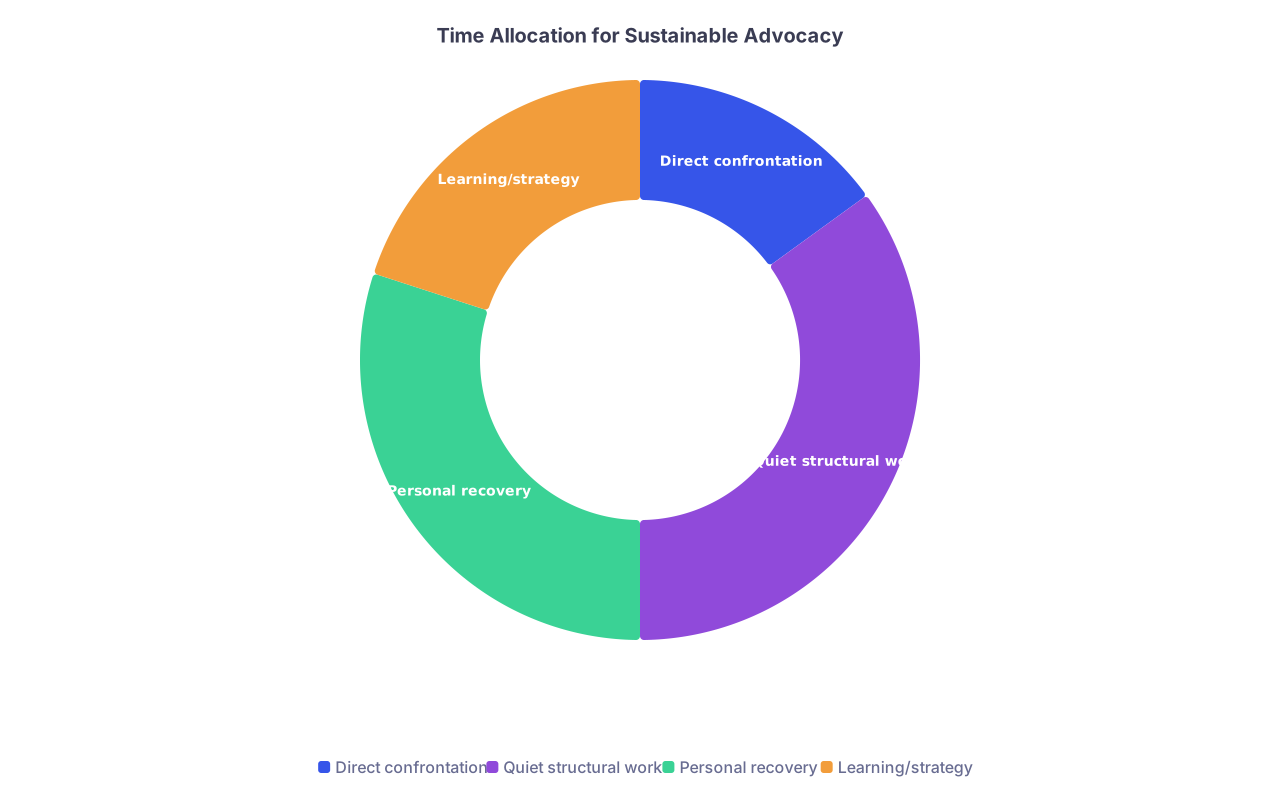
| Category | Value |
|---|---|
| Direct confrontation | 15 |
| Quiet structural work | 35 |
| Personal recovery | 30 |
| Learning/strategy | 20 |
Build personal rules like:
- “I won’t argue about core humanity issues with people in bad faith. I’ll protect patients and move on.”
- “I’ll pick at most two major institutional fights per year.”
- “If my sleep, relationships, or mental health start collapsing, I pause new advocacy and focus on stabilization.”
And sometimes the ethical move is living to fight another day. Leaving a toxic program for a healthier one is not “giving up on advocacy.” It’s joining a different front line.

FAQ (4 Questions)
1. What if my attending’s views directly contradict evidence-based care (e.g., anti-vaccine, anti-trans)?
Separate belief from behavior. If their personal views are creeping into patient care (discouraging vaccines, misgendering, refusing standard treatments), you have an obligation to the patient. Start with gentle, evidence-based redirection in front of the patient when possible: “The current guidelines recommend…” If it’s severe or persistent, document specific incidents and discuss with a trusted faculty mentor, chief, or program leadership. You’re not required to silently participate in substandard care.
2. Should I post about controversial issues on social media as a trainee?
Only if you’re prepared for screenshots to outlive your training. Use a filter: would I be okay with a future fellowship director reading this out loud in an interview? If yes, post with professional language and avoid naming your institution unless it’s explicitly sanctioned. If no, keep it anonymous or offline. Social media can support advocacy, but it’s a terrible place to first discover your institution’s red lines.
3. How do I handle being the “only one” speaking up from my identity group (e.g., only Black resident)?
You are not required to be the spokesperson. You can say, “I don’t have the bandwidth to educate on this right now,” and direct people to resources. Prioritize finding at least one mentor who shares your background or at least your values, even outside your institution if needed. When you do choose to speak, consider asking for institutional support: protected time, acknowledgment of the emotional labor, shared responsibility with others.
4. When is it actually worth escalating to GME, ombuds, or legal?
When there’s clear harm or risk: patient safety violations, discrimination, harassment, retaliation, or patterns of abuse. Also when internal, informal attempts have failed and the behavior continues. Before you escalate, organize your documentation, talk through your options with a trusted mentor, and be clear on your goal: Do you want corrective feedback, formal investigation, protection from retaliation, or transfer? Escalation is a tool, not a magic fix—use it when the stakes justify the blowback risk.
Key points: pick your battles with intention, tie your advocacy to concrete patient and system outcomes, and build protection (mentors, documentation, multiple arenas) so you do not get crushed while trying to do the right thing.