
The fastest way to destroy your credibility in public health policy is to fake expertise on a board you’re not ready for.
Let’s be blunt: being invited to sit on a policy board you’re not qualified for is both flattering and dangerous. People will tell you “imposter syndrome is normal, say yes to everything.” That advice can get patients hurt and communities misled.
You need a sharper filter.
This is about two things: your integrity and the real-world impact of bad policy. If you’re a med student, resident, junior faculty, or early-career public health professional and someone suddenly wants you on a “task force,” “advisory council,” or “governor’s policy board” that feels out of your depth, here’s exactly how to handle it without burning bridges—or yourself.
Step 1: Pause Your Ego, Then Diagnose the Invitation
Do not give an immediate yes. Ever. I do not care if it’s the state health commissioner emailing you personally. You thank them, then you buy yourself time.
Say something like:
“Thank you for thinking of me for this role. It sounds important. Could I review the board’s scope, expectations, and composition and get back to you by [specific date]?”
Now, your job is to figure out why you and why now.
Use these questions:
What expertise do they think I bring?
Not what you wish you had. What they have actually seen from you: that one op-ed, your COVID volunteering, your residency QI project, your MPH concentration. If you cannot identify a clear domain, that’s a flag.Is this board advisory, decision-making, or rubber-stamp?
Rubber-stamp boards are more politics than policy. Decision-making boards can influence budget, regulations, or standards of care. The higher the impact, the higher the ethical bar for your competence.Who else is on this board?
You want to see deep, relevant expertise there—health economists, epidemiologists, community leaders, experienced clinicians. If it’s mostly random “leaders” with big titles but no obvious subject-matter depth, be cautious.What’s the scope of work?
Are they asking for your lived experience? Your clinical perspective? Youth perspective? Technical judgment on complex modeling? These are not interchangeable.
Ask them directly for:
- A brief description of the board’s mandate
- The membership roster or typical roles
- Expected time commitment
- Whether it’s compensated or voluntary
- Length of term and any conflict of interest expectations
That’s your “clinical history.” You do not treat a patient without one. Same principle.
Step 2: Separate “I’m Growing” From “I’m Reckless”
Feeling underqualified is common. Sometimes it’s just growth. Sometimes it’s malpractice for you to say yes.
Here’s the difference.
You’re probably experiencing healthy stretch if:
- The board’s topic overlaps with what you actually know (e.g., you’ve done sustained work in addiction medicine and this is a state opioid policy advisory group).
- Your role is clearly defined as partial expertise: “early-career clinician voice,” “community clinician perspective,” “representative from X community.”
- Others around the table clearly have deeper, more technical policy expertise.
- There’s space for you to ask questions, get briefings, and learn.
You’re venturing into unethical territory if:
- The board is being sold as “we really need your policy expertise” and you have essentially none in that specific area.
- You’re expected to vote on or endorse policies that will shape funding, care access, or regulations, and your knowledge is surface-level.
- You’re there mostly because of optics: you’re the only person of your demographic, or they call you “diverse representation” and that’s basically it.
- You’re being pushed to lend your MD, MPH, or “frontline clinician” status to decisions you do not understand.
Strip away the flattery. Ask yourself:
“If this goes badly and my name is on it, can I defend my involvement ethically?”
If the honest answer is no, you’re not just underqualified—you’re a liability, to yourself and to the public.
Step 3: Do a Quick “Risk to Public” Check
This is where ethics moves from abstract to concrete.
Think about three risk levels:
| Risk Level | Example Board Type | Ethical Flexibility |
|---|---|---|
| Low | Hospital wellness committee | High – good for growth |
| Medium | City health advisory council on clinics | Moderate – need some grounding |
| High | State Medicaid formulary or pandemic response team | Low – must have real competence |
If the board will:
- Decide what treatments are covered or not
- Set allocation of scarce resources (beds, vaccines, money)
- Shape laws or regulations around public health interventions
…then your lack of competence is not just your problem. It’s a direct risk to populations that will never know your name.
The higher the stakes, the more you must:
- Limit your role to areas you truly understand
- Be explicit about your limits
- Or decline if those conditions cannot be met
This is medical ethics 101 applied to policy: nonmaleficence and integrity, just on a bigger scale.
Step 4: Clarify and Narrow Your Role—In Writing
If you decide this might be appropriate but you’re uneasy, your next move is to narrow the scope of what you’re responsible for.
You do that explicitly.
Write back something like:
“I’m honored by the invitation. My strongest expertise is in [X: e.g., community HIV care, emergency medicine, vaccine outreach in low-resource settings]. I’m less experienced in [Y: e.g., detailed health finance, epidemiologic modeling]. If you see my role as focusing on [clinical/community/frontline] perspective rather than technical modeling or budget decisions, I’d be more comfortable accepting.”
You’re drawing lines.
If they respond with “Oh yes, we mainly want your frontline and community experience,” that’s viable. If they push you toward “full voting member shaping the whole policy package” in areas where you’re clueless, that’s a red flag.
Onboarding is your next test. Ask for:
- Background briefs or prior reports
- Existing policies you’ll be asked to critique
- Meeting agendas in advance
If their prep materials are vague or nonexistent, expect meetings to be the same. That’s where people with weak understanding say confident nonsense. You don’t want to be part of that chorus.
Step 5: How to Speak in Meetings When You Feel Out of Your Depth
Let’s say you accepted. Now you’re in a room (or Zoom) with people throwing around jargon, acronyms, and “as we showed in our model” like candy.
Here’s how you handle yourself so you’re useful, honest, and not a liability.
Use These Three Sentences Often
“This is outside my expertise; I’d like to hear from someone with more background in X.”
You’re signaling your lane. You’re also protecting the group from your guessed opinions.“From the clinician/frontline perspective, what I see is…”
Anchor your comments in your lived/clinical experience. That’s your value.“I’m not comfortable supporting this element without more data on X and Y.”
Especially important before formal votes or public endorsements.
What you do not do:
- Nod silently then later complain they made bad decisions.
- Repeat buzzwords to sound smart.
- Pretend to understand technical summaries you clearly do not.
You’re not there to cosplay a health economist or a senior epidemiologist. You’re there to bring what you actually know.
Step 6: When You Should Say No—And How
Sometimes the right choice is to decline. Not “maybe later.” Just no.
Here are clear signs you should walk away:
- You’re being used primarily for your title, demographic identity, or institutional affiliation, not your expertise.
- The board has heavy technical responsibilities (e.g., modeling transmission scenarios, designing reimbursement mechanisms) and lacks the right experts.
- There’s pressure to sign onto pre-written recommendations you don’t fully understand.
- You’ve raised concerns about your competence and they get brushed off with “Oh, you’ll be fine, don’t worry.”
If any of that sounds familiar, you protect yourself like this:
“After reviewing the board’s mandate, I’m concerned that its technical scope is beyond my current expertise, particularly in [X]. I’m not comfortable taking on a role where I cannot contribute responsibly at the level that’s needed.
I’d be happy to support in a more limited way—for example, as a clinician informant or stakeholder interview—if that would be useful, but I must decline a formal board position at this time.”
Firm. Respectful. Clear ethical boundary.
If they get offended or try to guilt you (“We really need someone like you”), that’s data. They’re prioritizing optics over competence. You just avoided a mess.
Step 7: Use the Situation to Actually Grow (Without Lying to Yourself)
Sometimes you can grow into the role, if you structure it right.
If you accept, build a mini-curriculum for yourself anchored to that board’s work.
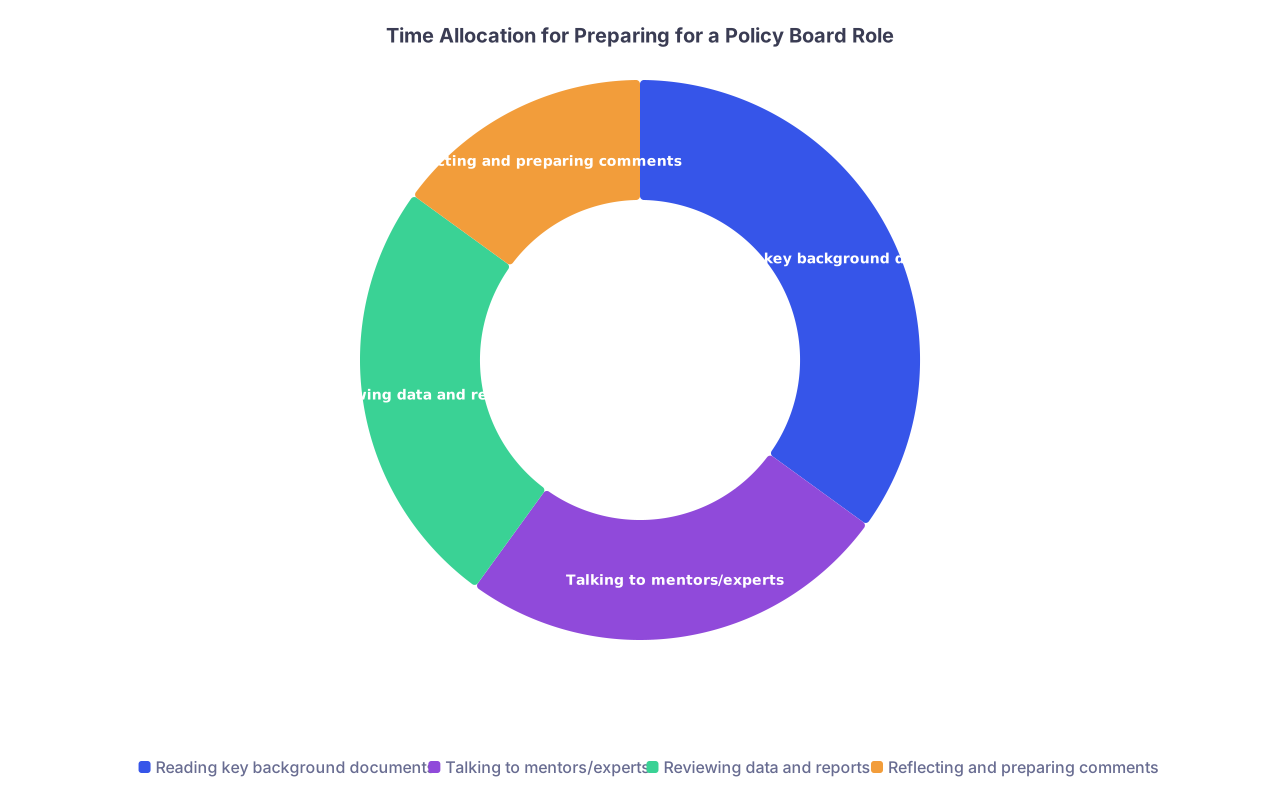
| Category | Value |
|---|---|
| Reading key background documents | 35 |
| Talking to mentors/experts | 25 |
| Reviewing data and reports | 25 |
| Reflecting and preparing comments | 15 |
Here’s a realistic prep plan:
- Ask a more senior person (faculty, public health mentor) to walk you through the basics of the board’s domain. One or two focused conversations. Not a full fellowship.
- Read 3–5 foundational documents: last year’s state health report, WHO brief, CDC guidance, or landmark paper relevant to that board’s focus.
- Before each meeting, identify 1–2 areas where you can contribute meaningfully and 1–2 where you’ll explicitly defer.
You’re not trying to become the board’s senior expert. You’re trying to become safe and honest as a junior member.
Also, keep a running “I don’t know enough about this” list. That becomes your study list after the meeting, not in the middle of decision time.
Step 8: Protect Yourself From Being the Token “Ethics Cover”
Public health boards love to say they have “clinician representation” or “community voices.” Sometimes that’s real. Sometimes you are there so they can claim that box is checked.
An ethical nightmare is when your presence is then used to defend harmful or half-baked policies: “We had clinicians at the table, they agreed.”
You avoid being used as cover by:
- Asking that your dissent or uncertainty be reflected in minutes when appropriate.
- Saying things like, “I cannot support this recommendation as written; here’s what would need to change for me to be comfortable.”
- Following up with written comments if you think your verbal concerns were glossed over.
If you see a pattern of your concerns being ignored but your name still plastered on final documents, you have three moves:
- Request your dissent be specifically recorded.
- Ask for your role to be redefined (e.g., non-voting advisor).
- If those fail, resign with a short, factual explanation citing misalignment between the board’s functioning and your ethical comfort.
You’re not a human decoration. If they treat you like one, you leave.
Step 9: Talk to Someone Outside the Politics
You’re probably not the first person this has happened to in your institution or network.
Find one or two people who meet this bar:
- Understand public health policy or institutional politics.
- Are not directly connected to this board.
- Will tell you the truth, not what they think you want to hear.
Ask them:
- “If you were at my career stage, would you accept this?”
- “What would be the ethical concerns you’d want me to watch for?”
- “Is this level of responsibility normal for someone at my stage here?”
Sometimes they’ll say, “Yes, this is how people get started. Just stay in your lane.” Sometimes they’ll say, “Absolutely not, they should have invited someone more senior. This looks like a stunt.”
Treat that perspective as clinical consultation. You still decide, but you’re not flying blind.
Step 10: If You Already Said Yes and Realize You’re in Over Your Head
Maybe you found this article two meetings in. You’re lost, nodding along, and your name is already on the member list.
You’re not trapped.
Here’s the damage-control sequence:
Admit the problem to yourself clearly.
“I do not understand enough of X to ethically vote on Y. I accepted before I understood the scope.”Schedule a conversation with the chair.
Keep it brief. Example:“After participating in the first few meetings, I’ve realized much of the board’s work is more technical than I anticipated. I’m concerned I can’t contribute at the level this role deserves, especially on [X]. I’d like to either narrow my responsibilities to [A, B] where I can add value, or consider stepping back to an advisor role.”
In the next meeting, adjust your behavior.
Speak up only in your lane. Use the sentence: “I don’t have the technical background to weigh in on that piece.”If they resist narrowing your role and still expect full participation, prepare to resign.
You can send something like:“Given the technical demands of this board, I’ve concluded that I’m not the right person for this role at this time. I appreciate the opportunity but need to step back in order to maintain the level of professional integrity I expect of myself.”
Yes, it’s uncomfortable. Short term embarrassment is better than long term damage to your reputation or, worse, harmful policy with your name stamped on it.

| Step | Description |
|---|---|
| Step 1 | Receive Invitation |
| Step 2 | Request details |
| Step 3 | Accept with clear role |
| Step 4 | Decline or limit role |
| Step 5 | Board scope matches your real expertise? |
| Step 6 | Risk to public high or low |
| Step 7 | Are there strong experts on board |
| Step 8 | Can you have narrow nontechnical role |
The Bottom Line
Three things to keep in your head if you’re staring at a policy board invitation that scares you:
Your job is not to look important; your job is to be honest about what you know and what you don’t. The moment you fake it on policy that affects real people, you’ve left professional ethics behind.
You can say yes and set boundaries—or you can say no. Both are acceptable. What’s not acceptable is silent, smiling complicity when you’re out of your depth.
Every invitation is data about how you’re perceived—but it’s not a verdict on what you should accept. Use it to grow smartly, protect your integrity, and only attach your name to work you can stand behind if it’s ever scrutinized in public.
Handle this right, and you build a career where people trust not just your knowledge, but your judgment. That’s the kind of person who should be on policy boards.