
The idea that caring about health outside US borders could hurt you in US training is backwards.
But I know why you’re asking. Because I’ve had the same pit in my stomach: “If I talk about international health policy, are programs going to think I’m not committed to US patients? Or that I’m some ‘activist’ who won’t fit?”
Let’s pull this apart honestly, not with the fake “everything is fine, just be yourself” fluff.
The Fear: Will My International Health Policy Work Backfire?
Here’s the nightmare scenario that loops in my head at 2am:
You’ve done real things: maybe an MPH with a global health policy concentration, work with WHO, an internship with a ministry of health, advocacy around pharma pricing, or some health-systems research in another country. You’re proud of it. It actually shaped your ethics and how you see patients.
And then you imagine a PD or faculty reviewer thinking:
- “So… are they just going to leave for WHO after residency?”
- “They’re into ‘policy’—are they actually any good clinically?”
- “Is this going to turn into political drama in our program?”
- “Are they going to criticize US healthcare all day instead of working with what we have?”
This is the core anxiety: that the thing that gives your career meaning will be interpreted as disloyalty, distraction, or trouble.
Is that possible? Yes. I’ve watched some programs roll their eyes at anything that sounds like “systems change” or “global health equity.”
But is it usually a dealbreaker? No. Not if you’re smart about how you frame it.
How Programs Actually Think About International Policy Work
This part honestly depends on three things: specialty, type of program, and how you present your story.
Let me be blunt: some places will love it, some will tolerate it, and a few will quietly side-eye it.
| Program Type | Likely Reaction |
|---|---|
| Academic, research-heavy | Generally positive, if framed as scholarship |
| Large urban safety-net | Positive if linked to health equity and underserved work |
| Community, service-heavy | Mixed; needs to be clearly tied to boots-on-the-ground care |
| Highly conservative culture | Risk of skepticism if framed as “activism” |
| Global health–branded programs | Strong positive; often a major asset |
If your work looks like:
- Serious research (publications, policy briefs, data)
- Systems thinking (financing, access, workforce, health equity)
- Longitudinal commitment (not “two weeks in X country for photos”)
…it usually helps you at places that care about leadership, health equity, and academic impact. These are the same places that talk nonstop about “advocacy,” “population health,” and “social determinants,” even if they sometimes don’t practice what they preach.
Where it can get tricky is if:
- Your work is obviously partisan in a very specific US political direction
- You come off as contemptuous of US healthcare rather than critical and constructive
- You sound like you want to do 90% policy and 10% patient care (for a clinically heavy program)
- You give off “I’m using residency as a brief stopover before I go back abroad and never look back” vibes
Programs are not allergic to international work. They are allergic to instability, conflict, and residents who might bolt.
So the question isn’t “Is international health policy work bad?”
The question is “Do I sound like someone who will show up, do the work, and be a solid colleague here, even though I think about systems more broadly?”
The Real Risks (Not the Imaginary Monster Under the Bed)
Let me not sugarcoat this. Yes, there are some risks. They’re just… more specific and manageable than the giant vague disaster in your head.
1. Being Misread as “Not Clinical”
Some faculty immediately classify people as “policy person” or “clinician.” Unfair, but real.
Red flags they might see:
- Tons of non-clinical experiences and relatively thin US clinical exposure
- Statements like “I’m more interested in policy than direct patient care”
- Limited US letters from people who’ve seen you on the wards
How to blunt this:
- Explicitly say that clinical training is central to your policy goals
(e.g., “I can’t do credible systems-level work unless I truly understand bedside care in this system.”) - Highlight concrete examples where policy made you a better clinician or vice versa
(e.g., you adjusted discharge planning because of your understanding of insurance gaps or national coverage policies)
2. Being Labeled As Political “Trouble”
If your policy work touches pricing, insurance, government regulation, migrants, refugees, reproductive health, harm reduction, or anything politically hot, you may worry: “Will they think I’m a walking debate club?”
Yes, some might. Especially if:
- You write in absolutist, combative language
- Your social media is full of scorched-earth takes
- You frame people who disagree with you as ignorant or unethical
You don’t have to hide your values. But in your application and interviews, you should sound like someone who can:
- Work with imperfect systems and imperfect people
- Critique policy while still treating every patient respectfully
- Collaborate with folks who don’t share your ideology
You’re not auditioning for cable news. You’re auditioning to be someone they’d trust at 3am on call.
3. Worry You’ll Leave for a Non-Clinical Career Immediately
If your whole story is “policy, policy, policy,” some PD’s brain will do this:
“So they’re going to finish intern year, then go straight to an NGO and leave us short a resident.”
You counter that by:
- Emphasizing that you want strong clinical training first
- Naming ways you see yourself combining both (academic medicine, health systems leadership, public health departments, etc.)
- Showing prior long-term commitments instead of bouncing around
How to Frame Your International Policy Work So It Helps You
This is where the anxiety gets weaponized into something useful.
You’re not going to lie. But you are going to curate and translate.
Anchor Everything to Patients
Programs don’t wake up every day thinking, “How do we train better policy analysts?” They think, “How do we train safe, effective clinicians?”
So you connect the dots for them:
- If you worked on essential medicines policy, show how it changed your perspective on prescribing and cost-conscious care.
- If you worked on insurance coverage in another country, explain how it shapes your understanding of access issues in the US.
- If you did health systems research, talk about integrating that with QI projects or patient safety work during residency.
You can literally say something like:
“My international policy work made one thing extremely clear: none of the reforms we talk about matter if care at the bedside isn’t safe, respectful, and accessible. That’s why I want rigorous clinical training first, then bring that experience back into systems-level work.”
That sentence alone will calm down about 70% of skeptical reviewers.
Emphasize Skills, Not Just Locations
Don’t just say “I worked with the Ministry of Health in X country.” That sounds like a vacation line if you leave it there.
Spell out the skills you gained:
- Data analysis
- Stakeholder negotiation
- Implementation science
- Program evaluation
- Cross-cultural communication
- Working in under-resourced settings
These are not abstract. They’re directly relevant to residency: managing complex systems, communicating with diverse teams, working in constrained environments.
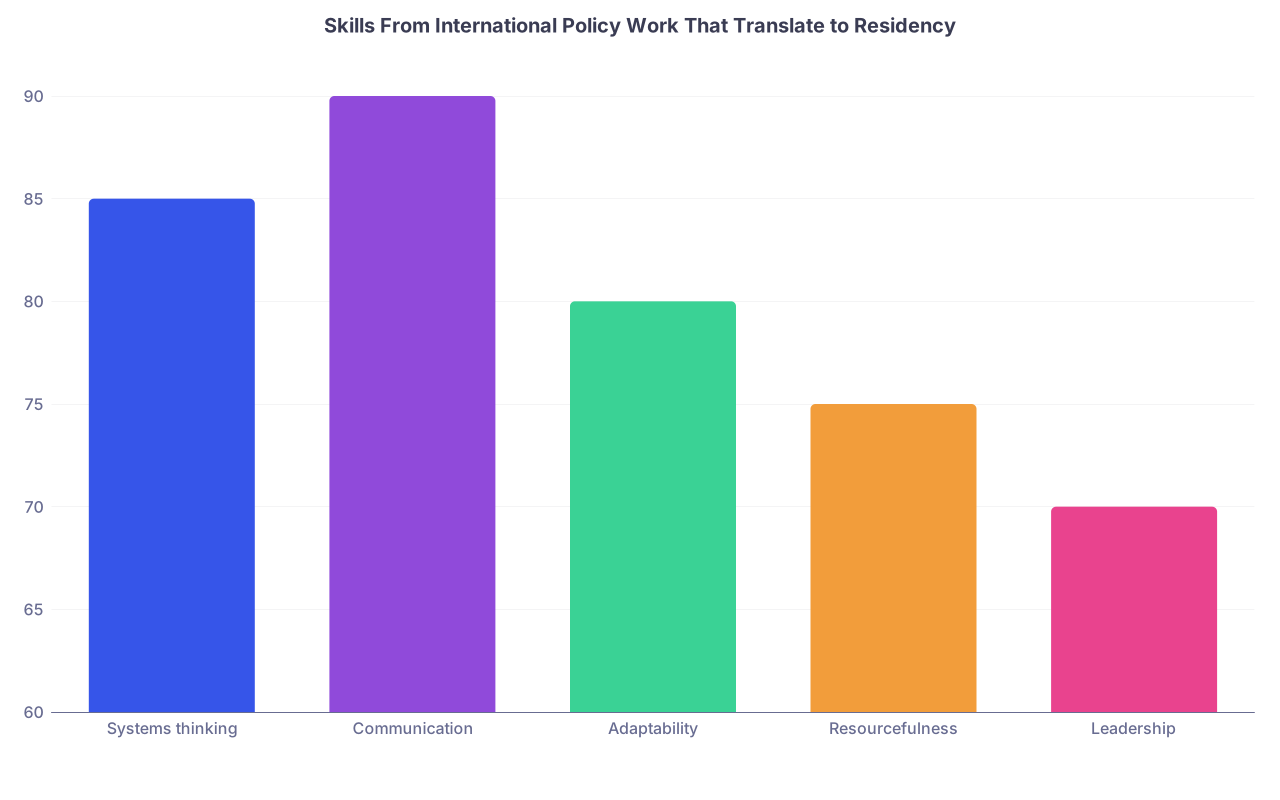
| Category | Value |
|---|---|
| Systems thinking | 85 |
| Communication | 90 |
| Adaptability | 80 |
| Resourcefulness | 75 |
| Leadership | 70 |
Show You Understand the US System Too
One thing that legitimately worries some PDs:
“This applicant knows everything about Country X but not much about Medicaid, Medicare, US hospital chaos, or EHR hell.”
So you explicitly show:
- US-based clinical experience (rotations, sub-I, observerships, etc.)
- Any US-focused projects (quality improvement, community health work, local policy initiatives)
- Awareness that the US system is its own beast, not just “worse” or “better” than elsewhere
You can connect them:
“Working on national insurance coverage in Country Y pushed me to learn how Medicaid and uncompensated care work at our local safety-net hospital. Seeing those parallels is what made me want to train in a system I eventually hope to help reform from the inside.”
Now you’re not “foreign policy person.” You’re “systems-aware future physician.”
What You Should Probably Avoid (Or Handle Very Carefully)
You don’t have to erase your convictions. But you do have to be strategic.
A few landmines:
Sounding like you hate US medicine
Saying, “The US system is broken” is one thing.
Saying, “US clinicians are complicit in a corrupt machine” is another. The first is critique. The second is a war declaration.Only talking big-picture and never about actual patients
If you never mention individual patients, specific clinical moments, or bedside experiences, you’ll sound like you belong in a policy school, not a hospital.Using jargon as a shield
“Intersectional, decolonial, neoliberal, hegemonic, etc.”
I’m not saying those words are wrong. Just that most PDs don’t speak that language fluently. Translate. Show you can talk like a human to patients and colleagues.Being visibly unprepared for the grind
If your whole story is high-level conferences, think tanks, policy briefs—but nothing about sweat, call, or showing up for unglamorous work—people will worry. You don’t have to fake loving 28-hour calls. But you should signal resilience and realism.
Will Certain Programs Quietly Judge You? Yes. Here’s What to Do.
Some programs want residents who are:
- 100% clinically oriented
- Happy to stay in their lane
- Not interested in “rocking the boat”
Those programs may not love your background. That’s not a moral failing on your part. It’s a mismatch.
Two moves here:
Screen wisely.
Look at program websites. Do they talk about:- Advocacy?
- Global health?
- Health equity?
- Public health partnerships?
- Population health?
If yes, your background is more likely to be a plus.
If their website is all “procedural volume” and nothing else, you can still apply—but calibrate your expectations.Tell a coherent story in your personal statement and interviews
One that answers, very clearly:- Why medicine, not just policy?
- Why the US, not solely international NGO work?
- Why this specialty?
- Why now?
If that story is tight and believable, most decent programs will not “hold it against you.” They’ll see you as someone with a clear, mature trajectory.
You’re Not Weird. You’re Just Early.
A lot of what you care about—universal coverage, rational drug pricing, equity, global collaboration—are the same things big-name health systems claim to care about in their strategic plans and glossy brochures.
You’re just showing up with that mindset earlier than usual.
Right now, that can feel like a liability. Like you’re “too political,” “too academic,” or “too something.” But the trend line in medicine is toward more integration of:
- Health systems science
- Policy literacy
- Advocacy and equity work
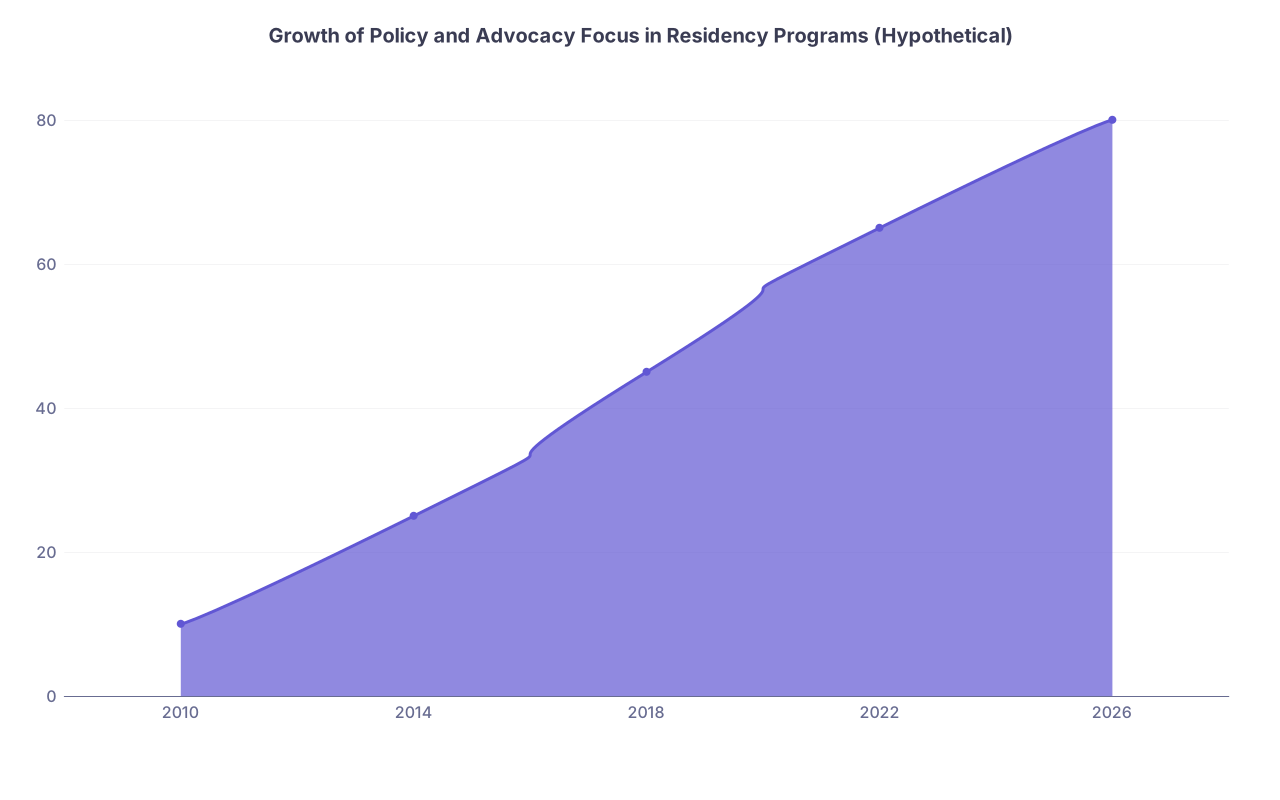
| Category | Value |
|---|---|
| 2010 | 10 |
| 2014 | 25 |
| 2018 | 45 |
| 2022 | 65 |
| 2026 | 80 |
The programs that don’t “get” this yet? They’re not going to suddenly change because of you. And that’s fine. That’s why there are 100+ other programs.
Your anxiety is screaming, “Everyone will hate this and think I’m a threat.”
Reality is more like, “Some programs won’t care, some won’t get it, and some will actively be looking for exactly this.”
Your job is to help the last group recognize you.
A Quick Way to Sanity-Check Your Story
If you’re spiraling, do this:
Write down your international health policy experience in one raw paragraph—no filtering.
Underline any sentence that could be misread as:
- “I don’t really want to do clinical work”
- “I think US medicine is trash and I’m above it”
- “I’m here to argue, not to learn”
Rewrite those lines so they:
- Explicitly connect to patient care
- Show humility and curiosity
- Emphasize wanting to be clinically excellent and systems-aware
Then ask: “If a tired program director read this in 90 seconds, would they see me as:
a) a risk, or
b) a future leader they’d be proud to train?”
If you can push it to (b), you’re in good shape.

| Step | Description |
|---|---|
| Step 1 | International health policy experience |
| Step 2 | Generally positive |
| Step 3 | Mixed or skeptical |
| Step 4 | Seen as potential leader |
| Step 5 | Seen as poor fit for some programs |
| Step 6 | How is it framed |


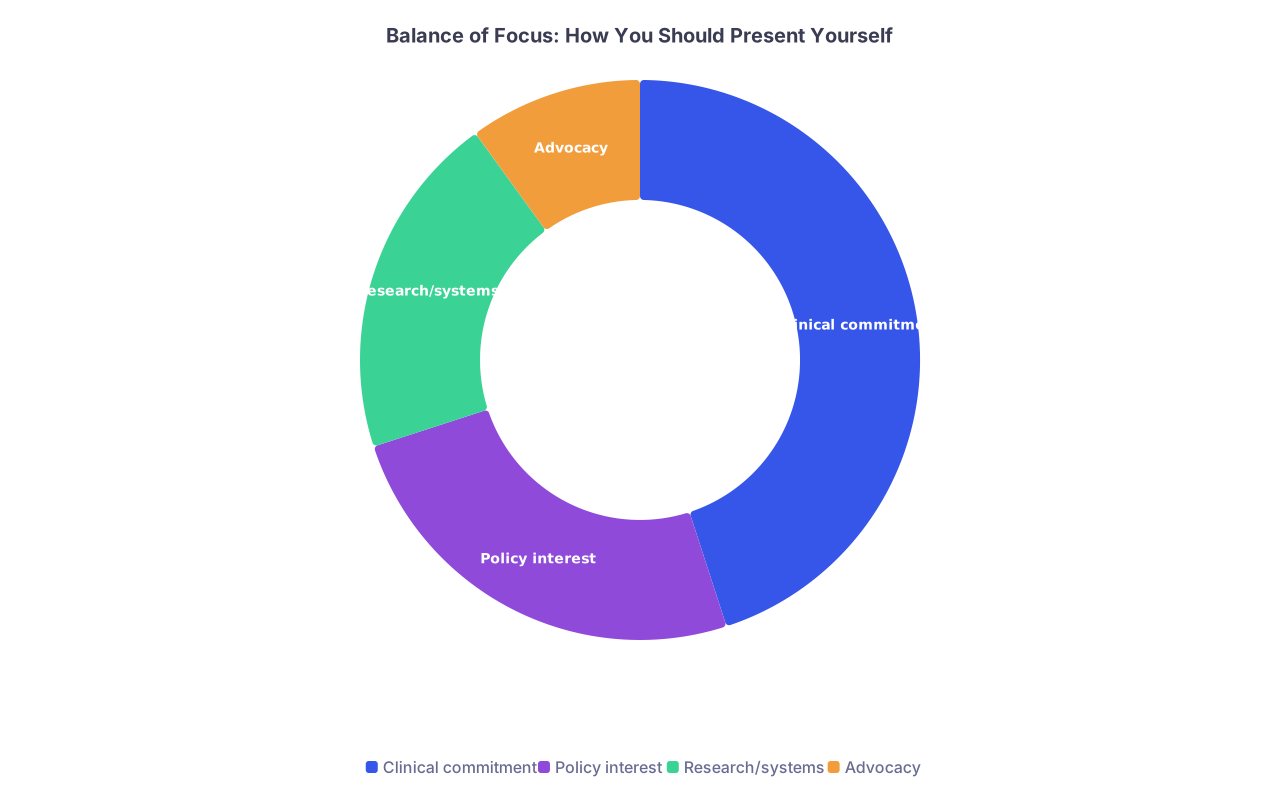
| Category | Value |
|---|---|
| Clinical commitment | 45 |
| Policy interest | 25 |
| Research/systems | 20 |
| Advocacy | 10 |

FAQs
1. Should I remove some of my international policy experiences to avoid scaring programs?
You probably don’t need to delete them, but you might need to prioritize. If your application reads like a CV for a policy fellowship and barely shows clinical depth, then yes—rebalance. Keep the most substantial, longitudinal, clearly relevant experiences. Cut the scattered short-term, loosely related items that don’t add much. You’re not hiding who you are; you’re curating so the signal isn’t drowned out by noise.
2. Can I be honest that I might not stay clinical my whole career?
Yes, but be smart about phrasing. Saying, “I might eventually move into health systems leadership or policy work, grounded in strong clinical training” sounds fine. Saying, “I don’t really see myself practicing long term; I just need this MD for policy credibility” is asking for trouble. Programs want to believe you’ll take residency seriously and that your future work—clinical or not—will reflect well on them.
3. What if my international work is in a politically sensitive area (abortion, harm reduction, migrant health)?
You don’t need to erase it, but you do need to show maturity. Focus on patient outcomes, ethics, and evidence rather than partisan rhetoric. Emphasize that you’ve worked with people across different backgrounds and constraints. If a program can’t handle any mention of those topics, that mismatch was going to hurt you later anyway. But you don’t need to go in swinging like it’s a debate stage.
4. How do I answer, “Why train in the US if you care so much about global health policy?”
You answer directly: because the US is a major player whose policies shape health globally; because clinical training here is rigorous and you want that foundation; because you want to understand this system from the inside if you’re ever going to help change it; because vulnerable populations exist here too and you care about them as much as anyone abroad. Make it clear you’re not using the US as a stepping stone—it’s part of the mission.
5. Could programs actually blacklist me for being “too political” or policy-oriented?
“Blacklist” is dramatic. Could one or two programs quietly decide you’re not their type? Sure. But residency selection is already a chaotic mix of fit, numbers, timing, funding, visa issues, internal candidates, and randomness. Your policy background is one factor, not a death sentence. The key is this: if you present as grounded, clinically serious, and collaborative, your international health policy work is far more likely to be seen as a differentiator than a disqualifier.
Bottom line:
- International health policy work is not inherently a red flag; how you frame it is everything.
- Tie your experiences relentlessly back to patient care, clinical excellence, and realistic commitment to US training.
- Some programs won’t get it. The right ones will—and those are the ones you actually want.