
The loudest voices in the firearm debate are usually the least informed about what physicians actually do. That needs to change.
You are not a legislator. You are not a lobbyist. You are something far more strategically placed: the person who sees the trauma, the depression, the dementia, the domestic violence, and the kids who know exactly where the gun is “hidden.”
Firearm injury prevention is not a political hobby for physicians. It is core clinical work, backed by very solid evidence. Let me walk through this in a way that is useful to you at the bedside, in the chart, and—if you choose—in the policy arena.
1. The Actual Epidemiology: Who Is Dying, How, and Why It Matters Clinically
Let’s start with data, not talking points.
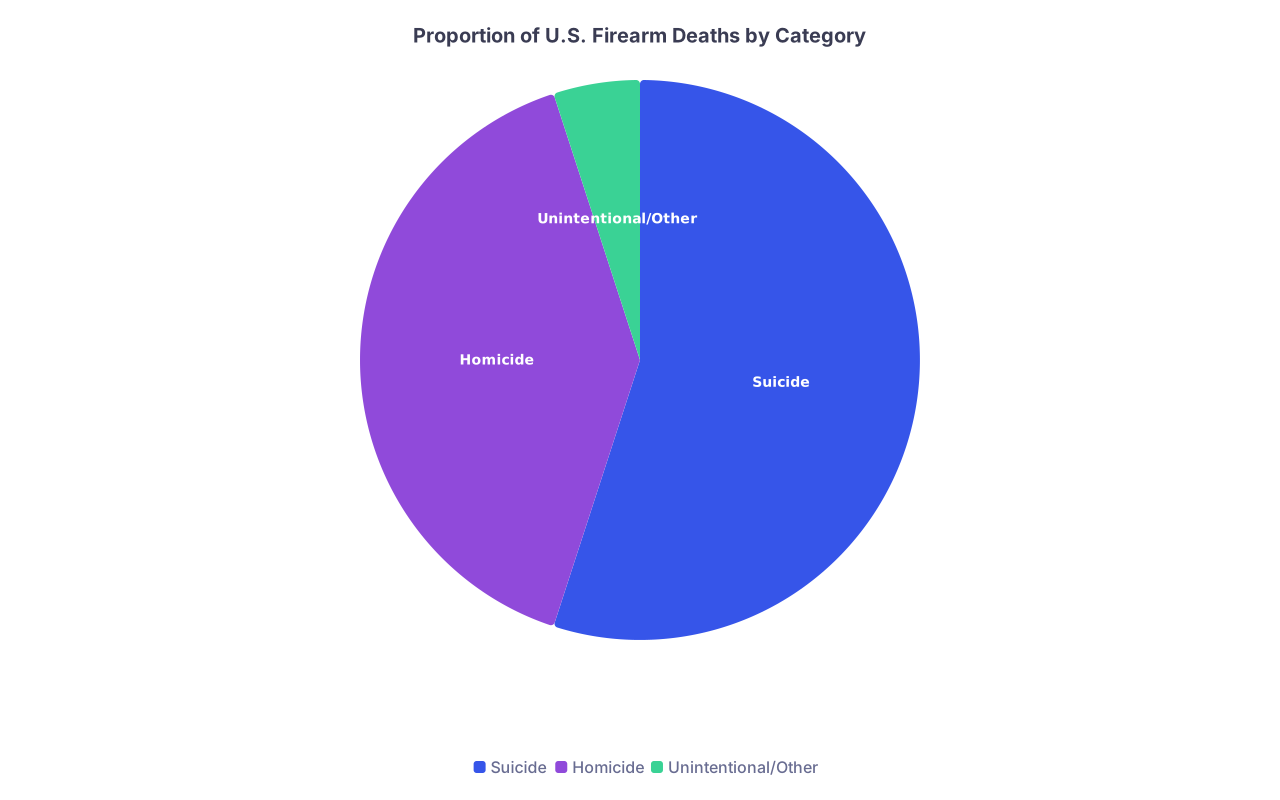
| Category | Value |
|---|---|
| Suicide | 55 |
| Homicide | 40 |
| Unintentional/Other | 5 |
Nationally, the pattern is roughly this:
- About half to 60% of firearm deaths are suicides.
- Roughly 35–45% are homicides.
- Unintentional, legal intervention, and undetermined make up the small remainder.
So when a clinician says “firearm violence,” but only pictures drive‑by shootings, they are missing the majority of what is preventable in their own panel: firearm suicide.
Suicide and firearms
Key points you should have in your head:
- Suicide attempts with firearms are almost always fatal (case fatality >80–90%).
- Drug overdoses? Often survivable. Cutting? Usually survivable.
- The single strongest modifiable factor is access to a loaded firearm during a crisis.
If you see:
- Major depressive disorder
- Bipolar disorder
- PTSD
- Substance use disorder
- Acute psychosocial stressors (divorce, job loss, legal problems)
and you do not at least think about firearm access, you are leaving risk on the table.
Homicide and community violence
For homicide and assault:
- Firearm homicide disproportionately involves young Black men in urban settings.
- Intimate partner homicide is vastly more lethal when a firearm is present in the home.
- Children in homes with unsafe storage (loaded, unlocked) are at higher risk of unintentional shootings and suicides.
You will not “fix” structural violence from the clinic, but you can absolutely mitigate risk in individual households, and you can support policies that match what we see in trauma bays every week.
2. Ethical Ground: Why Firearm Conversations Belong in Medicine
Some physicians still say, “Isn’t this political? I do not want to go there.”
That is poor ethics and worse risk management.
Physician roles are traditionally framed in four domains: beneficence, nonmaleficence, respect for autonomy, and justice. Firearm injury prevention fits all four cleanly.
Beneficence and nonmaleficence
Your obligation is to:
- Promote patient welfare (beneficence).
- Avoid causing harm (nonmaleficence).
We already apply this logic to:
- Seatbelts and car seats
- Smoking and secondhand smoke
- Falls in the elderly
- Domestic violence safety planning
Firearm access in a suicidal patient is ethically identical to giving 540 tablets of morphine to someone with new severe depression and telling them to keep it on the nightstand “just in case.”
Autonomy: what it actually means in this context
Respect for autonomy does not mean never raising a topic that might be sensitive. It means:
- Provide clear, honest, evidence-based information.
- Check understanding.
- Support voluntary, informed choices.
You can counsel about safe storage and voluntary temporary transfer without coercion. You are not confiscating anything. You are not reporting lawful ownership by default. You are giving patients tools to survive their worst 10 minutes.
Justice and structural risk
Justice is where policy enters.
Firearm injury is not evenly distributed. It clusters where housing is unstable, schools are underfunded, policing is fraught, and mental health care is scarce. If you care at all about health equity, pretending firearms are outside your lane is indefensible.
You are not required to become an activist. But you cannot pretend there is no ethical dimension when entire neighborhoods absorb the trauma of nightly shootings that you then “treat” with SSRIs and sleep hygiene handouts.
3. Clinical Roles: What You Should Actually Be Doing with Patients
This is where the conversation usually gets vague. “Physicians should counsel about firearm safety.” Sure. But how? With whom? And what exactly do you say?
Let me be specific.
A. When to ask about firearm access
You do not need to interrogate every patient about every item in their house. But you absolutely should be asking in clearly indicated contexts.
Minimum set of indications:
- Any suicidal ideation or recent suicide attempt
- Depression, bipolar disorder, psychosis with risk factors
- Substance use disorders (especially alcohol, opioids, stimulants)
- Cognitive impairment (dementia, moderate TBI) in a firearm owner
- Domestic violence or coercive control
- Parents/guardians of children and adolescents
- High‑risk periods: recent discharge from inpatient psych, major loss, new diagnosis of serious illness
In these settings, failing to assess lethal means is bad practice.
You do not need a long speech. Use normal, neutral language:
“For my patients’ safety, I always ask about access to things that can be dangerous in a crisis, like medications, chemicals, or firearms. Are there any firearms in your home or vehicles?”
Make it routine. Like asking about seatbelts or smoke detectors.
B. How to ask without blowing up the visit
The biggest mistake I see residents make is leading with judgment. They project their personal politics into the question. Do not.
You want three things: neutral tone, matter‑of‑fact framing, respect.
Examples:
- “Many of my patients own firearms. When someone is going through a tough time like this, we talk about how and where those are stored, just to lower risk during a crisis.”
- “I’m not here to tell you whether you should or shouldn’t own a firearm. My focus is on how to keep you and your family as safe as possible with the ones you have.”
If the patient bristles—“Why are you asking about that?”—you respond calmly:
“I ask everyone in situations like this. It helps me understand your safety at home and make good recommendations. You are free not to answer, but I find the conversation helpful and usually quick.”
No defensiveness. No debate.

C. Core counseling messages: what actually changes behavior
Counseling works best when it is concrete and tailored.
Evidence‑based safety messages typically include:
Storage basics
- Firearms stored unloaded.
- Locked, in a secure device (lockbox, safe, cable lock).
- Ammunition stored separately and locked.
Kids and adolescents
Key point: “Hidden” is not “safe.”
Children are very good at finding things adults think are secret. You say directly:“In homes with kids or teens, we recommend locked storage every single time. Even if you trust your child, you cannot control their friends or a bad day.”
Suicide risk and temporary off‑site storage
This is where you can significantly lower mortality.For acutely suicidal or severely depressed patients with firearms at home, the goal is time and distance:
- Ask: “Is there someone you trust who could hold your firearms for a while?”
- Consider: Storage at a relative’s home, local gun shop, or shooting range if that is legal in your state.
- Normalize temporariness: “The idea is to get you through this rough patch. We revisit later when you are feeling more stable.”
You are not attacking their identity. You are helping them survive their worst day.
Intimate partner violence
Where IPV is present, firearms increase lethality dramatically.
Your role: screen, safety‑plan, and know your jurisdiction’s laws on firearm relinquishment in restraining orders. You do not need to be a lawyer, but you should know the basics and refer to appropriate legal and advocacy resources.
D. Documentation and legal risk
Physicians worry—often excessively—about liability here. A few practical rules:
- Document neutrally: “Discussed firearm access; patient reports one handgun stored locked/unloaded in safe; ammunition locked separately.”
- If high suicide risk and unsafe access persists, document your concern and your counseling.
- If you believe imminent risk exists, follow your usual emergent safety pathway (ED evaluation, possible involuntary hold, etc.) exactly as you would with any other lethal means.
You are almost never under a legal obligation to report lawful ownership, and in many states you are explicitly protected in asking about firearms as part of safety assessment. The Florida “Docs vs Glocks” law that tried to limit physician inquiry was largely struck down years ago. Stop letting ghost laws muzzle you.
4. System and Policy Roles: Beyond the Exam Room
Individual counseling is necessary but not sufficient. The scale of firearm injury demands system‑level work. That does not mean you need to give TED talks. It does mean you should understand which policies actually have evidence behind them.
A. Policies with reasonably strong evidence
We are not guessing here. There is decent empirical support for a few key levers.
| Policy Type | Evidence Strength | Clinical Relevance |
|---|---|---|
| Child access prevention / safe storage | Strong | Reinforces your pediatric counseling |
| Extreme risk protection orders (ERPOs) | Growing / Moderate | Tool for imminent suicide or violence risk |
| Background checks for all sales | Moderate | Reduces certain types of firearm homicide |
| Domestic violence firearm prohibitions | Strong | Tied to IPV risk assessments |
| Waiting periods for purchase | Moderate | May reduce impulsive suicide |
Let’s translate this into what you can support as a physician.
1. Child access prevention (CAP) and safe storage laws
These laws impose liability on adults who allow children unsupervised access to firearms. They are associated with lower unintentional firearm deaths and some reduction in suicides among youth.
For you, this means:
- Your counseling is legally and culturally reinforced.
- Public messaging (“Lock it up”) aligns with your exam‑room messaging.
- You can explicitly say: “Our state has a law about safe storage to protect kids. Here is how to comply and keep everyone safe.”
2. Extreme Risk Protection Orders (ERPOs / “red flag” laws)
ERPOs allow temporary removal of firearms from individuals at high risk of harming self or others, based on evidence brought before a judge.
Clinically relevant scenarios:
- Patient has escalating suicidal ideation, refuses voluntary secure storage, but has specific access to firearms and is not yet committable.
- Family member reports threats of violence coupled with access to multiple firearms.
Your role:
- Know if your state has an ERPO law.
- Know who can petition (in many states: law enforcement, sometimes clinicians, sometimes family only).
- Know who to call—often this is a social worker, hospital legal, or risk management. You are not expected to draft the legal filing yourself.
ERPOs are not about permanent confiscation. They are time‑limited, with due process. For some patients, they are the difference between a survivable crisis and a fatal one.
3. Domestic violence firearm prohibitions
Federal law (Lautenberg Amendment) and many state laws prohibit firearm possession by people subject to certain domestic violence restraining orders or convicted of specified DV misdemeanors.
You synchronize your role by:
- Doing real IPV screening (not a checkbox you speed through).
- Documenting clearly when IPV is present.
- Referring patients to advocacy services that can help them pursue protective orders, which then may trigger firearm removal mechanisms.
You are not the gun police. But you are often the only professional who will hear the full story before someone gets shot.

| Step | Description |
|---|---|
| Step 1 | Patient Encounter |
| Step 2 | Routine care |
| Step 3 | Ask about firearm access |
| Step 4 | Document and address other risks |
| Step 5 | Counsel on safe storage |
| Step 6 | Plan follow up |
| Step 7 | Consider ER visit or hold |
| Step 8 | Consider ERPO or law enforcement consult |
| Step 9 | Risk factors present |
| Step 10 | Firearms present |
| Step 11 | Acute suicide or violence risk |
5. Institutional Responsibilities: What Your Hospital or Clinic Should Be Doing
You, individually, can only do so much if the system around you is indifferent or clueless.
If you have any influence locally—and residents, you often have more than you think—push for a few baseline institutional practices.
A. Standardized screening and prompts
Incorporate firearm safety into:
- Suicide risk assessments
- Pediatric well‑child templates
- IPV and elder‑abuse workflows
Not a 15‑question interrogation. Simple, clearly triggered prompts:
- “If suicidal ideation present → ask: Any firearms at home or accessible?”
- “Pediatric well‑child age 0–19 → ask: Firearms in home? If yes, storage method?”
B. Training clinicians on how to talk about firearms
You train residents endlessly on breaking bad news and code status, then throw them into firearm conversations with zero preparation. That is lazy education.
A decent curriculum should include:
- Basic epidemiology and misconceptions.
- Role‑play with firearm‑owning standardized patients.
- Scripts for high‑tension scenarios (“I do not trust doctors with this topic”).
- Legal overview for your specific state (ERPO, mandatory reporting boundaries).
If your institution lacks this, it is absolutely reasonable to say so loudly at a residency meeting.
C. Providing actual hardware: locks and materials
Counseling is undermined if it ends with, “You should lock your firearms,” and the patient thinks, “Sure, with what money?”
Best practice setups I have seen:
- Clinics partner with local health departments or coalitions to offer free cable locks.
- Patient‑facing handouts with pictures of lockboxes and safes, not just text.
- Information on local ranges or retailers that offer storage or buy‑back programs.
Do not underestimate the symbolic power of handing a patient a physical lock and saying: “Here. Use this tonight.”

6. Advocacy and Public Voice: What Physicians Can Ethically Support
You will hear the line “stay in your lane” from people who have never pronounced time of death on a 17‑year‑old shot in the neck.
Public health has always included advocacy: tobacco, drunk driving, lead paint, HIV, maternal mortality. Firearms are no different.
Here is the distinction that matters:
- Partisan campaigning for candidates = your personal choice, outside your physician role.
- Advocacy for evidence‑based public health policy = entirely consistent with professional ethics.
A. What “evidence‑based” looks like here
You should not support every proposal that has “safety” in the title. You should support ones that align with data:
Strong or emerging evidence:
- CAP/safe storage laws.
- ERPOs that include due process and clear risk standards.
- Robust background checks that close private‑sale loopholes.
- Prohibitions for IPV perpetrators.
- Research funding for firearm injury as a health issue (NIH, CDC, state-level).
Dubious or purely symbolic measures are common. Your job is not to memorize every statute, but to anchor your advocacy to what actually affects morbidity and mortality.
B. How to participate without burning out
You do not need to spend every evening testifying at the statehouse. A few realistic roles:
- Sign onto policy statements from specialty societies that you actually read.
- Provide anonymized clinical narratives (de‑identified) that show real-world consequences—these are powerful in legislative hearings.
- Work with your hospital’s government relations team to educate local officials.
- Write one clear, specific op‑ed or letter to the editor in your career that explains how firearm injuries look from your side of the stretcher.
The point is not to become famous. The point is to stop letting non‑clinical voices define the “physician perspective” as silence.
7. Personal Development: Reconciling Your Own Views and Biases
You cannot do this work well if you have not examined your own head.
Some clinicians are deeply uncomfortable with firearms and try to avoid the topic. Others are firearm owners themselves and worry about being seen as “anti‑gun” if they speak up for safety policies.
Both groups need to do some internal homework.
A. If you are strongly anti‑gun
You still need to:
- Approach firearm‑owning patients with genuine respect.
- Focus on risk reduction, not confiscation fantasies.
- Avoid moralizing. You can think privately that civilian handguns are a bad idea; your patient’s clinic visit is not your soapbox.
Remind yourself: you treat smokers without lecturing them every time about the existence of cigarettes. You can do the same here.
B. If you are a firearm owner
You actually have a huge strategic advantage.
You can say things like:
“I own firearms myself, and I lock them up. When I went through a rough time, I changed where I stored them. I recommend the same for my patients.”
That breaks down defensiveness in seconds.
You do need to be careful about not letting identity override evidence. Your role is not to be the “gun‑friendly doc” who just reassures everyone that everything they are doing is fine. Your role is to model responsible ownership and evidence‑based safety.
C. The ethical bottom line
You are not obligated to agree with every proposed law. You are obligated to:
- Know basic firearm risk patterns.
- Incorporate firearm access into risk assessments where indicated.
- Offer concrete safety advice and resources.
- Support policies that demonstrably reduce preventable injury and death.
If you cannot do that because you are “uncomfortable talking about guns,” you have a professional development problem, not a political problem.
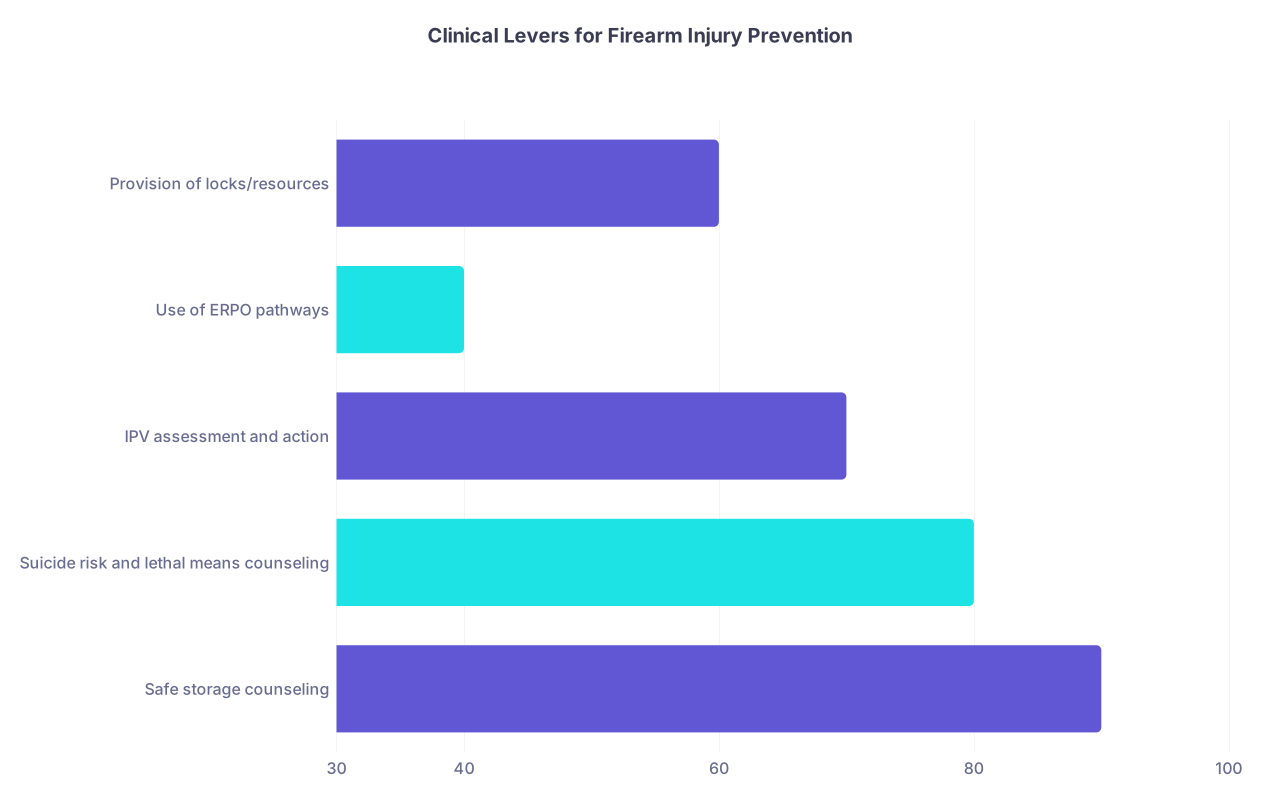
| Category | Value |
|---|---|
| Safe storage counseling | 90 |
| Suicide risk and lethal means counseling | 80 |
| IPV assessment and action | 70 |
| Use of ERPO pathways | 40 |
| Provision of locks/resources | 60 |
(Percentages here conceptually represent “potential impact/feasibility” as judged by many clinicians—counseling is easy and broad, ERPO use is narrower but powerful.)
8. Concrete Moves You Can Make This Month
If this all feels abstract, here is a short list of moves you can actually implement in the near term:
- Add one sentence to your suicide‑risk template: “Ask about firearms and other lethal means; document where and how stored.”
- Identify in your state: Do we have ERPO? Who can file? What is the contact pathway from our ED or clinic?
- Talk to your clinic manager about stocking free cable locks and a simple firearm safety handout.
- In your next pediatric well‑child check, ask about firearms exactly the way you ask about car seats. See how the parent responds and refine your wording.
- In residency or department meeting, ask flatly: “What is our institutional guidance on discussing firearms with high‑risk patients?” The silence will tell you how much work there is to do.
None of this requires you to register with a political party or join a march. It does require you to treat firearm injury like the major, modifiable health problem it is.

FAQ (Exactly 6 Questions)
1. Am I allowed to ask patients about firearms, or could I get in legal trouble?
In virtually every U.S. jurisdiction, you are absolutely allowed to ask about firearm access as part of safety assessment. No current law prohibits good‑faith clinical inquiry. The much‑publicized Florida law that tried to chill physician speech about firearms was largely struck down on First Amendment grounds. You should, however, avoid documenting speculative judgments about illegal behavior; stick to neutral descriptions of access and counseling.
2. Do firearm safety counseling interventions actually work?
Yes, particularly for safe storage. Multiple studies (especially in pediatrics and primary care) show that tailored counseling plus provision of locking devices increases the likelihood of locking firearms and separating ammunition. For suicide prevention, data on counseling alone are more limited, but we know conclusively that reducing access to highly lethal means reduces suicide deaths, even if underlying distress remains. The logic is the same as blister‑packing toxic meds or restricting bridge access.
3. What if a patient becomes angry or refuses to talk about firearms?
You back off respectfully but do not apologize for asking. You can say: “I understand this feels personal. I ask because my job is to think about anything that could put you or your family at risk, especially when someone is struggling. If you would rather not discuss it today, we can revisit later.” Document that the patient declined. If imminent risk is present and you have credible information about access from other sources (family, EMS, prior notes), you still act on that information in your risk management.
4. Do I need to report firearm ownership when a patient is suicidal?
In most cases, no. Mandatory reporting laws typically concern imminent threats to specific individuals (duty to warn/protect) or categories like child or elder abuse. A suicidal patient who owns firearms does not automatically trigger a reporting obligation. Your first‑line response is clinical: risk assessment, possible hospitalization, counseling on lethal means, and engaging family or trusted others for safe storage. In rare scenarios where a specific threat to others exists, duty‑to‑warn laws may apply and can intersect with firearm access.
5. How do I handle firearm discussions with patients who are veterans or law enforcement?
Respect their experience and normalize the conversation. Many already understand firearm safety conceptually but may not have translated that into home practices during times of mental health stress. Use language like: “Given your background, I know you are very familiar with firearms. When people who use firearms in their work go through tough periods, we sometimes adjust how and where those guns are stored. Have you made any changes like that recently?” Avoid stereotyping; focus on individual risk and supports.
6. I disagree with some firearm laws being proposed. Does that mean I should stay out of all advocacy?
No. Ethical advocacy is not an all‑or‑nothing package deal. You can oppose policies you see as ineffective or overreaching while actively supporting others that have data behind them—such as CAP laws, ERPOs with due process, and better research funding. Your credibility actually increases when you are selective and evidence‑driven rather than reflexively endorsing everything labeled “gun control.” The key is to be explicit: “I support policy X because it aligns with clinical evidence and addresses the risks I see in my patients.”
Key takeaways:
- Firearm injury prevention is squarely inside the physician’s lane—especially around suicide, safe storage, and IPV.
- Your most powerful tools are targeted assessment of firearm access, concrete counseling on storage and temporary off‑site transfer, and smart use of legal mechanisms like ERPOs where available.
- At the systems level, push for training, standardized workflows, and basic resources (locks, handouts), and lend your voice to policies with real evidence behind them.