
What if you wake up one day and realize: “I want to be that person giving testimony on Capitol Hill or writing national guidelines”… and then it hits you—you’ve literally never done anything that looks like “policy”?
The Fear Behind “No Policy Experience”
Let me say out loud what you’re probably thinking quietly:
- “Everyone else interested in public health policy started in undergrad, right?”
- “Faculty on these fancy public health / policy tracks can all say ‘I worked at the WHO’ or ‘I interned on the Hill.’ I… shadowed in a clinic.”
- “If I have zero policy experience now, am I already behind for an academic career?”
You’re afraid that admissions committees and promotion committees have this mental checkbox:
“Policy experience: yes / no”
…and you’re sitting there mentally circling “no” in red Sharpie.
Here’s the blunt truth:
Lack of policy experience will limit you if you let it be a permanent condition.
It will not kill your academic dreams if it’s just your starting point and you can show a credible trajectory.
Committees don’t actually care whether you did policy at 18. They care whether:
- Your current story makes sense.
- You can show you’re moving toward the thing you say you want.
- You’re not just chasing buzzwords because they sound impressive.
If you’re early and honest—“I’m late to this but I’m serious now”—you’re fine.
If you’re late and vague—“I’m interested in leadership and advocacy and innovation”… and there’s zero evidence—you will look unserious.
The difference is not where you started. It’s what you do next.
What “Policy Experience” Actually Means (And What It Doesn’t)
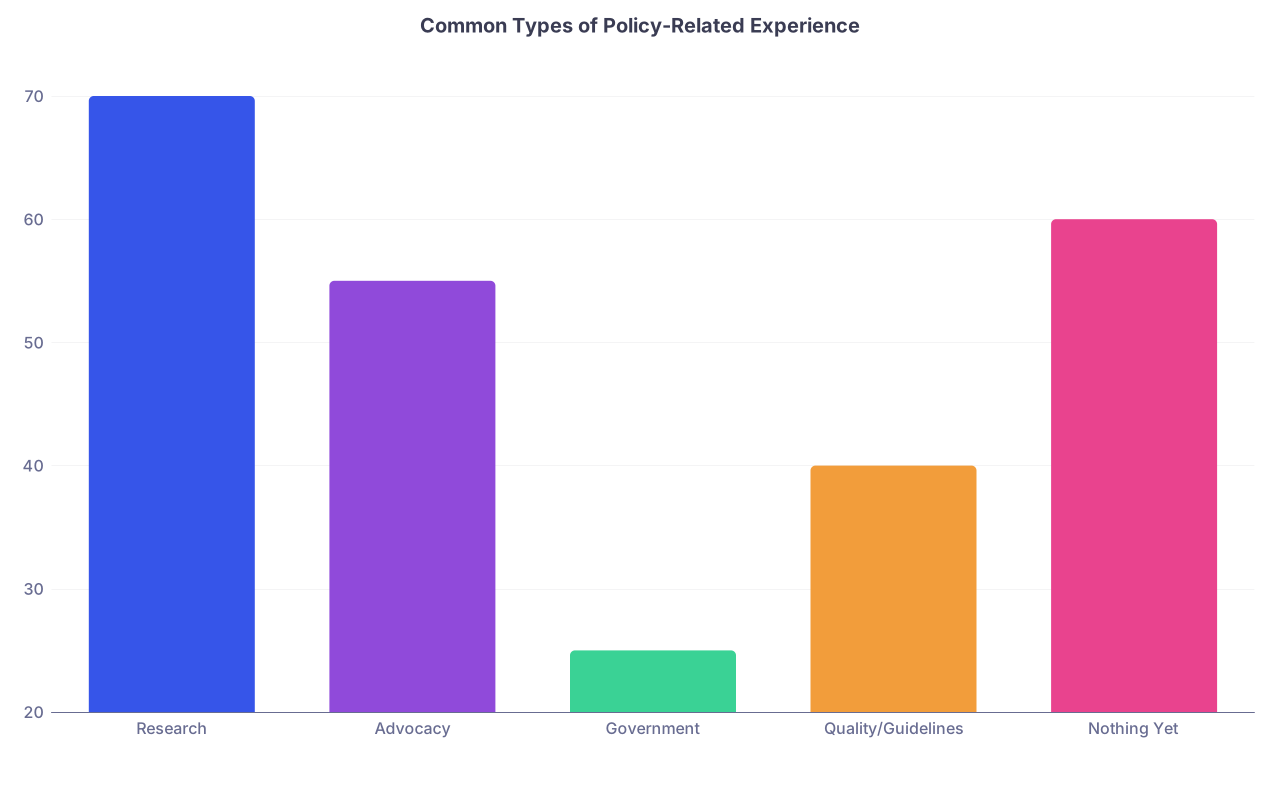
| Category | Value |
|---|---|
| Research | 70 |
| Advocacy | 55 |
| Government | 25 |
| Quality/Guidelines | 40 |
| Nothing Yet | 60 |
Part of the panic comes from this blurry idea that policy experience = you’ve worked at some government agency, drafted a bill, and been quoted in the New York Times.
That’s… not reality.
When academic people say “policy experience,” they’re usually looking at a few buckets:
Research that informs policy
Health services research, cost-effectiveness, implementation science, disparities work—anything with clear implications for systems, payment, or laws.Organized advocacy
AMA, ACP, AMA-MSS, APHA, local medical societies, student-run health advocacy orgs, writing resolutions, going to lobby days.Government / institutional roles
City/county health department projects, work with state Medicaid offices, IRB / hospital quality committees, task forces on guidelines or protocols.Formal training
MPH with policy concentration, health policy certificate, policy courses, summer policy programs, think-tank internships.
And then there’s what doesn’t count as policy, even though people try to spin it:
- “I volunteered at a free clinic.” (Good. Not policy unless you did something systemic—funding model, regulations, data analysis that drove a change.)
- “I started a club.” (Fine, but unless it led to some external-facing advocacy or institutional change, it’s more leadership than policy.)
- “I’m really passionate about health equity.” (Every single person says this now. Without action, it’s white noise.)
So when you say “I have no policy experience,” check if you actually have some proto-policy stuff that you just never labeled that way:
- Did you help your clinic change a protocol because of some regulation?
- Did you collect data to justify funding for something?
- Did you write or co-write a letter to hospital leadership about a systemic problem?
You might not be starting from absolute zero. You might be starting from “unlabeled.”
How Much Policy Experience Do You Actually Need for an Academic Career?
| Path | Policy Experience Needed Early | Comment |
|---|---|---|
| Clinician-Educator (mostly) | Low | Interest helpful, not required |
| Clinician-Researcher (some policy focus) | Moderate | Need some signal by fellowship |
| Health Policy Researcher | High | Should build clear track record |
| Policy-Focused Administrator | Moderate-High | Experience + some leadership needed |
| Government / Agency Scientist | High | They want real policy-adjacent work |
Here’s where people get really scared, so I’ll be very explicit.
If your dream is:
“Be a solid clinician-educator who occasionally does advocacy”
Then no, having no policy experience right now will not hurt your academic career much. You can add advocacy work as you go.“Lead a residency advocacy track, direct a public health course, be involved in institutional policy”
You should show some organized, visible policy activity by the end of residency or early faculty. You do not need it all figured out now.“Be a legit health policy researcher, write guidelines, work with CMS / WHO / CDC”
Yes, here it matters more. But again, the bar isn’t “you started in high school.” The bar is “by the time you’re applying for serious policy fellowships or K awards, do you look like you’ve actually tested this interest in the real world?”
What absolutely doesn’t work:
Saying “I want a career in health policy” and having:
- No projects that even touch systems or population-level outcomes
- No advocacy, no committees, no coursework, no letters that mention it
- And then expecting people to trust that this is a serious, durable goal
They’ve seen too many people use “policy” as a vague stand-in for “impact” with zero follow-through.
The “I Started Late” Panic: Are You Already Behind?
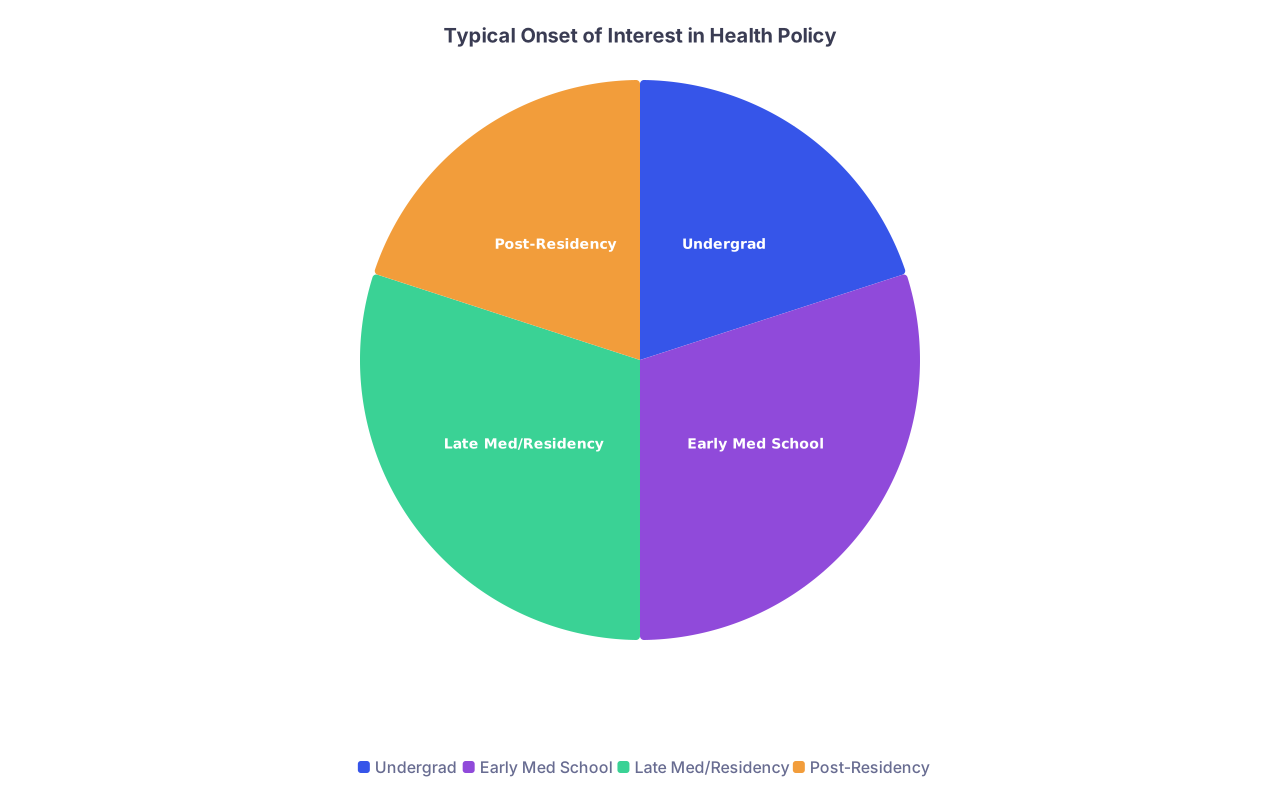
| Category | Value |
|---|---|
| Undergrad | 20 |
| Early Med School | 30 |
| Late Med/Residency | 30 |
| Post-Residency | 20 |
A not-so-comforting secret: a lot of people you see now dominating the policy world? They had zero formal policy experience until residency or after residency.
You just don’t see that part on their bio because it’s compressed into a one-line story:
“Dr. X completed a health policy fellowship at [impressive institution]…”
No one writes: “Panicked in PGY-2 because she realized she was sick of only doing one-on-one care and had no policy experience.”
I’ve seen:
- A medicine resident who only had QI posters pivot into a Robert Wood Johnson–type fellowship by tying that QI work to payment models and regulation.
- A pediatrician with only local community outreach and an MPH pivot into vaccine policy work at a state health department, then onto CDC advisory committees.
- A surgical resident who realized mid-PGY-3 he wanted trauma policy, started then, built relationships with hospital leadership, and ended up leading a state-level committee five years later.
The patterns were the same:
- They admitted (to themselves) they were behind.
- They found real, not-performative ways to get involved.
- They got specific about what kind of policy they cared about.
- They let their CV slowly tilt toward that direction, step by step.
You’re behind only if you stay vague and paralyzed.
What To Do in the Next 6–12 Months If You’re Starting From Zero
This is the part you actually care about: what concrete moves keep this “no policy experience” thing from haunting your applications?
Step 1: Pick a lane. Vague “policy” is killing you.

Say out loud, right now, one sentence:
“I’m most drawn to policy about ________.”
Not “health equity.” Too vague.
Something like:
- Medicaid reimbursement for mental health
- Harm reduction and overdose prevention
- Maternal mortality in rural areas
- Vaccine access and school requirements
- Gun violence as a public health issue
- AI in healthcare and patient safety
- Disability and access to care
Once you name a lane, you can stop drowning in abstract opportunities and find things that actually match.
Step 2: Attach yourself to one actual project
Not six. One.
Look for:
- A faculty member doing health services / policy / public health research
- A community organization or advocacy group working on your topic
- A hospital committee or system-level initiative (e.g., readmissions, access, quality)
Your goal: by 6–12 months from now, you want one of these on your CV:
- A poster or abstract with policy implications
- A white paper, report, or policy brief you co-authored
- A structured advocacy effort (resolution, testimony, organized campaign)
- A defined role on a committee that touches systems-level decisions
Not glamorous. Just real.
Step 3: Add visible, low-barrier policy “signals”
These are small things that scream, “I didn’t make this interest up yesterday”:
- Attend your first advocacy day with your state medical society or specialty organization.
- Join the policy / advocacy committee of a national org (students and residents can do this way more than you think).
- Take one formal policy course or online module from a reputable group (Harvard edX, Coursera with known instructors, your school’s public health program).
- Write one op-ed or commentary (even if it’s in a student newspaper or local outlet) about your chosen lane.
Each of these is a breadcrumb. A reviewer can follow them and think, “Okay, this person actually did things when they got interested. Not just vibes.”
Step 4: Fix how your story sounds
Right now your inner monologue probably sounds like:
“I have no policy experience, but I’m really interested and would love opportunities to learn more.”
This is the weakest, most common, most forgettable line people use in emails and personal statements. It makes you sound passive and late.
You want something more like:
“In the last year I’ve become very focused on [specific lane]. I know I’m early in this, but I’ve started [brief concrete thing: joined X committee / working on Y project / attended Z advocacy day], and I’m looking for opportunities to deepen that work, especially around [more specific interest].”
See the difference? You’re not asking them to believe in a fantasy version of you. You’re asking them to extend what you’ve already started.
Reality Check: Ways Lack of Policy Experience Can Hurt You (If You Ignore It)
I’m not going to pretend there are no consequences if you do absolutely nothing and still talk big about policy.
Here’s where it bites:
Competitive policy fellowships (NRSA, RWJF, VA, etc.)
They’re going to compare you to people with legit track records: MPH, publications, advocacy leadership. Coming in cold with just vibes will sink you.Application essays and interviews
Saying “I want to influence health policy” with zero related activity makes you sound like you’re parroting stock phrases. Faculty are allergic to this.Letters of recommendation
If no one can write, “This person has shown real commitment to and aptitude for policy / systems-level work,” you’re asking committees to take a leap of faith they won’t take.Being taken seriously locally
When you speak up in meetings or suggest “policy” changes, people look for: have you done the work, or are you just opinionated? Experience gives you credibility.
The fix isn’t to panic and quit. It’s to do enough so that when someone reads your file, the jump from who you are now to who you say you want to be doesn’t feel like a fantasy.
Quick Sanity Check: How Behind Are You Really?
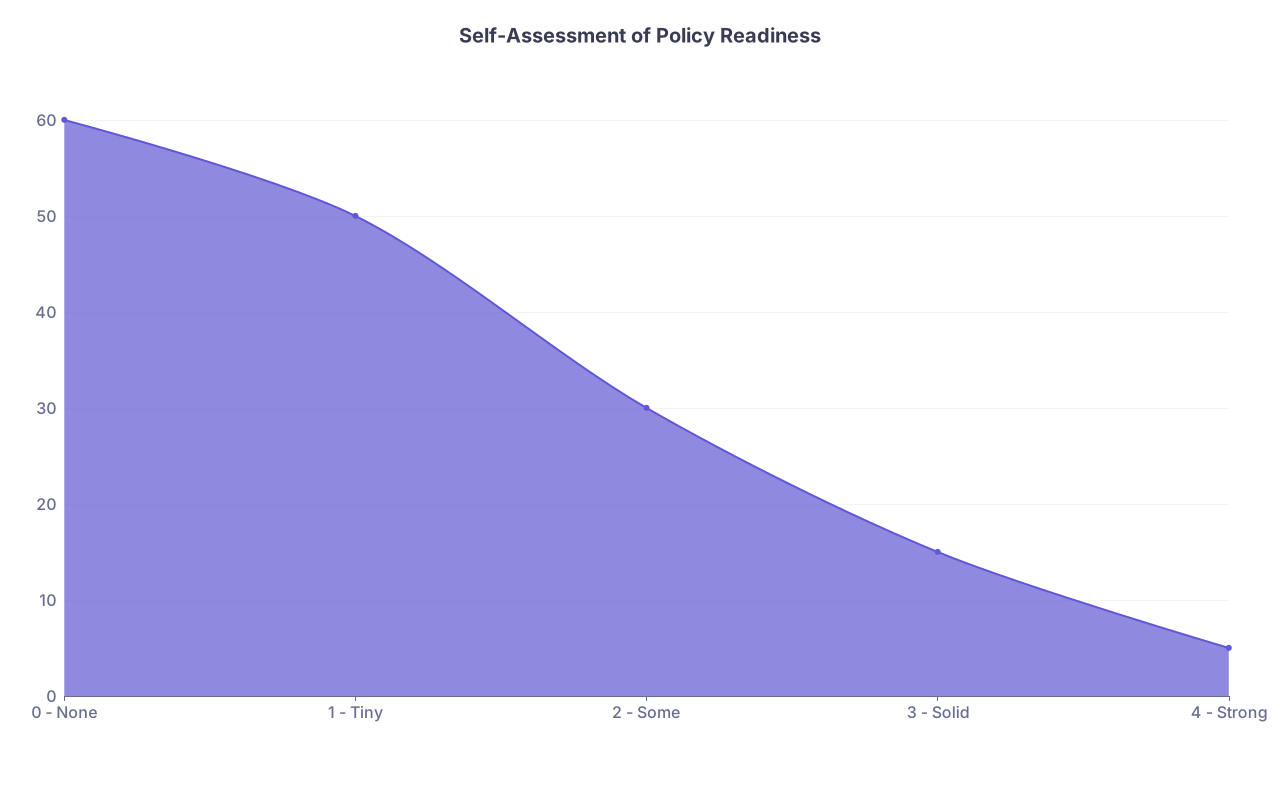
| Category | Value |
|---|---|
| 0 - None | 60 |
| 1 - Tiny | 50 |
| 2 - Some | 30 |
| 3 - Solid | 15 |
| 4 - Strong | 5 |
Ask yourself these, and answer brutally:
- Can I name one specific policy area I care about, not just “policy” or “equity”?
- Do I have any activity (research, committees, advocacy, coursework) that touches that area?
- Has anyone who matters (mentor, PI, program leadership) heard me say this interest out loud?
- If someone read my CV with no explanation, would they guess I might care about policy at all?
- In 6 months, could I reasonably add 1–2 concrete, policy-adjacent things if I started now?
If you’re mostly at “no” right now, it’s not game over. It just means your top priority isn’t reading 10 more think tank reports. It’s getting yourself into one real situation where policy is not hypothetical.
FAQ: Anxiety Edition (Exactly 5 Questions)
1. Is it dishonest to say I’m interested in policy if I’ve done basically nothing yet?
It’s dishonest if you keep saying it year after year without doing anything. If you’ve recently realized this is something you care about and you’re already taking first steps—reading serious sources, going to events, reaching out to people, joining a project—then it’s honest to say: “I’m early in this, but I’m moving toward it.” The key is the phrase “and here’s what I’ve started doing,” not just “I’m interested.”
2. Do I need an MPH or formal degree to be taken seriously in health policy?
No. An MPH or MPP is helpful, especially if you want a research-heavy or government-agency path, but it’s not mandatory. Plenty of academic physicians do policy-relevant work without extra degrees. What you do need is some combination of: methodologic skills (stats, HSR methods), tangible projects, and mentors who are already in the policy space. A degree can compress the learning curve, but you can also build that expertise through fellowships, targeted coursework, and projects.
3. If I’m already a resident with no policy background, is it too late?
Annoying answer: it’s late for some super-competitive early-career policy fellowships, but it’s not too late for an academic career that includes policy. You’ll probably need to be more deliberate: find a policy-minded mentor in your institution, get on a QI or systems committee, maybe plan for a post-residency fellowship or part-time MPH. What hurts you isn’t your current lack of experience; it’s staying stuck in “eh, I’ll think about it later” mode until you’re an attending with no track record.
4. I’m scared my “policy work” will just look like padding—how do I avoid that?
Easy rule: if the only purpose of an activity is “look good on CV,” it’s probably fluff. Stick to things that would matter even if no one ever saw your CV: a project that changes how your clinic runs, an advocacy effort that affects real patients, a research question that actually bothers you. Depth beats breadth. One serious, sustained project that leads to something real (a change, a publication, a committee role) looks much better than five random, shallow “leadership” positions.
5. What’s the one thing I should do this month if I’m anxious and overwhelmed?
Pick one faculty member who seems even vaguely policy or public-health-adjacent—maybe they do disparities work, health services, QI, or are involved in hospital leadership. Send a short, specific email: who you are, your new-ish interest in a specific policy lane, and ask if you can talk for 20 minutes about how to get started and whether there are any projects you could help with. Don’t overthink the email. Just send it. One real conversation with the right person can shrink this whole “I have no policy experience” monster down to size.
Key Takeaways
- Having no policy experience right now doesn’t kill your academic dreams; staying vague and inactive will.
- You don’t need a heroic backstory—you need a clear lane, one real project, and a story that shows movement, not wishful thinking.
- In the next 6–12 months, your goal is not to “be a policy person.” It’s to stop being a policy tourist and become someone who’s actually started doing the work.