
The loudest person in the room is not automatically the most impactful in health policy.
The Lie You’ve Been Sold About “Policy People”
Let me just say the part that’s been eating at you: you picture health policy as a room full of extroverted people in blazers, speaking confidently on C-SPAN, debating at a podium, throwing around phrases like “stakeholder engagement” and “appropriations committee” without breathing.
And you’re sitting there thinking:
“I hate speaking up in small groups, how am I ever going to matter in health policy?”
“Everyone else seems so comfortable leading discussions. I freeze.”
“If I’m not outspoken, am I just destined to sign whatever policies other people create?”
Here’s my blunt answer: no, you’re not doomed. But if you keep believing health policy is only for podium people, you’ll quietly sideline yourself before anyone else ever has the chance to.
The health policy world runs on way more than microphones. It runs on drafts, analyses, quiet negotiations, late-night data cleaning, precise wording changes, backchannels, one-on-one conversations, and uncomfortable, slow, persistent systems work.
Half of that actually favors quieter people. If they stop assuming they’re disqualified.
What Health Policy Actually Looks Like (Not the Movie Version)
People think “health policy” and see congressional hearings, WHO press conferences, big speeches. That stuff exists. It’s just… not the majority of work.
The unglamorous truth: the policy machine is mostly:
- Someone reading 80-page PDFs while hunched over a laptop
- Someone editing one paragraph 15 times so it doesn’t get misused in court
- Someone quietly convincing an administrator that changing discharge protocols will save money and lives
- Someone comparing data across five counties at 1 a.m. to show why maternal mortality is worse in one zip code than the one next door
That “someone” does not have to be the loudest person in the room.
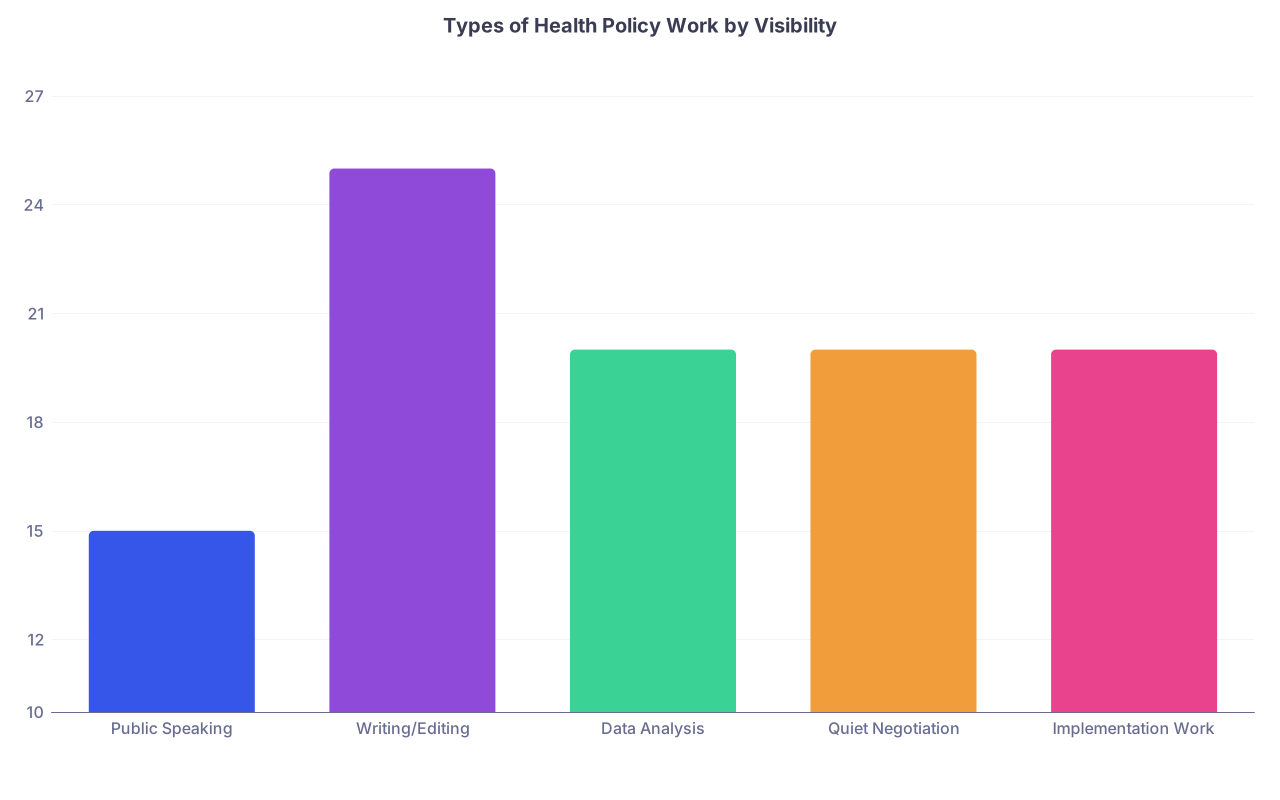
| Category | Value |
|---|---|
| Public Speaking | 15 |
| Writing/Editing | 25 |
| Data Analysis | 20 |
| Quiet Negotiation | 20 |
| Implementation Work | 20 |
Notice what’s secretly happening there? A big chunk of meaningful work is quiet, cerebral, one-on-one, or small group based. That territory is completely open to you.
The problem is you only see the visible 15% and then tell yourself, “I’m not that. So I’ll just… back away slowly.”
“But I’m Not Outspoken” — What That Usually Really Means
When people say, “I’m not outspoken,” I’ve found they usually mean one of a few things:
- “I overthink before I talk and miss my timing.”
- “I hate being the center of attention.”
- “I need time to process before I respond.”
- “Public speaking makes my heart race and my hands shake.”
- “I’m terrified of sounding stupid in front of people I respect.”
So basically: you’re thoughtful, risk-averse socially, and your nervous system hates being on stage.
None of that makes you fundamentally incompatible with policy. It just means your role and your path will probably look different from the TED-talk version.
Think about the people who:
- Catch the subtle ethical issue in a proposed law that others skimmed
- Notice that one sentence in a protocol will disproportionately hurt non-English speakers
- Pick up on the way a hospital policy will mess with continuity of care in ways administrators don’t see
Those are often the quieter folks who pay ridiculous attention. Who sit and absorb. Who don’t rush to fill silence.
Health policy desperately needs that.
The Roles That Quiet People Often End Up Owning
Let me be super concrete, because you probably need more than “you matter too” pep talk.
Here are actual ways quieter people I’ve known have had serious policy impact without ever loving a microphone.
1. The Drafter
They’re not the person giving the speech. They’re the one who wrote the speech, the memo, the policy, the briefing document. Law, guidelines, internal hospital policy, position statements for professional organizations—someone has to craft that language with obsessive care.
If you’re the person who rewrites a sentence three times until it actually says what you mean, that’s policy power. Because in policy, wording isn’t cosmetic. It’s binding.
2. The Evidence Person
Every flashy “We should do X!” moment eventually runs into someone asking, “Where’s the data?”
That’s where methodical, quieter people shine. Literature reviews, outcome analysis, cost-effectiveness modeling, looking at hospital data to show what’s broken—that’s policy too. A single well-done, boring-looking report has changed entire systems. Think about landmark public health papers; half the authors probably hated speaking but changed the world anyway.
3. The Behind-the-Scenes Convincer
Not everyone responds to speeches. Some people change their mind in a quiet office with the door half-closed, talking through details with someone they trust.
Quiet people are often really good at this: one-on-one, slower, less performative conversations. The resident who convinces the PD that adding social work to discharge rounds will reduce readmissions. The med student who pulls aside a clerkship director and shows them how a grading policy systematically disadvantages certain students.
No stage. Real change.
4. The Implementation Nerd
Policies on paper are fantasy until someone figures out how to make them real in a chaotic clinic where printers jam, language lines are busy, and no one has time.
The person who sits down and says, “Okay, how would this actually work on Tuesday at 3 p.m.?”—that person becomes invaluable. They catch failure points early. They modify workflows. They listen to patients and nurses and front desk staff and adjust.
That’s not glamorous. It’s essential. And again, not inherently tied to being outspoken.

The Fear Underneath: “If I Don’t Speak Up, Am I Complicit?”
Here’s the darker, more honest piece. You’re not just asking, “Can I have a role?” You’re worried: “If I’m quiet, am I basically just going along with harm?”
You see inequities in your rotations, or in the news—prior auth nonsense, uninsured patients being dumped, people with addiction treated like garbage—and you feel this gnawing guilt:
“I should say something. But my throat closes up. So I do nothing. Am I a coward? Is this unethical?”
That’s the part that keeps you up.
Here’s my take: your ethical obligation isn’t to become a different personality. It’s to not let fear completely paralyze you. To find some way, however small and however quiet, to resist just drifting.
That might look like:
- Writing one carefully thought-out email to a clerkship director about a grading policy
- Joining a small working group on a hospital committee rather than leading a town hall
- Co-authoring a short op-ed or letter with a more outspoken colleague
- Taking meticulous notes on disparities you see and later turning them into a quality improvement or policy proposal
No one said “being ethical” equals “becoming the person who grabs the mic at every meeting.” That’s Instagram ethics. Real life is more varied.
You Don’t Have to Stay This Quiet Forever (But You Can Start Where You Are)
There’s a brutal myth in medicine: you’re either “a natural leader” or you’re not. Translation: if you’re not already confident and outspoken, you’re just a follower.
I’ve watched that myth shut down so many thoughtful people who could eventually be incredible advocates with… practice. Not transformation. Practice.
You don’t have to jump from “I hate talking in class” to “I am testifying at the state capitol.” You can ratchet up slowly, in ways that still feel authentic.
Things that are uncomfortable but not impossible:
- Asking one clarifying question in a small meeting once a week
- Sharing your written thoughts before a meeting with a trusted attending and saying, “If this seems valid, could you help bring this up?”
- Practicing one paragraph of your opinion out loud with a friend before you go into a committee meeting
- Starting with writing (emails, memos, reflections) and then reading pieces of what you’ve written if you’re asked to comment
That’s how a lot of actually effective advocates are built. Not by being born fearless. By stacking slightly scary reps over years.

| Step | Description |
|---|---|
| Step 1 | Notice Problems |
| Step 2 | Write Private Reflections |
| Step 3 | Share Thoughts with Mentor |
| Step 4 | Join Small Working Group |
| Step 5 | Draft Policy or Memo |
| Step 6 | Speak Briefly in Meeting |
| Step 7 | Lead Small Project |
| Step 8 | Public Advocacy if Desired |
You’re allowed to hang out in the middle of that diagram. You don’t have to rush to H. You may never want H. That doesn’t erase the value of everything before it.
Where To Actually Plug In As a Quiet Future Clinician
Theoretical reassurance is fine, but I know your brain: “Okay but what do I actually do next semester? Next year?”
Here are a few entry points that align pretty well with quieter personalities:
| Pathway | Why It Fits Quieter People |
|---|---|
| Policy research project | Deep thinking, more writing than talking |
| Quality improvement (QI) | Focus on systems, small teams |
| Ethics or policy committees | Structured discussion, prep time |
| Writing op-eds/letters | Asynchronous, careful wording |
| Joining advocacy orgs taskforces | Work behind scenes, drafting and planning |
One very realistic example: a student joins a hospital’s ethics committee mostly as an observer. They rarely comment at first. But they volunteer to help draft follow-up summaries after meetings. Over time, they become the person people turn to when they need policy language tightened up. Five years later, that same person is co-author on hospital-wide policies about end-of-life care.
At no point did they become the loudest voice in the room. They just became indispensable.

The Worst-Case Scenario Spiral (And What’s Actually True)
Let me walk through the catastrophic monologue that’s probably running in your head and answer it straight.
“If I’m not outspoken, no one will listen to me.”
People listen to consistent, well-prepared, reliable voices. Not just loud ones. The person who always brings good data and clear thinking gets heard, even if they’re not dramatic.“In every policy space, there’s already someone more confident than me, so why bother?”
Because “confident” doesn’t mean “right.” I’ve seen confident people bulldoze bad ideas through rooms… until some quiet person calmly presents numbers that undermine them. Confidence without substance collapses eventually.“I’ll freeze in high-stakes situations and make things worse.”
You might freeze at first. That’s allowed. You’re not the last shot at saving democracy in every meeting. You’re one voice learning to contribute. Stakes feel higher than they actually are 90% of the time.“I’m being selfish because I’m letting my fear matter more than patient harm.”
That one hurts. But self-flagellation doesn’t create courage. Structured, small steps do. Beating yourself up just burns energy you could use to send one email, join one project, ask one question.“If I don’t become a strong public advocate, maybe I shouldn’t touch policy at all.”
That’s like saying, “If I don’t become a trauma surgeon, I shouldn’t go into medicine.” Policy is an ecosystem. It has analysts, implementers, writers, negotiators, enforcers, teachers. Not just activists at rallies.
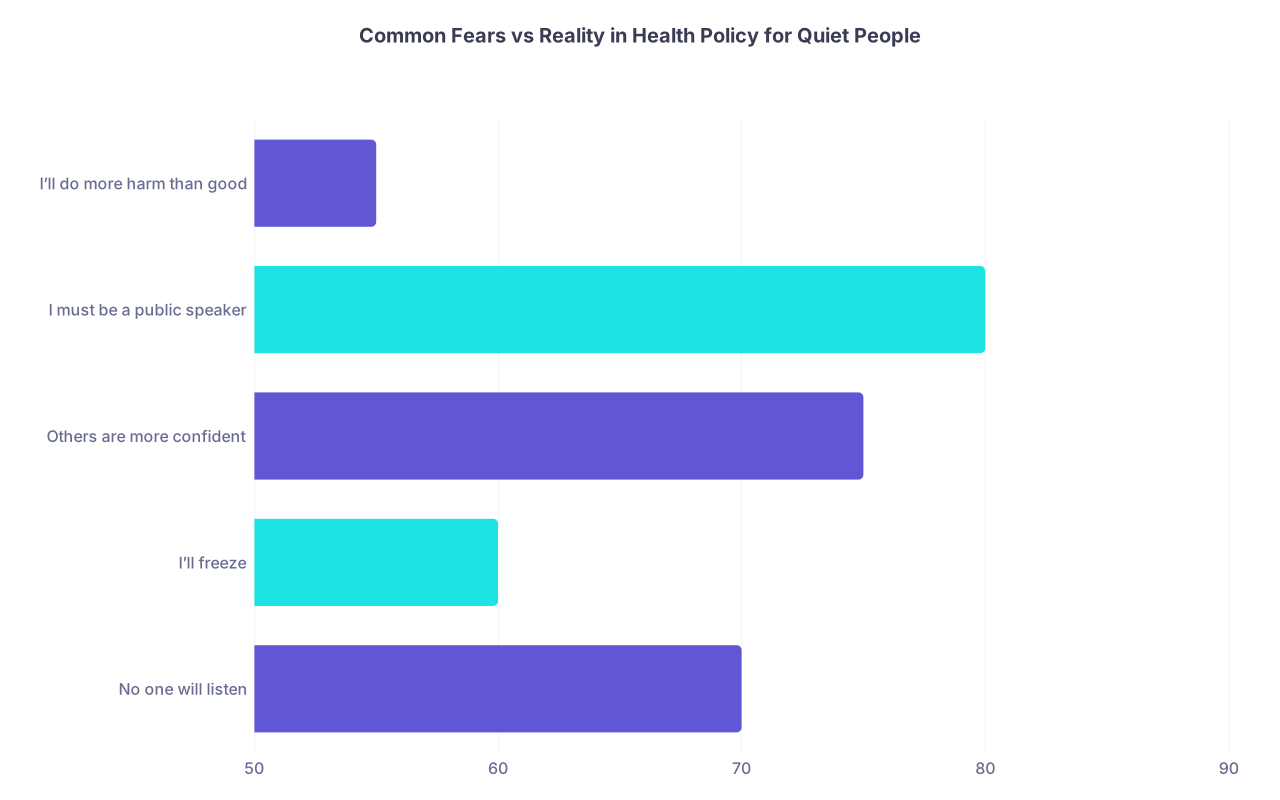
| Category | Value |
|---|---|
| No one will listen | 70 |
| I’ll freeze | 60 |
| Others are more confident | 75 |
| I must be a public speaker | 80 |
| I’ll do more harm than good | 55 |
Those percentages are made up, but the feeling isn’t. Almost everyone quietly worried about policy thinks they’re uniquely terrified. You’re not.
Guardrails So You Don’t Get Swallowed By Guilt or Burnout
There’s one more thing I need to say, because anxious, idealistic people in medicine are prime targets for self-destruction.
You are not morally obligated to become a full-time policy warrior.
You can:
- Care deeply
- Fix what you can in your lane
- Contribute to specific projects that align with your skills and capacity
- Say no to roles that would break you
And still be an ethical, meaningful participant in the health system.
Your job is not to single-handedly repair structural injustice. Your job is to not pretend you don’t see it, and to use some of your abilities—however small they feel—to push in the right direction.
If your contribution is one rigorously done QI project that permanently changes how your hospital handles interpreter services, that is not small. For the families who stop being lost in translation, it’s enormous.
FAQ (Exactly 6 Questions)
1. If I hate public speaking, should I just avoid health policy altogether?
No. Avoiding health policy because of public speaking is like avoiding clinical medicine because you don’t like grand rounds. Public speaking is one tiny slice of the field. You can do research, drafting, implementation, committee work, advocacy writing, or quiet one-on-one persuasion and still be doing real, substantive policy work.
2. Do policy committees even take quiet people seriously?
Yes—if you’re prepared and consistent. I’ve watched very soft-spoken people become the “go-to” person on committees because when they do speak, it’s clear they’ve actually read everything, thought deeply, and care about nuance. Over time, people start almost instinctively turning to them for their opinion. Volume matters way less than reliability.
3. How can I practice speaking up without overwhelming myself?
Start embarrassingly small. Aim to ask or say one thing per meeting: a question, a point of clarification, a short comment. Pre-write a sentence or two before you walk in. If the moment passes, fine. Try again next time. You’re not training for a debate team; you’re just teaching your brain that your voice can exist in the room without disaster.
4. Will being quiet hurt my chances of getting leadership or policy roles later?
It might slow you down if you use quietness as a reason to disengage completely. But if you’re quietly doing excellent work—research, writing, project follow-through—people notice. Many leaders in policy are actually not charismatic extroverts; they’re the person who always showed up prepared and followed through. That’s the trait that gets trusted with responsibility.
5. Is writing (like op-eds or policy briefs) really considered “doing health policy”?
Absolutely. Policy doesn’t exist without words that define it, justify it, and explain it. Op-eds, briefing documents, white papers, organizational position statements—those all shape what decision-makers think is possible or urgent. If you’re better in front of a keyboard than a microphone, lean into that. It’s not second-tier work.
6. What if I try to get involved and feel completely out of my depth or ignored?
That will probably happen at some point. You’ll sit through a meeting full of acronyms and feel like a fraud. Or you’ll make a comment and it’ll land flat. That’s not a sign you don’t belong; it’s a sign you’re new. Ask one person afterward, “Can I run some questions by you?” or “Was I missing something in that discussion?” The people who last in policy are not the ones who never feel lost—they’re the ones who don’t take that feeling as a stop sign.
Years from now, you won’t remember how small your voice sounded the first time you spoke up in a meeting. You’ll remember whether you showed up at all.