
It is 7:45 pm on a Tuesday. Clinic notes are half done, your inbox is a mess, and your phone buzzes with an email from your state medical society:
“Request for comments: Proposed Section 1115 Medicaid Waiver – Work Requirements, Premiums, and Coverage Changes.”
You skim it. It looks dense, legalistic, and frankly exhausting. But then you see the line: “Comments from practicing physicians are strongly encouraged.”
You wonder:
What does this actually mean?
Can I, as one physician with limited time, realistically influence a Medicaid waiver?
And ethically, where does my responsibility start and stop?
Let me break this down specifically, because most physicians were never taught how this part of the system works and policy people like to keep it that way—wrapped in jargon and process.
1. What Medicaid Waivers Really Are (And Why They Matter Clinically)
First, definitions, but the kind that matter at the bedside.
Medicaid waivers are essentially permission slips that states ask from CMS (the federal Centers for Medicare & Medicaid Services) to do things differently than the usual federal rules allow. The big one you will hear about nonstop: Section 1115 demonstration waivers.
A Section 1115 waiver lets a state “test” new ways of delivering or financing care for Medicaid beneficiaries. In practice, these waivers:
- Decide who actually gets coverage
- Decide what services they get
- Decide what hoops they must jump through to keep it
This is not abstract. I have seen:
- A waiver that added postpartum Medicaid coverage to 12 months. That directly changed my OB colleagues’ ability to manage chronic hypertension after delivery.
- A waiver that imposed work requirements and led to thousands of low-income adults losing coverage in Arkansas—people who had jobs or serious illness but could not navigate the reporting system.
- A waiver that carved out addiction treatment into a specialized managed care plan, which made it harder for primary care to coordinate with mental health.
If you see Medicaid patients, you are living under waiver decisions whether you have engaged or not.
Basic Types You Will Encounter
Do not memorize everything. Know the patterns.
The two waiver types that most affect physicians’ daily work:
- Section 1115 waivers – The “big experimental” ones. Coverage expansions, work requirements, premiums, new delivery models, SUD (substance use disorder) reforms.
- Section 1915 waivers – More technical, often for long-term services and supports, home- and community-based services, and managed care arrangements. These impact geriatrics, disability care, and complex pediatric patients a lot.
For most front-line physicians thinking about influence, Section 1115 is your main battlefield.
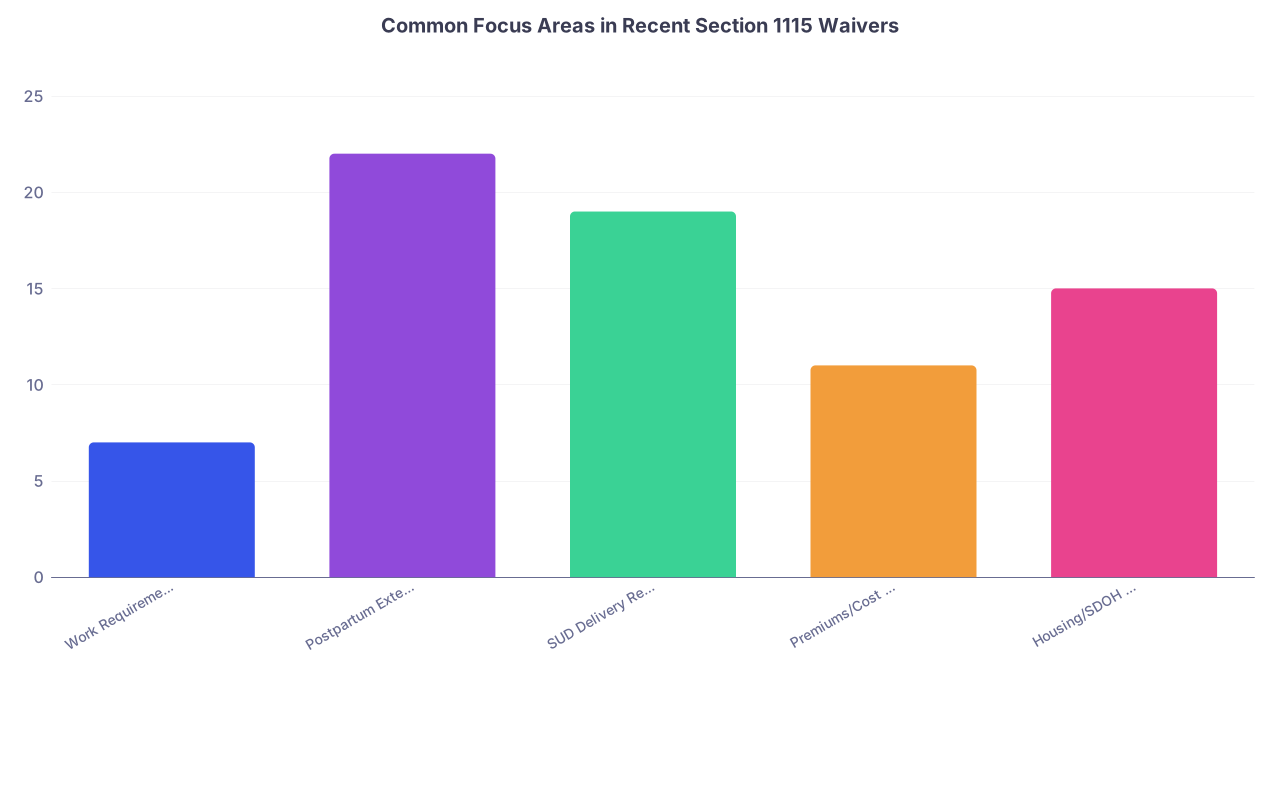
| Category | Value |
|---|---|
| Work Requirements | 7 |
| Postpartum Extension | 22 |
| SUD Delivery Reform | 19 |
| Premiums/Cost Sharing | 11 |
| Housing/SDOH Pilots | 15 |
The numbers here are illustrative but the pattern is real: states are increasingly using 1115s to tinker with coverage, chronic care, behavioral health, and social determinants of health. That is your lane.
2. Where Physicians Actually Sit in the Waiver Power Structure
Let’s be blunt: physicians are not at the top of the Medicaid food chain.
At the top:
- Governor’s office
- State Medicaid director
- Budget/finance staff
- CMS regional/federal officials
Below that:
- Managed care organizations (MCOs) and their lobbyists
- Hospital associations
- Big health systems and FQHC networks
- Large advocacy coalitions
Physicians, unless organized, often sit somewhere between “decorative” and “afterthought.”
But that is the lazy view. The reality is more nuanced:
- Policymakers crave credible, local, clinically grounded stories. They cannot get that from actuarial tables.
- Legal and policy staff routinely cite “provider input” in CMS submissions. If you are not there, someone else defines “provider input” (often insurers or hospital executives, not front-line clinicians).
- Ethics committees, public comment records, and advisory boards are permanently archived. There is a paper trail. That matters when policies are legally challenged, renewed, or revised.
Your individual voice will not rewrite a state’s waiver. But strategic physician engagement can:
- Kill or soften the most harmful pieces.
- Strengthen provisions that actually improve care.
- Give cover to more cautious state staff who quietly agree with you but lack political leverage.
So the question is not “Can I control this?” You cannot.
The question is “Where is my leverage greatest, relative to my effort?”
That is what you need to understand.
3. The Waiver Lifecycle: Where You Can Insert Yourself
Most physicians encounter waivers at precisely the worst time: when they are nearly done and released as a 200-page PDF for public comment.
You still have influence then, but you are late. Let me map the phases and where you fit.

| Step | Description |
|---|---|
| Step 1 | State concept drafting |
| Step 2 | Stakeholder pre-engagement |
| Step 3 | Public comment draft |
| Step 4 | Formal public comment |
| Step 5 | Submission to CMS |
| Step 6 | CMS review and negotiation |
| Step 7 | Approval and implementation |
| Step 8 | Ongoing monitoring and amendments |
| Step 9 | Clinician advisory input |
| Step 10 | Comments and testimony |
| Step 11 | Data and outcomes feedback |
Phase 1–2: Concept and Pre-Draft – Maximum Influence, Minimal Awareness
This is where state Medicaid staff are building the skeleton.
If your state has any of the following, this is your best entry:
- Medicaid physician advisory committees
- Behavioral health or maternal health task forces
- State medical society policy committees
- Academic medical center government relations groups
These groups often hear about waiver ideas months before the public does.
A very practical move:
Ask your specialty society or state medical society:
“Who in our state is tracking Section 1115 waivers, and how can I see early concepts?”
Most will be surprised you asked. That is good. It moves you from passive recipient to early stakeholder.
Phase 3–4: Draft and Public Comment – Where Most Physicians Enter
You see an email: “Comment on X waiver by [date].” This is the familiar point.
Here you can:
- Submit written comments (solo or with colleagues)
- Testify at virtual or in-person hearings
- Feed your insights to groups drafting detailed comments (medical society, AMA state chapter, specialty societies, patient advocacy organizations)
This is where ethically grounded, clinically specific physician voices have real weight, especially when they contradict vague “savings” or “personal responsibility” narratives with data and cases.
Phase 5–7: CMS Review, Implementation, Monitoring – Quiet but Important
After submission, you are not done. You shift to:
- Watching how the waiver is implemented in practice
- Tracking patient harm or benefit
- Documenting barriers: prior auth spikes, coverage loss, disrupted continuity
- Feeding data back to your health system, state medical society, and sometimes directly to CMS regional offices
This is long game work. But for renewals and amendments, these data points matter.
4. Practical Channels of Physician Influence: What Actually Works
There are five main routes for a practicing physician to touch Medicaid waivers in a way that is not just performative.
I will rank them by leverage relative to time.
4.1 Join or Create a Clinician Policy Channel (High Leverage)
If you are serious, start here.
Common structures:
- State Medicaid Clinical Advisory Group
- State medical society Medicaid or public health committee
- Specialty society Medicaid workgroup (e.g., state AAP, ACOG, APA)
- Hospital or academic system “government relations” or “policy and advocacy” committee
These groups typically:
- Receive early drafts or concept papers
- Have scheduled meetings with Medicaid leadership
- Can request briefings on upcoming waivers
You do not need to be a policy PhD. You need to:
- Understand your patients’ real-world barriers
- Tell coherent, specific stories
- Ask sharp questions: “Show me the data that premiums below 100% FPL improve outcomes.”
4.2 Public Comment: How to Write Like a Clinician, Not a Lobbyist
This is where most individuals can contribute without signing up for years of committee work.
A decent physician public comment is not 15 pages of citations. It is 2–4 pages of:
- Clear statement of position
- Tight explanation of clinical and ethical impact
- Specific suggestions or changes
Here is a simple structure you can reuse:
Who you are
“I am an internist practicing in [city], caring for approximately [X] Medicaid patients per year, including [brief description of population].”Core stance
“I support/oppose [specific waiver element], as proposed in Section [X], because of its likely impact on [coverage continuity, maternal mortality, addiction treatment, etc.].”Clinical reality
“In my practice I routinely see [describe pattern]. This waiver provision would likely [exacerbate/mitigate] this by [mechanism]. For example, [1–2 anonymized cases].”Ethical frame
Tie to core ethical principles:- Beneficence: Does this help patients get needed care?
- Nonmaleficence: Does this create foreseeable harm?
- Justice: Does this shift burden onto those least able to bear it?
- Respect for persons: Does it respect patient autonomy or just add surveillance?
Concrete recommendations
Not just “oppose this.” Instead:- “Remove monthly premiums for individuals under 100% FPL.”
- “Allow continuous eligibility for 12 months to reduce churn.”
- “Phase in work programs only after evidence of no coverage loss.”
- “Ensure SUD pilots include access to MOUD in primary care, not just specialty programs.”
Offer to support implementation
“I would be willing to participate in advisory groups or pilots to test approaches that improve care without creating additional access barriers.”
That last line signals you are not just complaining. You are volunteering to help fix the system.
4.3 Testifying at Hearings: The 3-Minute Ethical Story
Public hearings are often under-attended. I have sat in rooms where two Medicaid lawyers, three advocates, and one physician were essentially talking to each other while a state official took notes. That one physician testimony ended up cited later in CMS correspondence.
Your job in 3–5 minutes is not to litigate the entire waiver. It is to land three points:
- Who you are and what population you see
- One specific provision and why it matters clinically
- One ethical framing and one practical alternative
Example focused testimony on work requirements:
“I am a family physician in [city]. About 60% of my panel is insured through Medicaid, including many with multiple chronic conditions who work unstable jobs in retail, food service, and seasonal labor.
The proposed monthly work reporting requirement in Section [X] is likely to cause coverage loss for patients who are already working or too sick to work, because it depends on timely online or phone reporting that many of my patients cannot reliably access.
From an ethics standpoint, this policy shifts the burden of administrative complexity onto those least able to meet it, violating basic principles of justice. I have seen patients with uncontrolled diabetes lose coverage due to missed paperwork. Adding more conditions will not improve their employment; it will worsen their health and make employment less likely.
If the state wishes to support employment, I recommend investing in case management, transportation, and stable coverage instead of conditional coverage. I urge you to remove the work reporting requirement from this waiver.”
That is it. Short, pointed, and grounded in clinical reality.
4.4 Partnering with Organized Medicine or Advocacy Coalitions
You do not have time to read 200 pages. Someone else already has.
The smartest move for a busy clinician: find who is leading the comment process and plug into them.
Usual suspects:
- State medical society
- State AAP, ACOG, APA, ACP chapters
- Hospital association (sometimes aligned, sometimes not)
- Legal aid organizations and public interest law centers
- Disease-specific advocates (e.g., HIV, mental health, disability, maternal health coalitions)
Your value to them:
- Real patient examples
- Data from your clinic or network
- Willingness to put your name and title on a letter or op-ed
Their value to you:
- Drafting capacity
- Policy analysis
- Knowledge of political constraints
This is not “being used.” This is division of labor.
4.5 Internal Influence: Using Your Role in a Health System
If you work in a large system that depends heavily on Medicaid, there is almost certainly:
- A government relations office
- A public policy or community benefit team
Most clinicians never talk to them. That is a mistake.
You can say:
“I see that our state is considering a Medicaid 1115 waiver on [topic]. I can provide front-line perspective on how this will affect care delivery for our patients. Who on your team should I speak with?”
You will be welcomed. Systems are often looking for “real clinician voices” for letters, meetings with state officials, or background for their positions.
5. Ethics in Action: How to Think Through Waiver Proposals as a Physician
You are not a budget analyst. You do not need to be. Your comparative advantage is ethical and clinical reasoning applied to policy.
Here is a usable mental model.
5.1 Core Questions to Run Through
When you see a waiver proposal, ask yourself:
- Who gains coverage or services?
- Who loses coverage or faces new hoops?
- Are the tradeoffs transparent and justified?
- Is there any credible evidence that the proposed change improves health outcomes?
- Does it offload moral and logistical burden from institutions onto individual patients?
Then map to core principles:
Justice
Does this create or reduce inequities?
Example: Extending postpartum Medicaid to 12 months reduces racial disparities in maternal mortality. That is justice-promoting.Beneficence/Nonmaleficence
Does the change likely help or harm your patients?
For instance, imposing premiums on people below 100% FPL has repeatedly been shown to reduce coverage. That is predictable harm.Respect for Autonomy
Are patients given meaningful choices, or just more obligations?
Many “incentive” programs in waivers function more like punishment—lose coverage if you do not complete a program that is hard to access.
5.2 Concrete Ethical Red Flags in Waivers
Over the last decade, there are certain patterns that should trigger your inner alarm immediately.
Common red flags:
- Work or “community engagement” requirements tied to coverage
- Lockouts for failure to pay minimal premiums
- Frequent re-verification or reporting that is practically unworkable for low-wage workers
- Coverage limits or exclusions for critical services (e.g., certain SUD treatments, reproductive health)
- Cost savings goals not tied to quality or outcomes metrics
On the flipside, common ethically positive moves:
- Continuous eligibility for children and adults (12-month coverage without redetermination)
- Expanded postpartum coverage
- Integration of behavioral health and primary care with payment reforms that support it
- Pilots for housing or food supports tied to clear evaluation metrics
- Reduced prior authorization burden for evidence-based treatments
| Waiver Feature | Likely Ethical Direction |
|---|---|
| Work requirements tied to coverage | Problematic / Justice concern |
| 12-month postpartum extension | Positive / Supports equity |
| Premiums for income < 100% FPL | Problematic / Predictable harm |
| Housing support for high-risk members | Potentially positive |
| Narrow SUD provider networks | Problematic / Access concern |
| Continuous child eligibility | Positive / Stability benefit |
You do not need to be neutral about this. Many of these things have been studied. Some are just bad ideas resurrected for political reasons.
6. The Tension: Time, Burnout, and Professional Responsibility
Let us talk honestly. Most clinicians are already underwater. Asking them to read policy documents on top of 60-hour weeks can feel absurd.
So where is the ethical line?
Here is my position, and not everyone will like it:
- You are not required to become a health policy expert.
- You are not morally obligated to respond to every waiver.
- But if a proposal will obviously and significantly harm your patients—by cutting coverage, restricting key services, or adding barriers—you have at least some obligation to try to put that on the record in whatever limited way you can.
That may be:
- Signing onto a well-drafted comment letter
- Sharing a few patient stories with someone who is testifying
- Taking one hour to write a short comment on the single worst element of the waiver
If you are in a leadership role—program director, department chair, CMO—that responsibility is higher. You are closer to power and have more slack in your schedule. Use it.
7. Making This Sustainable: A Practical Engagement Strategy
If you try to respond to everything in depth, you will burn out and quit. So set a realistic structure.
Step 1: Pick Your Domain
You do not need to track all Medicaid policy. Choose one or two domains aligned with your work:
- Maternal health
- Child health
- Behavioral health and SUD
- Primary care access and chronic disease
- Long-term care / disability
Then tell your society or network: “If there is a Medicaid waiver touching [X], loop me in.”
Step 2: Build a Micro-Network
You want 3–6 people you can email when something comes up:
- One policy or legal expert
- One medical society contact
- One or two clinician colleagues who care about this too
- Maybe a patient advocate or social worker
That way, when a waiver appears, you are not alone staring at 150 pages.
Step 3: Develop Two Templates
You do not write from scratch every time. Create:
- A 2–3 paragraph “who I am / what I see” section you can adapt
- A short explanation of key ethical concerns you commonly see (e.g., coverage churn, administrative burden, SUD access)
Then you only customize the middle part for each waiver.
Step 4: Decide Your Time Ceiling
For example:
- Major harmful waiver in your domain: up to 3–4 hours (reading summary, drafting a comment, maybe testifying)
- Moderate impact: 30–60 minutes (sign-on, quick edits, brief email)
You are not a full-time advocate. You are a clinician with bounded energy. Treat this like any other professional responsibility with limits.
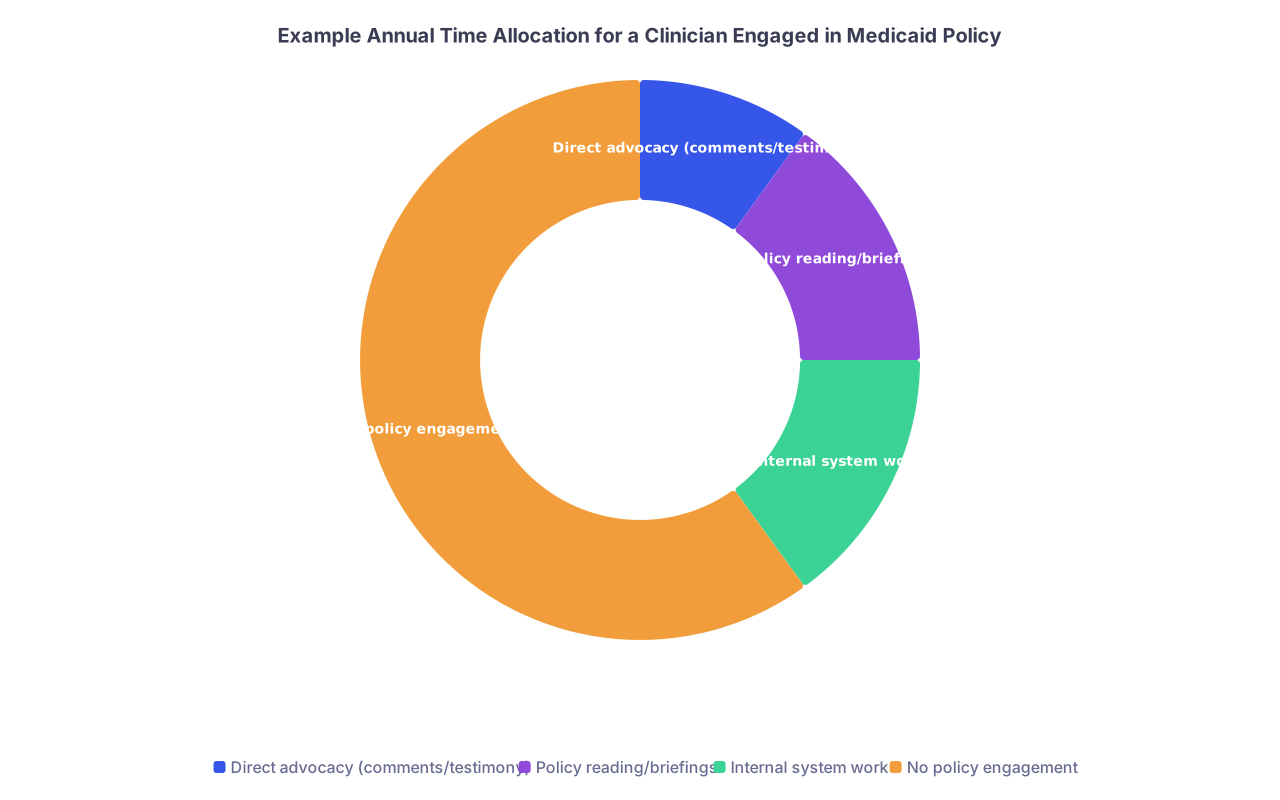
| Category | Value |
|---|---|
| Direct advocacy (comments/testimony) | 10 |
| Policy reading/briefings | 15 |
| Internal system work | 15 |
| No policy engagement | 60 |
That is roughly realistic for someone “moderately engaged” without making this their entire identity.
8. Case Examples: How Physician Voices Have Shifted Waivers
This is not theoretical. A few concrete patterns I have seen:
Case 1: Softening Work Requirements
In one Midwestern state, the original 1115 draft imposed harsh work reporting rules with short coverage lockouts. A coalition of physicians—from primary care, psychiatry, and hospital medicine—testified with specific stories:
- Patients with severe mental illness missing deadlines
- Post-surgical patients temporarily unable to work
- Low-wage workers without reliable internet or smartphone access
Result: the final submission extended reporting windows, added more exemptions, and removed the most punitive lockout period. Work requirements still went forward (until federal action), but the damage was reduced.
Was that “victory”? Not fully. But ethically, reducing foreseeable harm matters.
Case 2: Strengthening SUD Treatment Access
In a New England state planning an SUD-focused 1115, physician addiction specialists pushed aggressively for:
- Coverage of buprenorphine and methadone across settings
- Removal of arbitrary counseling requirements before MOUD
- Explicit coverage for integrated primary care + addiction care models
Their comments were detailed, referenced real clinic workflows, and offered implementation-ready models. CMS took their side in negotiation. The final waiver had broader SUD coverage than the original state draft.
Here, physician expertise did not just block something bad; it created something better.
Case 3: Postpartum Coverage Expansion
Obstetricians and family physicians in multiple states have used maternal mortality data plus day-to-day examples—postpartum depression emerging at 6 months, cardiomyopathy diagnosed late—to make the case for 12-month postpartum Medicaid coverage in waivers.
In several states, their direct engagement, combined with advocates and legislators, turned vague “maternal health improvement” language into concrete coverage extensions. This changed who could be seen, treated, and followed in clinic.

9. What to Watch For Next: Emerging Waiver Trends
If you want to focus your attention, here is where the action is shifting:
- Postpartum and maternal health waivers: standardizing 12-month coverage, adding doula services, mental health supports.
- Behavioral health integration: moving SUD and serious mental illness care into new payment and delivery models.
- Social determinants pilots: housing, food, and transportation “in lieu of” services under waivers.
- “Value-based” care transitions: risk-bearing models pushed into safety-net and primary care settings.
- Redetermination and churn management: post-pandemic coverage cliffs being restructured via waiver.
Physicians have something to say about each of these. Especially where “innovation” is really just shifting risk and complexity onto patients and front-line practices without support.

10. If You Do Nothing Else
You are busy. I am realistic. So if you are going to take only a minimal set of steps based on all this, make it these:
- Identify who in your state tracks Medicaid waivers (medical society, specialty chapter, or health system policy team) and send them one email: “Include me on anything that affects [your clinical domain].”
- Read a summary (not the full PDF) of the next big waiver touching your patients. Decide whether it is mostly benign, mostly positive, or actively harmful.
- If it is actively harmful to your patients’ access or safety, invest one hour: either sign a detailed letter, or submit a short comment with your name and a concrete example.
That is a low bar. But multiplied across hundreds of clinicians in a state, it changes the record. It stiffens the spine of cautious officials. And sometimes, it actually changes the policy.

Key Takeaways
- Medicaid waivers, especially Section 1115, are not abstract policy—they directly determine who you can treat, what you can offer, and how hard it is for your patients to stay covered.
- Your leverage points are clear: early advisory roles, targeted public comments, brief but focused testimony, and strategic partnership with organized medicine and advocacy groups.
- Ethically, you are not obligated to respond to everything, but when a waiver predictably harms your patients—through coverage loss or access barriers—you have a professional responsibility to put that on record, in whatever limited but concrete way you can.