
Most doctors who argue about safe injection sites have never actually stood in one. That is a problem.
If you are going to carry real influence in public health policy, you cannot afford to have fuzzy thinking about supervised consumption sites (SCS) and harm reduction. The evidence base is now deep enough that “I’m not sure” usually means “I have not done my homework” or “I’m uncomfortable with addiction and I’m hiding behind ethics language.”
Let me break this down specifically, from the vantage point of a physician who wants to practice ethical medicine and also speak intelligently in policy spaces.
1. What Safe Injection Sites Actually Are (And Are Not)
First, definitions. Sloppy language is how this topic gets derailed in hospital hallways and legislative hearings.
Supervised consumption sites (SCS) — also called safe injection sites, drug consumption rooms, or supervised injection facilities — are legally sanctioned places where people use pre-obtained drugs under the supervision of trained staff. Often nurses. Sometimes physicians on-site or on-call. Always naloxone within arm’s reach.
They are not places that provide illicit drugs. They are not “shooting galleries with better lighting.” They are structured, protocol-driven clinical and social service environments embedded in a harm reduction framework.
Typical components:
- A reception / check-in area (not a triage desk for moral approval)
- A consumption area with individual booths, clean surfaces, sharps containers
- Sterile equipment: syringes, cookers, filters, tourniquets, water, swabs
- Supervision by nurses, harm reduction workers, sometimes peer workers
- On-site emergency response capacity: oxygen, bag-mask, naloxone, protocols
- Post-consumption “chill” area and linkage to:
- Addiction treatment (OAT, detox, rehab referrals)
- Primary care
- Mental health and social services
- Housing and legal aid

What they are clinically:
- Overdose prevention sites
- Wound and infection control hubs
- Outreach points for highly marginalized patients
- Entry doors into the treatment and health system, for people who otherwise stay outside it
That last function is the one my colleagues underestimate. Many of the people in these rooms will not walk into your clinic, or if they do, they will leave before the third “have a seat and someone will be with you shortly.”
2. The Evidence: Outcomes You Should Actually Quote
If you plan to open your mouth about SCS in any professional context, you need at least a mental “fact sheet” you can pull from without hand-waving.
Overdose and Mortality
The best early data come from Vancouver’s Insite and European drug consumption rooms, then replicated in Australia and more recently in multiple North American cities.
Key findings across sites:
- Marked reduction in on-site overdose deaths: essentially zero when supervised properly.
- Reduction in local overdose mortality around the facility (usually in a 500 m–1 km radius), on the order of 25–35% in several studies.
- Faster overdose response time (seconds, not minutes), so fewer anoxic brain injuries.
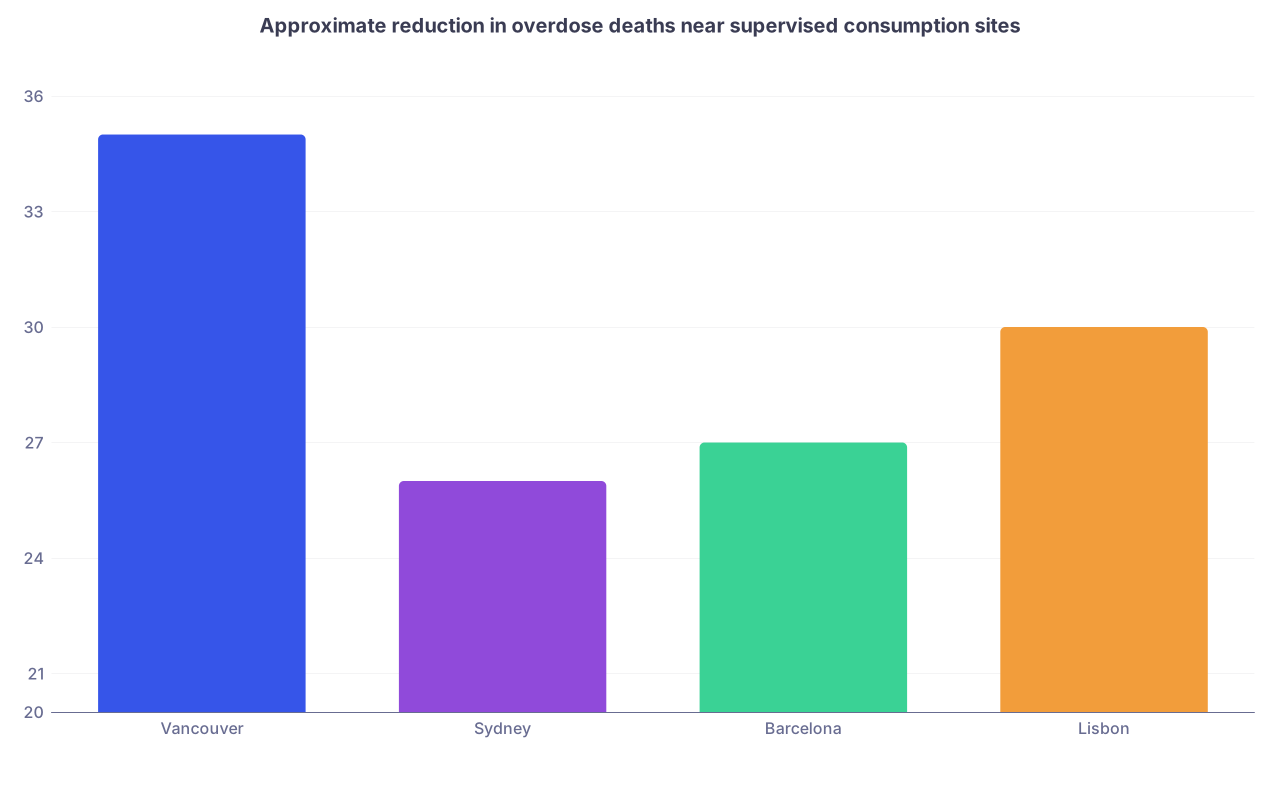
| Category | Value |
|---|---|
| Vancouver | 35 |
| Sydney | 26 |
| Barcelona | 27 |
| Lisbon | 30 |
These numbers move policy. You will hear people question methodology, but the consistency across jurisdictions with very different political contexts is striking.
Infectious Disease and Injection-Related Harms
Repeated findings:
- Lower rates of syringe sharing among SCS users compared with similar users not attending sites.
- Lower incidence of skin and soft tissue infections; fewer ED presentations for abscesses and cellulitis.
- Strong association with earlier referral to HIV and HCV testing and treatment.
You can frame this in hospital language: fewer ICU beds for endocarditis, fewer amputations, fewer weeks of IV vancomycin for preventable infections.
Treatment Engagement and Behavior Change
The lazy criticism: “These sites keep people stuck in addiction.”
The data say the opposite.
Regular SCS users are:
- More likely to enter opioid agonist therapy (OAT) such as methadone or buprenorphine.
- More likely to access detox or long-term treatment when offered.
- More likely to stay engaged with health care services.
One of the better findings: people who use SCS frequently are more likely to attempt to reduce or stabilize their use over time, not escalate it. They also self-report improved injection practices (less rushed, less public, less unsafe).
3. Core Harm Reduction Principles Every Doctor Should Internalize
Before policy, ethics. Most clinicians get into trouble here because they are smuggling moral judgment into “clinical” arguments without noticing.
Harm reduction is not a slogan. It is a set of operational principles:
Drug use exists on a spectrum from occasional, lower-risk use to chaotic dependence with life-threatening sequelae. Our interventions should target risk, not simply “presence of drug.”
Abstinence is a valid goal, but not the only legitimate goal. Safer use, reduced frequency, controlled substitution, or even just surviving another year without HIV are all legitimate clinical wins.
Dignity and autonomy matter even for people who make choices you strongly dislike. That is not moral relativism; it is realism about what coercion achieves long term. (Usually: worse outcomes and patients who learn to lie to you.)
Health is multi-dimensional. Housing, social connection, trauma, and legal status shape risk as much as pharmacology does.
If you accept those points, then supervised consumption is not awkward at all. It is just a logical endpoint of risk-focused, non-coercive medicine.
4. Ethical Analysis: The Framework You Should Use In Debates
Most medical ethics objections to safe injection sites are shallow the first time you hear them. But you still need a structured response. Let us apply classic principles.
Beneficence
Benefit is straightforward:
- Prevented overdose deaths
- Reduced infections and complications
- Increased access to care and treatment
- Stabilization of chaotic use patterns
Any ethicist who has read the literature and still claims “no clear benefit” is arguing from ideology, not data.
Nonmaleficence
The common line: “By supervising use, I am participating in harm.”
The more honest claim: “I am helping someone do something illegal that might kill them.” Except, in the absence of the site, they will still do it. Only now alone, in a stairwell or alley, with a higher probability of death and infection.
You have three options as a clinician:
- Be present and reduce harm.
- Be absent and allow greater harm.
- Be present only on your moralistic terms (abstinence or nothing), in which case they simply avoid you.
If your presence obliges you to prevent every possible self-initiated harm, you should never give a patient with severe COPD a nicotine patch if they insist on continuing to smoke.
The more precise ethical framing is:
- The primary moral agent for the drug use is the patient.
- The clinician is responsible for the safety of the context.
- You are not neutral if you refuse to engage; you are choosing the higher-risk context.
Autonomy
Patients with substance use disorders retain moral agency unless decisional capacity is acutely impaired. Their preferences regarding risk trade-offs and treatment timelines are ethically relevant, even if they diverge sharply from your own.
Supervised consumption respects:
- Informed, voluntary choice to use drugs.
- Informed, voluntary choice to reduce certain risks of that use.
- Informed, voluntary engagement with offered treatment options.
Coercive abstinence programs often violate autonomy more flagrantly than any SCS does.
Justice
Here is where this conversation should become uncomfortable.
The heaviest users of SCS are almost always individuals:
- Experiencing homelessness or unstable housing
- With histories of childhood trauma, incarceration, and systemic racism
- With multiple psychiatric comorbidities
We already accept wealthy patients slowly destroying themselves with wine and benzodiazepines in upscale homes, with concierge medicine mitigating the fallout. We just call that “private care.”
Blocking harm reduction infrastructure for poor, racialized, or stigmatized groups while tolerating more subtle forms of self-harm in privileged patients is a justice problem, not an abstract “ethics of enabling” question.
5. Policy Frameworks: How Different Jurisdictions Actually Do This
You do not need to be a health policy PhD, but you do need a working mental model of how SCS get authorized and constrained.
| Jurisdiction Type | Legal Mechanism | Federal Role | Typical Physician Involvement |
|---|---|---|---|
| Canada (federal waiver) | Controlled Drugs waiver | Direct approval | Medical director, protocols |
| European (statutory law) | National or state law | Minimal to variable | Advisers, on-site clinicians |
| US (litigation-heavy) | Local approval + courts | Often oppositional | Policy advocacy, protocol dev |
Canada
- SCS operate under exemptions (waivers) from federal controlled substances law.
- Applications require evidence of need, community consultation, and detailed protocols.
- Physicians often serve as medical directors, write policies on overdose management, infection control, record-keeping.
Your role: supporting applications with data, testifying to clinical need, helping design clinical protocols and outcome metrics.
Western Europe (Germany, Switzerland, Netherlands, etc.)
- Drug consumption rooms authorized by national or sub-national law.
- Embedded in broader “four-pillar” or “balanced” strategies: prevention, treatment, harm reduction, enforcement.
- Long history, strong evaluation cultures, heavy integration with social services and opioid agonist therapy.
Your role: clinical liaison, integration with primary and specialty care, research.
United States
- Federal law (specifically the so-called “crack house statute”) has been interpreted as banning facilities where drugs are knowingly used.
- Some localities (e.g., New York City, Rhode Island pilot) are pushing ahead under varying degrees of legal risk.
- Heavy litigation, political fluctuation, and inconsistent federal signals.
Your role: credible voice in contentious hearings, helping separate data from moral panic; designing local protocols that are defensible and clearly focused on overdose prevention and disease control.
6. What Doctors Actually Do Inside These Frameworks
Let us get more concrete. You are not just a symbolic supporter. There are specific tasks you should anticipate.
Clinical Protocol Design
You will be expected to shape or sign off on:
- Overdose response algorithms (including when to escalate to EMS).
- Criteria for EMS activation versus on-site management.
- Wound and infection assessment pathways.
- Hepatitis/HIV screening and linkage workflows.
- Vaccination protocols (Hep A/B, influenza, etc.).
- Confidentiality practices and documentation standards.
These are not abstract. They get tested fast the first week the site opens.
Risk Management and Quality Assurance
Boards and public health authorities will ask for your input on:
- Staff training standards: who can administer naloxone, who can start basic airway maneuvers, when to call for backup.
- Adverse event reporting structures.
- Integration with local emergency departments: warm handoff pathways, information sharing (with consent), shared care for high utilizers.
If you have never thought about how to write a protocol that is clinically sound and politically defensible, this is where you grow.
Research and Evaluation
You can be deeply involved in:
- Defining outcome measures beyond “number of visits”:
- Overdoes reversed, EMS transports prevented
- Linkage to OAT or housing
- Infectious disease testing and treatment uptake
- Designing pragmatic studies that actually satisfy skeptical policymakers:
- Pre–post analyses of local overdose deaths
- Temporal correlation with ED utilization
- Qualitative work on patient experiences and barriers
This is where your credibility as a scientist matters. Sloppy or purely descriptive reports will not shift policy in hostile jurisdictions.
7. Common Objections You Will Hear — And How To Answer Them
You will hear the same five arguments on an endless loop. Learn to handle them cleanly.
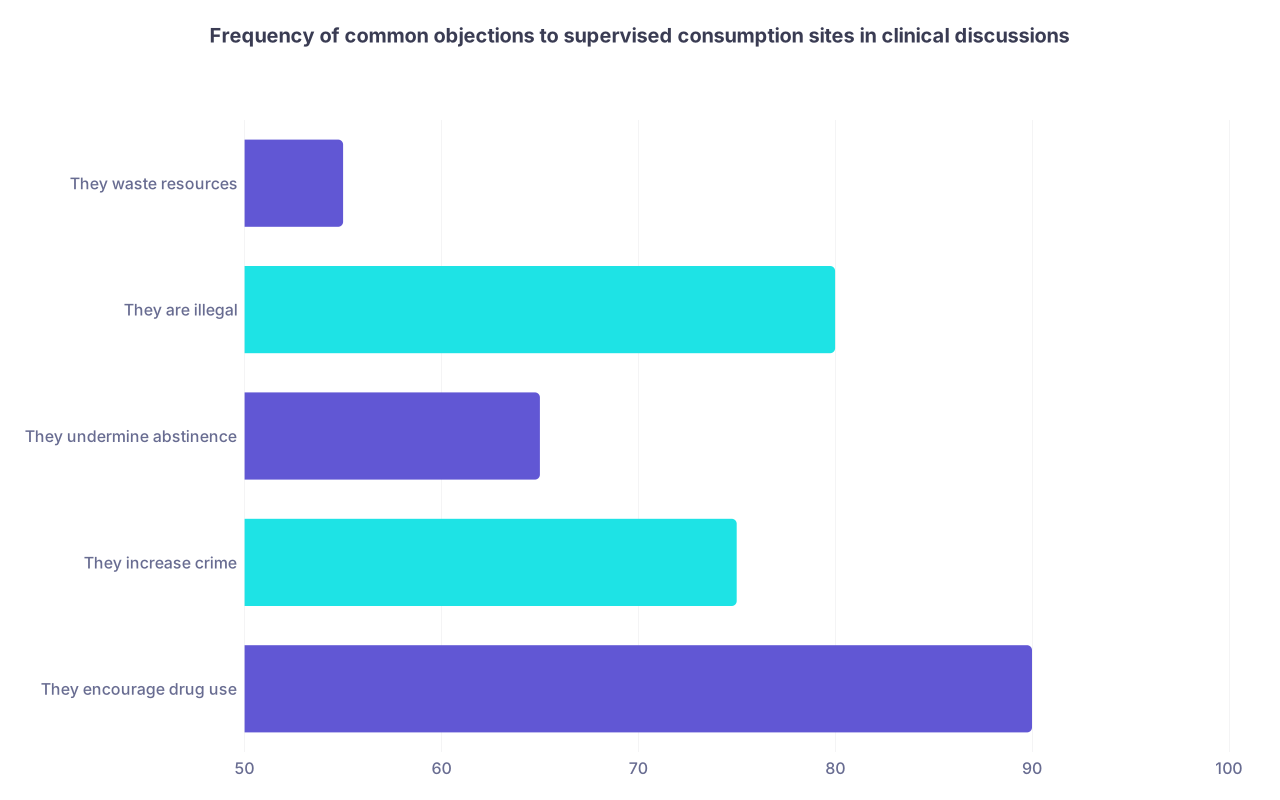
| Category | Value |
|---|---|
| They encourage drug use | 90 |
| They increase crime | 75 |
| They undermine abstinence | 65 |
| They are illegal | 80 |
| They waste resources | 55 |
“They encourage drug use.”
Evidence: people do not start using heroin because a supervised site exists. SCS users are “deep end” users with long histories of drug use.
Response you can actually use:
“We have no good data showing that supervised sites increase the number of people using drugs. We have very robust data showing they decrease deaths and disease among people already using. As a physician, that trade-off is simple.”
“Crime will go up.”
Careful here. The area around a new SCS can feel busier because people are actually congregating in one safer place instead of scattering. But most rigorous studies show:
- No significant increase in serious crime.
- Often a decrease in public injecting and syringe litter.
Reasonable response:
“Public order usually improves: fewer people injecting in doorways or parks, fewer discarded syringes. Crime trends do not spike. The fear here is more about visibility of marginalized people than about actual violence.”
“We should invest in treatment, not enablement.”
Lazy false dichotomy. Smart systems use SCS as treatment entry points.
Better answer:
“Every supervised site I have worked with is one of the most effective referral sources into treatment. These are not competing priorities. If you remove harm reduction, many of the people you want in treatment will never walk through the door.”
“It is against the law.”
Sometimes, yes. That is why physicians must be explicit:
“Our ethical analysis is separate from current statutory frameworks. If the data show benefit, and if the ethics line up, then the law is what needs to change.”
You are not obliged to treat current law as a proxy for morality.
“My conscience will not allow me to help someone inject heroin.”
Fair. Conscientious objection is real. But it carries obligations:
- You must be accurate about the evidence when speaking publicly.
- You should not block colleagues who are willing to staff or support SCS.
- You should consider whether your same standard would forbid nicotine replacement or managed alcohol programs.
What you do not get to do is conflate personal discomfort with medical truth.
8. How To Prepare Yourself As A Physician-Advocate
This falls squarely in your “personal development and medical ethics” bucket. You are shaping the kind of physician you will be in public.
Build A Real Knowledge Base
At minimum:
- Read 2–3 key systematic reviews on supervised consumption sites.
- Skim at least one major evaluation report (e.g., from Vancouver, Sydney, or a European DCR).
- Understand your jurisdiction’s legal stance: what statute or regulation is actually in play, not just “I heard it’s illegal.”
Spend Time On Site If Possible
The difference between a clinician who has actually been inside a site and one who merely imagines it is obvious within 30 seconds of them speaking.
You should aim to:
- Observe the flow: arrival, use, post-use, referrals.
- Talk to staff about real-world challenges: intoxicated clients, violence risk, irregular supplies, burnout.
- Reflect honestly on your own visceral reactions. Disgust, fear, protectiveness, judgment — all of it.
You cannot ethically shape policy based entirely on abstract reasoning if you have avoided direct exposure.
Decide Where You Draw Your Own Lines
You will not agree with every harm reduction intervention.
Some physicians are comfortable with supervised injection but uneasy about safer smoking sites. Others are the reverse. Some support prescribed injectable opioids, others balk.
Your obligation is not to like everything. It is to:
- Ground your stance in evidence and clear ethical reasoning.
- Be transparent about what is truly evidence-based discomfort versus moral or cultural bias.
- Not weaponize your status to shut down interventions that clearly benefit patients just because they violate your aesthetic sense of what “real recovery” should look like.
9. Integrating Harm Reduction Into Your Broader Clinical Ethic
If all this still feels like an awkward exception, you are framing it wrong. Harm reduction is not a weird side project. It is continuous with what you already do.
You:
- Prescribe lower-risk but still potentially harmful medications (opioids for cancer pain, benzodiazepines for severe anxiety) because the alternative is worse.
- Give post-exposure prophylaxis to people who engaged in very high-risk behaviors without interrogating every life choice they made.
- Support depressed patients with realistic but non-zero ongoing self-harm risk out in the community instead of forcing them into locked wards indefinitely.
Safe injection sites are just another place where you accept that:
- You cannot instantly change human behavior.
- You can reduce the worst harms.
- Relationships and trust precede deep change.
If your broader ethic is “I only work with people who are already doing what I think is best,” then you are not practicing realistic medicine. You are curating your own comfort.
FAQ (Exactly 5 Questions)
1. Do safe injection sites actually reduce overall drug use in a community?
No high-quality evidence shows a population-level reduction in drug use purely from opening a supervised consumption site. That is not their primary function. What they do reduce is overdose deaths, infectious complications, and public injecting. Over time, they increase entry into treatment among the heaviest users, which may contribute to reduced harm and potentially reduced use in specific subgroups.
2. Are doctors legally at risk if they work in or support a supervised injection site?
It depends entirely on the jurisdiction. In countries or regions with explicit legal frameworks or federal exemptions (e.g., Canada, several European nations), physician roles are clearly protected. In more hostile legal environments, direct clinical involvement can carry some risk, but policy advocacy, testimony, and research are usually protected speech. You need local legal advice, not hallway rumors.
3. Does working at a supervised consumption site mean I have to abandon abstinence-based goals?
No. You can still view abstinence as an ideal outcome for many patients. Harm reduction does not forbid abstinence; it refuses to make abstinence a prerequisite for compassion or care. Many clinicians working in SCS also run abstinence-focused programs. The key is not to weaponize abstinence as an ultimatum.
4. How do I respond to colleagues who equate harm reduction with “giving up” on patients?
You answer plainly: giving up looks like letting people die in alleys because they will not agree to abstinence. Harm reduction is the opposite. It is staying in the room with patients even when they are not ready to meet your preferred endpoint. You can invite them into treatment relentlessly while still protecting them from the worst immediate harms of ongoing use.
5. What skills should I develop if I want to be effective in harm reduction policy work?
You need three clusters: a solid understanding of addiction medicine and its evidence base; practical experience with marginalized populations and community-based services; and basic policy literacy — how laws are made, how health systems are financed, and how to read and present population-level data. Add to that one more skill: the ability to say uncomfortable truths succinctly, in rooms full of people who would prefer a simpler story.
Key points, briefly:
- Supervised injection sites are evidence-based overdose and infection prevention tools, not moral experiments.
- Ethically, they align cleanly with beneficence, nonmaleficence, autonomy, and justice when you stop pretending abstinence is the only acceptable outcome.
- As a physician, your job is to know the data, understand the policy levers, and decide whether you will be the colleague who quietly reinforces stigma or the one who accepts reality and works to reduce harm.