
Most conversations about Prescription Drug Monitoring Programs focus on the software. The real story is how they quietly rewire clinical ethics and daily practice.
You are not just “checking the PDMP.” You are participating in a state surveillance system that changes how you prescribe, how you trust, and how your patients experience pain care. If you do not understand the policy design under the hood, the tool will control you instead of the other way around.
Let me break this down specifically.
1. What PDMPs Actually Are (Not the marketing version)
A Prescription Drug Monitoring Program (PDMP) is, at its core, a state-run database of controlled substance prescriptions, usually Schedule II–V, reported by pharmacies and dispensing clinicians.
Forget the glossy brochure language. Functionally, PDMPs do three things:
Aggregate:
- They collect data on controlled prescriptions filled in a state (and often from neighboring states through interstate data sharing).
- Fields usually include patient identifiers, prescriber, pharmacy, drug name, strength, quantity, days’ supply, and payment method.
Expose:
- They make this data queryable by:
- Prescribers
- Pharmacists
- Sometimes law enforcement and licensing boards (with varying thresholds of access).
- They make this data queryable by:
Nudge (or shove):
- They are designed to influence prescribing behavior by surfacing “red flags”: multiple prescribers, multiple pharmacies, high morphine milligram equivalent (MME) totals, overlapping benzodiazepine and opioid prescriptions, rapid fills, and cash payments.
That is the architecture. But the purpose differs depending on who you ask:
- Public health officials: Prevention of overdose, early detection of risky use, population-level surveillance.
- Law enforcement: Diversion control, fraud detection, prosecution support.
- Clinicians: Clinical decision support, risk mitigation, and—let’s be honest—“board and DEA shield.”
- Patients: Often feel it as surveillance, suspicion, and barrier.
Those competing purposes are where the ethical friction starts.
2. Key Design Features: The Policy Levers That Actually Matter
The impact on your practice is not mainly “PDMP vs no PDMP.” It is how your state’s PDMP is designed. Three levers matter most: mandates, integration, and access scope.
2.1 Mandatory use vs “voluntary” use
Most states have moved from voluntary to mandatory PDMP checking. But the details vary in ways that directly affect your workflow.
Common mandate types:
- Before first opioid/benzo prescription for a new patient.
- Before each controlled prescription, sometimes with defined exceptions.
- At specific intervals (e.g., at least every 90 days for chronic opioid therapy).
- Triggered by thresholds, like:
- More than 7 days’ supply.
- Dose above a certain MME.
- Combination of opioid + benzo.
These design choices produce very different clinical realities.
| State (example pattern) | Mandate Trigger | Frequency Requirement |
|---|---|---|
| State A | Any opioid Rx | Every prescription |
| State B | >7 day supply | First and q90 days |
| State C | Opioid + benzo | First combo only |
| State D | Chronic opioids | At initiation, q120d |
| State E | None | Voluntary use |
A blanket “check before every prescription” mandate in a busy ED or primary care clinic is not just a minor nuisance. It is a structural change to visit flow. It pushes clinicians toward heuristics and shortcuts, which we will get to.
2.2 EHR integration vs standalone portals
This is where the policy rubber meets the clinic floor.
Two extremes:
- Integrated PDMP:
- Data appears directly in your EHR as a tab or embedded report.
- Single sign-on or near-instant access.
- Sometimes with risk scores or alert banners (e.g., “High overdose risk”).
- Standalone portal:
- Separate website, separate login.
- Often clunky, timed-out sessions, CAPTCHA, slow response times.
- Copy-paste or manual transcription into your note.
Same policy, radically different lived experience. Integrated PDMPs get checked more consistently. Standalone ones push you into one of two behaviors:
- Check only when required.
- Or do “batch checking” for certain “risky-looking” patients—introducing bias.
2.3 Who can see what: Access and secondary uses
Here is where ethical red flags start waving.
Typical roles with some access:
- Prescribers
- Pharmacists
- Delegates (MAs, RNs, residents, sometimes medical students under supervision)
- Licensing boards
- Law enforcement (with or without warrant requirements, depending on state)
- Public health agencies (de-identified or aggregated data for surveillance)
Key design issues:
- Does law enforcement need a warrant, or is “drug-related investigation” enough?
- Can licensing boards perform “fishing expeditions” on prescribers?
- Are there clear rules about when and how PDMP data can be used in malpractice or criminal cases?
These policy decisions change how safe you feel prescribing legitimate opioids for palliative care or severe acute pain. They also shape how comfortable patients feel disclosing use, especially those in marginalized communities.
3. How PDMPs Actually Change Prescribing Behavior
Let me be blunt: PDMPs do not operate as neutral “decision support tools.” They create behavioral pressure.
We have decent data now on high-level effects—reduced high-dose opioid prescribing, less doctor-shopping. But we also have evidence of some ugly side effects.
3.1 The intended effects (that policy makers love to cite)
Most evaluations show:
- Decreases in:
- High MME prescribing.
- Concurrent opioid + benzo prescribing.
- Multiple prescriber use.
- Mixed but often positive impact on:
- Doctor-shopping metrics.
- Prescription opioid–related overdoses (though illicit opioids then take over).
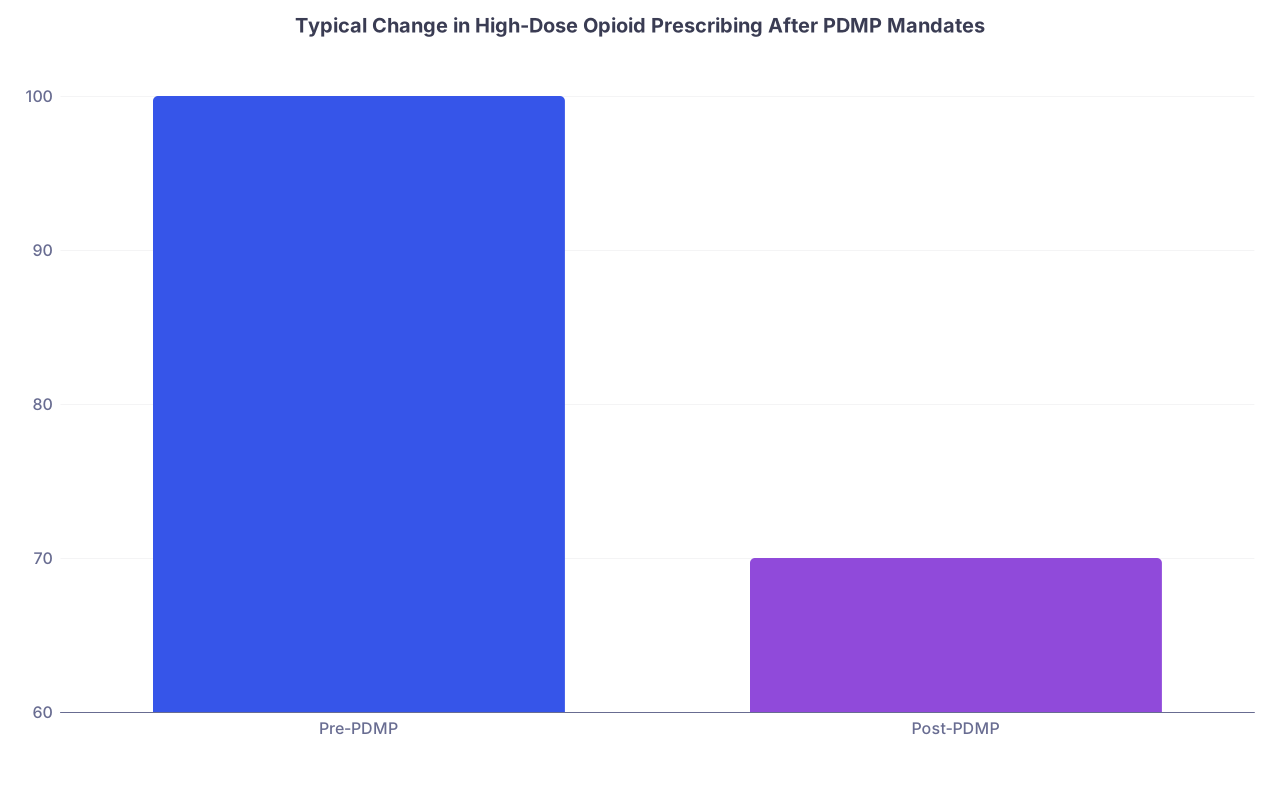
| Category | Value |
|---|---|
| Pre-PDMP | 100 |
| Post-PDMP | 70 |
So on a graph, PDMPs look like a win. Less supply, fewer high-risk patterns. Public health slides look beautiful.
But that is not the full story.
3.2 The unintended—yet entirely predictable—consequences
I have watched this dynamic play out in multiple clinics:
Rapid involuntary tapers and abrupt discontinuations
- Clinicians see a concerning PDMP profile (multiple prescribers, high MME, benzos).
- Panic about liability, board discipline, DEA scrutiny.
- Response: abrupt taper, discharge from practice, “no more opioids” letter.
- Patients: destabilized, in withdrawal, sometimes turning to illicit supply.
Risk-avoidant care
- “I don’t want to be on the PDMP radar.”
- So clinicians:
- Avoid chronic opioids entirely, even when appropriate.
- Refuse to accept inherited patients on high doses.
- Hand off “complex pain” to overburdened or nonexistent pain clinics.
Shift from prescription opioids to illicit opioids
- As prescription access tightens, some patients (especially with opioid use disorder) move to heroin or fentanyl.
- Policy folks like to pretend this is “unrelated.” It is not.
Disparities get worse
- Who gets extra PDMP scrutiny?
- Patients with Medicaid.
- Patients who look “noncompliant.”
- Racial and ethnic minorities.
- People who use substances openly or have mental health diagnoses.
- PDMPs become one more tool that amplifies existing bias.
- Who gets extra PDMP scrutiny?
Visit time squeezed
- You now have 15 minutes to:
- Build rapport.
- Do exam.
- Discuss multimodal pain management.
- Counsel on overdose risk, naloxone.
- And… log into PDMP, interpret results, document your reasoning.
- Guess which piece gets rushed.
- You now have 15 minutes to:
None of these are surprising if you understand behavior under fear and surveillance. That is the ethical terrain you are walking.
4. The Ethical Core: Surveillance, Trust, and Dual Loyalty
Let us talk ethics directly, not in vague “balance risks and benefits” terms.
PDMPs turn you into a gatekeeper backed by a surveillance state. That creates several ethical tensions.
4.1 Autonomy and informed consent
PDMP data sharing is rarely optional for patients. Pharmacies submit data automatically. Patients often have no meaningful way to opt out short of not getting controlled meds at all.
Ethical questions:
- Are you telling patients you are checking their PDMP?
- Are you using that information with them, or against them?
- Do they understand who else may see that data? Licensing boards? Police?
Legally, you do not need explicit consent to check the PDMP. Ethically, hiding the existence of this tool from patients breeds mistrust.
The more transparent, collaborative version:
“Part of safe prescribing now is that I check a state system that shows controlled prescriptions from all pharmacies. I will look at it while we talk, and if something seems off, we will address it together.”
Versus the policing version:
“I checked your PDMP and you have been getting opioids from two other prescribers. What is going on?”
Same data. Very different ethical stance.
4.2 Nonmaleficence vs public health harm
Public health framing: reduce prescriptions → reduce overdoses.
Clinical ethics framing: do not harm this patient sitting in front of me.
Abruptly cutting off opioids in a patient physiologically dependent on them is harm. Not hypothetical. Real-world: withdrawal, uncontrolled pain, suicidality, illicit use.
Your duty is to this patient, even while you recognize population-level risks. That dual obligation—individual care vs public health—is classic “dual loyalty” tension.
The ethically defensible approach:
- Use PDMP data to identify risk.
- Address it with the patient.
- Transition safely:
- Gradual taper vs abrupt stop.
- Offer medication for opioid use disorder (buprenorphine, methadone) when OUD is present.
- Integrate behavioral and non-opioid modalities.
The lazy, fear-driven approach:
- “I saw your PDMP. I am done prescribing. Goodbye.”
I have heard some clinicians justify this with “I have to protect my license.” It is an understandable fear. It is not ethically strong medicine.
4.3 Justice and structural bias
PDMPs sit on top of already biased systems:
- Unequal access to pain specialists.
- Differential policing of drug use by race and class.
- Historical under-treatment of pain in Black patients.
- Over-criminalization of substance use in marginalized communities.
When you use PDMP data, you must ask:
- Who ends up labeled “drug-seeking” or “doctor-shopping”?
- Who is more likely to be dismissed from a practice?
- Who gets offered MOUD vs just cut off?
If your PDMP-triggered decisions reinforce existing disparities, you are not practicing justice, regardless of intentions.
5. Practical Clinical Use: How to Use PDMPs Without Becoming a Jerk or a Robot
Let us get specific about how to integrate PDMP checks into ethically sound, efficient practice.
5.1 A practical workflow for outpatient visits
Here is a realistic, time-conscious pattern that actually works:
Delegate pre-check when allowed
- If your state permits, have MA/RN staff:
- Run PDMP prior to visit for:
- New patients on controlled meds.
- Established patients on chronic opioids/benzos.
- Attach PDF or summary screenshot to chart.
- Run PDMP prior to visit for:
- If your state permits, have MA/RN staff:
Scan, do not obsess
- Look for:
- Multiple prescribers or pharmacies.
- Unexpected meds (e.g., high-dose opioids from another source).
- Overlapping opioid and benzo fills.
- Rapid early refills or escalating quantities.
- Look for:
Contextualize before accusing
- Check for:
- Legitimate multi-prescriber care (ED visit, surgeon, dentist).
- Transitions of care.
- Hospice or oncology involvement.
- Check for:
Bring it into the conversation, not as a weapon
- Phrases that work:
- “This report shows prescriptions filled in the last year. I see something I want to clarify with you.”
- “I see a prescription from the ED for hydromorphone last month. How has your pain been since then?”
- Phrases that work:
Document your reasoning, not just “PDMP checked”
- Example:
- “PDMP reviewed 01/08/2026. Shows oxycodone 10 mg TID from this clinic, also hydrocodone 5 mg q6h PRN #12 from ED visit 3 weeks ago for ankle fracture. No evidence of multiple overlapping opioid prescribers. Will continue current regimen and recheck in 3 months.”
- Example:
This is what protects you clinically and ethically. Not simply that you “checked the PDMP,” but that you actually thought.
5.2 A simple decision framework when you see concerning patterns
Use a three-step mental model:
Check your facts
- Is the data current?
- Could there be identity mix-ups (common names, wrong DOB)?
- Any clear clinical explanations?
Assess risk vs explanation
- Do findings suggest:
- Miscommunication between prescribers?
- Fragmented care?
- Emerging misuse?
- Clear diversion?
- Do findings suggest:
Match response intensity to risk
- Low concern:
- Address with patient, minor adjustments, closer follow-up.
- Moderate concern:
- Tighter refill intervals, pill counts, urine drug testing with explicit consent and explanation.
- High concern / clear danger:
- Gradual taper with transition to MOUD if OUD present.
- Set firm boundaries, but maintain engagement.
- Rarely, consider dismissal only when safety and therapeutic relationship are irreparably broken.
- Low concern:
What you avoid: the reflexive “gotcha → cut off” reflex.
6. Burnout, Moral Distress, and How PDMPs Hit Clinicians Personally
PDMPs are often added on top of existing burnout drivers: prior auths, EHR clicks, quality metrics, “opioid stewardship” committees.
You end up in a predictable bind:
- You want to relieve suffering.
- You are told your prescribing might “fuel the epidemic.”
- You are watched by PDMP analytics, licensing boards, and sometimes your own institution.
- You get mixed messages:
- “Treat pain aggressively.”
- “Do not prescribe opioids.”
- “Document everything.”
- “See 20–25 patients a day.”
That contradiction generates moral distress.
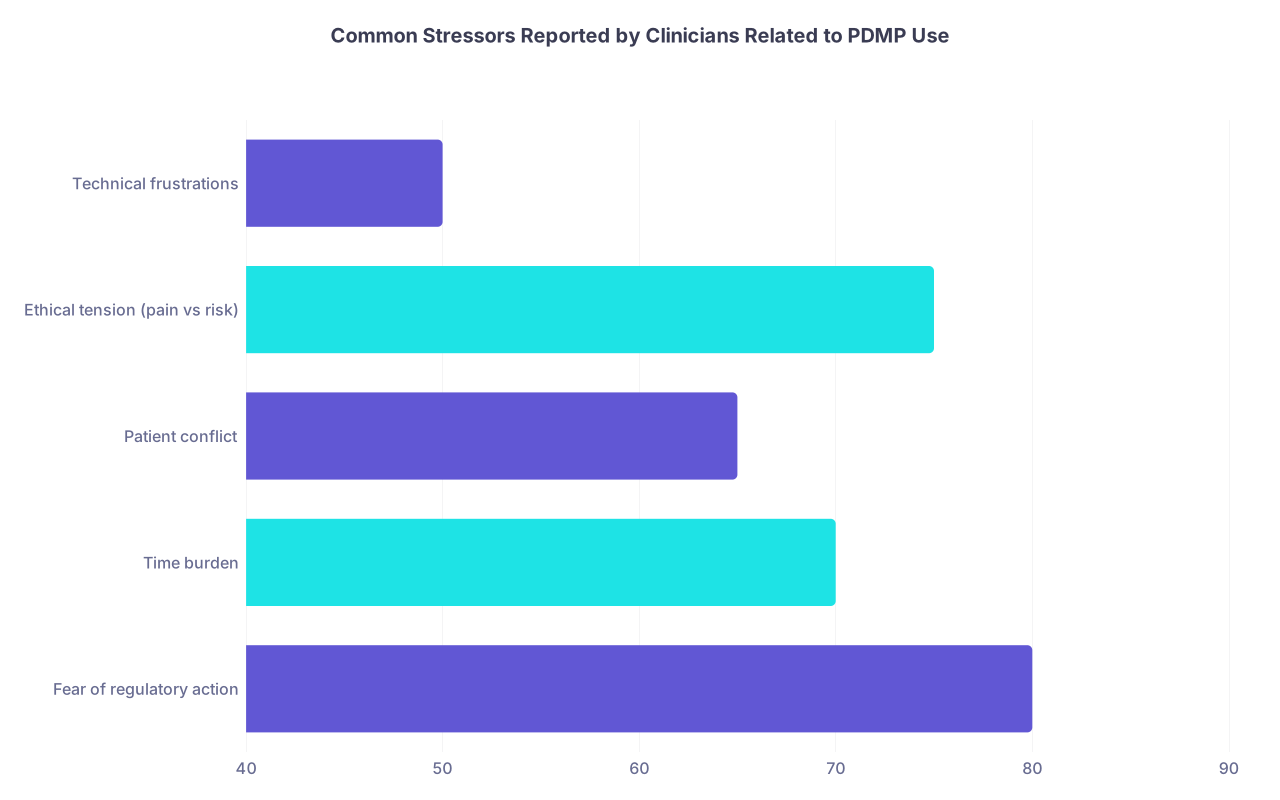
| Category | Value |
|---|---|
| Fear of regulatory action | 80 |
| Time burden | 70 |
| Patient conflict | 65 |
| Ethical tension (pain vs risk) | 75 |
| Technical frustrations | 50 |
Strategies that actually help (beyond “practice self-care,” which is useless advice here):
Team-based decision-making
- Use pain committees, pharmacy consults, ethics consults.
- Share responsibility; do not carry all of it alone.
Clear clinic policies
- Written, transparent policies on:
- When PDMP is checked.
- How aberrant findings are addressed.
- How tapers and referrals are managed.
- This reduces individual arbitrariness and protects both clinician and patient.
- Written, transparent policies on:
Explicit ethics framing
- In training and practice meetings, name the dual loyalty issue.
- Teach residents explicitly:
- “You will feel torn between public health and individual duty. Here is how we think about that as a department.”
Realistic boundaries
- You are not the DEA.
- You are not solely responsible for the opioid epidemic.
- You are accountable for honest, thoughtful, compassionate use of the tools you are given. Nothing more heroic than that.
7. Policy Design Done Right: What a Better PDMP Would Look Like
Current PDMPs are a mixed bag. Some are evolving in the right direction; others are essentially blunt police tools bolted onto care.
If I were designing a PDMP that actually supported ethical clinical practice, it would include:
EHR-native integration
- Single click.
- No separate logins.
- Summary view with drill-down capacity.
- No garish, shaming “high-risk” badges that drive overreaction.
Clinically nuanced alerts
- Not just:
- “High MME: bad.”
- But context:
- “Chronic cancer pain.”
- “Palliative / hospice status.”
- “Recent surgery with defined taper plan.”
- Not just:
Strong guardrails on secondary use
- Law enforcement requires warrant or high, clearly demonstrated threshold.
- Licensing boards use aggregate patterns to trigger outreach and education before punitive actions.
- Transparent, publicly available reports on how often PDMP data leads to disciplinary or criminal actions.
Patient portal visibility
- Patients can view their own PDMP data easily.
- They can challenge errors or identity mix-ups.
- They receive plain-language explanation of who can access their data and why.
Built-in equity checks
- Regular analysis of:
- Differential flagging rates by race, insurance, geography.
- Public reporting.
- Iterative adjustment of algorithms and thresholds to reduce bias.
- Regular analysis of:
Decision support, not decision replacement
- PDMP flags are the beginning of a conversation, not a verdict.
- Systems designed to surface nuance:
- “Multiple prescribers—but all at same cancer center.”
- “Multiple pharmacies—but due to insurance / access issues.”

| Step | Description |
|---|---|
| Step 1 | Clinician opens patient chart |
| Step 2 | Automatic PDMP summary loads |
| Step 3 | Proceed with usual prescribing |
| Step 4 | Clinician reviews details |
| Step 5 | Discuss findings with patient |
| Step 6 | Document reasoning and follow-up |
| Step 7 | Adjust plan and consider MOUD or taper |
| Step 8 | Any concerning patterns |
| Step 9 | Risk remains high |
You cannot fix the system alone, but you can advocate for these features at your institution and with state stakeholders.
8. Bringing It Back To You: Professional Development and Medical Ethics
This is under “PERSONAL DEVELOPMENT AND MEDICAL ETHICS” for a reason.
PDMPs are not just about data and policy. They are about what kind of clinician you are becoming.
Three concrete growth edges:
Moral courage under surveillance
- Prescribing a needed opioid when PDMP is “clean” is easy.
- The real test is:
- Can you still treat pain appropriately when PDMP is messy, but your clinical judgment says the patient is more at risk from abrupt cutoff than continuation with guardrails?
Ethical communication skills
- Using PDMP data without shaming.
- Having blunt, honest conversations about risk and misuse.
- Doing this in a way that preserves dignity, not humiliation.
Systems thinking
- Seeing that every click, every PDMP decision, is embedded in:
- Policy design.
- Institutional culture.
- Historical injustice.
- Using that insight to push for better tools, not just complaining about bad ones.
- Seeing that every click, every PDMP decision, is embedded in:
You do not get points for ignoring the PDMP. Nor for blindly obeying its prompts. Professional maturity here means thoughtful, transparent, patient-centered use of a flawed but powerful tool.
FAQ (Exactly 6 Questions)
1. Am I legally required to check the PDMP for every opioid prescription?
It depends on your state and on the specific scenario. Some states require a PDMP check before any Schedule II opioid prescription; others only above certain day supplies (for example, more than 7 days) or for chronic therapy. There may be explicit exceptions, such as hospice, inpatient care, or ED prescriptions under a low threshold. You need to know your state’s statute and your institution’s policy; do not assume “always” or “never”—the actual text matters.
2. Can I get in trouble for not acting on concerning PDMP findings?
Yes, if your documentation and reasoning are clearly negligent or reckless. Boards and investigators often look at patterns: ignoring obvious doctor-shopping, continuing high-risk combinations without any discussion or mitigation, or failing to address clear diversion. However, you are not obligated to take a punitive approach. If you can show that you reviewed PDMP data, assessed risk, discussed it with the patient, and chose a reasonable plan (taper, MOUD referral, closer monitoring), you are standing on solid ground.
3. Should I tell patients I am checking the PDMP?
Legally, in most jurisdictions, you do not have to. Ethically, you probably should. Transparency builds trust and allows you to use PDMP data constructively rather than as a hidden surveillance tool. A simple, normalized explanation—“I check this for all patients on controlled meds so we can keep you as safe as possible”—prevents the “gotcha” dynamic and often leads to more honest conversation about use, misuse, and goals of care.
4. What if the PDMP is wrong or shows prescriptions that the patient denies?
PDMP data are not infallible. Identity mix-ups, pharmacy entry errors, and timing delays all occur. When there is a discrepancy, stay curious rather than accusatory. Ask for details, check dates, consider ID theft or misidentification, and, if indicated, contact the pharmacy or prescriber listed to verify. Document your concerns and the steps you took. Do not base life-altering decisions solely on a single suspicious entry without confirmation or context.
5. How should I respond if PDMP shows clear evidence of doctor-shopping?
You still have obligations to treat the patient as a person, not a problem. Discuss what you see, give them a chance to explain, and assess for opioid use disorder. If OUD is present, offer or refer for MOUD rather than simply terminating opioids and dismissing them. You may need to tighten monitoring, adjust prescriptions, or decline further controlled meds, but abrupt disengagement without alternatives is clinically and ethically weak. Again, thorough documentation of the conversation and rationale is critical.
6. Do PDMPs actually reduce overdose deaths, or just shift people to illicit opioids?
The evidence is mixed. Many studies show reductions in high-dose prescribing and certain prescription-related harms after PDMP implementation, especially with mandates. However, there is credible concern—and some data—that in regions with aggressive supply restriction and poor access to treatment, people with opioid use disorder are pushed toward street fentanyl and heroin, which carry higher overdose risk. PDMPs alone are not a magic bullet. They must be paired with widespread access to MOUD, harm reduction services, and careful, patient-centered prescribing practices to avoid simply shifting the problem from prescriptions to illicit markets.
With a clear understanding of how PDMPs are built and how they shape your daily decisions, you are better positioned to use them as tools rather than shackles. The next step in your development is learning how to integrate this with complex pain management and addiction treatment—so that “check PDMP” becomes just one small, thoughtful part of genuinely comprehensive care. That is the deeper work ahead.