
You are in the back row of a Wednesday night school board meeting. You came straight from clinic, white coat folded over your arm, Epic notes still half-finished on your laptop. The agenda item is buried as #7: “Discussion – Revisions to School Health and Wellness Policy.” A parent is at the podium arguing that the district should allow “personal belief” exemptions for vaccines. A board member is nodding along.
You realize in real time: there is not a single physician at the microphone. The school nurse is present but quiet. The district’s legal counsel is talking more than anyone with actual health training.
If you do not step into this space, someone else will fill it—with YouTube “research,” political talking points, and anecdotes passed off as data. This is exactly where pediatricians can, and frankly should, influence local school health policy.
Let me break this down specifically.
What “School Health Policy” Actually Means (Not The Vague Version)
People toss around “school health policy” like it is one thing. It is not. It is a cluster of concrete, highly modifiable decisions that directly affect your patients’ health every day from 8 a.m. to 3 p.m.
At the district level, school health policy usually shows up in written board policies, administrative guidelines, and sometimes union contracts. Typical domains:
- Immunization requirements and enforcement (including how strictly exemptions are handled).
- Medication administration and chronic disease management (asthma, diabetes, epilepsy, allergies).
- Illness exclusion and return-to-school rules.
- Physical education requirements and recess policy.
- Nutrition standards: vending machines, competitive foods, classroom rewards, fundraisers.
- Mental and behavioral health supports: school counselors, social workers, threat assessment teams.
- Substance use policy: vaping, marijuana, alcohol, random screening, discipline vs diversion.
- Sexual health education: whether it exists, what is taught, how evidence-based it is.
- Injury prevention and sports safety: concussion protocols, heat policies, athletic clearance.
- Environmental health: indoor air quality, lead in water, mold, safe playground design.
Pediatricians intersect with all of these in clinic notes, 504 letters, and last-minute sports physicals. But that is reactive, patient by patient.
The actual power sits where the policies are written and revised—usually by people who have never spent a day rounding on the pediatric floor.
Where Pediatricians Fit In The School Policy Machinery
You influence local boards through three main channels: formal roles, institutional partnerships, and direct civic engagement.
Let us be concrete.
1. Formal Roles: Committees, Advisory Councils, and Board Seats
Every district of any size has some version of:
- A wellness committee or school health advisory council.
- Policy review committees (curriculum, student services, discipline).
- Occasionally, a dedicated “health services” or “safety” committee.
These structures are usually mandated by state law or accreditation requirements. They are often desperate for people with actual clinical training.
This is where a pediatrician can:
- Help write or revise wellness policies (for example: eliminating food as a reward; setting evidence-based physical activity benchmarks).
- Standardize chronic disease plans (asthma action plans based on NHLBI guidelines; consistent diabetes management protocols).
- Sanitize terrible policies that have been cut-and-pasted from twenty-year-old templates.
The highest leverage version: sitting on the school board itself. That is a different level of time and political exposure, but I have seen pediatricians elected in suburban districts where the campaign boiled down to: “I take care of your kids. I know what keeps them safe. Let me help set policy.”
2. Institutional Partnerships: Schools, Health Departments, and Your Hospital
A lot of boards do not think in terms of “we need a pediatrician.” They think in terms of “we need a community partner.”
You leverage:
- Your local health department: They usually have MOUs with school districts for immunization audits, outbreak response, or school-based clinics. They love having a pediatrician willing to stand in front of a board and say “Here is the data. Here is what we recommend.”
- Your hospital or academic center: Many children’s hospitals have community benefit requirements. They are often looking for concrete projects—school asthma initiatives, mental health screening pilots, obesity prevention programs—that require policy shifts at the board level.
- Existing school-based health centers: If your community has one, it is the most logical bridge between medical and educational systems. Those clinicians often get invited to board work sessions. You can get in through them.
3. Direct Civic Engagement: Public Comment, Op-eds, and One-on-Ones
Sometimes there is no nice committee structure. Just a messy open mic at a board meeting and whoever shows up.
That is where you:
- Testify during public comment when a specific health policy item is being debated (mask mandates, e-cigarette discipline, immunization enforcement).
- Offer to present a short “state of child health in our district” talk at a work session.
- Meet individually with board members or the superintendent as a constituent, not as “Dr. Expert” parachuting in.
You are not trying to be the board’s doctor. You are lending clinical clarity in a space filled with fear, politics, and half-understood statistics.
What Boards Actually Respond To (And What They Tune Out)
Let us be blunt. You can be factually correct and completely ineffective if you present like you are in Grand Rounds instead of a local political body.
Board members are:
- Politicians (even if it is unpaid). They respond to stories, constituents, risk, and optics.
- Worried about legal exposure. “What is our liability if we ignore this guideline and a child is harmed?”
- Sensitive to loud minorities. Ten anti-vax parents in matching T-shirts feel louder than a quiet majority.
You have a few levers.
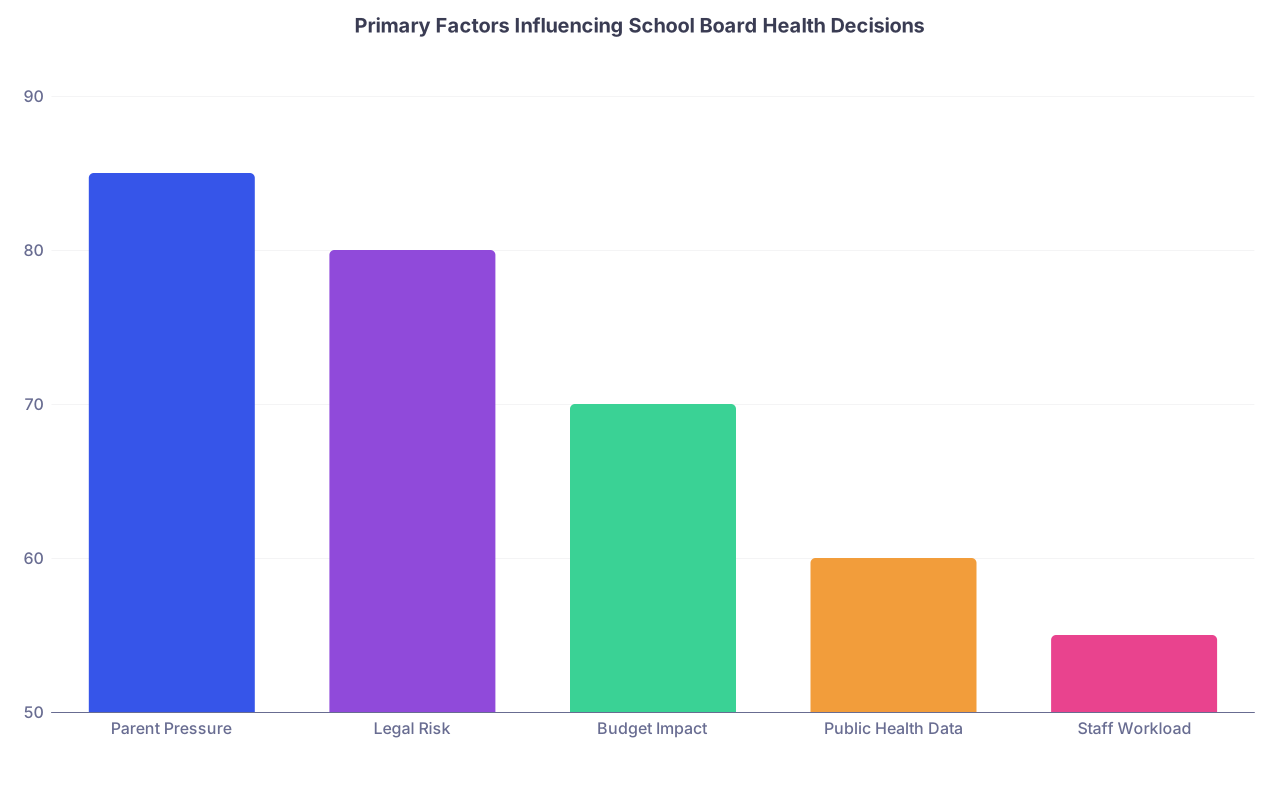
| Category | Value |
|---|---|
| Parent Pressure | 85 |
| Legal Risk | 80 |
| Budget Impact | 70 |
| Public Health Data | 60 |
| Staff Workload | 55 |
Translate Evidence Into Their Language
Example: Vaccine mandates.
Bad approach: “The ACIP clearly recommends…”
Better: “In our county, we had 2 measles cases in 2019. Each exposure meant dozens of children pulled from class, emergency notifications, and hours of staff time. Districts that loosen exemptions have seen repeat outbreaks and heavy media coverage. Maintaining strict immunization policies is actually the least disruptive and safest path for learning and for your legal risk.”
You tie:
- Local data (your county’s immunization rates, outbreaks).
- Operational impact (“This many missed school days, this many staff hours”).
- Legal / reputational risk (“This is what happened in District X when they had an in-school transmission and lax policies”).
Use Clinical Stories—Tightly
One story + one number beats a 20-slide forest plot.
Example: Concussion protocols.
“I admitted a 16-year-old last month who had been put back in the game after a hit because ‘he seemed okay.’ He later deteriorated. Your current policy puts that decision on a coach with no formal training. There is a simple, evidence-based protocol that shifts that responsibility to a designated trained person and keeps kids like him on the field long term instead of in my ICU.”
Then you bring:
- The state high school athletic association recommendations.
- The AAP concussion guidelines.
- Examples of nearby districts already implementing the change.
Boards pay attention when they realize they are out of step with peers.
Acknowledge Tradeoffs Explicitly
If you ignore cost, staffing, or logistics, they will tune you out. They live in constraints; you have to show you see them.
On school nurses, for example:
Instead of “Every school must have a full-time nurse,” try:
“Right now you have one nurse covering 3 buildings, with over 100 students in the district who have an asthma or seizure diagnosis. That is dangerous. I understand you cannot hire ten nurses tomorrow. But there are middle steps: prioritize a nurse in the buildings with the highest medical complexity, use telehealth nursing backup, and tighten your delegation policies so untrained staff are not making medication decisions alone.”
You are not just demanding; you are sequencing realistic steps.
Specific Policy Domains Where Pediatricians Have Outsized Influence
Let me go through concrete areas where I have seen pediatricians move the needle, and exactly how they did it.
Immunization Policy and Exemptions
You already write the medical exemption letters. That is the tip of the iceberg.
Typical leverage points:
- Tightening non-medical exemptions (philosophical, religious, “personal belief”).
- Ensuring accurate audit and exclusion procedures during outbreaks.
- Developing communication strategies that present vaccines as default, not optional.
How you influence:
Present district-level immunization data:
- Overall compliance.
- Clusters of under-immunization (often tied to particular schools or neighborhoods).
- Comparison to state averages and neighboring districts.
Link exemptions to outbreak risk in plain language:
- “Once more than 3–5% of students in a building have exemptions, that school becomes an obvious weak point for measles or pertussis. That is not theoretical. It has already happened in [nearby area].”
Clarify medical vs non-medical:
- Offer to review and help standardize criteria for medical exemptions based on ACIP and AAP guidance.
- Encourage a policy that requires annual renewal and physician documentation for medical exemptions.
Offer solutions that are not just “be stricter”:
- School-based immunization clinics in partnership with the health department.
- Opt-out framing instead of opt-in for reminder notices (“Your child is due for…” instead of “Would you like to…”).
You are the one person in the room who both knows the science and sees the community-level consequences.
Asthma, Diabetes, and Chronic Disease Management
This is where school policy quietly makes or breaks your outpatient work.
Common problems:
- Inconsistent use of asthma action plans.
- Restrictive rules about students carrying inhalers or epinephrine.
- Untrained staff administering insulin or glucagon.
- Poor communication between clinic, parent, and school nurse.
Your influence:
- Advocate for district-wide standardized forms based on national guidelines (not 14 slightly different “med forms” per school).
- Push policies that allow capable students to self-carry inhalers and epinephrine with appropriate safeguards.
- Support stock emergency medication policies (stock albuterol, stock epinephrine) and training requirements.
You can walk into a board work session with:
- Brief data: hospitalizations or ED visits for asthma by zip code.
- Case examples (de-identified) of children whose asthma is well-controlled at home but constantly exacerbated at school due to triggers and delays in medication.
- A model policy from your state AAP chapter or national organizations.
A very practical step: explicitly offer to review and revise the district’s medication administration and chronic disease policies once every 2–3 years. Most boards are relieved someone competent wants this job.
Mental Health, Suicide Prevention, and Discipline
Post-COVID, every school district is talking about student mental health. Most are flailing.
You step in on several fronts:
- Screening and referral: Advocate for schoolwide programs that are actually validated, and for clear referral pathways to community resources.
- Suicide prevention: Support evidence-based training for staff, crisis protocols, and reasonable postvention policies that avoid glorification.
- Discipline policies: Push for approaches that separate mental health crises from pure “behavioral issues,” and that minimize exclusionary discipline that worsens depression and anxiety.
Ethically, this is delicate. You are not the district psychiatrist. But you can:
- Explain what an appropriate response to a suicidal disclosure looks like, versus a knee-jerk suspension or police referral.
- Clarify the difference between short-term safety planning and long-term treatment.
- Reinforce that ignoring mental health has huge academic, legal, and safety consequences.
You will run straight into issues of confidentiality, parental rights, and community values. This is where your role as an honest broker—“Here is what helps kids and what does not”—matters more than your credentials.
Ethics: How To Use Your Authority Without Abusing It
The second half of your question—personal development and ethics—sits right here. Being “Dr. So-and-so” at a school board meeting gives you power you can misuse if you are not careful.
Know When You Are Out of Your Lane
Pediatricians are not automatically experts in:
- Curriculum design.
- School finance.
- Every subspecialty area (for example, complex special education law).
If you get asked, “Doctor, do you think we should adopt this specific math curriculum?” the correct answer is: “That is outside my expertise. My concern is how we address the students who may struggle due to behavioral or learning differences. Here is what I see clinically and what helps them.”
Stay anchored:
- To child health, safety, and development.
- To domains where there is actual consensus evidence (AAP, CDC, major societies).
- To clearly explaining uncertainty when it exists.
Avoid Being a Political Weapon
Boards love putting a doctor at the mic when it supports what they already want to do. Parents do the same. That is where your ethical compass comes in.
Ask yourself:
- Am I here primarily to support a political faction, or to advocate for child health?
- Am I presenting the full picture, including harms and tradeoffs—even if they cut against my “side”?
- Have I disclosed my relevant affiliations? (For example, ties to a hospital that might profit from a proposed clinic.)
In practice, this often means:
- Turning down invitations that want you to deliver a pre-scripted line on a controversial issue where evidence is weak or heavily value-laden.
- Being willing to disappoint both “sides” by insisting on data and nuance.
Respect Student and Family Autonomy
You can easily drift into talk that sounds like you want the school to override families. That erodes trust fast.
Example misstep: “Parents are often wrong about vaccines, so the school must enforce mandates.”
Better framing: “Families have deep concerns. My role in clinic is to listen and respond honestly. The school’s role is different: to ensure a safe environment for all students. Strong immunization policies are about protecting vulnerable students who cannot be vaccinated, not about punishing anyone.”
You hold two truths:
- Families have a right to make decisions for their children.
- Schools have a duty of care to the entire student body.
Ethics is staying honest about that tension, not pretending it does not exist.
Be Transparent About Evidence Limits
Some school health areas are built on rock-solid data. Others are… not.
Example: Cell phones and mental health.
You will be tempted to say, “Phones are killing our kids’ mental health, ban them all day.” Does excessive social media correlate with worse mental health? Yes. Is the evidence that in-school bans significantly improve outcomes strong? Thinner.
An ethical approach:
- “There is decent evidence that heavy, unsupervised social media use correlates with increased anxiety and depression. The link is not simple cause-and-effect, but it is strong enough that limiting exposure, especially during the school day, is prudent. That said, any policy you adopt should be evaluated for effectiveness and unintended consequences, rather than assumed perfect from day one.”
You model intellectual honesty. That is far more powerful than overselling certainty.
Practical Steps: How To Start Influencing A Local Board Next Month
Theory is fine. Let me give you an actual sequence.

| Step | Description |
|---|---|
| Step 1 | Identify Target District |
| Step 2 | Map Key Players |
| Step 3 | Reach Out to School Nurse or Health Dept |
| Step 4 | Attend Board Meeting |
| Step 5 | Offer to Serve on Committee |
| Step 6 | Prepare Evidence and Stories |
| Step 7 | Present at Work Session |
| Step 8 | Follow Up and Refine Policy |
Pick one district.
Where most of your patients attend school. Not the whole county. One.Map the players.
- Superintendent.
- Board members.
- Director of student services or health.
- Lead school nurse (if the district has one). Two emails and a school website search will usually get you this.
Introduce yourself to the school nurse or student services director. A short email: who you are, your practice, that you care about student health, you are available as a resource. Ask what their top 2–3 health challenges are.
Start showing up. Attend at least one board meeting just to listen. See how they handle public comment, what their dynamics are, who dominates discussions.
Watch the agenda. Almost always posted online a few days in advance. When a health-related policy is listed (immunizations, mental health supports, wellness policy), that is your opening.
Offer value, not criticism.
- To the superintendent or board chair: “I saw you are revising X policy. I am a local pediatrician; I would be happy to provide a brief evidence summary and answer questions if that would be helpful.”
- To the school nurse: “I can help validate our protocols against national guidelines.”
Prepare like a lawyer, speak like a neighbor.
- 2–3 key data points.
- 1–2 clinical stories.
- A one-page handout with references and concrete recommendations.
Follow through. Policies rarely change after one meeting. Stick around. Offer to serve on an advisory group. Expect this to be a 1–3 year relationship, not a single “drop in, drop wisdom, and leave” event.
Guardrails For Your Own Sanity
One more piece: this work can chew you up if you go in naive.
- Time: Be honest about what you can sustain. A quarterly committee role might be manageable. Weekly activism probably is not.
- Emotional wear: Board meetings are often ugly. You will hear conspiracy theories about vaccines. You will watch adults fight over wash-your-hands level truths. Decide what you can stomach and when to walk out.
- Boundaries with patients: Do not turn every clinic visit into a policy debate. But when a parent complains about school asthma management, you can say, “I also serve on the district’s health advisory committee; I will bring this pattern up—thank you for telling me.”
- Safety: On hot-button issues (for example, masks during COVID), physicians were doxed and harassed. If you wade into those waters, document communications, coordinate with your employer, and be thoughtful about how much personal info you share publicly.
Being effective sometimes means pacing yourself, not throwing yourself against every bad policy at once.
How This Changes You As A Physician
This is personal development, not just public health.
Once you have spent a year dealing with a school board, you:
- Think differently in clinic: You stop writing ridiculous, impossible orders (“Needs one-on-one nurse all day”) and instead think in tiers: what is essential, what is negotiable.
- Communicate differently: You become better at boiling down evidence into language that actually moves non-physicians. That skill helps everywhere—family meetings, media interviews, advocacy at the statehouse.
- Understand systems: You stop pretending health happens only in hospitals and homes. You see the daily grind of classrooms, cafeterias, and bus routes.
There is also an ethical maturation here. You confront in real time the tension between ideal recommendations and what a resource-limited school can actually do. You learn the uncomfortable art of “better but not perfect” policy—and you learn when to accept that and when to dig in your heels.
| Policy Area | Your Best Entry Point | Typical Ask |
|---|---|---|
| Immunizations | Health dept + board mtg | Tighten exemptions, add SB clinics |
| Asthma/Allergies | School nurse | Standard action plans, stock meds |
| Diabetes Management | Student services director | Clear protocols, staff training |
| Mental Health Supports | Superintendent/work session | Evidence-based screening, referral |
| Concussion/Sports | Athletic director + board | Enforce return-to-play guidelines |
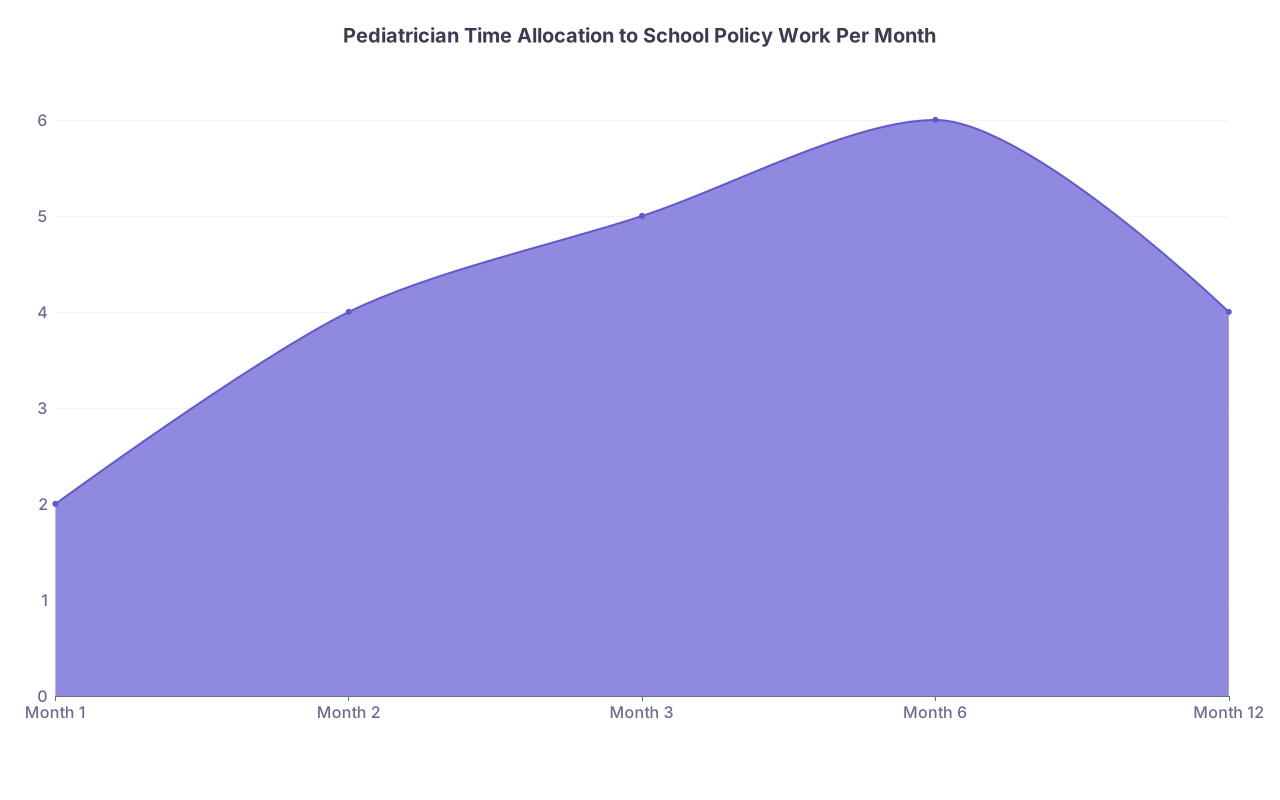
| Category | Value |
|---|---|
| Month 1 | 2 |
| Month 2 | 4 |
| Month 3 | 5 |
| Month 6 | 6 |
| Month 12 | 4 |
You will notice something if you track your time: the early months are heaviest as you learn the system, meet people, and build trust. Then it settles into a more predictable rhythm—an evening meeting here, a policy review there, an occasional intense stretch during a controversial vote.


You are standing in that board meeting again. Immunizations, mental health, vaping, recess time—it all gets rolled into a ninety-minute argument sandwiched between bus contracts and roofing bids. The board is about to vote on something that will affect hundreds or thousands of kids you care for.
You cannot fix everything in that room. You will not win every vote. But if you have done the slow, unglamorous work—built relationships, joined committees, translated evidence into their language—you are no longer watching helplessly from the back row.
You are the person they look toward when the conversation turns to student health. You are the steady voice that keeps at least some policies tethered to reality, not rumor.
With that foundation, the next step in your journey is obvious: bring trainees with you. Let residents sit in on those meetings. Show them that pediatrics is not only 15-minute visits and EHR clicks. Show them that the health of their patients is being shaped in school board conference rooms—and that they have every right, and I would say obligation, to be there.
The mechanics of building that kind of advocacy into residency training, and into your own career long-term, is its own topic. But once you have taken that first step into local school policy, you will not look at those agenda packets—or your clinic notes—the same way again.