

The biggest ROL mistakes do not happen in October. They happen in the last 72 hours when people rush, panic, or blindly trust “vibes” and friends’ opinions.
You’re too close to the finish line to wing it now.
I’m going to walk you through the final 3 days before you certify your Rank Order List, hour by hour in broad strokes, with exact sanity checks and safety steps. At each point: what you should be doing, what you should stop doing, and what absolutely must be double‑checked before you click “Certify.”
Big Picture: Your Last 72 Hours Timeline
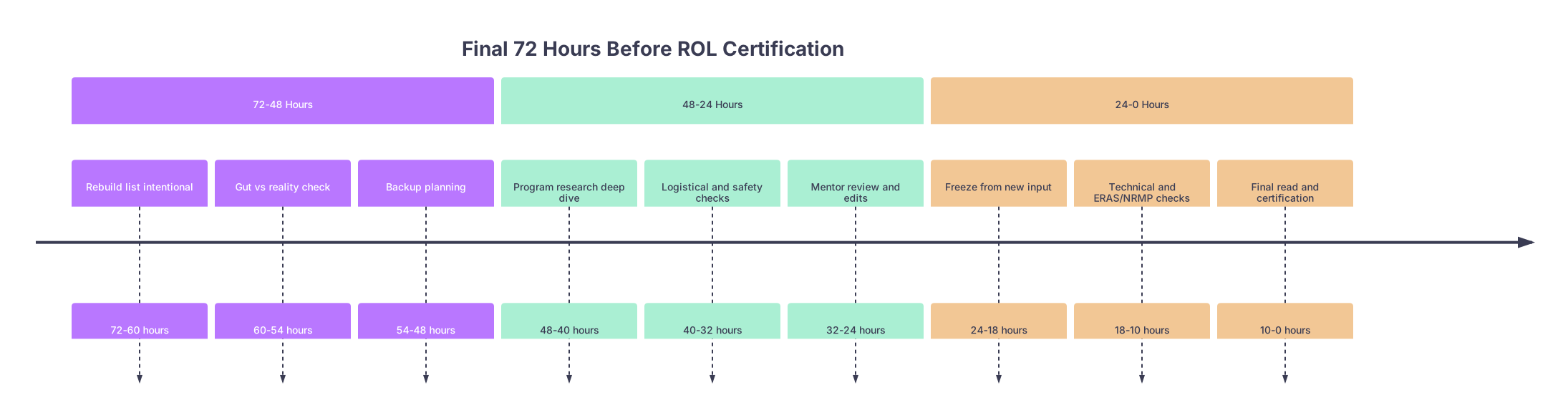
| Period | Event |
|---|---|
| 72-48 Hours - Rebuild list intentional | 72-60 hours |
| 72-48 Hours - Gut vs reality check | 60-54 hours |
| 72-48 Hours - Backup planning | 54-48 hours |
| 48-24 Hours - Program research deep dive | 48-40 hours |
| 48-24 Hours - Logistical and safety checks | 40-32 hours |
| 48-24 Hours - Mentor review and edits | 32-24 hours |
| 24-0 Hours - Freeze from new input | 24-18 hours |
| 24-0 Hours - Technical and ERAS/NRMP checks | 18-10 hours |
| 24-0 Hours - Final read and certification | 10-0 hours |
We’ll break this into:
- 72–48 hours before submitting
- 48–24 hours before submitting
- 24–0 hours before submitting
And within each, I’ll tell you: “At this point, you should…”
72–48 Hours Before Submitting: Strip It Down and Rebuild
At this point you should stop touching ERAS/NRMP and start working on paper (or offline).
Close the browser. Seriously. People destroy good lists by nudging things live while they’re still thinking.
Step 1 (T–72 to T–66 hours): Extract and freeze your current list
At this point you should:
Export or write down your current ROL exactly as it appears:
- Open your NRMP (or CaRMS/other) list.
- Take screenshots of the entire list.
- Also write it out in a text doc or spreadsheet in order: #1, #2, #3, etc.
Label this file clearly:
- “ROL_current_[date]_[time].”
- This is your baseline. If you panic later, you can always revert to this instead of starting from chaos.
Put that file somewhere backed up:
- Cloud folder (Google Drive, Dropbox, iCloud).
- Email it to yourself if you have to.
This is your safety net. If you change your mind and then regret it, you have something real to return to.
Step 2 (T–66 to T–60 hours): Rebuild your list from zero (offline)
Now you’re going to rebuild your ROL from scratch, away from the website.
Make three columns on paper or spreadsheet:
- Column A: Program name
- Column B: True desirability (gut rank 1–10)
- Column C: Deal-breaker flags (Y/N + short note)
At this point you should:
Dump every program you interviewed at into the sheet. No order yet.
For each program, write a gut number (1–10) based on where you’d want to train if all else was equal.
- 9–10: “I’d be excited to open this Match envelope.”
- 7–8: “Solid; I’d be content, maybe even happy.”
- 5–6: “Acceptable but with real concerns.”
- 1–4: “Only here to avoid going unmatched.”
Add deal-breaker notes:
- Examples:
- “Partner can’t work there (no license reciprocity).”
- “PD retiring and program unstable.”
- “Malignant culture from multiple residents.”
- “No ability to do fellowship I want.”
- Examples:
Programs with true deal-breakers need to be scrutinized hard before they stay on the list at all.
Step 3 (T–60 to T–54 hours): Reality vs. rumor check
This is where I watch people get manipulated by other applicants every year.
At this point you should:
Ignore:
- “They said they’re ranking me highly.”
- “They sent me a ‘you are in our top tier’ email.”
- “My friend matched there and said they don’t like IMG/DO/low Step” (unless coming from multiple trusted sources).
Focus on things that actually matter:
- Where you want to live.
- Where you felt supported on interview day.
- Faculty quality and resident satisfaction.
- Board pass rates, fellowship placement.
- Visa/IMG policies if applicable.
For your top 5–10 programs, write one sentence:
- “I want Program X at #1 because ______.”
- If that sentence is anything like, “Because I think I have the best chance there,” you’re thinking wrong. NRMP algorithm rewards your preferences, not your odds.
You should be asking: “If I match here, will I be okay waking up at 4:30am in January to go there for 3 years?” Not: “Do they like me.”
Step 4 (T–54 to T–48 hours): Build your provisional offline rank list
Now assemble your Provisional List v1 offline.
At this point you should:
Order programs purely by where you’d most like to train, ignoring:
- Where you think you’re “competitive.”
- Who sent you love letters.
- Who ghosted you post-interview.
Mark the cut line:
- The point where programs stop being “I would be okay training here” and start being “I would be moderately horrified but less horrified than being unmatched.”
- That cut line matters. Programs below it can stay, but they’re clearly labeled as “safety only.”
Make two versions side-by-side:
- Version A: Pure preference (dream-first, all the way down).
- Version B: Preference + life logistics (partner, childcare, money, visas).
You’re not deciding yet. You’re setting up the comparison you’ll do in the next 24 hours.
48–24 Hours Before Submitting: Deep Checks and Risk Management
This is where you stop rethinking your whole strategy and instead attack the details. Mistakes now are almost always logistical, not philosophical.
Step 5 (T–48 to T–40 hours): Reality-check the top 10
At this point you should put your top 10 programs under a microscope.
For each program in your top 10, confirm:
Location practicality
- Can you actually live there on a resident salary?
- Is cost of living going to drown you? (NYC, SF, Boston for someone with 200k+ loans and no savings? Needs thought.)
Support and culture
- Did residents look exhausted vs. normally tired?
- Any red flags like:
- “We don’t have any problem residents here” (they do, they’re just not reflective).
- “We’re like a family, we hang out all weekend” (for some this is a bug, not a feature).
- Residents not allowed to speak to you without staff present.
Training quality
- Volume and pathology.
- Fellowship placement if needed (cards, GI, heme/onc, etc.).
- Board pass rates and remediation support.
| Program | Location OK? | Culture Safe? | Training Strong? | Deal-Breaker? |
|---|---|---|---|---|
| #1 | Yes/No | Yes/No | Yes/No | Y/N |
| #2 | Yes/No | Yes/No | Yes/No | Y/N |
| #3 | Yes/No | Yes/No | Yes/No | Y/N |
| #4 | Yes/No | Yes/No | Yes/No | Y/N |
| #5 | Yes/No | Yes/No | Yes/No | Y/N |
Any program in your top 5 with “No” in culture or deal-breaker = serious rethink. I’ve seen too many people miserable at “prestigious” places they knew in their gut were wrong.
Step 6 (T–40 to T–32 hours): Safety and unmatch risk check
Now zoom out: completeness and safety.
At this point you should:
Count how many programs you’re ranking:
- For competitive specialties (Derm, Ortho, ENT, Plastics, Rad Onc):
If you’re under ~12–15, your unmatch risk is nontrivial. - For moderately competitive (EM, Anesthesia, General Surgery, Neuro, Ob/Gyn):
Under ~10–12 is thin. - For IM, Peds, FM, Psych (US MD/DO):
Under ~8–10 can be risky if you’re not a strong applicant.
- For competitive specialties (Derm, Ortho, ENT, Plastics, Rad Onc):
Mark your true safeties:
- Programs where:
- You interviewed.
- You’re not obviously overreaching (they don’t only take 260+ Step 1 types, etc.).
- You could live with going there.
- Programs where:
Confirm they’re on the list and not bunched at the very bottom out of ego.
- The algorithm doesn’t punish you for ranking high programs you’re unlikely to get. But it can punish you for pushing safe-but-acceptable places lower than places you actively dislike.
If your list is very short or top-heavy, this is the time to accept reality and keep some “less sexy” programs higher than your pride wants.
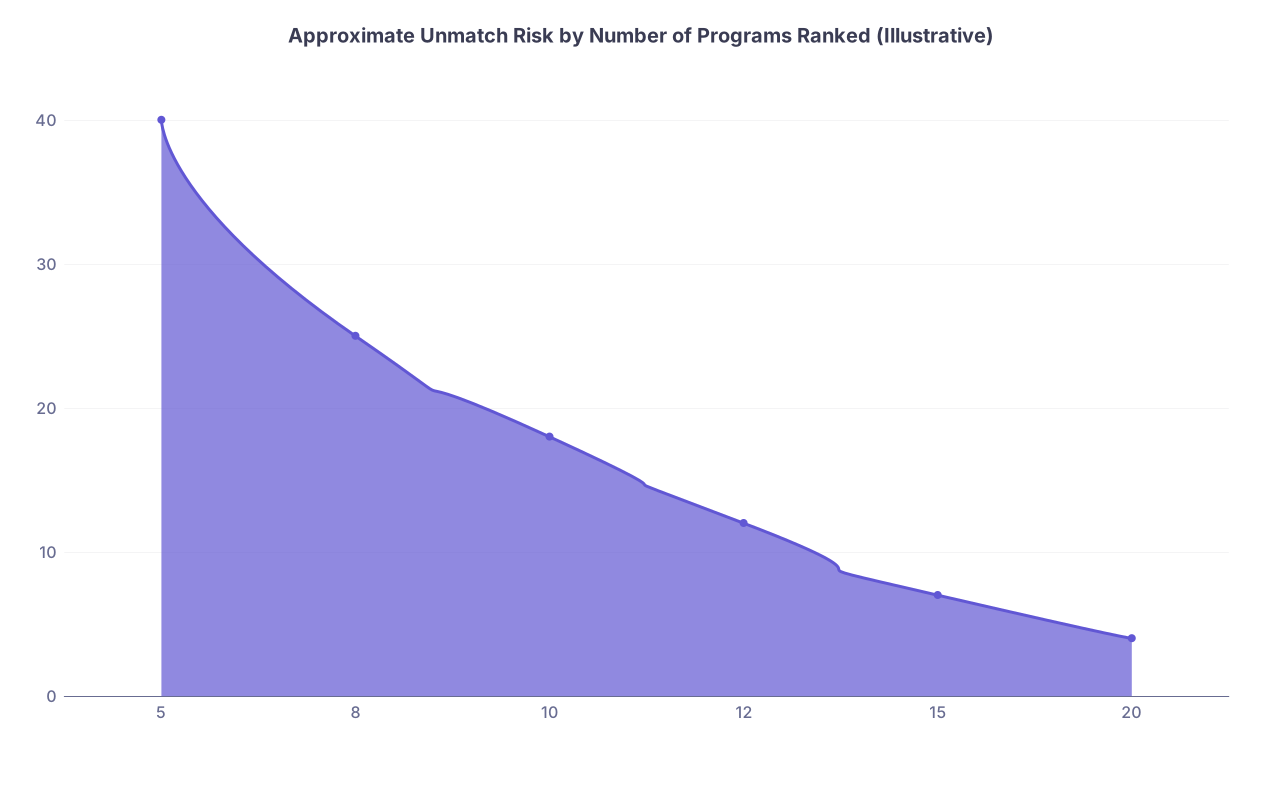
| Category | Value |
|---|---|
| 5 | 40 |
| 8 | 25 |
| 10 | 18 |
| 12 | 12 |
| 15 | 7 |
| 20 | 4 |
The exact numbers vary by specialty, but you get the point: ultra-short lists are dangerous.
Step 7 (T–32 to T–26 hours): Logistics and life details
Now the unglamorous part that ruins people’s lives if ignored.
At this point you should check for each program:
State licenses / visas
- For IMGs: confirm visa sponsorship type (J-1 vs H-1B), caps, history.
- For DOs: some states are more DO-friendly; check prior match lists.
- For couples: ensure both specialties even exist in the same city/region.
Commuting reality
- If your top program is in a city where you’ll be commuting 60–90 minutes each way because you can’t afford nearby rent, reconsider.
Family / partner constraints
- School systems if you have kids.
- Partner’s job market.
- Proximity to support systems if you’re prone to burnout or mental health issues.
This is the pass where “Preference + life logistics” (Version B of your list) might legitimately shift some ranks.
24–0 Hours Before Submitting: Freeze, Verify, Certify
This last stretch is where you stop asking for new opinions and start protecting yourself from technical and impulsive mistakes.
Step 8 (T–24 to T–18 hours): Commit to one final offline list
At this point you should:
Choose between Version A and Version B of your offline list.
- If they’re very different, you’re probably overthinking. Merge into a single, coherent Version C:
- Top 5–10 optimized for training and happiness.
- Middle chunk balanced between preference and pragmatism.
- Bottom chunk = “better than SOAP,” clearly labeled.
- If they’re very different, you’re probably overthinking. Merge into a single, coherent Version C:
Print this final offline list or save as PDF:
- Title it: “Final_Rank_Order_List_[date].pdf”
- This is what you’ll mirror into NRMP.
Show it to one or two max trusted humans:
- A mentor who knows you.
- A partner/family member directly affected.
- Do not send it to every group chat you’re in. Too many voices = panic.
Ask them specific questions:
- “Is there anything here that seems wildly inconsistent with what I’ve been saying all season?”
- “Any obvious life disaster I’m not seeing?”
You’re not crowdsourcing. You’re screening for blind spots.
Step 9 (T–18 to T–12 hours): Technical sanity checks in NRMP
Now you go back into the system.
At this point you should:
Log in with:
- A stable internet connection.
- A device that’s not dying, glitching, or on 3% battery.
Open your current ROL and compare it line-by-line with your Final_Rank_Order_List offline.
Check every single line:
- Program name
- Program code (people mix up prelim vs categorical all the time)
- Track (e.g., categorical vs. primary care vs. research)
Prelim and transitional year folks: triple-check.
| Scenario | What to Check |
|---|---|
| Categorical vs Prelim | Program code & description |
| Advanced + TY/Prelim | Both lists present & aligned |
| Different tracks (e.g. PC) | Track label & position |
| Couple's Match | Partner code linkage |
If you’re in the Couples Match, this is where you must:
- Print or PDF both of your lists.
- Verify each pair:
- Your #1 aligns with their corresponding #1.
- You’ve added reasonable combinations that reflect real willingness to match in those combos.
- Check there are no orphan ranks that leave one of you in a city alone that you never agreed to.
Step 10 (T–12 to T–6 hours): Final risk sweep and emotional check
You’re almost done. This window is about two things: catching last risks and avoiding self-sabotage.
At this point you should:
Ask three blunt questions about your current NRMP list:
- “If I match at #1, will I be happy telling people I’m going there?”
- “If I match at #3 instead of #2, will I feel like I sold myself out?”
- “If I match at #last, will I still be glad I ranked it instead of going unmatched and into SOAP?”
Remove any program that fails question #3.
- If you would truly rather go unmatched than train there, do not rank it.
- People say “Oh, I’ll just transfer after intern year” far more often than they actually do.
Check for hidden ego moves:
- A big-name program at #3 that you actually hated.
- Dropping a “less prestigious” program you loved into the mid-teens so you “don’t look weak” (no one sees your real list).
You’re not curating an Instagram bio. You’re choosing where you will spend 3–7 years of your life.
Step 11 (T–6 to T–2 hours): System, time zone, and deadline safety
Last technical pass.
At this point you should:
Confirm:
- Official NRMP deadline date and time.
- Time zone (this messes people up every year).
Set:
- A phone alarm for 2 hours before the deadline.
- A second alarm for 1 hour before as a backup.
Log out and log back in once more:
- Make sure you remember your password.
- Make sure 2-factor or email codes are working.
If your ROL is final and you’re calm enough:
- You can certify now. You don’t get extra points for waiting until 5 minutes before the deadline.
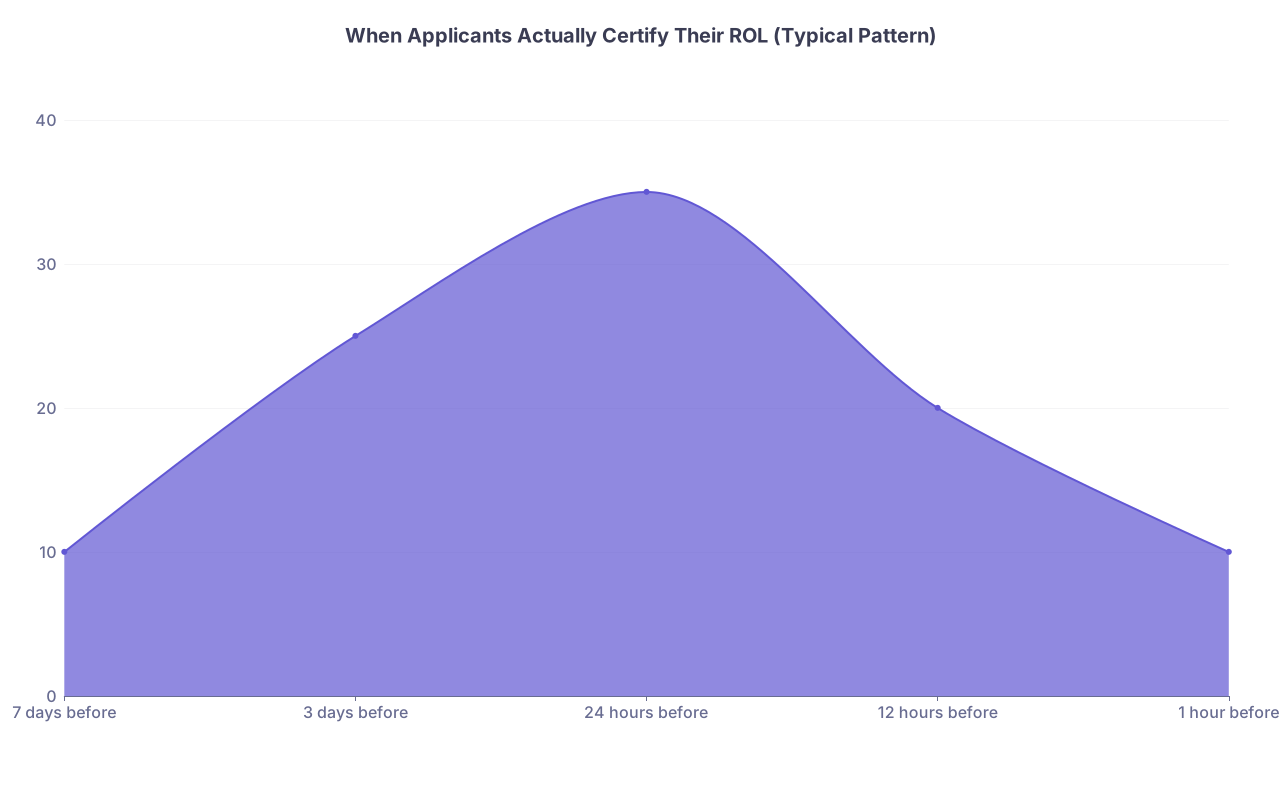
| Category | Value |
|---|---|
| 7 days before | 10 |
| 3 days before | 25 |
| 24 hours before | 35 |
| 12 hours before | 20 |
| 1 hour before | 10 |
A huge chunk of people click in the last 24 hours. Don’t be the person doing it on a hospital computer with spotty Wi‑Fi between admissions.
Step 12 (T–2 to T–0 hours): Final visual check and certification
This is it.
At this point you should:
- Open your NRMP ROL one last time side-by-side with your offline final list.
- Read it out loud, slowly:
- “Number 1: [Program, City, Track, Code]”
- All the way down.
You’ll be surprised how often reading aloud catches a silent typo or swapped pair.
Confirm the system shows:
- “List is certified” or the equivalent label.
- Check for the timestamp confirmation or certificate (NRMP shows a confirmation page—screenshot it).
Take screenshots or save PDF of:
- The certified list page.
- The confirmation message.
Store them with your Final_Rank_Order_List file. No one expects drama, but if something goes sideways, proof helps.
Then log out.
At this point you should not:
- Re-open the list every 15 minutes.
- Text 12 people asking, “Should I move Program X above Y?”
- Go hunting through Reddit for last-minute “insider intel.”
You’re done. Don’t break it now.
What You Should Absolutely Not Do in the Last 72 Hours
Quick lightning list. If you catch yourself mid-act, stop.
Do not rearrange your top 5 based on:
- Who sent you a “we really liked you” email.
- Who’s “more prestigious” based on some ranking site.
- A single offhand comment from a resident you barely know.
Do not:
- Remove all your safeties because someone told you “you’re a lock at Big Name U.”
- Rank any program you truly would not attend.
Do not:
- Wait until the final hour assuming the system will never glitch.
- Assume your phone hotspot is “good enough” for the most important submission of med school.
Final 3 Takeaways
Rank by where you truly want to train, not where you think you’re wanted. The algorithm is built to honor your preferences; use it properly.
Treat logistics, safety, and technical details as seriously as prestige. One wrong code, one missing TY, one absurd commute can wreck a great match.
Freeze the list, verify slowly, certify early. Extract offline, rebuild with intention, then mirror into NRMP carefully and walk away.


