

The biggest mistake applicants make after interviews is going on autopilot until rank lists are due.
You cannot afford that dead zone.
From the last interview to the NRMP rank order list deadline, every week should have a job. A focus. A small set of decisions that move you from “I liked that place” to “this is my precise, defensible rank list.”
Here is how to run that period week‑by‑week so you do not wake up three days before the deadline with a half‑baked list and a knot in your stomach.
Big Picture: The 6–8 Week Arc After Interviews
At this stage you should assume:
- Interviews are essentially done.
- You are in the NRMP Main Match (not SOAP, not late adds).
- You have 8–15 programs you actually interviewed at, give or take.
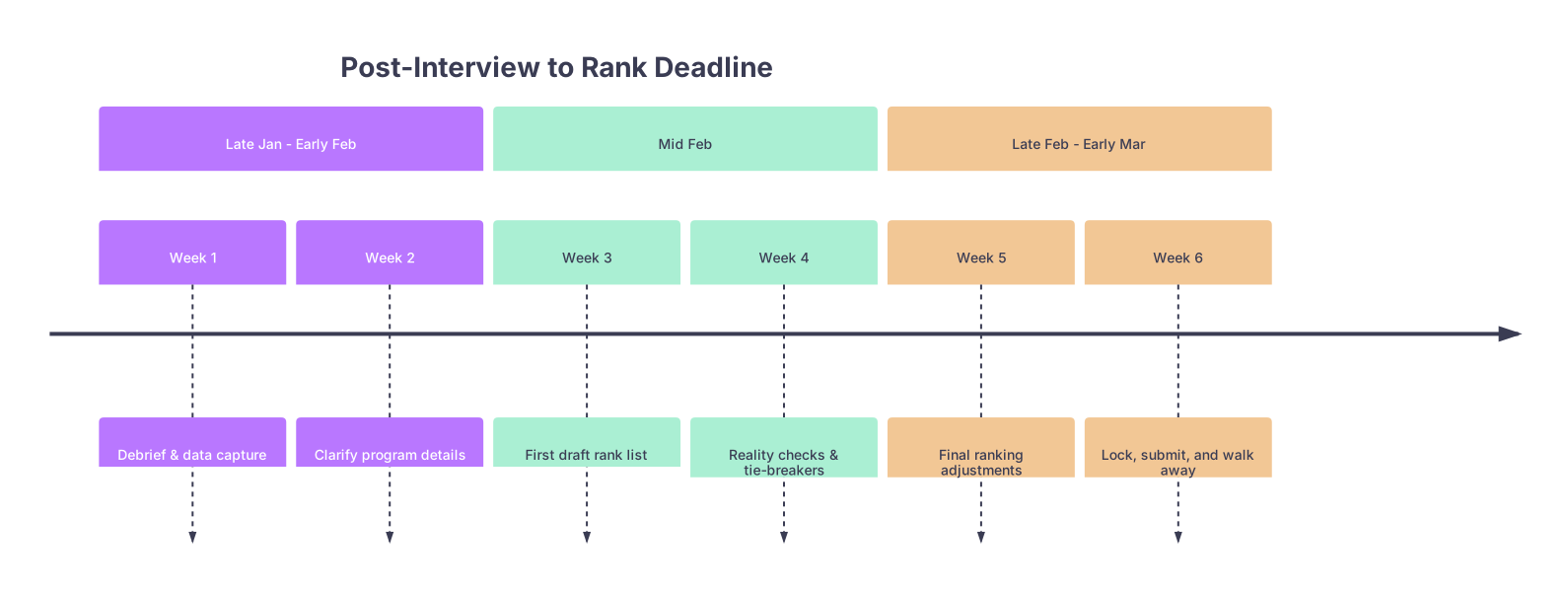
Your post‑interview to rank‑deadline arc usually looks like this (dates are approximate, adjust by year):
| Period | Event |
|---|---|
| Late Jan - Early Feb - Week 1 | Debrief & data capture |
| Late Jan - Early Feb - Week 2 | Clarify program details |
| Mid Feb - Week 3 | First draft rank list |
| Mid Feb - Week 4 | Reality checks & tie-breakers |
| Late Feb - Early Mar - Week 5 | Final ranking adjustments |
| Late Feb - Early Mar - Week 6 | Lock, submit, and walk away |
You are going to walk through that, week by week, with specific tasks and decision points.
Week 1 After Your Last Interview: Capture Everything Before You Forget
At this point you should not be ranking. You should be downloading your brain.
The first 7 days after your final interview are about one thing: preserving details while they are still fresh. Your future self will not remember them accurately.
Task 1: Build a One‑Page Snapshot for Every Program
You want one structured page per program. Paper or digital, does not matter. It just has to be uniform.
Include:
- Program name and city
- Interview date and names of key people (PD, APD, chief residents you met)
- Call schedule structure (q4, night float, weekends)
- Rotation sites (main hospital, VA, community sites)
-“Vibe” notes: specific phrases residents used, moments that stood out - Strengths (e.g., “ridiculous procedural volume,” “protected didactics actually protected”)
- Weaknesses (e.g., “angry nurse culture in the ICU,” “chiefs joked about scut — not joking”)
- Red flags (anything where your gut said no)
- Your raw post‑interview score (1–10) before other people’s opinions
Do not sanitize this. If you wrote “PD felt fake, kept checking phone,” leave it. That is useful.
Task 2: Pull Hard Data into a Simple Comparison Table
Now consolidate the non‑emotional stuff.
| Program | City Cost Level | Call Style | ICU Months PGY-1 | Fellowship Rate | Resident Happiness* |
|---|---|---|---|---|---|
| A | High | Night float | 3 | High | 8/10 |
| B | Medium | 24-hr call | 2 | Medium | 6/10 |
| C | Low | Hybrid | 4 | High | 9/10 |
| D | Medium | Night float | 2 | Low | 7/10 |
*Your subjective rating from conversations and body language, not some online ranking.
Keep it short. This is a dashboard, not a novel.
Task 3: Capture Personal Life Constraints Explicitly
You are not ranking in a vacuum. You are a person with a body and people and maybe a partner who has opinions.
List your non‑negotiables on a separate page:
- Partner job location or flexibility
- Proximity to family (distance or flight time, not “vague East Coast”)
- Existing health issues where climate or support matters
- Visa considerations if you are an IMG
- Financial constraints (e.g., you genuinely cannot afford SF/NYC rent)
At this point you should not be bending your list to fit these yet. You are just making the constraints visible.
Week 2: Clarify, Confirm, and Clean Up the Noise
At this point you should have the raw material. Now you clean and complete it.
Task 1: Fill Gaps by Emailing Programs (Tightly and Professionally)
If there are critical unknowns that affect ranking, this is the window to ask. After this, you are just being avoidant.
Examples of legitimate follow‑up questions:
- “Can you confirm how many months of night float interns typically do?”
- “Are there funded away electives or global health electives available, and when do residents usually take them?”
- “How are maternity/paternity leaves structured? Does this typically extend training?”
Keep it:
- Short (3–5 sentences)
- Specific (one or two concrete questions)
- Directed (to the coordinator or APD who invited follow‑ups)
This is not the time to “reaffirm strong interest.” That does not meaningfully change your rank position.
Task 2: Talk to 1–2 Trusted Upper‑Levels, Not a Committee
Groupthink ruins rank lists.
You want:
- One resident or fellow in your chosen specialty who knows your personality and priorities.
- One mentor who cares about your actual life, not your CV optics.
Ask them:
- “Given these 6 programs and what you know about me, which top 3 make the most sense and why?”
- “Any programs on this list you would NOT rank highly if you were me?”
Limit it. Do not crowd‑source on Reddit. You will get noise: “Program X is malignant” from a single bitter anecdote or someone who thrived on 90‑hour weeks telling you you are soft.

Task 3: Start a Rough Tiering, Not a Final Rank
End of Week 2 goal: 3–4 loose tiers, in order, no overthinking.
Example:
- Tier 1: “I would be thrilled here” (2–4 programs)
- Tier 2: “Solid fit, I would be happy” (3–6 programs)
- Tier 3: “Fine, I can tolerate it”
- Tier 4: “Only rank if needed to avoid going unmatched”
You are not numbering yet. You are sorting into buckets so your brain stops treating everything as equal.
Week 3: First Draft of the Rank List (You Will Not Get It Perfect)
At this point you should start ranking. Not debating whether to rank.
Task 1: Build Your Initial 1–N List
Take your tiers and force yourself to put an actual number next to each program.
Rules:
- Rank only programs where you would be willing to train.
- Your #1 spot must be somewhere you can realistically see yourself living and working for several years.
- Do not play “strategy.” The algorithm favors your true preferences, not your second‑guessing.
By the end of this task, you should have a complete list from 1 to however many places you will rank (8, 12, 18 — whatever is true for you).
Task 2: Weight Your Core Priorities Explicitly
Most people hand‑wave this part and then wonder why they feel uneasy.
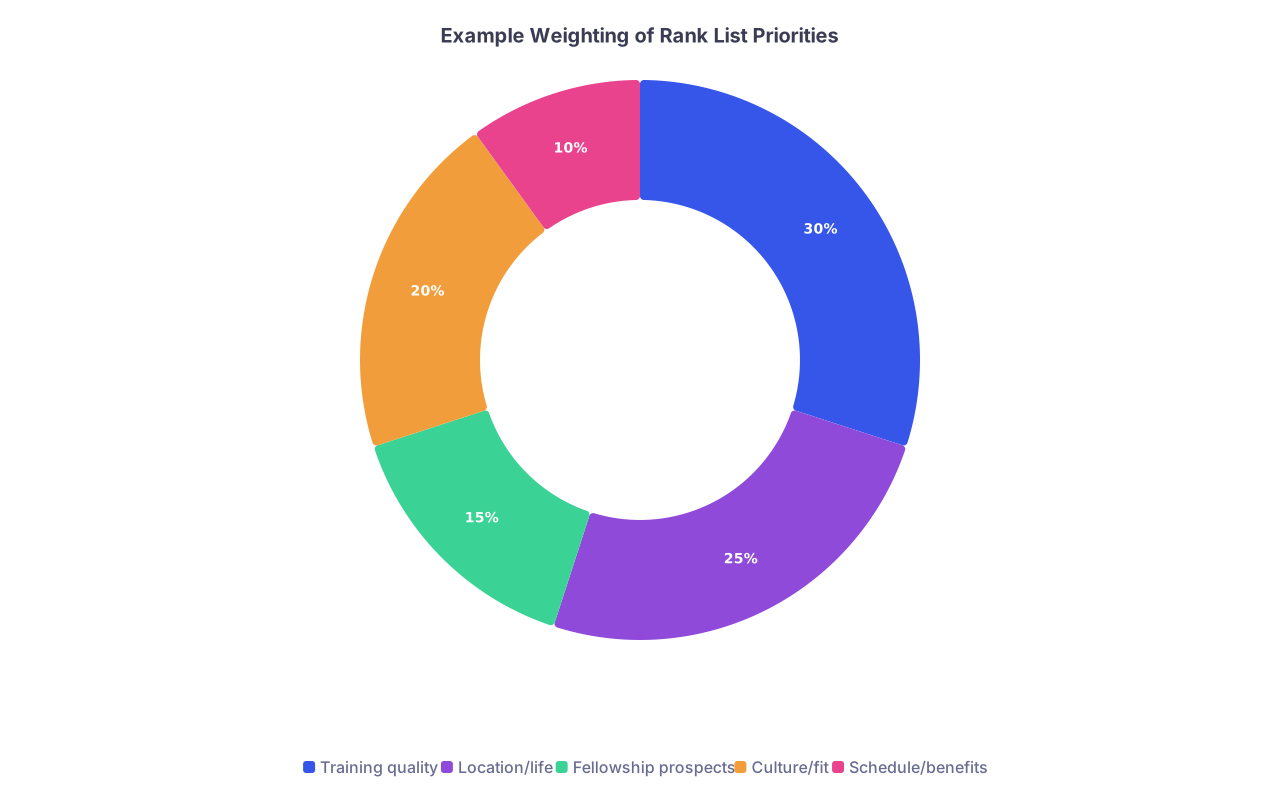
Pick 3–5 core factors and decide, consciously, how much weight they get. Use rough percentages.
| Category | Value |
|---|---|
| Training quality | 30 |
| Location/life | 25 |
| Fellowship prospects | 15 |
| Culture/fit | 20 |
| Schedule/benefits | 10 |
Then ask, for each pair of programs where you are stuck:
“If I apply this weighting honestly, which program wins?”
Most people still over‑weight prestige and under‑weight day‑to‑day life. Your burnout risk does not care where the hospital ranks on Doximity.
Task 3: Do a 24‑Hour Gut Check
When you have a first draft list:
- Save it.
- Do not send it to anyone.
- Walk away for a full day.
Then come back and answer:
- “If I matched at my #1, would I feel mostly relieved or mostly anxious?”
- “If I fell to #3, does that feel like a disaster or just a different flavor of good?”
If your top 3 all feel like “I could thrive here,” you are on the right track. If you secretly hope you do not match at your #1, then it should not be #1.
Week 4: Reality Checks, Tie‑Breakers, and Hard Conversations
At this point you should be pressure‑testing your list, not rebuilding it.
Task 1: Address Deal‑Breakers You Have Been Avoiding
This is when you deal with the awkward stuff. For example:
- Your partner cannot realistically find work in City X.
- Your chronic illness is much harder to manage in a program with 24‑hour calls and no nearby specialists.
- You are pretending cost of living does not matter, but it does.
Make two columns:
- “I can adapt to this.”
- “This will damage my health, relationships, or long‑term goals.”
Programs that land in the second column and stay there after a couple of days? Move them down, or off, your list.
Task 2: Use Structured Tie‑Breakers for Close Calls
If you are stuck between, say, Programs B and C for spots #2 and #3, do not spiral. Run a quick tie‑breaker.
Pick 3 specific factors where they are most different and rate them 1–5 for each program:
| Factor | Weight | Program B | Program C |
|---|---|---|---|
| Proximity to partner job | 3 | 2 | 5 |
| ICU/autonomy PGY‑2 | 2 | 5 | 3 |
| Resident satisfaction vibe | 2 | 3 | 4 |
Multiply and sum. If one clearly wins, respect that result unless your gut violently disagrees — then interrogate why.
Task 3: Optional Second Look (If Truly Necessary)
I am not talking about formal second‑look visits that some programs semi‑discourage. I mean:
- Driving through the neighborhood again.
- Walking the area where you would live.
- Talking to one more resident there, briefly.
Do this only for programs in your probable top 3–4. If you are doing full blown second looks for 10 places, you are procrastinating on making decisions.
| Category | Value |
|---|---|
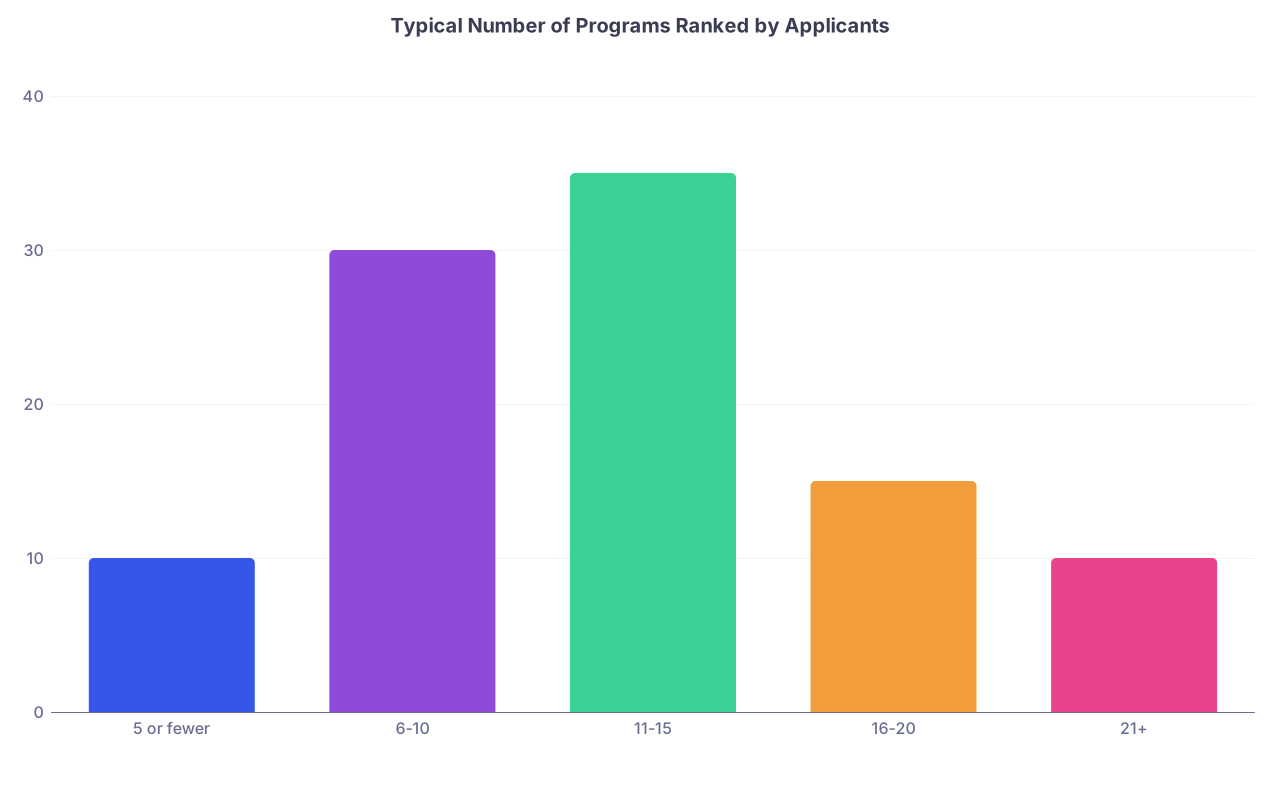
| 5 or fewer | 10 |
| 6-10 | 30 |
| 11-15 | 35 |
| 16-20 | 15 |
| 21+ | 10 |
Week 5: Finalize Top Half, Sanity‑Check Bottom Half
At this point you should be 80–90% locked in. You are not doing a full rebuild unless something huge changed.
Task 1: Hard‑Lock Your Top 3–5
Look at your top 3–5 and ask:
- “If I matched at #2, would I feel genuinely good — not ‘settling’?”
- “Is there any program lower on my list where, in your heart, you would rather be than #3?”
If you keep finding yourself mentally bumping a program upward (“Honestly, I keep picturing myself at Program D”), listen to that. Move it and then stop shuffling.
Task 2: Rationalize the Lower Half — But Still Be Honest
The bottom of your list matters. People match there.
For each low‑ranked program, do a quick pass:
- “Would I rather scramble/SOAP than match here?”
- If the answer is yes, remove it. Do not rank a place you truly cannot tolerate for years.
Some examples of bottom‑half reasons that are valid:
- Minimal faculty support and clear resident burnout.
- Consistent stories of unsafe workloads or being “thrown under the bus.”
- Location completely incompatible with partner/kids/health.
Your future self will not thank you for “at least I matched” if you are miserable and unsafe.
Task 3: Technical Check — NRMP and Institutional Rules
Before you get too pleased with yourself:
- Confirm every program you are ranking is on your NRMP list and correctly identified (codes matter).
- Check if any preliminary / advanced program pairings require specific ordering.
- If you are dual‑applying (e.g., prelim medicine + advanced anesthesia), make sure your lists are logically consistent.
This is the unglamorous part. But I have seen people torpedo their own match with a single code error.

Week 6: Lock, Submit, and Walk Away
At this point you should be done. Not still crowd‑sourcing on social media.
Task 1: Sleep on the Final List Once
Do a final pass 3–5 days before the deadline. Not the night before.
Checklist:
- Top 3 reflect your true preferences, not prestige signaling.
- No programs remain that you would refuse if it were your only option.
- Program codes checked against NRMP or ERAS documentation.
- Advanced/prelim pairings make sense.
- You can articulate, in one sentence each, why your top 5 are in that order.
Then walk away for a night. If you wake up wanting to swap #1 and #2, explore that. If you just feel vaguely anxious, that is normal. Ignore it.
Task 2: Submit 24–48 Hours Before the Deadline
Do not flirt with server issues or last‑minute dramas.
- Log in.
- Enter list exactly as you have it written.
- Double‑check against your offline copy.
- Get confirmation that your list is certified.
Print the confirmation or save a PDF. Then close the tab.
Task 3: Set a Hard “No More Tweaks” Rule
Once it is certified and you are past your personal deadline (for example, 24 hours after submission), stop re‑opening it “just to check.”
Last‑minute emotional swings are usually:
- A bad shift where you suddenly hate your current city.
- A conversation with someone who does not really understand your priorities.
- Panic about prestige, not about fit.
If you did the work in Weeks 1–5, your list is already better than whatever you would throw together in a cortisol spike at 11:58 p.m. on deadline night.
Micro‑Timeline: Last 10 Days Before Rank Deadline
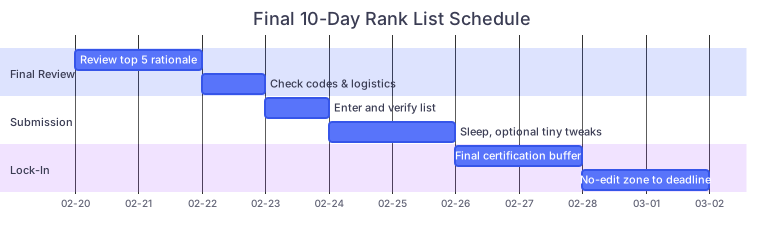
You want the final stretch ultra‑clear. Here is your day‑by‑day for the last 10 days.
| Task | Details |
|---|---|
| Final Review: Review top 5 rationale | a1, 2026-02-20, 2d |
| Final Review: Check codes & logistics | a2, 2026-02-22, 1d |
| Submission: Enter and verify list | b1, 2026-02-23, 1d |
| Submission: Sleep, optional tiny tweaks | b2, 2026-02-24, 2d |
| Lock-In: Final certification buffer | c1, 2026-02-26, 2d |
| Lock-In: No-edit zone to deadline | c2, 2026-02-28, 2d |
Assume a hypothetical March 1 deadline; shift dates accordingly.
Day −10 to −8:
- Re‑read your Week 3–5 notes.
- Confirm your top 5 still align with your written priorities and constraints.
Day −7:
- Do a quick call or message with one trusted mentor if you have unresolved doubts about a specific ordering.
- No adding new voices at this point.
Day −6 to −5:
- Cross‑check every program code.
- Verify prelim/advanced logic.
Day −4:
- Enter your list into the NRMP system. Do not certify yet.
- Walk away for 24 hours.
Day −3:
- Compare on‑screen list to your offline version.
- If there are any final positional swaps, make them once.
- Certify.
Day −2 to 0:
- Do nothing. Seriously. System is locked; your job is to not lose your mind.
- Focus on school, rotations, and sleep so you are not a wreck on Match Day.

Final Thoughts: What Actually Matters
Condensed to the essentials:
- Front‑load the thinking. The week after your last interview is where you capture real impressions and data. Everything later is just re‑arranging pieces.
- Rank for your life, not other people’s egos. The best list is the one where your top few spots are places you can genuinely thrive, not just impressive logos.
- Give yourself a personal deadline and stick to it. Submit early, stop tinkering, and let the algorithm do its job. Your work is in the weeks before, not in the last 5 minutes.


