

The worst thing you can do after Match Day—whether you matched or not—is move on without dissecting what your rank list actually did.
If you do not debrief your rank strategy in the days and weeks after Match, you will repeat the same mistakes on your next application cycle. I’ve watched it happen. Same mindset. Same ranking errors. Same outcome.
You are going to treat this like a morbidity and mortality conference for your rank list. Calm, data-driven, a little ruthless.
First 48–72 Hours After Match Day: Stabilize, Then Capture Reality
At this point you should not be rewriting your entire life plan. You’re too close to the emotional blast radius.
Day 0–1: Let the dust settle (but not for too long)
If you matched:
- Celebrate with your people.
- Skim your Match email, confirm the basics (program, location, start date).
- DO NOT email PDs with “Why did I match here and not there?” You’ll get nothing useful and look unprofessional.
If you did not match (SOAP or complete no‑match):
- Survive SOAP if you’re in it. That takes priority over reflection.
- Get sleep where possible.
- Do not make any “I’m switching fields forever” declarations yet.
But within 48–72 hours, before the details fade, you need to capture what you actually did—not what you remember in six months.
Day 2–3: Reconstruct your rank and application map
At this point you should sit down with your laptop and:
Download or screenshot:
- Your final NRMP rank order list (ROL)
- Your ERAS “Programs applied to” list
Create a simple spreadsheet with columns like:
- Program
- City/State
- Specialty (and track: categorical, preliminary, TY, advanced)
- Where you ranked it (number)
- Whether you interviewed there (Y/N)
- Outcome (Matched / Did not match / SOAPed later / Not ranked by you)
- “Initial gut feeling after interview” (you’ll reconstruct this from memory)
- Notes: red flags, strengths, connections, etc.
Lock in your memory of how you felt at the time:
- Open your calendar, email, and any notes you took during interview season.
- For each program you ranked:
- Write 1–2 phrases you remember thinking:
- “Loved residents, worried about call schedule”
- “Great name, weird vibe, felt like they didn’t care I was there”
- “PD very supportive of IMG”
- “No research, but close to partner”
- Write 1–2 phrases you remember thinking:
You are building the baseline so Future You doesn’t gaslight Past You about what actually mattered.
Week 1 Post‑Match: Autopsy Your Rank List (Program by Program)
At this point you should be out of crisis mode. This is the week for a clear-eyed rank list autopsy.
Step 1: Compare your rank order to your real priorities
Most people think they ranked by “fit” and “training quality.” Then we actually look and discover:
- Half the top 5 were chase-name programs in cities they hate.
- Or every strong but less flashy program near real support systems was buried.
Create a short list of your true priorities (looking backward, not idealized):
- Geography (close to family/partner vs “anywhere”)
- Name/prestige
- Fellowship opportunities
- Workload + culture
- Visa support (if IMG)
- Couples Match constraints
- Lifestyle (cost of living, call schedule, night float vs 24‑hour call)
Then categorize each program you ranked top 10:
| Rank # | Program Tier | Geography Fit | Culture Fit | Career Fit |
|---|---|---|---|---|
| 1 | Reach | Poor | Unknown | Strong |
| 2 | Realistic | Good | Strong | Strong |
| 3 | Reach | Fair | Weak | Strong |
| 4 | Safety | Good | Strong | Fair |
| 5 | Realistic | Excellent | Strong | Strong |
| 6–10 | Mix | Mixed | Mixed | Mixed |
Be honest:
- Did your top 3 truly reflect what you said mattered to you in October?
- Or did prestige pull weight it didn’t deserve?
Step 2: Tier your programs against your competitiveness
This is where I watch people flinch. But it’s non‑negotiable.
Make rough tiers for each program you ranked or applied to:
- Reach: You’d be below average for their usual residents (Step/COMLEX scores, research output, med school pedigree, AOA, etc.).
- Realistic: You’re inside their usual range. Some stronger, some weaker applicants than you.
- Safety: You’re clearly above average for what they typically take.
If you have no idea, use:
- Program websites (look at resident med schools, background).
- Residency Explorer data.
- Your advisors’ explicit opinions, not their polite ones.
Then count:
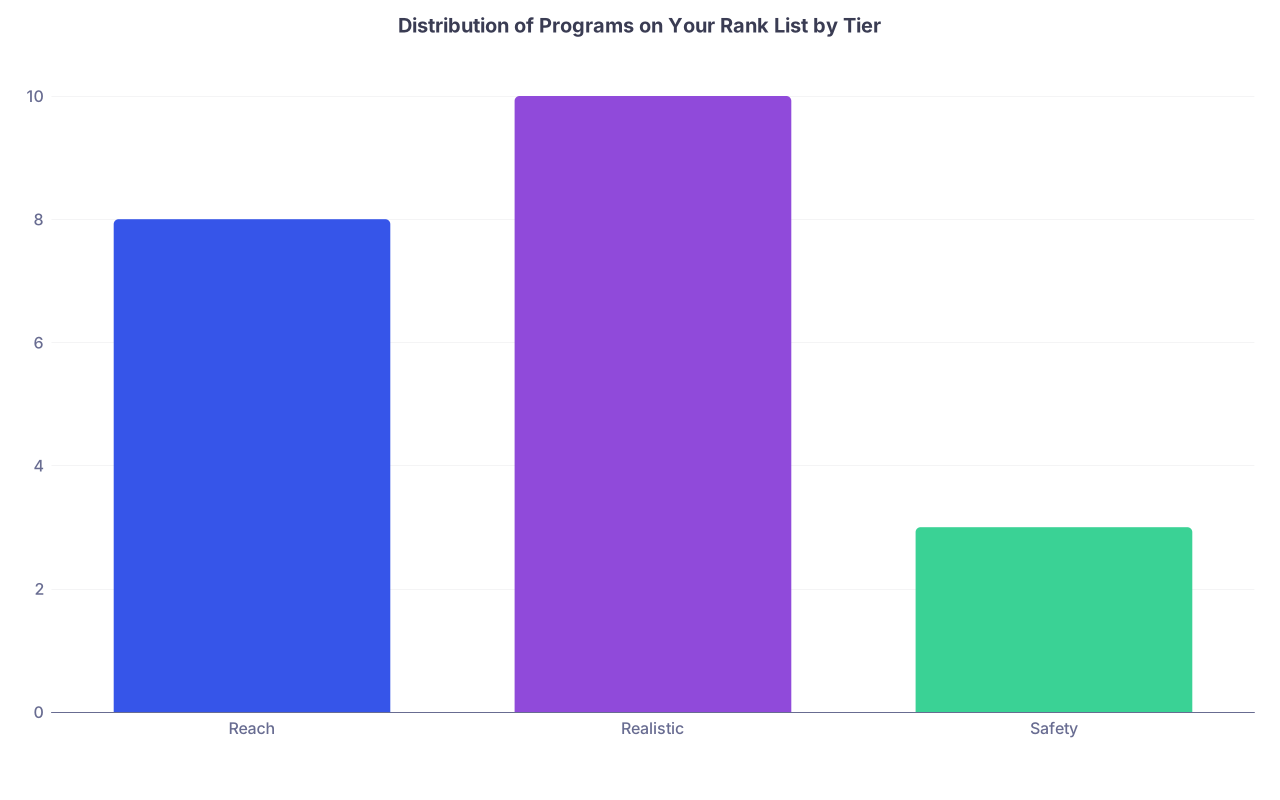
| Category | Value |
|---|---|
| Reach | 8 |
| Realistic | 10 |
| Safety | 3 |
If your rank list was 60–70% reach and only 1–3 true safeties, your strategy was bad. Full stop. The algorithm can’t save you from that.
Step 3: Identify mismatches between interviews and rank spots
Now line up:
- Where you interviewed
- Where you ranked
- Where you didn't get interviews but still ranked highly in your head
Questions to answer:
Did you rank a program highly that:
- Interviewed you late in the season?
- Seemed disinterested (group interview, PD barely present)?
- Felt cold or transactional?
Did you underrank places that:
- Invited you early
- Followed up warmly (resident emails, PD thank-you messages)
- Expressed clear interest in you as an individual?
You’re looking for disconnects:
- Did your ego about “top programs” override your sense of who actually wanted you?
Week 2 Post‑Match: Understand What the Match Outcome Says About Your Rank Strategy
Now you know what you did. Time to link it to what happened.
Scenario A: You matched, but far down your list
At this point you should ask: was this “bad luck” or “bad strategy”?
Common rank errors I see here:
Over‑stacked at the top with reaches
- You ranked 6–8 programs way above your realistic tier.
- You gave yourself a very narrow realistic landing zone.
Under‑ranking solid mid-tier programs
- You visited 3 programs where you felt wanted and could thrive.
- Ranked them below reach programs where you were clearly a long shot and the vibe was lukewarm.
Geography denial
- You said, “I’ll go anywhere,” but deep down you knew you’d be miserable.
- Subconsciously ranked “cool city” programs higher than programs near support, even when the local ones were better fits.
Tactically, for future cycles (switching specialty, reapplying for fellowship, etc.):
- You need more true mid‑tier realistic programs clustered in ranks 3–10.
- You shouldn’t have a cliff drop from reach to desperate safeties at the bottom.
Scenario B: You matched your #1, but the process felt chaotic
You still need to debrief, because chaos that ends well breeds overconfidence.
Ask yourself:
- Did you under-apply and get lucky?
- Did you rank a #1 that looked great on paper but gave you subtle red flag vibes?
- Did you ignore spouse/partner/family needs for location and they “let it slide” this time?
For future applications (fellowship later, another Match if you’re switching):
- Don’t assume the same approach will protect you again.
- If multiple mentors said, “You should add more backups,” they were probably right even if this time you landed on your feet.
Scenario C: You did not match (or had to SOAP into something you did not want)
This is where brutal honesty pays off.
For the rank strategy specifically (different from overall application competitiveness), common patterns:
Too few programs ranked
- You ranked < 10 programs in a moderately or very competitive specialty.
- Or < 12–13 as an IMG/FM, or in competitive metro areas.
Ranked almost all reaches
- You believed your “story” or letters would override colder objective metrics.
- You trusted vague “we like you” comments at places that statistically don’t take many like you.
No true safety net
- Zero inclusion of community programs, newer programs, or less desirable locations.
- All big-name academic centers in lifestyle cities.
Overconfidence from one signal
- One PD said, “Let us know if we’re your top choice.”
- You mentally locked in a match there and structured the rest of your rank list around that fantasy.
For your next application cycle, this becomes your mandate:
- Double or triple the number of realistic and safety programs.
- Build your rank list around landing a position, not impressing your classmates.
Week 3–4 Post‑Match: Deconstruct Application Strategy vs Rank Strategy
At this point you should distinguish two separate autopsies:
- Your application strategy (where you applied, when, how strong the file was)
- Your rank strategy (how you ordered the programs that actually interviewed you)
They’re related, but not the same.
Map from applications → interviews → rank → match
Set up one more view of your data:
- For each program you applied to:
- Did you get an interview?
- If yes, did you rank it?
- If ranked, how high?
- Final outcome.
You want to see this kind of flow:

| Step | Description |
|---|---|
| Step 1 | Programs Applied |
| Step 2 | Interviews Received |
| Step 3 | Programs Ranked |
| Step 4 | Match Outcome |
Questions to answer in this phase:
- Did you apply too top‑heavy?
- If you applied mostly to reaches, you never even had the chance to build a safer rank list.
- Did you leave interviews off your rank list?
- If you attended but didn’t rank, why?
- Was that a wise “this would truly be a bad fit” call? Or perfectionism?
- Did you cancel lower‑tier interviews too early?
- Because you “felt good” about a couple of high-tier interviews?
You’re trying to identify where your rank list options were constrained by earlier choices.
Month 2: Translate Debrief Into a Future Rank Strategy Template
By now you’ve got the emotional distance and the data. Time to turn this into a reusable framework.
Task 1: Build your personal “future rank rules”
At this point you should write a short, specific document for yourself:
“How I will build my rank list next time.”
Include rules like:
Program tier balance rule
- Example:
- At least 30–40% of ranked programs must be solid realistic options.
- At least 20–30% must be true safeties (where you’d still be okay training).
- Reaches get capped at ~30–40% of the list.
- Example:
Geography and support rule
- Example:
- I will not rank a program top 3 if it isolates me from all support systems and has a brutal workload, unless it offers a truly unique career benefit I can define in one sentence.
- Example:
Vibe vs prestige rule
- Example:
- If my gut says “the residents are miserable,” I drop that program at least 3–5 spots below any place where the residents felt energized and supported, regardless of name.
- Example:
Honesty about constraints
- Couples Match: I will include combined rank options that may not be ideal individually but are sustainable together.
- Visa: I will prioritize programs with a consistent history of sponsoring my visa type.
You’re not writing poetry. You’re creating guardrails so you don’t spin the wheel based on Match‑week anxiety and peer pressure again.
Task 2: Decide your future program mix
You should now outline what your next cycle’s distribution might look like (even if it’s for fellowship or another specialty) based on your competitiveness:
| Tier | Target % of Applications | Target % of Rank List |
|---|---|---|
| Reach | 20–30% | 25–35% |
| Realistic | 40–50% | 40–50% |
| Safety | 20–30% | 20–30% |
Then translate that into real numbers based on your specialty. For example, if applying to 60 IM programs:
- 15–18 reaches
- 24–30 realistic
- 12–18 safeties
Your future rank list should roughly mirror that distribution, modified by how interviews shake out.
Task 3: Document specific lessons learned
This is where you write down what you’ll actually forget if you let it live only in your head.
Examples I’ve seen people write:
- “I overestimated how much prestige mattered. The places that liked me most were mid‑tier but great fits; I pushed them down for name.”
- “I ranked any program in X City too high just because I loved the location, even when the training seemed weak.”
- “I trusted off-the-record ‘we’re ranking you highly’ comments as guarantees.”
Keep this to one page. You should be able to read it the night before you lock a future rank list and adjust accordingly.
Month 3 and Beyond: Set Up for Your Next Application Cycle (If You’ll Re‑Enter the Match)
At this point you should stop purely reflecting and start laying groundwork, if you’re reapplying or planning a competitive fellowship.
3–4 Months Post‑Match: Get outside feedback on both application and rank strategy
Schedule meetings with:
- A trusted faculty advisor (ideally in your specialty).
- A PD or APD who will give you real talk.
- If unmatched or SOAPed: your dean’s office or career advising.
Bring:
- Your original ROL.
- Your application statistics: Step/COMLEX scores, number of programs applied, number of interviews, where you matched or didn’t.
- Your one‑page “lessons learned” summary.
Ask directly:
- “Given my stats and performance, did my rank list lean too aggressive, too conservative, or about right?”
- “What would you change in my program mix and rank distribution if I re‑applied?”
- “If I apply for fellowship later, how should I balance prestige and fit differently?”
You’re checking your self‑assessment against someone who’s seen hundreds of cycles.
6–9 Months Before Your Next Application Opens: Apply your new framework in planning
When you’re planning a new cycle (fellowship, switch of specialty, or rare reapplication):
Use your future rank rules to shape:
- Where you apply.
- How many programs per tier.
- Which geographical compromises you’re genuinely willing to make.
Start a new spreadsheet with:
- Possible programs
- Tier estimates (reach/realistic/safety)
- Early notes on culture, geography, fellowship placement
By the time interview season rolls around, your rank strategy shouldn’t be a guess. It should be a refined version of the post‑Match debrief you did this year.
Visual Timeline: Your Post‑Match Debrief Process
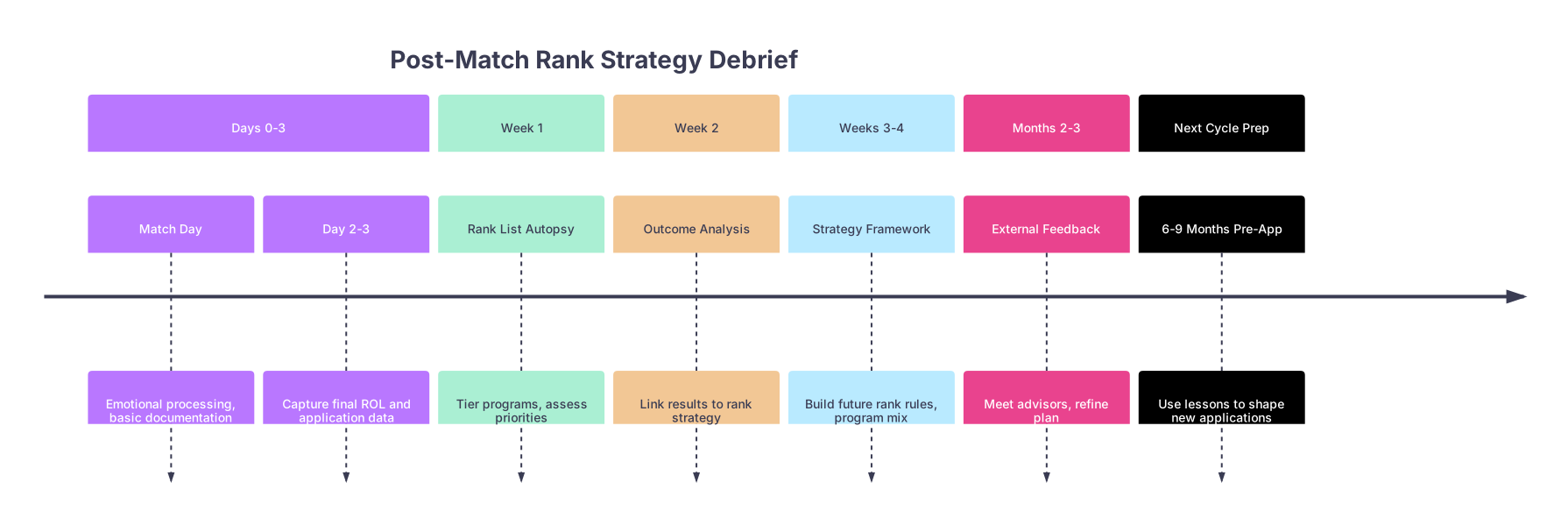
| Period | Event |
|---|---|
| Days 0-3 - Match Day | Emotional processing, basic documentation |
| Days 0-3 - Day 2-3 | Capture final ROL and application data |
| Week 1 - Rank List Autopsy | Tier programs, assess priorities |
| Week 2 - Outcome Analysis | Link results to rank strategy |
| Weeks 3-4 - Strategy Framework | Build future rank rules, program mix |
| Months 2-3 - External Feedback | Meet advisors, refine plan |
| Next Cycle Prep - 6-9 Months Pre-App | Use lessons to shape new applications |
Keep the Core Lessons Tight
If you remember only a few things from this debrief, make them these:
- Your rank list is data, not destiny. Treat this year’s ROL like a case study. Break it apart, learn from it, and rewrite the rules for next time.
- Balance matters more than bravado. A rank list stuffed with reaches is not bold; it is reckless. Future you deserves a realistic, layered strategy.
- Write your own rules now, follow them later. Do the hard thinking in the calm months after Match, then trust that framework when emotions run hot during your next rank deadline.


