

The worst rank lists are written in the last 72 hours.
You do not make better decisions at 1:30 a.m. staring at an email from a program director. You make weirder ones. More emotional ones. Sometimes catastrophic ones.
Let’s walk through deadline week—day by day—so you get to 9:00 p.m. ET on rank list certification day with a list you trust and no panic edits.
10–7 Days Before the Rank List Deadline: Lock the Framework
At this point you should not be “starting” your rank list. That ship sailed weeks ago. Right now, you’re moving from rough draft to almost-final.
Day –10 to –8: Build Your Stable Shortlist
Your job in this 3‑day window:
Create your definitive program pool
- Pull your ERAS list and interview list.
- Delete programs where:
- You’d truly rather reapply than go there.
- You have genuine deal-breaking concerns (unsafe environment, blatant toxicity, partner can’t move there, etc.).
Be honest. If you matched there and your first thought would be, “I’m devastated,” that program shouldn’t be ranked.
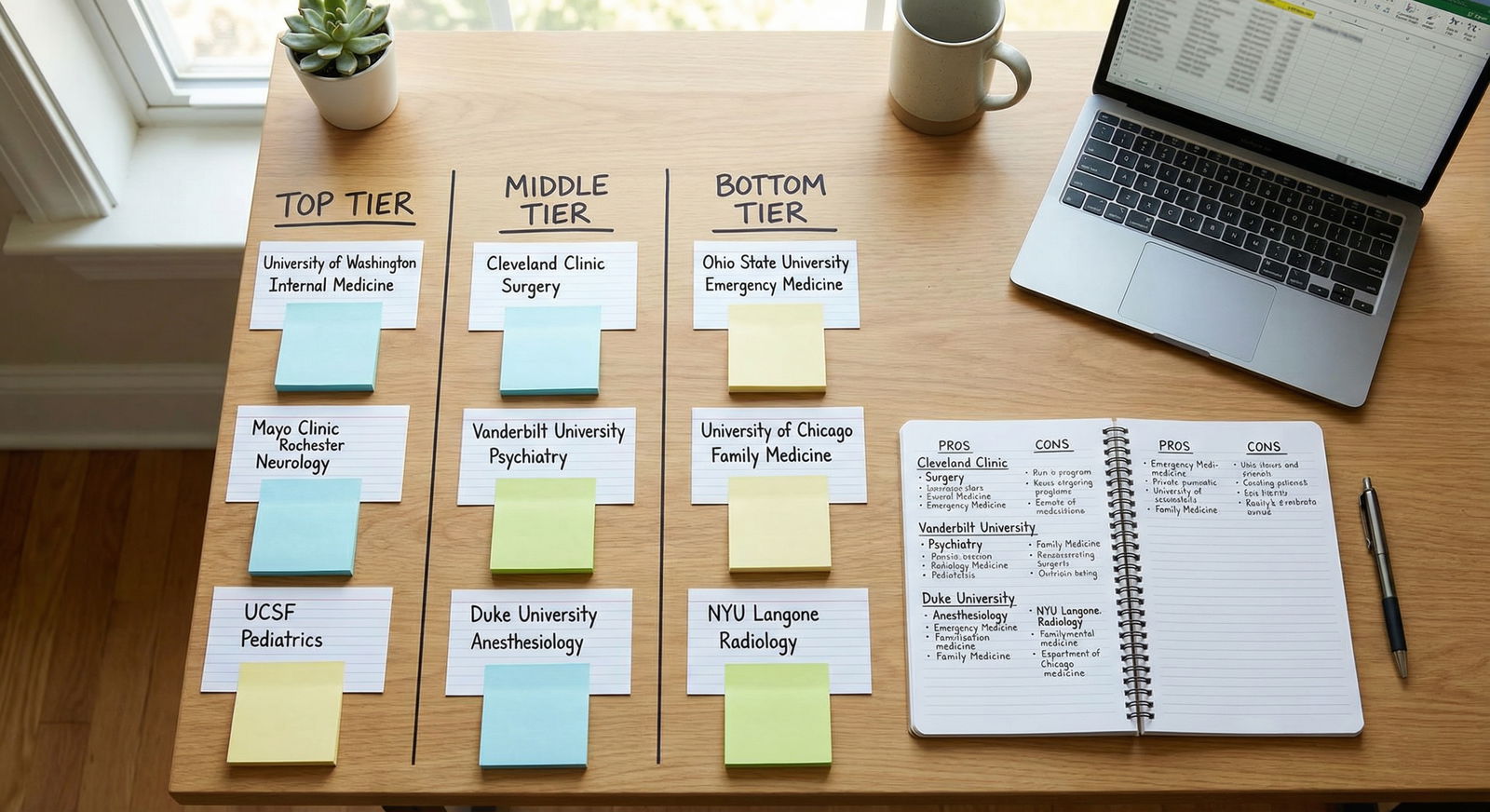
Sort into tiers (rough, not final)
Use three buckets:- Tier 1: “I’d be excited to open this email.”
- Tier 2: “I’d be fine—solid training, decent fit.”
- Tier 3: “I can tolerate it, but I’m wary.”
Decide your non-negotiables
Write them down. On paper. Not in your head. Examples:- Must be within X hours of partner/family.
- Avoid nights-float-heavy schedules for childcare reasons.
- Need strong fellowship in cardiology.
- No programs with significant PD turnover in last year.
This list is your anchor when you start spiraling later.
Day –7: Define Your Ranking Rules
At this point you should be moving from vibes to structure.
Create 3–5 rules that will govern the final list. For example:
- Rule 1: Academic IM with strong cards > community IM in same city
- Rule 2: City quality is tiebreaker only, not main driver
- Rule 3: Programs where I felt clearly unwanted drop to lower third
- Rule 4: Keep at least X programs within Y hours of my support system
- Rule 5: No last-minute jumps based only on post-interview emails
Write these rules at the top of your rank list document.
Because on deadline day, when a “You’re ranked highly!” email hits your inbox, you’re going to forget all your values. These rules keep you from doing something dumb.
6–4 Days Before Deadline: From Tiers to Ordered List
Here’s where you actually start putting numbers next to program names. Still not final, but close.
Day –6: Rank Within Each Tier
At this point you should be comparing within tiers, not jumping between them.
Process:
Inside Tier 1, ask:
- Where did I feel most comfortable on interview day?
- Where could I realistically see myself for 3–7 years?
- Who seemed like “my people” among residents?
Look at specific data, not just feelings:
- Board pass rates
- Fellowship match lists (for IM/EM/Anes/Peds, etc.)
- Surgical case volumes
- Call schedules and night float structure
- Moonlighting options for later years
Build a draft order for each tier separately.
Your list might look like:
1–5: Tier 1
6–12: Tier 2
13–18: Tier 3
Don’t obsess about the exact numbers yet. Just get a logical order.
Day –5: Reality Check With Your Life, Not Just Your CV
At this point you should match your draft list against your actual life constraints.
Run through:
- Relationship status and location plans
- Family health or obligations
- Kids or plans for kids in training
- Financial realities (COL, moonlighting, relocation costs)
- Visa or licensing issues if applicable
This is where “great program in a brutal city for your mental health” sometimes needs to drop a few spots.
| Program | City Fit | Training Strength | Family Proximity | Gut Feeling |
|---|---|---|---|---|
| A | High | High | Low | Strong Yes |
| B | Medium | Very High | Medium | Yes |
| C | Low | High | High | Neutral |
| D | Medium | Medium | High | Weak Yes |
If your future self with a toddler, a sick parent, or $300k of loans would laugh at your current ordering, adjust now.
Day –4: Get One Outside Opinion (And Only One)
At this point you should not be crowdsourcing your rank list in every GroupMe.
Pick:
- One advisor who knows your specialty, or
- One trusted resident/fellow in that field, or
- One faculty mentor who has actually sat on selection committees
Show them:
- Your current ordered list
- Your rules and non-negotiables
- Your concerns about 2–3 “close call” swaps (e.g., #2 vs #3, #7 vs #8)
Ask specific questions:
- “Given I want GI, does it make sense to keep Program X over Y?”
- “Are there any red flags on this list I’m missing?”
- “Is there any program here that historically under-delivers compared to its image?”
Listen. Adjust if their input aligns with your values and data. Then stop shopping for opinions.
3–2 Days Before Deadline: Lock the Core, Quarantine the Chaos
This is where most people blow it. They let last-minute noise destabilize a basically good list. You won’t.
Day –3: Freeze Your Top 5
At this point you should be able to say: “Unless I discover an actual ethical or safety problem, my top 5 will not change.”
Do this:
- Open your list and put a bold line after #5.
- Write out, in 1–2 sentences each, why each of those top 5 is in that position. For example:
- #1: Best combo of cards fellowship placement + city we can both work in.
- #2: Slightly weaker cards, but incredible resident culture, strong PD.
- #3: Closer to family, but fellowship outcomes less aligned with my goals.
If tomorrow someone sends you a “We really liked you” email from #3, that doesn’t magically make it #1. The training, city, and fit didn’t change overnight.
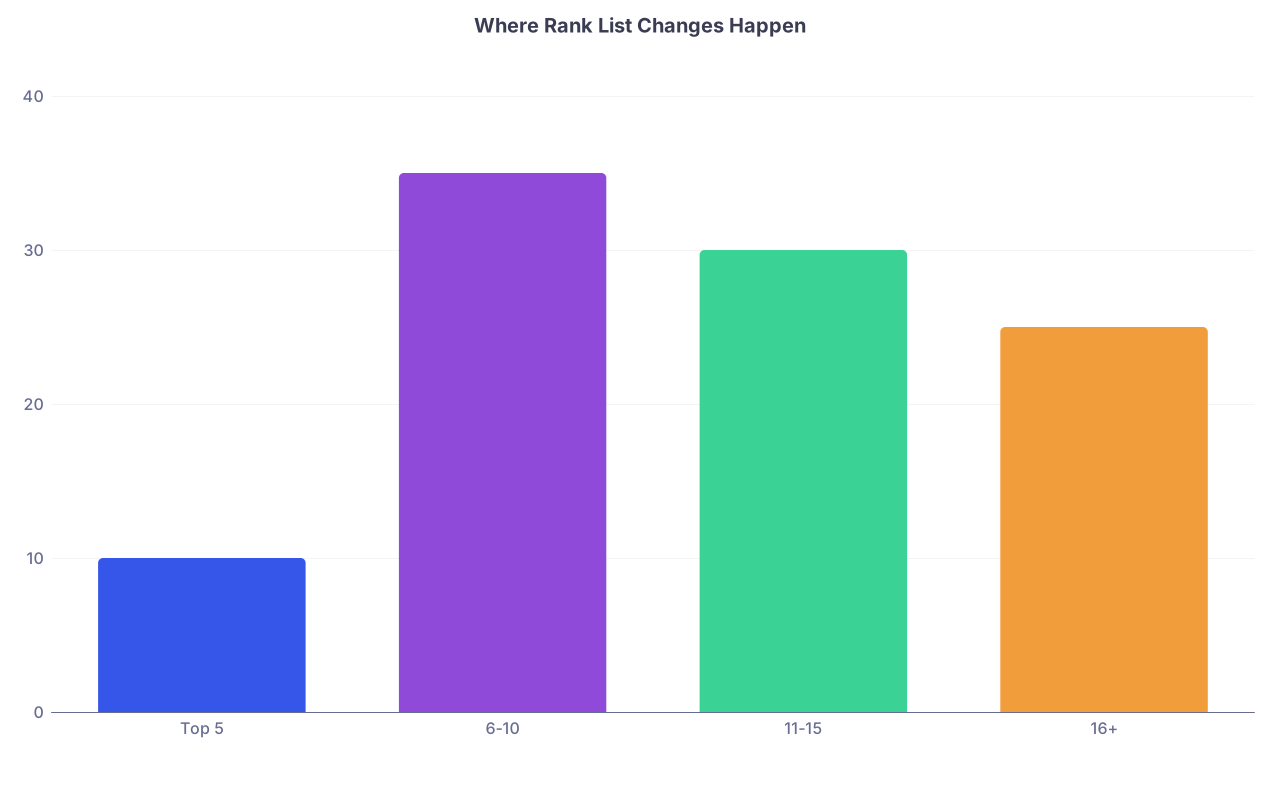
| Category | Value |
|---|---|
| Top 5 | 10 |
| 6-10 | 35 |
| 11-15 | 30 |
| 16+ | 25 |
Interpretation: most last-minute changes I see people make are in the messy middle (6–15), not at the top. That’s where you’ll want to tweak—and where damage can be minimized if you’re thoughtful.
Day –2: Deal With Emails, Signals, and “You’re Ranked to Match” Nonsense
At this point you should expect your inbox to be a circus.
You may get:
- “You are ranked to match at our program” emails
- “You will be ranked highly” emails
- Vague “We hope to see you in July” messages
- Total silence from places you liked
Rules:
Do not move a program up based solely on an email.
- PDs overpromise.
- Some systems auto-send “ranked to match” to half their list.
- Verbal promises are not binding. Your rank list is.
You can use silence or tone as a mild tiebreaker between very similar programs:
- If your #9 and #10 are otherwise equal and #9 has been warm, #10 radio silent → sure, keep #9 above.
- But don’t move #9 over #4 because they emailed you.
Don’t send desperation emails asking, “Where am I on your list?”
- It makes you anxious.
- It doesn’t change your outcome.
- It signals insecurity more than interest.
Instead, today:
- Confirm your list structure still matches your rules.
- Make small, justifiable tweaks in the 6–15 range if absolutely needed.
- Leave the top 5 alone unless you uncover a major new concern.
Deadline Day: Hour-by-Hour Survival Plan
Now we’re at the point you really care about—the last 24 hours. This is where panic lives.
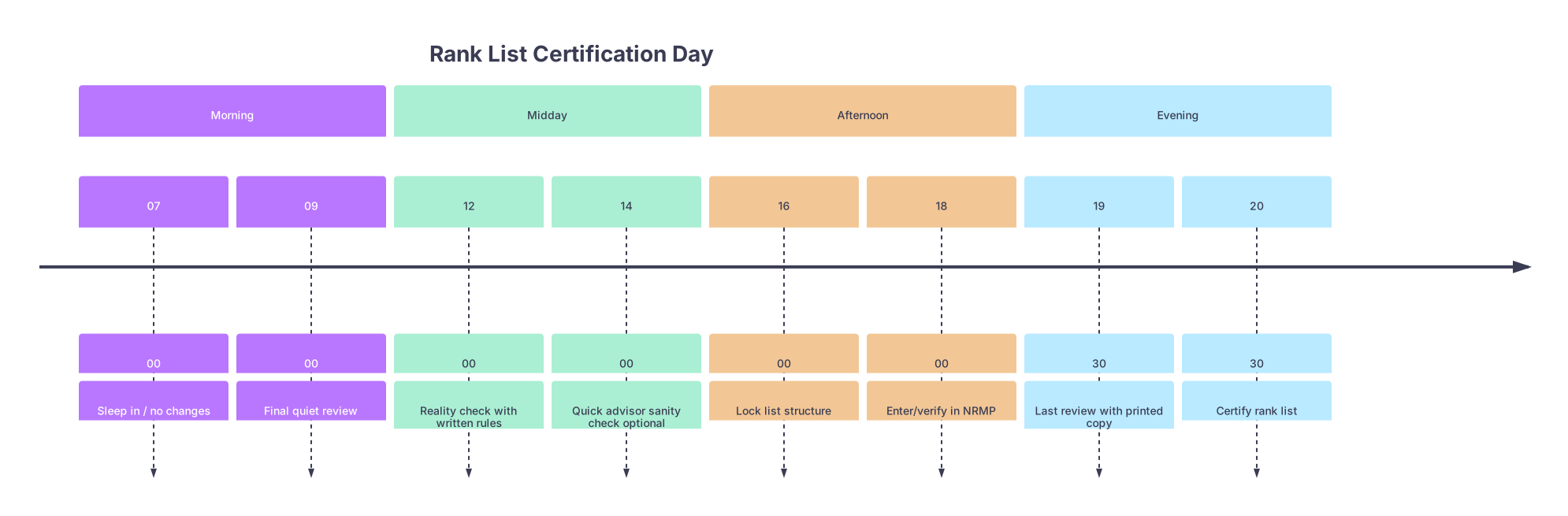
| Period | Event |
|---|---|
| Morning - 07 | 00 |
| Morning - 09 | 00 |
| Midday - 12 | 00 |
| Midday - 14 | 00 |
| Afternoon - 16 | 00 |
| Afternoon - 18 | 00 |
| Evening - 19 | 30 |
| Evening - 20 | 30 |
Morning (Day 0, 7:00–11:00 a.m.): Do Less Than You Want To
At this point you should not be editing anything major.
Morning rules:
- No changes before coffee and food. Decision-making on an empty stomach is trash.
- No scrolling Reddit/SDN threads on “rank list help” or “where should I put Program X.” Those people don’t know your life.
- No calling three different mentors “just to check.”
Use this time to:
- Print your current list. Physically.
- Re-read your non-negotiables and ranking rules you wrote days ago.
- Circle any pairs you’re still genuinely unsure about (max 3–4 pairs, not half the list).
Midday (11:00 a.m.–3:00 p.m.): Focused Fine-Tuning Only
At this point you should be doing the last strategic thinking, not rebuilding the list.
Step-by-step:
Re-evaluate only the circled “close call” pairs
Ask:- Where did I feel more supported?
- Which program has a track record more aligned with my long-term goals?
- If I matched here, could I explain to a friend why this was a good outcome?
Use your rules as a referee
Example:- Rule: “Academic > community when fellowship is priority”
- Pair: Academic Program A (#7) vs Community Program B (#6)
- Result: A should almost certainly be above B. Fix it.
Optional: one short check-in with your advisor/mentor
- “I’m between A and B at #4 and #5. Given what you know about me, does this order make sense?”
- Then stop. No new debates. No new voices.
Late Afternoon (3:00–6:00 p.m.): Structural Lock
At this point you should lock the order of your list. Any changes after this need an emergency-level justification.
Actions:
Freeze tier boundaries
- Mentally accept: “I will not move a Tier 3 program above Tier 2 today.”
- If you’ve done your work earlier in the week, wholesale jumps are usually bad decisions.
Check for these common mistakes:
- Accidentally leaving off a program you actually liked
- Ranking a program you meant to exclude completely
- Confusing similarly named programs (e.g., University X vs X Affiliated Hospital)
- Putting prelim-only positions above categoricals you want more
Decide your absolute floor
Points where you’d rather:- Skip matching and reapply vs. go there
- Take a research year vs. go there
- Pivot to a different specialty vs. go there
If a program is below that floor, remove it entirely. Do not keep it “just in case.” The algorithm can’t read your mind; it only reads your ranks.

Early Evening (6:00–7:30 p.m.): Enter and Verify, Not “Re-Think”
At this point you should be in the NRMP system, not still on scratch paper.
Step-by-step:
Enter your final list into NRMP
- Slowly.
- Double-check spelling and program codes as you go.
- Confirm prelim, advanced, and categorical spots are where they belong.
Cross-check with your printed copy
- Put them side by side.
- Verify each number and each name line-by-line.
- Look especially at:
- #1–5 (obvious)
- Any place you changed in the last 48 hours
- Programs with similar names
Save and log out for 15–20 minutes
- Walk. Shower. Cook. Do something that isn’t residency.
- This reset is important. You see errors better after a short break.
Final Hour (7:30–8:30 p.m. ET): The No-Panic Zone
Here’s where people implode. You are not going to.
At this point you should be asking: “Does my list reflect what I’ve consistently wanted for weeks?” Not “What do I feel in this exact anxious moment?”
Your rules for the final hour:
No major restructures.
- No moving programs more than 2–3 spots.
- No pulling a program from #12 to #3.
- No new programs added back that you removed earlier in the week.
Only change for clear, articulable reasons:
- “I realized I misread the call schedule; Program X’s night float is 6 months vs 2 months at Y, and lifestyle is one of my non-negotiables.”
- “I discovered Program Z lost ACGME accreditation last month.” (Yes, that’s a real reason.)
If you can’t write a 1–2 sentence logical reason on paper, you don’t make the change.
Do a final holistic gut check:
- Look at your top 3. If you matched at #3, would you be okay opening that email? Not overjoyed, but not crushed? If not, your top 3 need revisiting before you certify.
- Look at your last 3. If you matched there, would you feel sick because you knew better? If yes, remove them.
When you’re satisfied:
- Reconfirm the certified list in NRMP.
- Take a screenshot or save a PDF of the final certified page for your records.
- Log out. Do not log back in. Resist the urge.

The Morning After: No Regret Re-Entry
Once the deadline passes, your job is to not torture yourself.
Next 24–48 hours:
- Do not obsessively replay alternate ranking universes.
- Do not ask friends for their lists—it won’t change yours and just breeds FOMO.
- Do not email programs trying to clarify “where you stood” or send retroactive love letters. That phase is over.
Instead:
- Write down 3 reasons your top 3 are good outcomes.
- File your final list and your reasoning notes somewhere you won’t look at them until after Match Day.
- Shift focus back to rotations, boards, and actual patients.
Two Simple Principles to Walk Away With
The best rank lists are built days before the deadline and only lightly polished on deadline day. If you’re rewriting on the last night, that’s not “optimizing”—it’s panic.
Your rules and non-negotiables protect you from last-minute emotional swings. When in doubt, follow the structure you created when you were calmer and thinking long-term, not the version of you staring at your inbox three hours before certification.


