

The worst rank lists are not made by people who ranked too few programs. They are made by people who panicked when a late interview arrived and blew up a list that was already solid.
You are not just ranking programs. You are managing timing and emotion under a deadline. Let us put structure around that chaos.
Big Picture: Your Timeline From “My List Is Done” To Rank Deadline
At this point in the season, here is your reality:
- You have a nearly finished rank list.
- You suddenly get 1–3 late interviews.
- You have limited time before the NRMP rank order list (ROL) deadline.
- Your memory of early interviews is fading, and recency bias is loud.
So your job is very specific: systematically integrate new data (late programs) into a nearly complete system (your list) without letting recency or anxiety sabotage you.
Here is the chronological framework you will use:
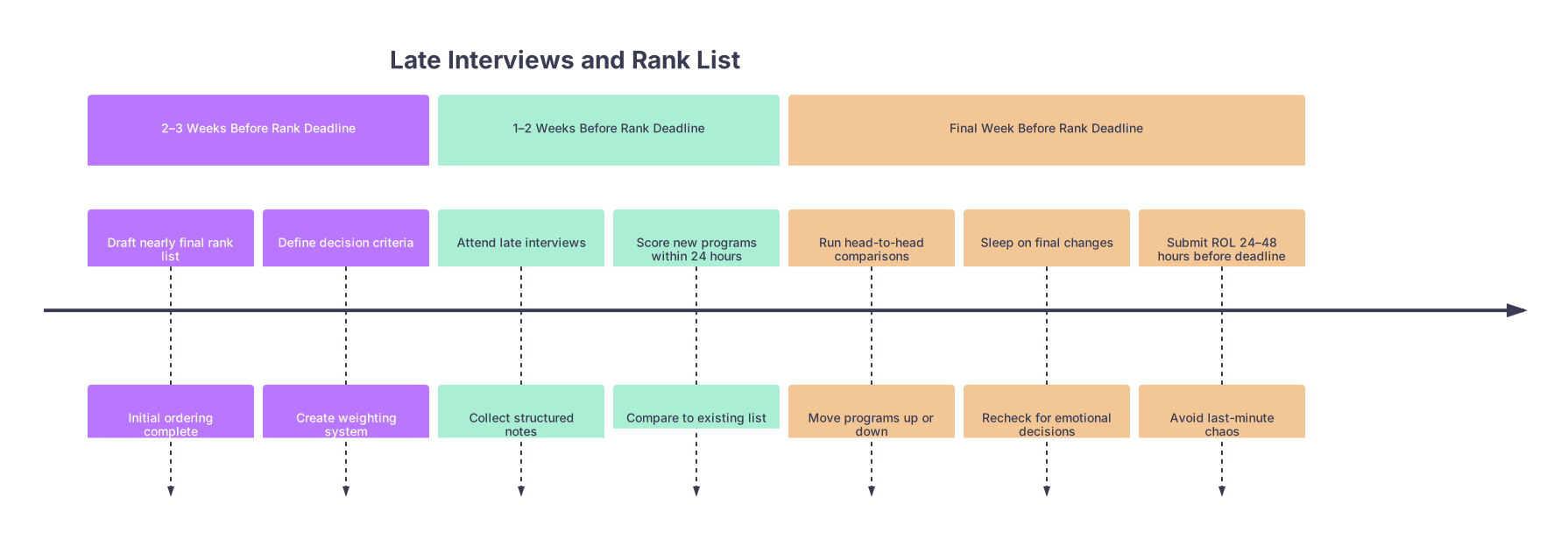
| Period | Event |
|---|---|
| 2–3 Weeks Before Rank Deadline - Draft nearly final rank list | Initial ordering complete |
| 2–3 Weeks Before Rank Deadline - Define decision criteria | Create weighting system |
| 1–2 Weeks Before Rank Deadline - Attend late interviews | Collect structured notes |
| 1–2 Weeks Before Rank Deadline - Score new programs within 24 hours | Compare to existing list |
| Final Week Before Rank Deadline - Run head-to-head comparisons | Move programs up or down |
| Final Week Before Rank Deadline - Sleep on final changes | Recheck for emotional decisions |
| Final Week Before Rank Deadline - Submit ROL 24–48 hours before deadline | Avoid last-minute chaos |
We will walk through:
- What to do before the late interview
- What to do on the day of the late interview
- What to do 24–72 hours after
- How to adjust your list in the final week without wrecking it
2–3 Weeks Before the Rank Deadline: Lock Your Baseline
At this point you think your list is basically done. Good. Now treat it like Version 1.0, not sacred scripture.
Step 1: Freeze a Snapshot of Your Current List
Within 2–3 weeks of the rank deadline, you should:
- Export or write down your full rank order outside NRMP:
- Spreadsheet
- Notebook
- Note app
- Label it clearly: “ROL v1 – PRE LATE INTERVIEWS – [date]”
This “frozen” version is your control. It protects you from rewriting history when your brain tries to rationalize changes later.
Step 2: Define Your Decision Criteria Explicitly
If you wait until after a late interview to decide what matters most, you will unconsciously bend the criteria to favor whatever just impressed you.
Right now—before the new interview—define what actually drives your happiness and success.
Common major factors (you pick 5–7 max):
- Training quality / case volume
- Fellowship match / career outcomes
- Geography (family, partner, cost of living)
- Program culture (resident happiness, support)
- Call schedule / work hours
- Research opportunities
- Visa / IMG support
- Brand name / prestige (yes, be honest if this matters to you)
Now give each factor a weight out of 10. Example for an Internal Medicine applicant:
| Factor | Weight (0–10) |
|---|---|
| Training quality | 10 |
| Geography | 8 |
| Culture / fit | 9 |
| Fellowship outcomes | 7 |
| Work hours / schedule | 6 |
You are creating a simple decision engine. Not perfect. But much better than “I just liked the PD a lot.”
Step 3: Back-Score Your Existing Programs
You should do this before the late interview appears if you can.
For each program already on your list:
- Give each factor a score 1–5 (1 = terrible, 5 = excellent).
- Multiply by the weight.
- Sum the total.
You do not need this to perfectly match your current rank order. You just need a consistent framework to compare new programs with old ones.
This way, two weeks later, you are not asking “Was Program #5 actually that good?” You have numbers plus your gut notes backing your memory.
1–2 Weeks Before Deadline: Preparing For and Attending the Late Interview
3–5 Days Before the Late Interview: Prep with a Purpose
At this point you should:
- Re-read:
- Your application
- Your personal statement
- Your notes about this program (if you had it on your ERAS list early)
- Identify 3–5 specific questions aligned with your ranking criteria. Examples:
- “How many graduates in the last 3 years matched into cardiology / GI / heme-onc?”
- “Can you describe any recent changes in call schedule or service structure?”
- “What kind of formal or informal feedback do residents receive?”
- “How many residents are from this region vs from elsewhere?”
You are not just trying to “impress” them anymore. You are collecting data against your pre-defined criteria.
Interview Day: Real-Time Data Capture
On the day of the late interview:
- During breaks or right after key conversations, jot down:
- PD vibe: supportive, distant, scripted, honest?
- Resident mood: tired, energized, bitter, cohesive?
- Any “red flag” phrases you heard (“We are in transition,” “We are working on…” with no specifics, “We lost a few faculty recently”)
- Specifics: case numbers, schedule changes, research structure
The key rule:
At this point you should never trust your memory alone.
Late-season interviews blend together even faster.
Within 24 Hours After the Late Interview: Lock in Your Impression
This 24-hour window matters. Your memory is still sharp, but your emotions are loud.
Step 1: Write the “Day-After” Summary
Within 24 hours you should sit down and answer, in writing:
- What impressed me the most?
- What bothered me the most?
- How did residents talk about:
- Autonomy
- Workload
- Leadership
- If I matched here, how would I explain it to a friend:
- “I am thrilled because…”
- “I am worried about…”
Keep these to short bullet points. Do not write a novel. You are trying to capture honest impressions before your brain starts rewriting them.
Step 2: Score the New Program Using Your Pre-Set Criteria
Now pull out your factor weights from earlier.
For the late-interview program:
- For each factor (training, geography, culture, etc.):
- Score 1–5 based on your notes and impressions
- Multiply by the weight
- Add up the total
Then compare that total to the scored totals for your current programs.
You will often discover one of three things:
- It obviously belongs near the top (score is clearly above many current programs).
- It belongs in the middle cluster (scores very similar to #7–#12 types).
- It belongs much lower than your emotional high would suggest (‘fun day’, but poor fit).
3–7 Days Before Deadline: Inserting the New Program into Your List
Now comes the actual integration.
Step 1: Identify Its “Score Neighborhood”
Look at your totals.
If the new program’s total score is:
- Higher than your current #3 but lower than #1 and #2 → it lives in the 2–4 range.
- Similar to the existing programs in the #8–#11 block → it lives there.
You are not ranking by score only, but this narrows where to think. You should not be dragging a 5th percentile program up into your top 3 just because the PD remembered your dog’s name.
Step 2: Run True Head-to-Head Comparisons
Now you do this the right way: pairwise matchups.
Start at the top of the “score neighborhood” and ask:
- “If I had offers from both Program X and this late program tomorrow, which would I sign?”
Force the binary choice. No maybes.
Work your way down until you hit the spot where you finally choose the old program instead of the new one. That is where the new program slots in.
Repeat this for any other new late interviews.
Step 3: Watch for Recency Bias and Shiny Object Syndrome
At this point you should be suspicious of yourself in two scenarios:
- You are suddenly moving a just-interviewed mid-tier program above long-standing favorites with clearly better training/culture.
- You find yourself saying, “But the facilities were so nice,” while ignoring weaker clinical exposure or bad resident vibes.
Recency shows up as:
- Overweighting:
- New PD charisma
- New hospital building
- A very friendly resident who took extra time with you
- Underweighting:
- Red flags mentioned
- Known issues from current residents elsewhere
- Your original geographic or family priorities
If the new ranking change would directly contradict the weights you set 2–3 weeks earlier, stop and justify that in writing. Sometimes your earlier assumptions were wrong and an outstanding program deserves to break your system. But you should be able to explain why.
Final 3–4 Days Before Deadline: Stabilize, Then Submit
The last few days are where people make their worst mistakes. Endless tinkering. Last-minute emotion.
3–4 Days Before Deadline: Build Your Final Candidate Version
At this point you should:
- Create “ROL v2 – FINAL CANDIDATE – [date]” outside NRMP.
- Compare v2 to:
- v1 (your pre-late-interview list)
- Your factor scores
Ask yourself:
- Did late interviews only change the middle of the list (completely normal)?
- Did you unexpectedly re-order your entire top 5 (possible, but rare and should be defendable)?
- Did any clear red-flag programs creep up the list just because they were nice to you?
If v2’s top 5 is radically different from v1’s, write one sentence for each change:
- “Program NewMed moved above Program CityMed because its fellowship outcomes in cards/onc are objectively better and my partner actually prefers its location.”
- “Program SuburbGen moved down because the chief residents explicitly warned about burnout and poor response from leadership.”
If you cannot write a rational sentence beyond “It just felt really good,” reconsider.
2–3 Days Before Deadline: Input Into NRMP and Walk Away
You should not be entering your ROL for the first time an hour before the deadline.
At this point you should:
- Enter your ROL v2 into NRMP exactly as written.
- Double check:
- No duplicates
- No typos in program codes
- Order matches v2 perfectly
- Hit Certify.
Then stop. You can edit later if something dramatic happens, but you want a certified list sitting there as a safety net.
Last 24–48 Hours: Only Change for True New Information
This is the danger window for:
- Group-chat panic
- “Someone on Reddit said this program is malignant”
- Sudden prestige anxiety when a friend ranks a big-name program high
Your rule is simple:
In the last 24–48 hours, you only change your list for real new information, not vibes.
Legitimate reasons to edit:
- New, credible information from current residents contradicting what you were told.
- Official news: major leadership change, loss of accreditation, loss of key hospital site.
- Serious life change (partner job, family illness, etc.).
Not legitimate:
- A classmate claims, “Everyone knows that place is malignant,” but has never rotated there.
- An attending says, “You would be crazy not to put Big Name U #1,” while ignoring your partner, cost of living, and your own values.
- Last-minute fear that you “aimed too high” with your top few programs. (You should always rank in your true preference order, regardless of competitiveness. That is how the algorithm works.)
How Late Interviews Should Not Change Your Strategy
Let me be blunt about a few things I have seen people do that are just wrong.
- Do not push a lower-tier late-interview program above a clearly superior long-standing favorite just because they invited you late and made you feel “wanted.”
- Do not re-order your list to game what you think programs think of you. You rank in your true preference order. Always.
- Do not drop strong programs you liked earlier just because they felt less “personal” than a small, late-interview place. Courtesy is not curriculum. Charisma is not culture.
A late interview can absolutely jump into your top tier if it truly outperforms on your criteria. I have seen people discover their eventual #1 in January. That is fine. But those are decisions backed by training quality, fit, and outcomes. Not just recency.
Quick Visual: How Your Time Should Be Spent
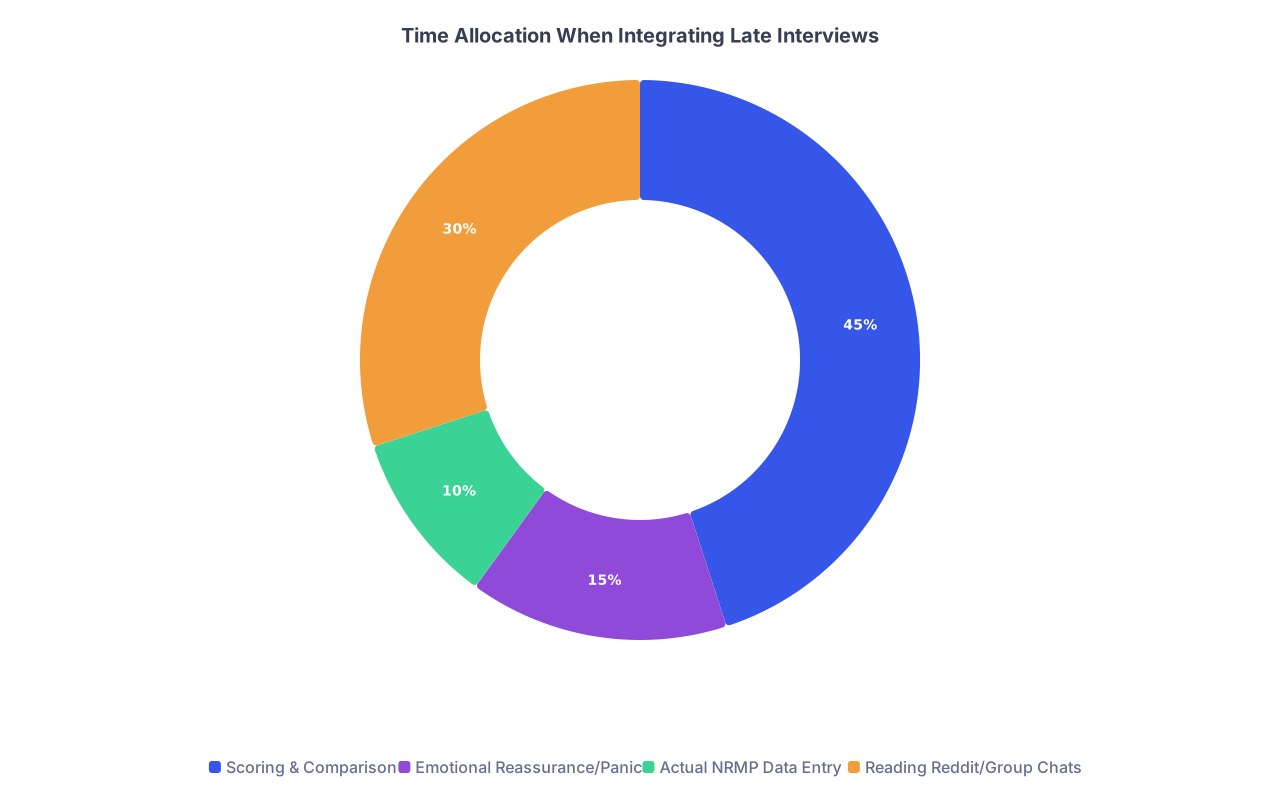
| Category | Value |
|---|---|
| Scoring & Comparison | 45 |
| Emotional Reassurance/Panic | 15 |
| Actual NRMP Data Entry | 10 |
| Reading Reddit/Group Chats | 30 |
If your pie chart is mostly “reading Reddit,” you are doing this wrong.
Special Situations: Couples Match and IMGs
Couples Match
If you are couples matching, each late interview is actually two changes:
- Your personal preference for that new program.
- The combined pair rankings (the couples grid) you may need to expand.
At this point you should:
- Immediately discuss with your partner: “Where does this new place realistically fall for you?”
- Only build additional pairs in your couples list for combinations that either:
- Improve your joint geography, or
- Add acceptable backups you previously did not have.
Avoid rebuilding the entire couples grid from scratch in the final 48 hours. That is how errors slip in.
IMGs / Visa-Dependent Applicants
Late interviews can feel like lifelines. Sometimes they are. But the same structure applies.
You prioritize:
- Programs with a clear track record of:
- Sponsoring your visa type (H-1B vs J-1)
- Successfully renewing and supporting immigration
- Places with multiple IMG residents already there
Do not push a visa-uncertain late interview above a visa-stable early one just because it felt slightly friendlier. If you cannot work there, nothing else matters.
Final 24 Hours: Sanity Check and Submit
At this point you should:
- Verify: Your NRMP list is certified, in your true preference order.
- Compare top 5 across:
- ROL v1
- ROL v2
- Your original criteria/weights
- Ensure:
- Every change has a reason beyond recency or prestige anxiety.
Then stop touching it.
Core Takeaways
- Your pre-late-interview list is Version 1.0, not garbage. Freeze it, define your criteria, and use it as an anchor.
- Each late interview gets:
- A 24-hour written debrief
- A structured score against your pre-set factors
- True head-to-head comparison with neighbors on your list, not a free leap to the top.
- In the final 48 hours, adjustments should reflect real new information and clear reasoning, not panic, gossip, or recency bias.


