

It is 7:45 a.m. the morning after an interview. Your suit is still half‑crumpled over the chair, your voice is a little raw from talking, and your inbox has three new emails titled “Thank you for interviewing with us.”
You feel two things: relief it is over and a vague dread that you are going to forget the details when it is time to build your rank list.
This is the moment that makes or breaks a rational rank order list. Not Match Week. Not the night before you certify. The day after each interview.
Here is exactly what you should do, in order, the day after every interview to prepare for ranking—broken down by morning, afternoon, and evening, with a bigger weekly rhythm for heavy interview blocks.
First Things First: Your Non‑Negotiable Same‑Day Window
Memory decays brutally fast after interview day. By 48–72 hours, programs start blending. People overestimate how much they “just know” which places they like.
So your rule: you always do a structured review within 24 hours of the interview ending. Earlier is better.
Think of the post‑interview day as three passes:
- Morning – Capture everything before it fades
- Afternoon – Organize and clarify
- Evening – Calm the noise, set a provisional rank position
We will walk through each.
Morning (0–6 hours after waking): Capture While It Is Fresh
At this point you should not trust your brain. Trust paper, or digital notes. Your job for the morning is to dump everything out before real life (travel, rotations, family) intrudes.
Step 1: Do a 10–15 minute “memory dump”
Before checking email, before Instagram, sit somewhere quiet with:
- Your interview schedule (agenda)
- Your notes from the day (if you took any)
- A blank doc or notebook
Set a timer for 10–15 minutes. No editing, no formatting. Just write:
- What stood out (good, bad, weird)
- Names you remember and what they said
- Any “red flag” moments
- Any “this could be home” gut reactions
Sample raw dump might look like:
- PD (Dr. Lee) – very resident‑focused, emphasized curriculum changes based on resident feedback every year
- Residents seemed tired but not miserable; 2 people hinted call is heavier than website suggests
- OB/GYN exposure very strong, MFM fellow said they scrub residents in early
- City felt safe walking back to hotel at 9 p.m., though expensive
- One resident whispered “get out while you can” as a joke in the elevator – not sure what to make of that
Do not polish. You will make it usable later.
Step 2: Log standardized ratings for key categories
You need a comparable framework across programs. Make yourself a simple 1–5 scale for core features. Use the same sheet for every program.
Example:
| Category | 1 (Poor) | 3 (Average) | 5 (Excellent) |
|---|---|---|---|
| Program Culture | Toxic | Neutral | Supportive |
| Clinical Training | Sparse | Adequate | Robust |
| Fellowship Prep | Weak | Ok | Strong |
| Resident Lifestyle | Unsustainable | Manageable | Balanced |
| Location / Life | Hate | Fine | Love |
Right after your memory dump, score:
- Culture / people
- Clinical training and case volume
- Academic / fellowship support
- Lifestyle (hours, call, schedule)
- Location / family / partner fit
- Gut feeling
Use whole numbers. Do not overthink. This becomes your “objective” backbone when emotions from different days blur.
Step 3: Write a 5–7 sentence “future me” summary
Next, write a short paragraph addressed to “future you” building your rank list. You are writing this while the emotional tone is still intact.
Format it like this:
- 1–2 sentences: How the day felt overall
- 2–3 sentences: Major strengths (specific)
- 2–3 sentences: Major weaknesses or concerns
- 1 sentence: Provisional verdict (e.g., “Currently in my top 3,” or “Rank only as backup”)
Example:
This place felt resident‑centered and sane. The PD clearly knows all the residents and emphasized flexibility for family needs. Strengths: very strong ICU exposure, happy senior residents, and faculty actively helping with critical care fellowships. Weaknesses: location is not great for partner’s job, and call schedule PGY‑2 sounded rough. Provisional: this is a serious contender for top 3 unless a major geographic favorite beats it.
You will be shocked how useful this short “letter to self” is in February.
Late Morning: Do the Professional Stuff (Thank‑You Emails)
Now that you have preserved your impressions, handle the etiquette. Do not reverse that order.
Step 4: Send thank‑you emails (efficiently, not obsessively)
You do not need a novel. You do not need to chase every single person who breathed near you.
At this point you should:
- Email:
- Program director
- Your primary interviewers (usually 2–4)
- Anyone who had a substantial one‑on‑one conversation with you about your interests (e.g., research mentor, chief resident who toured you solo)
Keep it short:
- 3–5 sentences
- One specific reference to your conversation or something about the program
- Reiteration of your genuine interest (no fake “you’re my #1” language)
Example skeleton:
Dear Dr. Smith,
Thank you for the opportunity to interview at [Program] yesterday. I appreciated our discussion about [specific topic], especially your perspective on [detail]. I was particularly impressed by [specific aspect of training or culture]. I would be grateful for the opportunity to train at [Program].
Sincerely,
[Name]
Send these by early afternoon the day after. That is normal. You are not “late.”
Do not say anything about how you will rank them. That belongs much later in the season, and only if you genuinely mean it.
Early Afternoon: Structure Your Data
Now the emotional fog is clearing. Time to convert the morning dump into something that will survive three months.
Step 5: Update your master program tracker
You need a central file that covers every program. Spreadsheet, Notion, Evernote, whatever. But one place.
Columns I recommend:
- Program name
- City / region
- Interview date
- Provisional rank tier (A, B, C, D)
- Culture score (1–5)
- Training / volume score (1–5)
- Lifestyle score (1–5)
- Location / partner / family fit (1–5)
- Red flags (Y/N + short note)
- Green flags (Y/N + short note)
- Notes link (to your full writeup)
Fill this out the day after every interview.
Then do one more thing: assign a tier. Not a specific number yet, just a rough bucket:
- Tier A – Strongly want to match here
- Tier B – Would be happy; solid option
- Tier C – Acceptable backup if needed
- Tier D – Only rank if desperate for a position
Force yourself to pick one tier that day. You can move it later, but give it a home.
Step 6: Clarify factual gaps while you still remember you had them
Go back to your memory dump and highlight any “I wish I had asked…” lines:
- “How often do prelims get categorical spots?”
- “Is there protected time for continuity clinic?”
- “What is the vacation approval process like?”
At this point you should decide:
- Is this question critical enough to email the coordinator or PD?
- Or is it mildly interesting but not rank‑changing?
If it is critical, send one concise email to the program coordinator, not the PD. Example:
Dear [Coordinator],
Thank you again for organizing the interview day yesterday. I realized afterward that I forgot to clarify one question about [specific]. Would you be able to let me know whether [specific, concise question]?
Best regards,
[Name]
Resolve it quickly or let it go. Do not build your rank list around mysteries you are too shy to clarify.
Late Afternoon: Compare Against Your Existing List
The most powerful thing you can do the day after an interview is decide where this program sits relative to others while both are fresh.
Step 7: Slot the program into a provisional rank position
Open your existing list. If this is your first interview, obviously it goes at spot #1 for now. If not, walk through this decision:
- Start from the top of your current list.
- Ask: “Would I rather train at yesterday’s program than at this one?”
- The moment the answer is “yes,” insert it right above that program.
- If the answer is “no” for all, it goes at the bottom.
Simple. Binary decisions beat “vibes” weeks later.
If you want to see how your impressions stack quantitatively, chart it. For example:
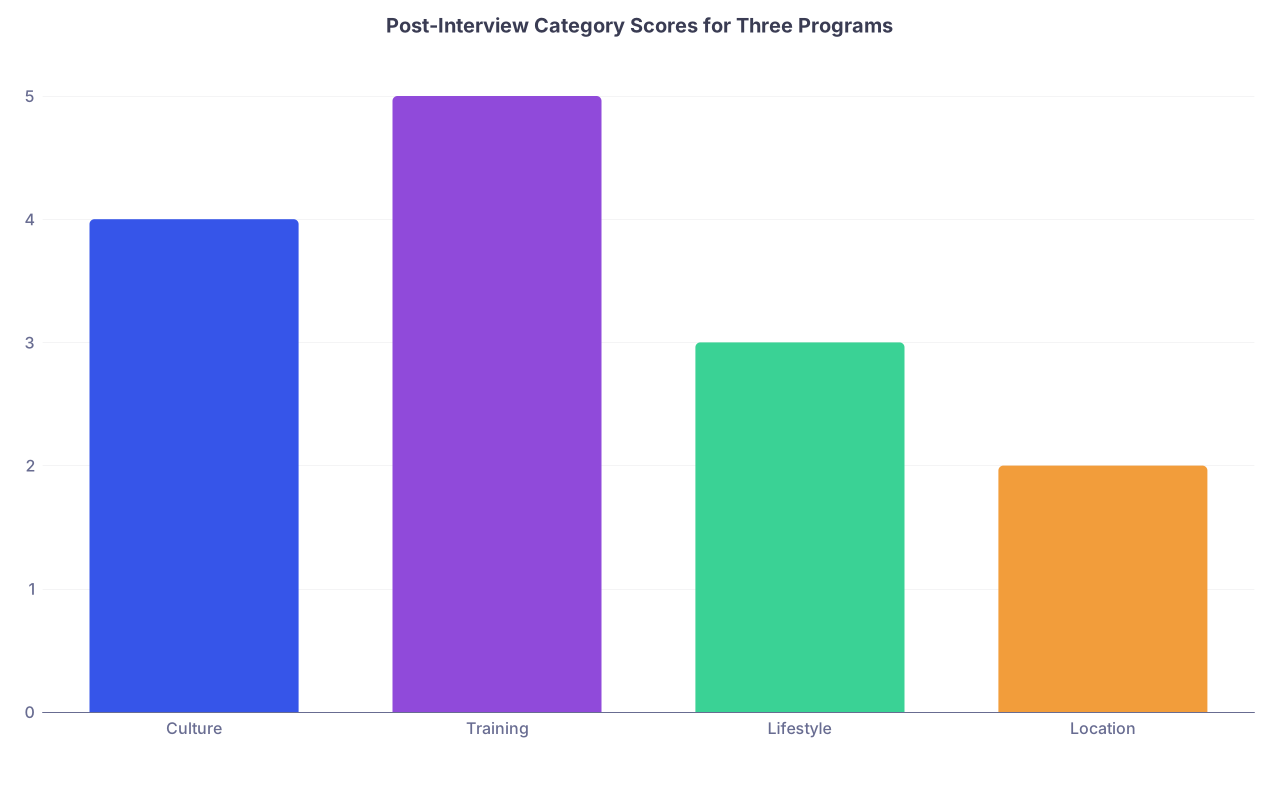
| Category | Value |
|---|---|
| Culture | 4 |
| Training | 5 |
| Lifestyle | 3 |
| Location | 2 |
Then do the same bar chart per program to see, “This place has amazing training but terrible location compared to Program X,” etc. It keeps you honest.
Step 8: Write a 2–3 sentence justification for that position
You are not locking anything in. You are documenting why you feel this way today.
For example:
I am putting [Program] above [Another Program] because the residents seemed more supported and the ICU training is clearly stronger. Location is worse for us, but I am willing to trade that for better education and fellowship outcomes.
Or, on the flip side:
I am keeping [Program] below [Top Choice] because although the culture felt good, the call schedule and location are significantly worse for our family, and fellowship options are similar.
Later, when recency bias from later interviews kicks in, this little note will anchor you.
Early Evening: Emotional Decompression and Noise Control
By now you have done the “work” part. The rest of the day is about clearing your head without re‑doing your decision 14 times.
Step 9: Debrief with 1–2 trusted people, not a committee
You can talk through impressions with:
- Partner / spouse
- Close friend
- One mentor who knows your priorities
Avoid group chats where everyone is obsessing and catastrophizing. That crowd tends to magnify minor issues and turn them into imaginary deal‑breakers.
When you debrief, focus on:
- How it felt
- Whether it fits your major life priorities (geography, partner job, kids, etc.)
- Any true red flags that need a second look
Do not crowdsource your rank list to classmates. Different specialty, different goals, totally different needs.
Step 10: Set a “no re‑hash” boundary for the rest of the night
After you have:
- Done your memory dump
- Scored your categories
- Updated your tracker
- Slotted the program
…you are done for the day.
At this point you should not:
- Re‑read SDN threads about the program
- Stalk more residents on Instagram to “double check” if they look happy
- Start re‑ordering your entire list because you are tired and slightly anxious
Instead:
- Eat something real
- Move your body (even a 20‑minute walk)
- Do something non‑medicine for at least an hour
Your brain will integrate the day in the background. That works better than consciously ruminating.
Special Situations and Weekly Rhythm
During peak season you might have 3–5 interviews per week, with travel layered on top. The day‑after routine becomes harder, but also more critical.
Here is how to handle that.
If you have back‑to‑back interviews
Scenario: You interviewed Monday, fly Monday night, interview again Tuesday.
In that case your “day after” work gets split:
- Same evening (after interview #1):
- 10–15 minute raw dump in the hotel
- Quick 1–5 scores in your phone or laptop
- Next evening (after interview #2):
- Complete tracker updates for both programs
- Write short “future me” summaries for both
- Send thank‑you emails to Monday’s program (still ok)
You will be tired. Do it anyway. Future you will be grateful.
If travel eats the whole next day
Use travel downtime as your “morning.” Airplane mode is actually your friend here.
- On the plane:
- Memory dump in a notes app
- Category scores
- When you land / get to the hotel:
- Plug into master tracker
- Provisional slotting into rank list
Weekly review: every Sunday evening
At this point in interview season, once a week you should step back and look at the whole picture. Sunday evening works for most.
Your Sunday routine:
- Re‑read all “future me” summaries from that week’s programs.
- Re‑look at your spreadsheet tiers (A/B/C/D).
- Ask yourself:
- Does anything need to move up or down a tier?
- Did any “red flag” feel worse or less bad with a few days’ distance?
- Does my geographic balance still match my actual willingness to move?
You are not certifying a list, but you are keeping your internal compass updated.
A simple flow of your interview season might look like this:

| Step | Description |
|---|---|
| Step 1 | Interview Day |
| Step 2 | Next Morning Capture |
| Step 3 | Update Tracker |
| Step 4 | Provisional Rank Slot |
| Step 5 | Weekly Review |
| Step 6 | Pre-Certification Final Review |
Red Flags and Green Flags: Checklists for the Day After
Your impressions the day after are the most honest you will ever have. Before you soften or rationalize.
Use these quick lists when you update your tracker.
At this point you should mark a red flag if:
- Multiple residents independently hinted at a toxic attending or service
- PD or faculty dismissed resident wellness concerns as “generational”
- Residents appeared burned out and avoided eye contact in the resident‑only session
- Schedule details were vague or contradicted what is on the website
- You felt physically unsafe in or around the hospital neighborhood
- A resident explicitly said they would not choose the program again
One red flag does not always kill a program. But track them. When one program has three and another has zero, that matters.
You should mark a green flag when:
- Residents openly praised PD responsiveness and specific changes made after feedback
- Graduates consistently match into fellowships / jobs aligned with your goals
- Several people independently talked about the same positive aspect (e.g., “we really protect your days off”)
- You found yourself relaxed and “yourself” during the day, not walking on eggshells
- The program’s weaknesses were transparent, and they had concrete plans to address them
These go into your tracker as short phrases, not essays: “PD changed call structure last year after resident feedback,” etc.
Final Night Check (5 Minutes)
Before bed, take 5 minutes:
- Glance once more at your new provisional ranking position for the program
- Confirm you sent all needed thank‑you emails
- Add one last line to your “future me” summary:
- “If I am torn in February, remember: [one key moment or feeling].”
Then close the file.
You are done with that program for now. When it resurfaces in your mind two months later, you will not be relying on your exhausted recollection of a hotel lobby and a Zoom breakout room. You will have hard notes and a snapshot of how it actually felt.
Key Takeaways
- The day after each interview, your non‑negotiables are: memory dump, standardized scoring, tracker update, and a provisional slot in your rank list. Do them within 24 hours.
- Use simple, repeatable structures—1–5 scores, short “future me” summaries, A–D tiers—so programs remain comparable when the season blurs together.
- Once you have captured your impressions and placed the program, stop re‑hashing. Protect your energy. Your future ranking decisions should be anchored in the clear thinking you did the day after, not in late‑season anxiety.


