

It’s two weeks before the NRMP rank list deadline.
Your phone is buzzing with “Have you decided yet?” texts.
You’ve opened the Rank Order List page ten times today and changed nothing.
This is the danger window. Close enough to feel urgent, far enough that you can still screw it up by overthinking.
Here’s how to walk through these last two weeks—day by day, then week by week—so that when you hit “Certify,” you’re calm, not nauseous.
Big Picture: What These Two Weeks Are Actually For
At this point you should not be reinventing your entire list from scratch.
These two weeks are for:
- Catching big logic errors (e.g., putting a clear backup above your clear dream).
- Correcting “vibe bias” from one loud interview day.
- Checking dealbreakers you might have ignored when you were high on free hotel breakfasts.
- Making peace with your top 3–5.
Not for:
- Rearranging programs nightly because of Reddit gossip.
- Panic-adding places you hated “just in case.”
- Trying to predict how programs ranked you. (You will be wrong.)
Use the time deliberately. Here’s the structure.
Day 14–13: Freeze the Draft & Gather Reality
At this point you should freeze your current list. Literally.
Day 14: Take a Snapshot and Stop Editing
- Log into NRMP (or appropriate match system).
- Export or screenshot your current Rank Order List.
- Print it or save as a PDF labeled clearly:
Pre-Review Draft – [Your Name] – [Specialty] – Two Weeks Out.
Then, stop editing the live list. Any changes over the next week should happen on paper or in a document, not in the portal. You don’t want accidental half-baked certification.
Create a working document with three columns:
- Program name
- Current rank number
- “Move up? Down? Or keep?”
You’ll fill this out stepwise.
Day 13: Hard Data Check – Compare Programs Side by Side
Today is about facts, not feelings.
Make a quick comparison table for your top ~10–15 programs. No more; beyond that the differences are mostly noise.
| Program | Location Fit | Training Strength | Call Schedule | Fellowships | Gut Feel |
|---|---|---|---|---|---|
| A | 5/5 | 5/5 | 3/5 | Strong | 5/5 |
| B | 3/5 | 4/5 | 4/5 | Moderate | 4/5 |
| C | 4/5 | 3/5 | 5/5 | Limited | 3/5 |
| D | 2/5 | 5/5 | 2/5 | Strong | 4/5 |
| E | 5/5 | 3/5 | 4/5 | Limited | 5/5 |
Use a 1–5 scale for things like:
- Location (family, partner, cost of living)
- Training strength / reputation
- Schedule/lifestyle
- Fellowship or job placement
- Support culture (resident happiness, PD vibe)
You’re not doing a perfect algorithm. You’re forcing your brain to confront reality:
- That program you keep pushing up because they were “so nice”? Might be a lifestyle black hole.
- That “prestige name” with malignant vibes? Needs to drop if you actually want to survive three years.
By end of Day 13 you should have:
- A scored snapshot of your top programs.
- A short list of “this looks off” programs to reconsider.
Day 12–10: Clarify Priorities & Filter Out Noise
At this point you should pin down your non-negotiables and your true tiebreakers.
Day 12: Decide Your Non‑Negotiables
Sit down and write 3–5 things you will not compromise on. Examples:
- “Must be within 2 hours of partner’s job.”
- “I will not do 24+2 call in a malignant culture.”
- “I need a program with a strong cardiology fellowship pipeline.”
- “I need solid visa support (H-1B, not just J-1).”
Be blunt with yourself. Rank list regret usually comes from lying about these.
Now, go down your top 10–15 and mark:
- “Yes” – meets non-negotiables.
- “Borderline” – at risk on 1 non-negotiable.
- “No” – violates 1+ non-negotiables.
If a program clearly violates a non-negotiable and isn’t your only shot at matching? It should drop. Significantly. Or come off the list entirely.
Day 11: Cut the Fantasy Games
Today is about killing three bad habits:
“But I think they loved me” rearranging
Ignore “we’d love to have you” emails, postcards, or memory of one enthusiastic chief. You have:- Zero real insight into your rank at that program.
- No ability to improve your odds by moving them artificially up or down.
NRMP algorithm reality:
You should rank programs in the order you actually prefer them, regardless of where you think they’ll rank you. Anything else is just self-sabotage.Overweighting one loud experience
Example: One resident said “Our nights are brutal” and you moved them from #2 to #9 in a panic.
Ask:- Was that consistent with what others said?
- Does that conflict with data from other residents, the PD, or alumni?
Reddit / group chat whiplash
Hearing “Program X is terrible” from a stranger who interviewed on a different day doesn’t override your own experience. Take gossip as background noise, not gospel.
Today’s output: a cleaner, more honest mental hierarchy. Your list might not change on paper yet, but you should feel a bit clearer on who really belongs near the top.
Day 10: Quick Financial & Location Reality Pass
You’re not just ranking hospitals. You’re ranking three years of your actual life.
Do a 30–60 minute “money and life” pass on your top 10:
- Look up realistic rent for a 1-bedroom near each hospital.
- Estimate commute times by Google Maps at 6:30 am.
- Check state income tax and cost-of-living.
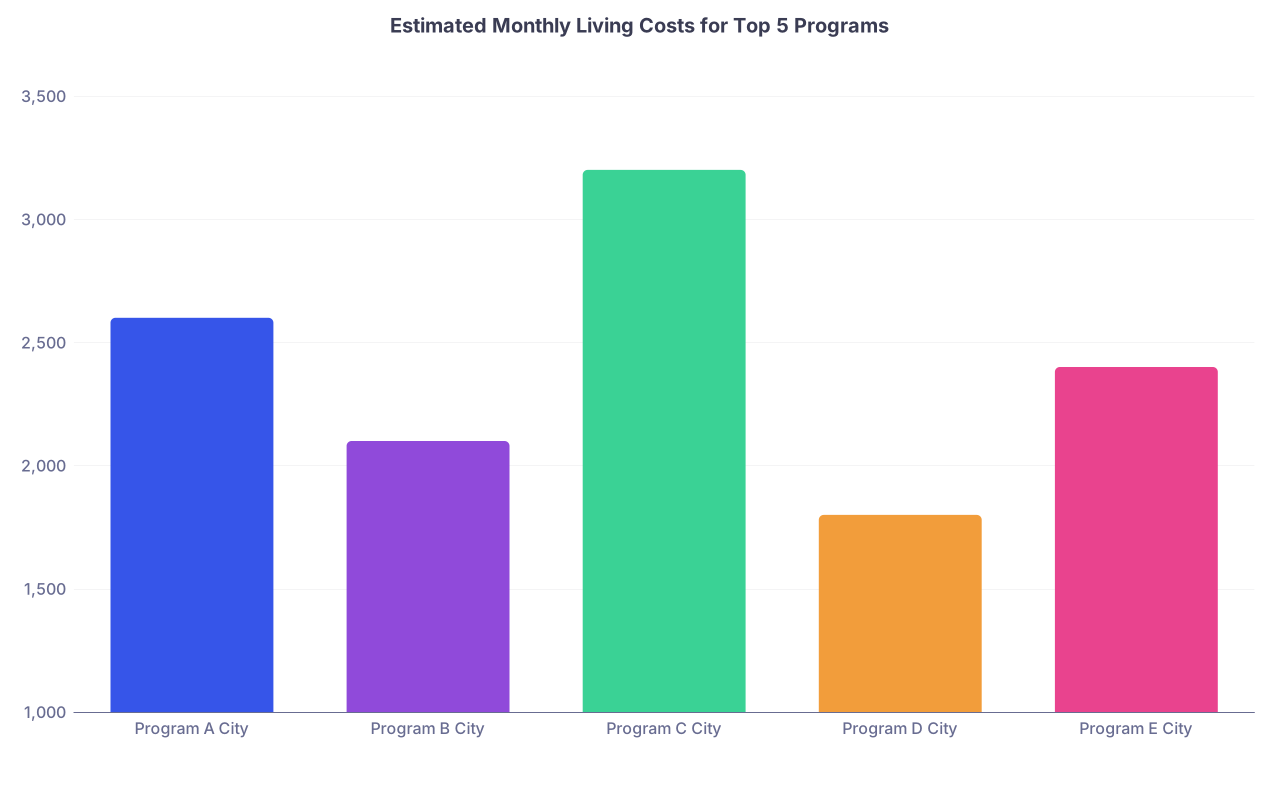
| Category | Value |
|---|---|
| Program A City | 2600 |
| Program B City | 2100 |
| Program C City | 3200 |
| Program D City | 1800 |
| Program E City | 2400 |
If one city will financially crush you and another will let you actually save money, that’s not trivial. You’ll feel it every call night DoorDash order.
You don’t need perfect budgets. Just enough to ask:
- “If Program X and Y were identical otherwise, would I rather live in City X or City Y?”
That gives you real tiebreakers later.
Day 9–7: Deep Dive on Your Top 5–7
At this point you should stop obsessing about #14 vs #17. Focus on the places where your decision will actually change your life: your top chunk.
Day 9: Reality Test Each Top Program
Take your top 5–7. For each, answer these out loud or in writing:
- “If I match here, will I be proud to tell people?”
- “Can I see myself in this city on a random Tuesday in February, exhausted and post-call?”
- “Do I trust the PD and leadership to have my back when something goes wrong?”
If you’re engaged, partnered, have kids, or other anchors: repeat this exercise with them. But you get the final vote. You’re the one on call.
Make three columns:
- “Absolutely would be happy”
- “I think I’d be okay, but not thrilled”
- “This would sting a bit”
Your #1 should come from the first column. If it doesn’t, your ranking is misaligned.
Day 8: Re‑Tier and Lightly Reshuffle
Today you’re allowed to revise—still offline.
Create tiers for your list:
- Tier 1: Dream/ideal programs (you’d be thrilled).
- Tier 2: Solid options (you’d be genuinely okay).
- Tier 3: Acceptable backups (you’d cope, not celebrate).
- Tier 4: “Only if needed” (do you even want them?).

| Step | Description |
|---|---|
| Step 1 | All Programs |
| Step 2 | Tier 1 |
| Step 3 | Tier 2 |
| Step 4 | Tier 3 |
| Step 5 | Tier 4 or Remove |
| Step 6 | Thrilled to Match? |
| Step 7 | Genuinely Ok? |
| Step 8 | Would Cope If Matched? |
Now:
- Make sure all Tier 1 programs are ranked above any Tier 2.
- Same logic: Tier 2 above Tier 3, etc.
- Inside each tier, adjust based on:
- Location preference.
- Lifestyle vs prestige.
- Fellowship goals.
You should end Day 8 with:
- A tiered list that feels directionally right.
- Maybe a few programs highlighted as “probable moves up or down 1–2 slots.”
Still no changes in NRMP.
Day 7: Midpoint Check – Sleep On It
At this point you should force a pause.
- Don’t touch your list (digital or paper) today after you’ve looked it over once in the morning.
- Let your brain process in the background.
Notice what keeps popping into your head:
- A program you keep fantasizing about = might need to move up.
- A program you feel dread about matching at = might need to move down or off.
By the end of Week 1 (Day 14–7), you should:
- Have a stable tiered list.
- Be mostly sure about your top 2–3.
- Have identified any programs that probably don’t belong on the list.
Day 6–4: Sanity Checks, Mentors, and Dealbreakers
Now it’s time for outside eyes and a final risk pass.
Day 6: Mentor Review (But Control the Conversation)
Pick one or two people max: someone who knows you and the field. Not random faculty you met once on rotation.
Before you show them the list, tell them:
- Your priorities (location vs prestige vs lifestyle).
- Any personal constraints (partner, kids, visa, health).
- Your current top 5 in order.
Then ask specific questions:
- “Given my goals in [subspecialty / type of practice], does this ordering make sense?”
- “Am I overrating or underrating any program here?”
- “Would you flip any of my top 3–5, and why?”
Don’t hand them full control of your list. You’re looking for:
- Red flags you missed (“That program is losing key faculty.”).
- Hidden strengths (“This place quietly matches into amazing fellowships.”).
Take notes. Do not log in and change things immediately afterward. Let it marinate 24 hours.
Day 5: Hard Dealbreaker Audit
Now do a ruthless pass for dealbreakers:
- Programs with toxic reputation confirmed by multiple independent sources.
- Visa limitations if relevant (e.g., suddenly only offering J-1 when you need H-1B).
- Major life conflicts you forgot (partner simply cannot move there, serious medical care access you need, etc.).
For each program on your list, ask:
- “If this were the only place I matched, would I actually go?”
If the honest answer is no, that program should not be on your rank list. Ranking a place you’ll refuse is pointless.
By end of Day 5:
- You’ve probably removed 0–3 programs.
- Maybe bumped down one or two that are now clearly “last resort.”
Day 4: Convert Your Working List to a Near‑Final Draft
At this point you should move to your near‑final digital version.
- Take your offline tiered list.
- Log into NRMP.
- Carefully enter or rearrange programs to match your current ordering.
- Double‑check:
- No duplicates.
- Every program is the correct track (categorical vs prelim vs advanced).
- Program codes all match.
Do not certify yet. Save and log out.
Take screenshots or print your updated Rank Order List; label it:Near-Final – [Date].
Day 3–2: Micro‑Adjustments & Emotional Check
These days are for tiny, intentional tweaks, not wholesale restructuring.
Day 3: The “1–2 Spot” Question
For each pair of adjacent programs in your top 10, ask:
“If both offered me a spot today, where would I sign?”
If you’d sign with the lower-ranked one? Swap them. Simple.
Don’t let prestige completely override this. If the difference in training quality is marginal, but your quality of life at one will be dramatically better, that matters. Three years is a long time.
Also run a short “future you” test:
- “If I match at Program X, will I look back and think, ‘Yeah, that fits who I am’?”
If something in your top 3 makes you feel queasy every time you imagine matching there, stop pretending it’s your dream.
Day 2: Calm Down the Catastrophizing
At this point your list should not be changing much.
Two targeted checks:
Backup depth
- Do you have enough realistic programs (especially if your specialty is competitive or your application is borderline)?
- You don’t fix a risky list by dragging safe programs above places you truly prefer. You fix it by having enough programs ranked.
Track sanity
- Categorical vs prelim vs advanced programs are entered correctly.
- Supplemental lists (e.g., for advanced programs needing prelim years) are linked and logical.
If everything looks sane, step away. No more than one minor change today, maximum.
Day 1: Final Review, Certification, and Walking Away
This is where people panic and blow up a perfectly good list. Don’t.
Morning of Day 1: Quiet, Methodical Final Pass
Give yourself a 30–60 minute protected block.
Go through this checklist line by line:
- Is my #1 truly where I’d most like to match?
- Are all the programs I’d be happy with ranked above the ones I’d “tolerate”?
- Did I remove any program I truly would not attend?
- Are all program codes, tracks, and cities correct?
- Are my supplemental/prelim lists set logically?
If you want a structured look, think of it like this:
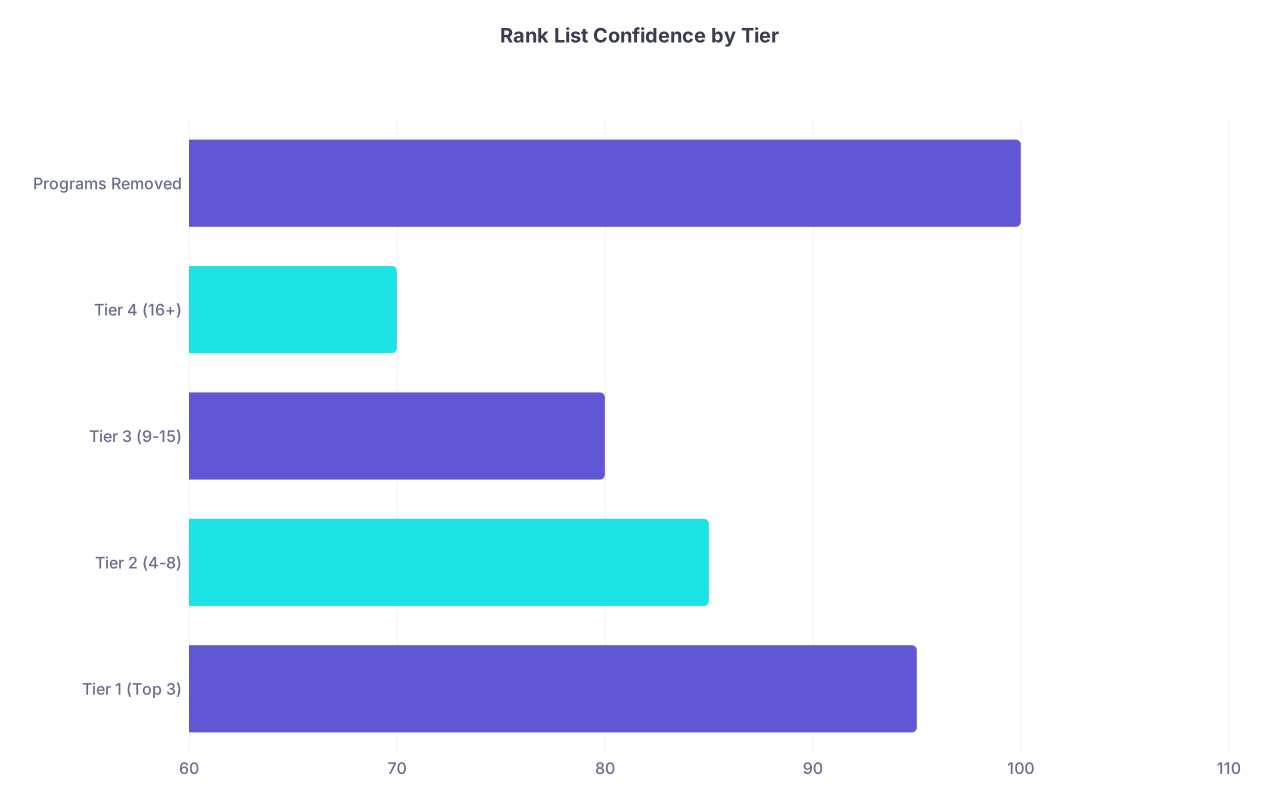
| Category | Value |
|---|---|
| Tier 1 (Top 3) | 95 |
| Tier 2 (4-8) | 85 |
| Tier 3 (9-15) | 80 |
| Tier 4 (16+) | 70 |
| Programs Removed | 100 |
You don’t need 100% certainty for every line. You need:
- Very high confidence in your top 3–5.
- Reasonable comfort the rest are in sensible order.
Afternoon/Evening of Day 1: Certify, Then Lock Yourself Out (Mentally)
Once the final pass looks good:
- Click “Certify List”.
- Confirm when the system asks. Read the wording; don’t just click through in a daze.
- Take a screenshot or print the certified list for your records.
Then:
- Log out.
- Close the browser.
- Do not log back in just to re‑read your list over and over.
If you catch an actual error before the deadline (wrong program code, missing prelim, etc.), sure, log back in, correct, re‑certify. But you should not be changing your list because of last‑minute nerves.
The 24–48 Hours After: Your Job Is To Stop Touching It
You will hear rumors. Somebody will text, “I just heard Program X is losing their PD” or “Somebody said Y is malignant now.”
Unless it’s a major, confirmed, reliable change that fundamentally alters your understanding (and you’re still before the deadline), don’t touch it.
Your pre‑deadline brain is anxious and loves drama.
Your pre‑deadline brain is not smarter than the version of you that spent two weeks carefully thinking this through.
Take Match advice from who you want, but this I’ll stand by:
- The list you built methodically over two weeks is almost always better than the list you panic‑edit at 11:57 pm on deadline day.
Quick Summary: What Actually Matters in These Two Weeks
- Rank your programs in the order you genuinely prefer, ignoring “where they might rank you.” The algorithm favors your true preferences, not your predictions.
- Use structure, not vibes alone. Tiers, non‑negotiables, mentor feedback, and a few blunt reality checks (location, lifestyle, dealbreakers) will give you a list you can live with.
- Decide, certify, and walk away. Once you’ve done a careful final pass and hit “Certify,” your job switches from tweaking to accepting. Let the list stand.


